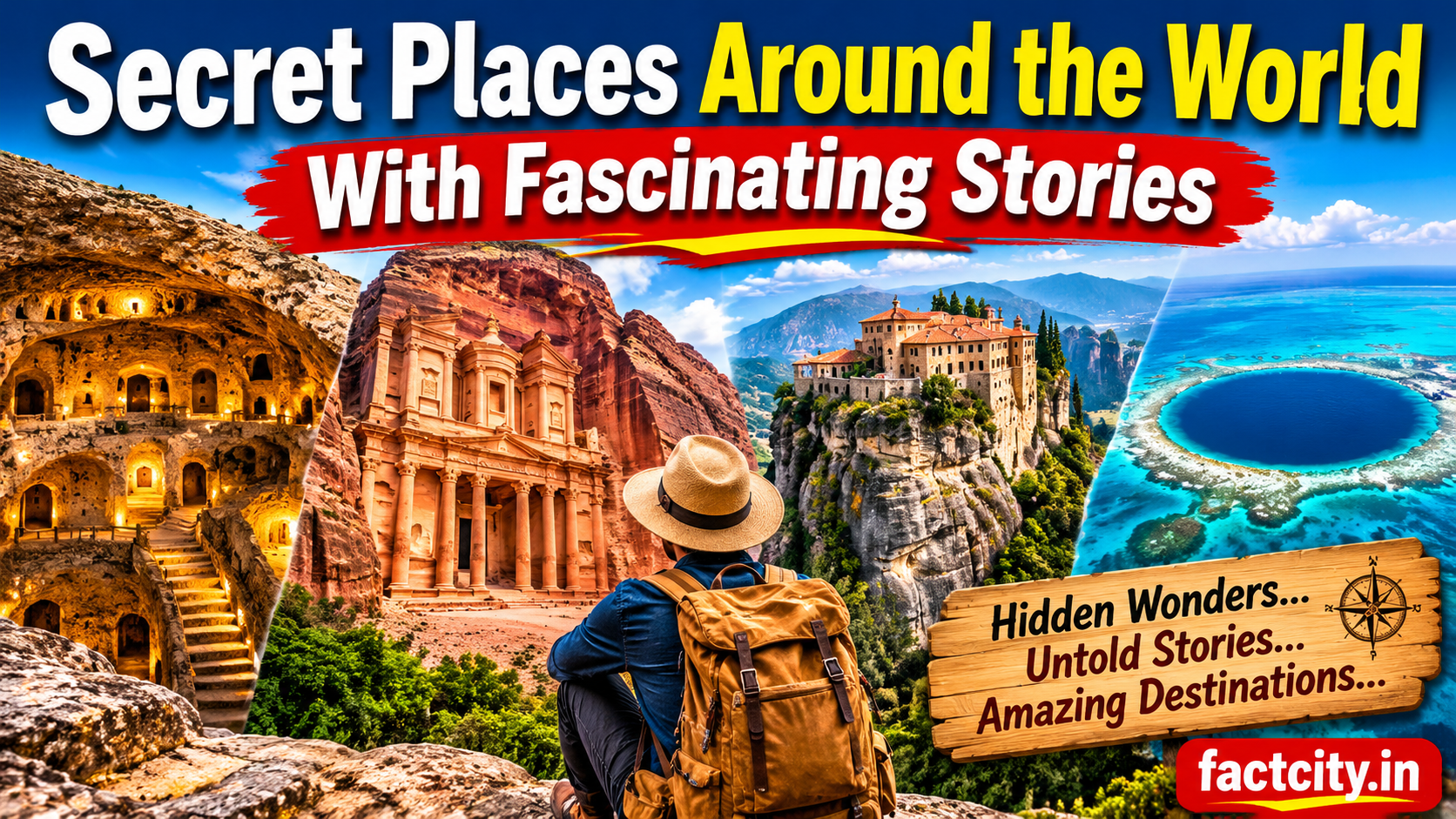
Secret Places Around the World. The world is filled with extraordinary places that remain hidden from the attention of most travelers. While famous landmarks attract millions of visitors every year, countless secret places around the world hold fascinating stories of forgotten civilizations, mysterious discoveries, unusual traditions, and remarkable natural events. Some of these destinations were abandoned centuries ago, while others remained unknown to outsiders because of their remote locations or unusual histories. From underground cities and ancient temples to isolated islands and mysterious landscapes, these places offer a glimpse into the hidden side of our planet. Exploring them is like opening a history book filled with stories that have survived through generations. Many of these locations are not completely unknown, but their fascinating backgrounds are rarely discussed. Here are some of the most interesting secret places around the world with fascinating stories that deserve to be discovered.
1. Derinkuyu Underground City, Turkey
Deep beneath the surface of Cappadocia in Turkey lies Derinkuyu, an extraordinary underground city that demonstrates the incredible creativity of ancient people. This hidden settlement extends several levels below the ground and contains rooms, storage areas, ventilation shafts, kitchens, and places of worship. It is believed to have been developed and expanded over many centuries, with some of its earliest sections dating back to ancient times.
The most fascinating part of Derinkuyu is its connection to survival. During periods of conflict and invasion, local communities could use underground spaces to protect themselves from danger. Heavy stone doors could be rolled across entrances, making it difficult for outsiders to enter. The city was designed to support people for extended periods, showing how ancient communities adapted to uncertain conditions. Today, Derinkuyu remains one of the most remarkable underground settlements ever discovered and offers a powerful reminder of human ingenuity.
2. The Lost City of Petra, Jordan
Hidden among the rugged mountains of southern Jordan, Petra is an ancient city famous for its buildings carved directly into rose-colored rock. Although Petra is now a popular tourist destination, its fascinating history still feels like a secret waiting to be uncovered. The city was developed by the Nabataeans, an ancient Arab civilization that became wealthy through trade routes connecting Arabia, Egypt, and the Mediterranean world.
Petra’s most famous structure, Al-Khazneh, is commonly known as the Treasury. Its impressive facade was carved into a sandstone cliff, creating an architectural masterpiece that has survived for centuries. The city also contained sophisticated water channels and reservoirs that helped its inhabitants manage scarce water supplies in a dry environment. After trade routes changed and natural disasters affected the region, Petra gradually declined. Its rediscovery by a European traveler in 1812 brought renewed attention to a city that local communities had known for generations.
3. The Island of Socotra, Yemen
Located in the Arabian Sea, Socotra is one of the most unusual islands on Earth. Its isolated position has allowed many plant and animal species to develop in ways rarely seen elsewhere. The island is especially famous for its dragon’s blood trees, which have umbrella-shaped branches and produce a deep red resin.
Socotra’s fascinating story is connected to its long geographical isolation. Because the island separated from mainland landmasses millions of years ago, its ecosystems developed independently. A large proportion of its plant species are found nowhere else in the world. Local communities have also developed traditional knowledge about the island’s plants, landscapes, and natural resources. Socotra looks almost like a place from another planet, but its real story is even more remarkable: it shows how isolation can create extraordinary biodiversity.
4. The Hidden Monasteries of Meteora, Greece
In central Greece, enormous rock pillars rise dramatically above the surrounding landscape. Atop several of these towering formations sit the monasteries of Meteora, creating one of the most breathtaking religious landscapes in the world. The name Meteora is often associated with the idea of being suspended in the air, an appropriate description for buildings perched high above the ground.
During the medieval period, monks sought peaceful and isolated places where they could dedicate their lives to prayer and spiritual reflection. The high rock formations offered protection from outside disturbances and created a sense of separation from ordinary life. In earlier centuries, reaching some monasteries was extremely difficult, with ladders and lifting systems used to transport people and supplies. Today, several monasteries remain active and preserve centuries of religious art, manuscripts, and traditions. Their history reveals how people transformed seemingly inaccessible natural formations into places of faith.
5. The Great Blue Hole, Belize
Far from the ordinary coastal landscapes of Belize lies the Great Blue Hole, a massive circular marine sinkhole surrounded by bright turquoise water. Viewed from above, it appears as a deep blue circle in the middle of the ocean, making it one of the most fascinating natural formations in the Caribbean.
The Great Blue Hole formed when a limestone cave system developed during periods when sea levels were much lower. As the climate changed and ocean levels rose, the cave became flooded, and its roof eventually collapsed. The result was a deep underwater structure containing layers of geological history. Divers have explored its depths and discovered ancient formations that provide clues about the Earth’s past environmental conditions. Its mysterious appearance has inspired countless stories, but its real origin is an extraordinary example of how natural forces shape the planet over thousands of years.
6. The Ancient City of Ani, Turkey
Near the border between Turkey and Armenia lies Ani, a once-thriving medieval city that is now largely abandoned. During its golden age, Ani was an important center of trade, culture, and architecture. It was sometimes called the city of a thousand and one churches because of its impressive religious buildings and monuments.
Ani developed along important trade routes and became a powerful capital of the Armenian kingdom. Its walls, churches, and public buildings reflected the wealth and influence of the city. However, invasions, political changes, earthquakes, and shifting trade routes gradually contributed to its decline. Today, the ruins stand across a wide, open landscape, creating a haunting atmosphere. Walking through Ani feels like entering a forgotten chapter of history where the remains of a once-busy city tell stories of prosperity, conflict, and abandonment.
7. The Enchanted River, Philippines
In the Philippine island of Mindanao, the Hinatuan Enchanted River attracts visitors with its remarkably clear blue water and mysterious appearance. Surrounded by lush greenery, the river seems to emerge from an unseen underground source before flowing toward the sea.
Local legends describe the river as a magical place protected by supernatural beings. Some traditional stories explain its unusual color through the presence of spirits, while others associate it with hidden treasures and mysterious underwater passages. Scientific explanations point toward underground springs and geological formations that contribute to the river’s striking clarity and color. The combination of natural beauty and local folklore has made the river a fascinating destination where cultural storytelling and environmental wonder come together.
8. The Cave of the Crystals, Mexico
Beneath the Naica mine in northern Mexico lies one of the most extraordinary underground environments ever discovered. The Cave of the Crystals contains enormous gypsum crystals, some measuring several meters in length. Their size and beauty make the cave look like a scene from a fantasy world.
The crystals formed over a long period under unusual geological conditions. Warm, mineral-rich water remained inside the cave, allowing gypsum to grow slowly into massive crystal structures. The cave was discovered during mining operations in 2000, revealing a hidden environment that had remained inaccessible for an extremely long time. However, its temperature and humidity are so intense that humans can only remain inside for very short periods without specialized protection. The cave’s story demonstrates how extraordinary natural formations can develop quietly beneath the Earth’s surface.
9. The Abandoned Island of Hashima, Japan
Off the coast of Nagasaki, Japan, lies Hashima Island, also known as Gunkanjima or Battleship Island because of its distinctive shape. The island once supported a major undersea coal mining operation and became one of the most densely populated places in the world during its industrial peak.
Thousands of people lived in apartment buildings on this small island, surrounded by factories, schools, shops, and other facilities. Coal mining played an important role in Japan’s industrial development, but the island’s economy declined as petroleum replaced coal. The mine closed in 1974, and residents left soon afterward. Today, abandoned concrete buildings stand exposed to wind and waves, creating a dramatic reminder of the rise and fall of industrial communities. Hashima’s history also includes difficult stories about wartime labor, making it an important place for understanding both industrial progress and human suffering.
10. The Underground Churches of Lalibela, Ethiopia
In the highlands of Ethiopia, the town of Lalibela contains a remarkable group of churches carved directly into solid rock. These structures were created during the medieval period and remain important religious sites for Ethiopian Orthodox Christians.
According to local tradition, King Lalibela wanted to create a sacred place that would serve as a spiritual alternative to Jerusalem. The churches were carved downward into the rock rather than built upward using ordinary construction methods. Their courtyards, tunnels, passages, and architectural details reveal an extraordinary level of planning and craftsmanship. Generations of worshippers have continued to use these churches, keeping their religious traditions alive. Lalibela is a fascinating example of how faith, architecture, and cultural identity can shape a landscape.
11. The Mysterious Stone Forest of Madagascar
Madagascar is home to Tsingy de Bemaraha, a remarkable landscape filled with sharp limestone formations that resemble a giant stone forest. The name Tsingy is associated with the idea of walking on tiptoe, reflecting how difficult it can be to move across the sharp rock surfaces. strange-things-found-in-different-countries-unusual-discoveries-around-the-world
These formations developed through a long process of erosion, as rainwater gradually dissolved limestone and created deep cracks, narrow passages, and pointed rock towers. Over time, the landscape became a complex maze of stone structures. The area also supports unusual wildlife, including species adapted to Madagascar’s distinctive ecosystems. Its isolated location and challenging terrain have helped preserve its natural character, making it one of the most fascinating hidden landscapes in the world.
Why These Secret Places Are Worth Discovering
Secret places around the world are valuable because they reveal stories that are often missing from ordinary travel guides. They show how ancient civilizations protected themselves, how communities adapted to difficult environments, and how nature created extraordinary landscapes over millions of years. Many of these destinations also preserve local traditions, cultural beliefs, and historical memories that deserve respect and protection.
Exploring these places is not only about discovering something unusual. It is also about understanding the people and natural processes behind their existence. Responsible tourism is especially important because many hidden destinations contain fragile ecosystems, ancient structures, or sacred sites. Visitors should follow local rules, respect cultural traditions, and avoid damaging the environment.
Conclusion
The world is full of secret places with fascinating stories that continue to inspire curiosity and wonder. From the underground city of Derinkuyu and the ancient ruins of Ani to the extraordinary landscapes of Socotra and Tsingy de Bemaraha, each destination reveals a different side of Earth’s history. Some places tell stories of survival and faith, while others demonstrate the incredible power of nature. These hidden wonders remind us that the most fascinating discoveries are not always found in famous cities or crowded tourist attractions. Sometimes, the most unforgettable stories are waiting in remote valleys, beneath the ground, or on isolated islands. Discovering these places allows us to appreciate the diversity, mystery, and beauty of our world while preserving their stories for future generations.