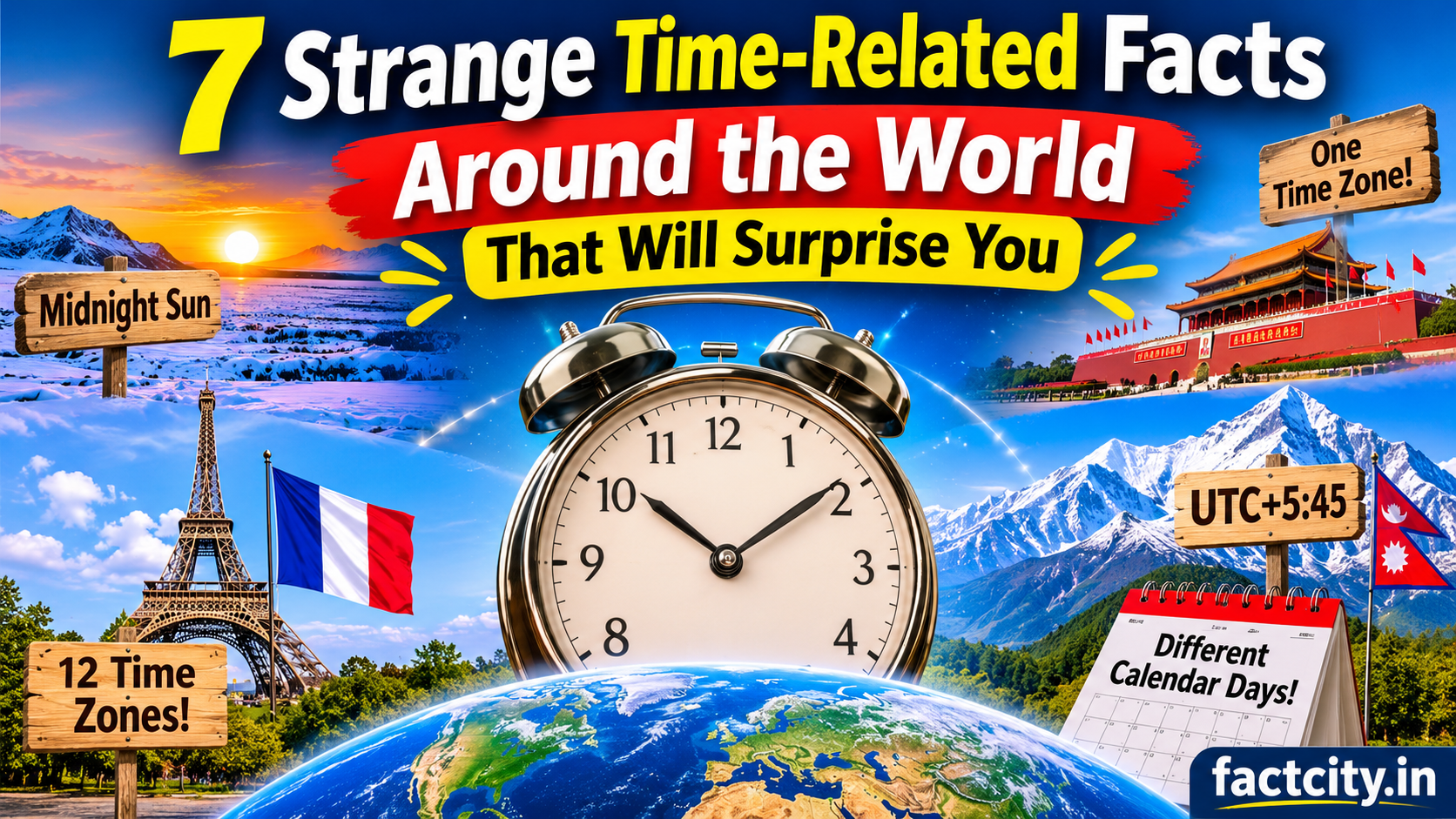
7 Strange Time-Related Facts Around the World. Time is one of the most fascinating parts of human life. Every day, people wake up, work, travel, celebrate special occasions, and make plans according to the clock. Although time seems simple and familiar, the way it works around the world is full of surprising details. Different countries follow different time zones, some places experience unusual daylight patterns, and certain locations have historical timekeeping traditions that seem almost unbelievable. Even more interestingly, scientific discoveries have shown that time does not pass at exactly the same rate everywhere. From countries with unusual time differences to places where the Sun behaves differently throughout the year, the world has many strange time-related facts worth exploring.
If you think time is the same everywhere, these seven strange time-related facts around the world may completely change the way you look at clocks, calendars, and daily life.
1. China Uses Only One Official Time Zone Despite Its Huge Size
One of the strangest time-related facts about the world is that China uses just one official time zone, even though it is geographically large enough to cover several natural time zones. The country stretches across a wide area from east to west, meaning sunrise and sunset naturally happen at very different times in different regions. However, the entire country follows Beijing Time, which is UTC+8.
This system creates some unusual situations for people living in western China. In eastern cities, the Sun may rise at a relatively normal morning hour, while people in western regions can experience sunrise much later according to their clocks. For example, in parts of Xinjiang, winter sunrise can occur well after 9 a.m. local official time. This means residents sometimes adjust their daily routines to match natural daylight rather than following the official clock strictly. 7 Strange Time-Related Facts Around the World
Some communities in western China also use an informal local time based on their geographical position. This arrangement helps people manage everyday activities more naturally. China’s single-time-zone system is unusual because most geographically large countries use multiple time zones to reflect differences in daylight. It is a fascinating example of how political decisions and geography can influence the way people experience time.
2. Nepal Has One of the World’s Most Unusual Time Offsets
Most countries set their clocks according to whole-hour differences from Coordinated Universal Time, commonly known as UTC. Some countries, however, use half-hour or even smaller time differences. Nepal is particularly interesting because its official time is UTC+5:45.
This means Nepal is 5 hours and 45 minutes ahead of UTC. Its time difference is not a simple whole number or half-hour, making it one of the most unusual official time offsets in the world. For comparison, India follows UTC+5:30, while Bangladesh uses UTC+6.
Nepal’s unusual time offset is connected to its geographical position and the country’s decision to establish a standard national time based on a location near Mount Gaurishankar. The 45-minute difference helps distinguish Nepal’s official time from the time used in neighbouring countries.
For international travellers, this small difference can sometimes be confusing. Someone travelling between India and Nepal needs to adjust their watch by 15 minutes, even though the two countries share a border. This unusual arrangement demonstrates that time zones do not always follow convenient one-hour divisions. Sometimes, geography and national history create time systems that are quite different from what people expect.
3. Some Places Experience Midnight Sun and Months of Darkness
Imagine living in a place where the Sun remains above the horizon even at midnight. In another part of the year, imagine experiencing days when the Sun barely rises at all. These unusual conditions are real and occur in regions near the Arctic and Antarctic Circles.
This natural phenomenon is known as the midnight sun and polar night. It happens because Earth is tilted on its axis as it travels around the Sun. During summer, the polar regions are tilted towards the Sun, allowing daylight to continue for long periods. During winter, those same regions are tilted away from the Sun, resulting in extended darkness.
Places such as northern Norway, northern Sweden, Alaska, Greenland, and parts of northern Canada experience these unusual daylight patterns. In Svalbard, Norway, the midnight sun can last for several months, while the winter season brings an extended period when the Sun does not rise above the horizon.
These conditions have a major influence on daily routines. People living in these regions often use special curtains, artificial lighting, and carefully planned schedules to maintain regular sleeping habits. Tourists also visit these destinations to experience the extraordinary sight of sunlight at midnight or the mysterious atmosphere of the polar night.
Although clocks continue to show ordinary hours and minutes, natural daylight follows a very different pattern. It is one of the clearest examples of how Earth’s movement creates unusual experiences of time around the world.
4. France Has More Time Zones Than Any Other Country
France is famous for its history, architecture, food, and culture, but it also holds a surprising record related to time. When overseas territories are included, France has more time zones than any other country, with 12 standard time zones in ordinary use and sometimes 13 depending on seasonal daylight-saving arrangements.
The reason is France’s overseas territories, which are spread across different parts of the world. Metropolitan France is located in Europe, but French territories also exist in the Caribbean, South America, the Indian Ocean, and the Pacific Ocean.
For example, French Guiana in South America follows a different time from Paris. Martinique and Guadeloupe in the Caribbean also have their own local time. French Polynesia, located in the Pacific Ocean, uses several different time offsets across its islands.
This geographical spread means that when it is daytime in one French territory, it may be night in another. Government offices, businesses, and international organisations must consider these differences when arranging meetings and managing communication.
The interesting part is that France’s time-zone record does not come from the size of metropolitan France. Instead, it comes from its worldwide territories. This makes the country a fascinating example of how history and geography can influence modern timekeeping.
5. Time Actually Passes Slightly Faster at Higher Altitudes
One of the most surprising scientific facts about time is that it does not pass at exactly the same rate everywhere. According to Einstein’s theory of general relativity, gravity affects the passage of time. The stronger the gravitational field, the slower time passes relative to a place with weaker gravity.
This means that a clock located at a higher altitude generally runs slightly faster than an identical clock located at sea level. The difference is extremely small in everyday life, but modern scientific instruments are accurate enough to measure it.
For example, a clock on top of a mountain experiences slightly weaker gravity than a clock at the bottom of the same mountain. As a result, the mountain clock records a tiny amount of extra time over a long period.
This effect is known as gravitational time dilation. Scientists have tested it using highly accurate atomic clocks placed at different heights. Even a relatively small difference in altitude can produce a measurable change when the clocks are sufficiently precise.
The same scientific principle is important for satellite navigation systems such as GPS. Satellites orbit Earth at high altitudes, where gravitational effects differ from those experienced on the planet’s surface. Their clocks also experience time differences because of their high speeds. Engineers must account for these effects to keep GPS calculations accurate.
It may sound unbelievable, but your location and altitude can influence how much time passes for you compared with someone somewhere else. The difference is tiny, yet it proves that time is more complicated than an ordinary clock suggests.
6. Two Countries Can Share a Border but Have Different Calendar Days
Time zones can create some unusual situations around international borders. One of the most interesting examples involves countries and islands located on opposite sides of the International Date Line.
The International Date Line is an imaginary line in the Pacific Ocean that separates one calendar day from the next. When people cross this line in one direction, they move forward by one calendar day. When they cross in the opposite direction, they move backward by one calendar day.
Kiribati is a particularly interesting example. The country consists of islands spread across a large area of the Pacific Ocean. In 1995, Kiribati adjusted its time-zone arrangements so that all its islands would follow the same calendar date. This decision moved the International Date Line significantly around its territory.
As a result, some locations in Kiribati are among the first places on Earth to welcome a new calendar day and celebrate New Year. 7-strange-international-borders-you-wont-believe
Another fascinating example involves Samoa and American Samoa. Although these neighbouring Pacific territories are geographically close, they are on opposite sides of the International Date Line and can have a calendar difference of one day. When it is Monday in one place, it can still be Sunday in the other.
This situation can seem confusing to travellers, but it is completely normal because international timekeeping follows established geographical and political arrangements. It also explains why New Year celebrations begin at different times across the world.
7. The Shortest and Longest Days of the Year Are Caused by Earth’s Tilt
Many people believe that summer days are longer because Earth moves closer to the Sun. However, the real reason is Earth’s axial tilt. Our planet is tilted approximately 23.5 degrees relative to its orbital plane, and this tilt creates seasonal changes in daylight throughout the year.
During summer, the hemisphere tilted towards the Sun receives more direct sunlight and experiences longer daylight hours. During winter, the same hemisphere tilts away from the Sun, resulting in shorter days and longer nights.
This creates two important events known as the summer solstice and winter solstice. The summer solstice is generally the longest daylight day of the year for a particular hemisphere, while the winter solstice is generally the shortest.
For example, countries in the Northern Hemisphere, including India, the United States, the United Kingdom, and Canada, experience their longest daylight period around June 20 or 21. Their shortest daylight period occurs around December 21 or 22.
The Southern Hemisphere experiences the opposite pattern. Countries such as Australia, New Zealand, and South Africa have their longest days around December and their shortest days around June.
These seasonal changes have influenced human activities for thousands of years. Ancient communities observed the movement of the Sun to develop calendars, plan agricultural activities, and organise religious celebrations. Even today, the solstices remain important events in different cultures.
The interesting fact is that the length of a day does not remain the same throughout the year when measured by the time between sunrise and sunset. Although clocks continue to divide a standard day into 24 hours, the amount of daylight changes according to the season and location.
Why Time Is Different Around the World
The seven facts above show that time is much more interesting than simply checking the numbers on a clock. Geography, astronomy, science, politics, and history all influence how people measure and experience it. Some countries use unusual time offsets, while others follow a single official time despite covering enormous geographical areas. In polar regions, sunlight can remain visible at midnight, and in other seasons, darkness can continue for weeks or months.
Modern science has also changed the way we understand time. Einstein’s theories demonstrated that gravity and motion can influence how quickly time passes. Technologies such as GPS depend on these scientific discoveries to provide accurate information about location and navigation.
At the same time, international time zones help billions of people organise their daily lives. They allow countries to coordinate business activities, transport schedules, communication, and international events. Without a standard system of timekeeping, travelling and communicating across different regions would be far more complicated.
Final Thoughts
Time is something everyone experiences, but its behaviour around the world is full of unexpected surprises. From Nepal’s unusual 45-minute time difference to China’s single official time zone, from the midnight sun in northern regions to the scientific reality of time dilation, every fact reveals a different side of our planet.
These strange time-related facts around the world also remind us that the clock is only one way of understanding time. Earth’s rotation, its journey around the Sun, gravity, and human decisions all play important roles in shaping our experience of it. The next time you check your watch, remember that somewhere else in the world, people may be waking up under the midnight sun, experiencing a completely different calendar day, or following a clock that is set just 15 minutes apart from yours.