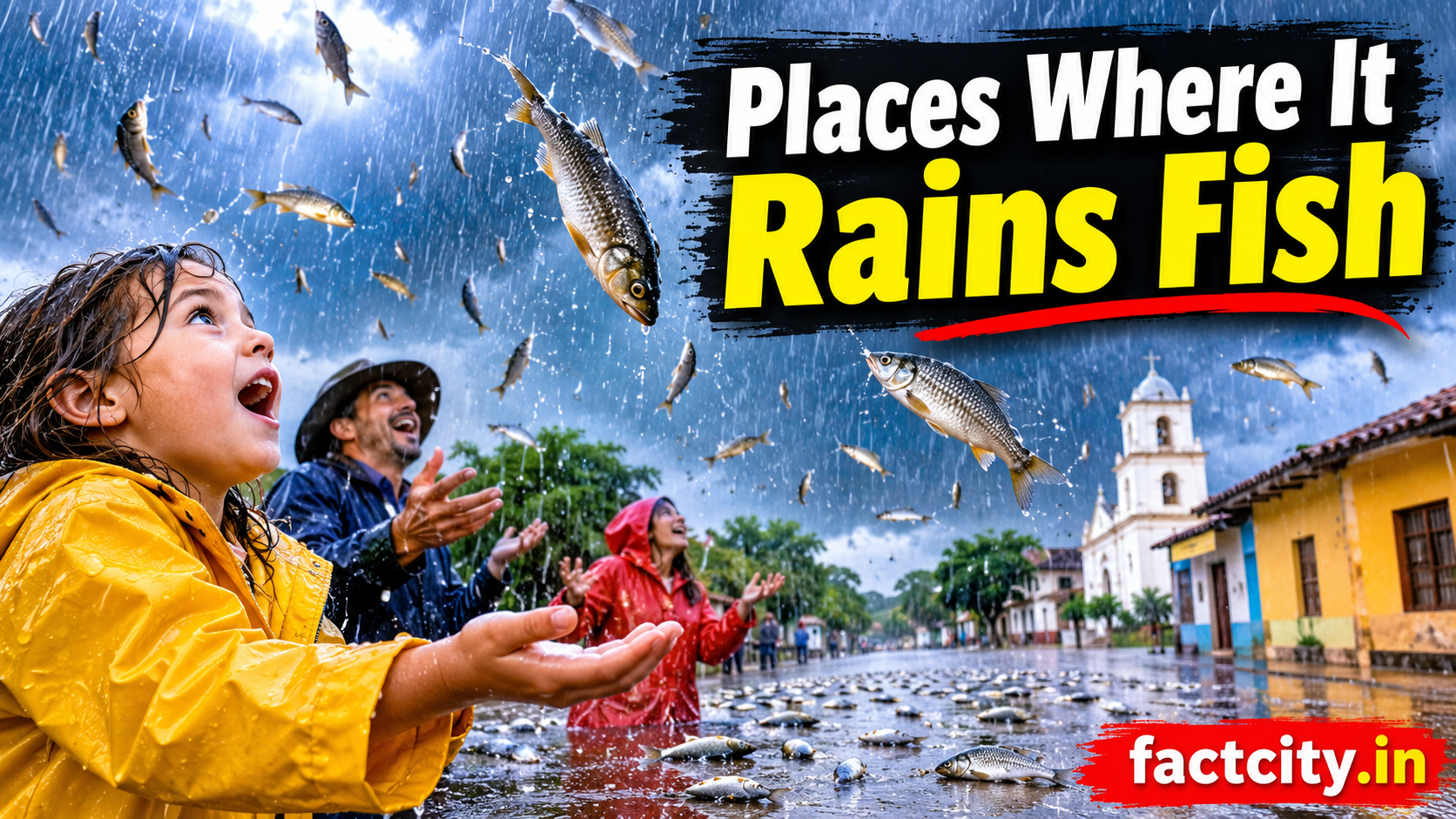
Places Where It Rains Fish Imagine standing outside during a heavy rainstorm and suddenly seeing small fish falling from the sky instead of ordinary raindrops. It sounds like something from a fantasy movie, but reports of fish falling from the sky have fascinated people for centuries. This unusual phenomenon is commonly known as fish rain, and it has been reported in several parts of the world. Although the idea of raining fish may seem impossible, scientists have proposed interesting explanations involving strong winds, waterspouts, and unusual weather conditions. Among the most famous locations associated with this mysterious event is Yoro, a town in Honduras where residents claim that fish rain occurs almost every year. Other places have also reported similar incidents, making fish rain one of the most fascinating weather-related mysteries on Earth.
What Is Fish Rain?
Fish rain is an unusual phenomenon in which fish are reportedly found falling from the sky during or after heavy rainfall. People living in areas associated with this event sometimes discover small fish scattered across streets, gardens, rooftops, and open fields after a storm. These stories have attracted attention from scientists, journalists, tourists, and curious travelers because fish normally live in rivers, lakes, oceans, and other aquatic environments rather than in the atmosphere. The phenomenon is sometimes called an animal rain because similar reports have involved frogs, small birds, and other creatures. However, fish rain remains particularly interesting because of the apparent connection between aquatic animals and powerful weather conditions.
Yoro, Honduras: The Most Famous Place Where It Rains Fish
One of the best-known places associated with fish rain is Yoro, a town in Honduras, Central America. The area has become internationally famous because residents claim that fish fall from the sky during powerful storms, particularly during a period that is traditionally associated with the rainy season. Locally, the event is known as Lluvia de Peces, which translates into English as Rain of Fish. According to local stories, the phenomenon has been happening for generations, and many residents consider it an important part of their cultural identity. Places Where It Rains Fish
The reported fish rain in Yoro usually occurs after dark clouds gather and heavy rainfall begins. Some accounts describe strong winds, thunder, and intense storms followed by the discovery of hundreds of small fish on the ground. Residents sometimes collect these fish and prepare them as food. The event has become so famous that it attracts visitors who hope to witness this extraordinary natural mystery themselves. Although the stories are widely shared, scientists have not conclusively established exactly how the reported fish arrive in the area.
The Legend Behind the Rain of Fish in Yoro
The fish rain phenomenon in Yoro is connected to a popular local legend involving a Spanish missionary named Father José Manuel Subirana. According to traditional accounts, he visited the region during the nineteenth century and witnessed the poverty and suffering of local people. The story says that he prayed for several days, asking God to provide food for the hungry population. Following these prayers, fish supposedly began falling from the sky, giving people an unexpected source of nourishment.
Over time, this story became deeply connected with the identity of Yoro and its famous fish rain. Whether the legend describes the original event or represents a symbolic explanation remains uncertain. Nevertheless, it continues to be shared by residents and visitors, adding a fascinating cultural dimension to the phenomenon. The story also helps explain why fish rain is not simply considered a strange weather event in Honduras but a meaningful tradition associated with hope, faith, and community.
How Can Fish Fall From the Sky?
Although fish rain sounds supernatural, scientists have proposed several natural explanations that could potentially explain some reported incidents. One of the most frequently discussed possibilities involves waterspouts. A waterspout is a rotating column of air and water that forms over oceans, lakes, or other bodies of water. Some waterspouts are associated with thunderstorms and powerful atmospheric conditions, making them capable of producing strong winds near the water’s surface.
In theory, a waterspout or intense storm-related wind could lift small aquatic animals from shallow water and transport them over a limited distance before dropping them elsewhere. If fish were carried by strong winds and later deposited during rainfall, people might observe what appears to be fish falling from the sky. However, this explanation has not been conclusively demonstrated for the recurring fish rain reports in Yoro. It is also important to understand that not every waterspout can lift fish, and the transportation of animals over long distances would require specific environmental conditions.
Can Tornadoes and Strong Winds Carry Fish?
Another possible explanation involves tornadoes and powerful storm winds. Tornadoes can generate extremely strong air currents capable of lifting lightweight objects, debris, and sometimes small animals. Historical reports from different countries have described unusual animal falls following severe storms. These incidents have occasionally included fish, frogs, and other aquatic creatures.
When a tornado or intense storm passes over a lake, river, or flooded area, it may potentially lift small animals from the water or surrounding environment. The animals could then be transported and deposited in another location as the storm weakens. This process might explain isolated cases of fish appearing in unexpected places after severe weather. However, it does not automatically explain recurring fish rain events in particular towns, and researchers would need direct observations or reliable evidence to confirm the mechanism.
Other Places Where Fish Rain Has Been Reported
Although Yoro is the most famous example, reports of fish falling from the sky have appeared in other parts of the world. These stories are usually associated with unusual storms, local weather conditions, or eyewitness accounts. Some reports have been documented in newspapers and historical records, while others remain difficult to verify independently.
In India, Australia, the United States, and different regions of Europe, unusual animal-fall stories have occasionally attracted public attention. Some accounts describe fish appearing on roads or fields after heavy rain, while others involve frogs or small aquatic animals. The exact causes of these events are not always known, and the quality of evidence varies considerably between reports. Therefore, it is more accurate to describe many of these incidents as reported fish rain rather than confirmed examples of fish being lifted directly from water and carried through the atmosphere.
Fish Rain in Australia
Australia has also been associated with unusual animal rain reports, including stories involving fish falling during storms. Some regional accounts describe small fish appearing in outdoor areas following heavy rainfall or strong winds. Such incidents have attracted curiosity because Australia experiences a wide variety of weather conditions, including intense thunderstorms, tropical cyclones, and severe rain events.
The country’s large network of rivers, wetlands, lakes, and floodplains provides many environments where aquatic animals could potentially be affected by extreme weather. Strong winds and flooding may also move fish into unusual locations. However, the appearance of fish after a storm does not necessarily prove that they fell from the sky. Floodwater, overflowing waterways, and storm-related movement can sometimes create similar observations.
Fish Rain and the United States
The United States has experienced several unusual animal rain reports throughout its history. Some accounts have described fish appearing on streets, lawns, and other outdoor areas after storms. These reports have been particularly interesting to people studying extreme weather because they raise questions about how animals can become displaced during powerful atmospheric events.
The country contains thousands of lakes, rivers, and coastal environments, which provide potential sources for aquatic animals during severe weather. In certain circumstances, storm winds could potentially move small fish over short distances. Nevertheless, many individual reports remain uncertain because eyewitness descriptions may not establish whether the animals were transported through the air or displaced by flooding.
Why Do Fish Rain Stories Usually Involve Small Fish?
An interesting detail in many fish rain stories is that the animals are often described as small fish rather than large aquatic species. There are several possible reasons for this pattern. Smaller fish are easier to move through shallow water, and their lower weight makes them more vulnerable to powerful winds than larger animals. They are also easier to overlook in ordinary environments until a storm makes them visible across open ground.
Small fish may also inhabit temporary pools, shallow streams, flooded fields, and wetlands that are more easily affected by severe weather. If storm conditions move these animals into nearby areas, people may discover them after the rainfall ends. However, the size of the fish reported in different incidents varies, and there is no universal scientific rule stating that fish rain can only involve small species.
Is Fish Rain a Real Scientific Phenomenon?
Fish rain is a real subject of historical reports, eyewitness accounts, and scientific discussion, but the explanation differs depending on the incident. There is a scientific basis for the possibility that powerful winds and unusual weather conditions could transport small animals from one location to another. Similar mechanisms have been proposed for reports involving frogs, insects, and other creatures.
However, the existence of documented animal displacement does not mean every fish rain story has been scientifically confirmed. Some reports may involve flooding, overflowing ponds, drainage systems, or fish carried into unexpected locations by water. Other stories may have developed through local traditions or repeated retelling. Scientists generally require reliable observations, photographs, weather information, and physical evidence before confirming the cause of a particular event.
The Famous Fish Rain Festival in Honduras
The fish rain tradition has become an important cultural attraction in Yoro. The town is associated with celebrations and community activities connected with the unusual phenomenon. The stories have attracted visitors who want to learn about the local tradition and experience the atmosphere surrounding the event.
For residents, fish rain represents more than an unusual weather story. It is connected with local history, religious traditions, community identity, and the way people understand their surroundings. The phenomenon has also helped bring international attention to Yoro, making it one of the most recognizable locations associated with unusual natural mysteries.
The popularity of the tradition demonstrates how natural events and cultural stories can become closely connected. Even when the scientific explanation remains uncertain, a phenomenon can continue to hold significant meaning for the people who experience and celebrate it.
Why Fish Rain Continues to Fascinate People
The idea of fish falling from the sky challenges our everyday understanding of nature. Rain normally consists of water droplets, while fish are creatures that depend on aquatic environments. Seeing them together in an unexpected location creates a striking contrast that naturally attracts attention. which-countries-have-the-most-islands-in-the-world
Fish rain also raises fascinating scientific questions about the relationship between weather and wildlife. It encourages people to explore how storms affect ecosystems, how animals move between environments, and how unusual natural events can be explained through observation and research. These questions make the phenomenon interesting not only to tourists but also to scientists, environmental researchers, and weather enthusiasts.
Another reason fish rain remains popular is that it combines mystery with a possible scientific explanation. Unlike stories that can only be interpreted through imagination, animal displacement during extreme weather is physically possible under certain conditions. This makes fish rain an intriguing subject where folklore, science, and environmental observations meet.
Could Fish Rain Happen Anywhere?
In theory, unusual animal displacement caused by storms could occur in many regions with suitable environmental conditions. Areas containing lakes, rivers, wetlands, and shallow water bodies may provide sources for small aquatic animals that could potentially be moved during powerful weather events. However, the appearance of fish after a storm would depend on many factors, including wind strength, the location of nearby water, the size of the animals, and the type of storm.
Recurring fish rain events are much more difficult to explain than isolated incidents. A location experiencing repeated reports would require detailed investigation to determine whether the animals are actually being transported through the air, emerging from flooded environments, or arriving through another mechanism. This is why Yoro remains particularly interesting to researchers and curious travelers.
Conclusion
Places where it rains fish represent one of the world’s most fascinating natural mysteries. From the famous Rain of Fish tradition in Yoro, Honduras, to unusual animal-fall reports in other countries, these stories demonstrate how extraordinary weather events can challenge our understanding of the natural world. Scientists have proposed explanations involving waterspouts, powerful winds, tornadoes, and flooding, but the exact cause of every reported fish rain incident remains uncertain.
Yoro continues to stand out because of its long-standing cultural connection to fish rain and the stories passed down through generations. Whether viewed as a fascinating natural mystery, a local tradition, or a subject of scientific investigation, fish rain reminds us that Earth still contains unusual events that deserve careful observation and research. The next time someone talks about fish falling from the sky, remember that behind this incredible story lies a combination of weather, wildlife, human imagination, and the continuing search for scientific answers.