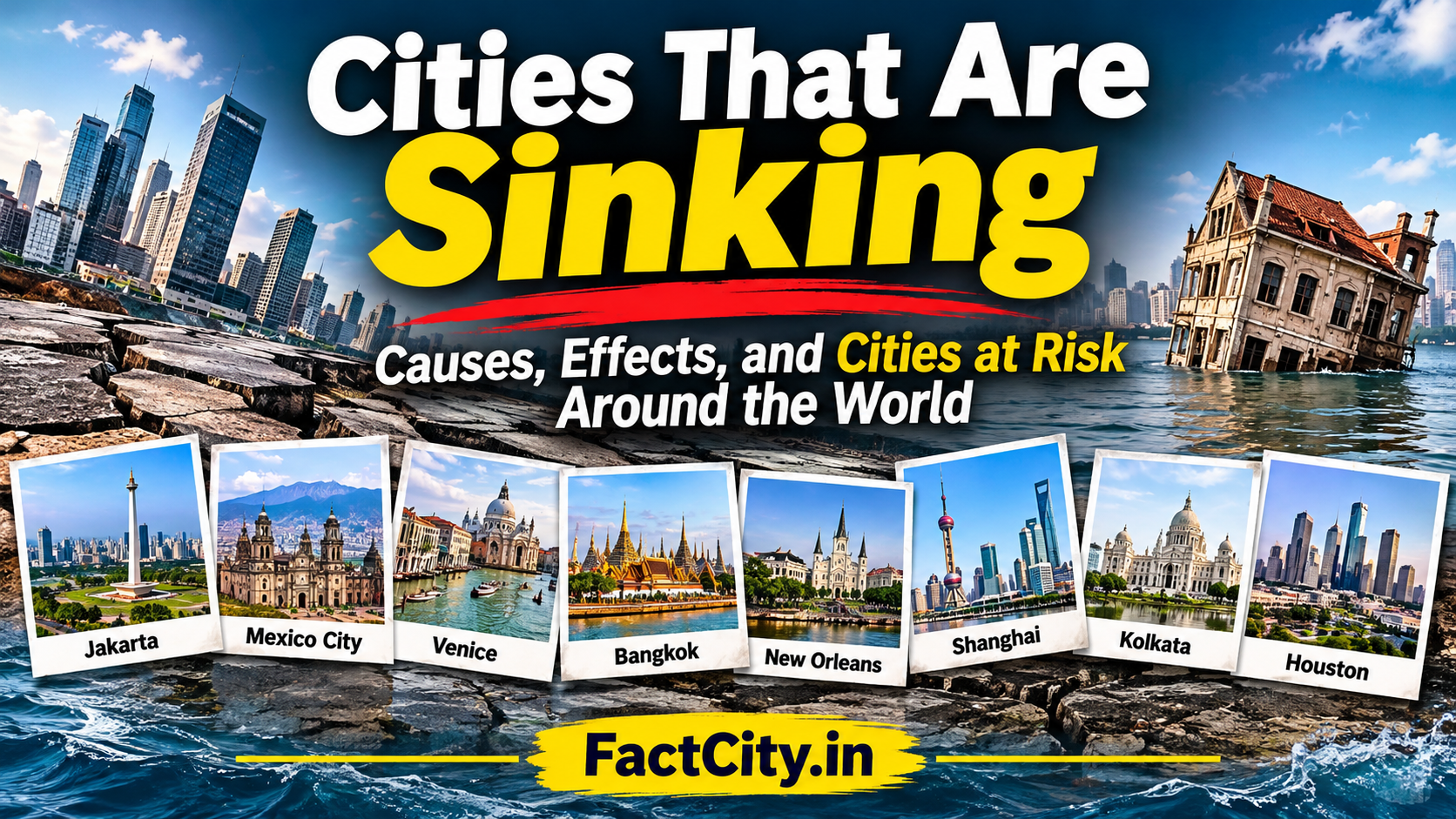
Cities That Are Sinking: Have you ever imagined living in a city that is slowly sinking into the ground? It may sound like something from a science-fiction movie, but it is a real problem affecting several cities around the world. From crowded cities in Asia to historic destinations in Europe and coastal communities in America, land sinking is becoming an important environmental challenge. This phenomenon is commonly known as land subsidence, and it happens when the ground gradually moves downward because of natural processes or human activities. In some places, the land sinks only a few millimeters each year, while in others, the movement can be much faster.
The topic of cities that are sinking has attracted attention because millions of people live in areas where the ground is slowly losing its height. Rising sea levels, excessive groundwater extraction, construction, mining, and natural soil movement can all contribute to this problem. Although sinking land is not always visible to people living in a city, its effects can become serious over time. Roads may develop cracks, buildings can become damaged, drainage systems may stop working properly, and coastal neighborhoods can face a greater risk of flooding.
The good news is that scientists, engineers, and governments are studying this issue and developing solutions to protect vulnerable communities. Understanding why cities sink and which places are most affected can help us understand one of the major environmental challenges of the modern world.
What Does It Mean When a City Is Sinking?
A sinking city is a place where the land surface gradually moves downward over time. This process is called land subsidence. It can happen naturally because of underground geological changes, the movement of tectonic plates, or the gradual compression of soft soil. However, human activities are responsible for accelerating land subsidence in many urban areas.
One of the biggest reasons is groundwater extraction. Many cities depend on underground water for drinking, agriculture, factories, and everyday activities. When too much groundwater is removed, the underground spaces that previously contained water can become compressed. As a result, the soil above them loses support, and the ground begins to sink. Cities That Are Sinking
This process can happen slowly, making it difficult to notice at first. However, over several years, even a small amount of land movement can create major problems. When sinking land combines with rising sea levels, the risk of coastal flooding becomes even greater.
Why Are Cities Around the World Sinking?
There is no single reason why cities sink. Different locations experience land subsidence for different reasons, depending on their geography, soil conditions, climate, and human activities.
One major cause is excessive groundwater pumping. As populations grow, cities need more water for households, industries, and businesses. When underground water is removed faster than nature can replace it, certain types of soil begin to compact. This reduces the height of the land surface.
Another important cause is rapid urban development. Large buildings, highways, bridges, and other infrastructure place considerable pressure on the ground. In areas with soft clay or loose sediment, this additional weight can contribute to soil compression and gradual settlement.
Natural geological processes also play a role. Some cities are built on river deltas, reclaimed land, or areas containing layers of soft sediment. These materials naturally compact over time. Earthquakes and underground geological movements can also change ground levels.
Climate change adds another layer of concern. Global sea levels are rising because of melting land ice and the expansion of warming ocean water. When coastal land is also sinking, communities can experience a greater relative rise in sea level, increasing their exposure to flooding and storm surges.
1. Jakarta, Indonesia: One of the World’s Most Famous Sinking Cities
Jakarta is one of the best-known examples of a city struggling with land subsidence. Located on the island of Java, Indonesia, the city has millions of residents and faces several environmental challenges, including flooding, rapid urban growth, and rising sea levels. One of the biggest reasons Jakarta is sinking is the excessive extraction of underground water. Many homes, offices, and industries have historically depended on groundwater because the demand for clean water is extremely high.
As groundwater is removed, underground soil layers become compressed, causing the surface to move downward. Some areas of northern Jakarta have experienced particularly rapid sinking. The situation becomes more serious because much of the city is low-lying and exposed to coastal flooding. Heavy rainfall, overflowing rivers, and high tides can create additional problems for residents. The Indonesian government has introduced measures to improve water supply, strengthen flood protection, and develop infrastructure. Jakarta demonstrates how uncontrolled groundwater use and rapid urban development can create long-term environmental risks.
2. Mexico City, Mexico: A City Built on a Former Lake
Mexico City is another major example of a sinking city. Interestingly, much of the modern city was built on the soft sediments of an ancient lakebed. This geological condition makes the ground particularly vulnerable to compression. As the population increased, the demand for water also grew, leading to extensive groundwater extraction.
When water is pumped from underground aquifers, the soft layers of clay and sediment can gradually become compressed. This causes parts of the city to sink over time. The problem has affected buildings, roads, drainage systems, and other important infrastructure. Some historic structures have developed visible tilting and uneven foundations because the ground beneath them has moved.
Mexico City is especially interesting because land subsidence does not happen at the same speed everywhere. Some neighborhoods experience much faster movement than others. This shows why it is important to examine individual neighborhoods instead of assuming that an entire city sinks equally.
3. Venice, Italy: The Historic City Facing Rising Water
Venice is famous for its beautiful canals, historic architecture, bridges, and romantic atmosphere. However, this Italian city has also become a well-known example of the challenges faced by low-lying coastal communities. Built across a group of islands in a lagoon, Venice is naturally vulnerable to changes in water levels.
The city has experienced gradual land subsidence over many years, although groundwater extraction and other human activities are not the only factors involved. Natural ground movement and rising sea levels also contribute to its vulnerability. During periods of unusually high water, known locally as acqua alta, streets and public spaces can become flooded.
Flooding can damage historic buildings, affect local businesses, and make everyday transportation difficult. Venice has introduced the MOSE flood barrier system, which uses movable barriers to protect the lagoon from exceptionally high tides. This engineering project represents an important effort to protect the city, although long-term climate and land movement challenges remain.
4. Bangkok, Thailand: A Growing City on Soft Ground
Bangkok is the capital of Thailand and one of Southeast Asia’s busiest urban centers. It is located on the Chao Phraya River delta, where much of the ground consists of soft clay and sediment. These natural conditions make the region vulnerable to land subsidence.
Rapid population growth, industrial development, and groundwater extraction have contributed to the city’s sinking problem. As more people move into urban areas, the demand for water and infrastructure increases. Excessive pumping of groundwater can cause underground soil layers to become compressed, lowering the ground surface.
Bangkok also faces seasonal flooding, heavy rainfall, and rising sea levels. Because many parts of the city are relatively low in elevation, even small changes in ground level can increase flood-related risks. Authorities have introduced groundwater management policies and improved drainage infrastructure to reduce these problems. However, protecting Bangkok requires long-term planning and cooperation between government agencies, engineers, and local communities.
5. New Orleans, United States: A City Surrounded by Water
New Orleans is located in Louisiana, near the Mississippi River and the Gulf of Mexico. Its location has helped make it an important cultural, commercial, and transportation center. However, the city faces significant challenges because large areas are low-lying and vulnerable to flooding.
Land subsidence in New Orleans happens for several reasons, including natural soil compaction, geological processes, and human activities. Much of the surrounding region consists of river sediments that gradually settle over time. Human-made flood-control structures, such as levees, can also reduce the amount of fresh sediment reaching nearby wetlands, affecting the natural processes that help maintain land elevation.
Hurricanes and storm surges make the situation more dangerous. When the surrounding land loses elevation, flood protection becomes more difficult. New Orleans has invested in levees, drainage pumps, floodwalls, and coastal restoration projects. These measures help reduce risk, but the city continues to face the combined challenges of sinking land, coastal erosion, and rising sea levels.
6. Shanghai, China: Urban Development and Ground Subsidence
Shanghai is one of China’s largest and most economically important cities. It is situated near the Yangtze River Delta, an area formed by layers of river sediments. Although Shanghai is famous for its modern skyscrapers and advanced infrastructure, it has also experienced land subsidence. which-countries-have-the-most-islands-in-the-world
Historically, groundwater extraction was an important factor behind the city’s sinking. Rapid industrial growth and urban development increased pressure on natural resources. The construction of heavy buildings and infrastructure on soft sediment also creates additional challenges.
Over the years, Shanghai introduced groundwater restrictions, monitoring programs, and other engineering measures to control land movement. These efforts have helped reduce the severity of subsidence compared with some earlier periods. However, the city still needs to monitor ground levels carefully because even relatively slow sinking can create problems for transport systems, underground infrastructure, and flood protection.
7. Kolkata, India: A Major City Facing Land Subsidence
Kolkata is one of India’s most important metropolitan cities and is located near the Hooghly River, within the wider Ganges delta region. Its geographical location, soft sedimentary ground, groundwater use, and urban development make certain areas vulnerable to land subsidence.
Groundwater extraction is one of the important factors contributing to sinking in several delta cities. In addition, natural soil compaction and changes in drainage can influence ground levels. For a densely populated city like Kolkata, even gradual land movement deserves attention because it can affect roads, buildings, drainage networks, and flood management.
Satellite-based research has identified land subsidence in Kolkata and several other Indian metropolitan areas. However, the sinking rate varies considerably between locations, and not every neighborhood experiences the same conditions. Better groundwater management, scientific monitoring, and improved urban planning can help reduce future risks.
8. Houston, United States: Groundwater and Oil Extraction
Houston is another American city where land subsidence has become an important environmental concern. Located in Texas, Houston has experienced ground movement linked to groundwater extraction and historical oil and gas production. Removing large amounts of underground resources can change pressure conditions beneath the surface, allowing certain soil layers to compact.
Some areas around Houston and the nearby Galveston region have experienced substantial land movement. This is especially concerning because the region is exposed to hurricanes, heavy rainfall, and coastal flooding. When the ground sinks, floodwater can reach places that were previously less vulnerable.
Researchers have used satellite observations to identify areas where land movement may threaten buildings and infrastructure. Better groundwater regulation, flood protection, and regular monitoring are important steps toward reducing these risks.
How Does Land Subsidence Affect People Living in These Cities?
Land subsidence is not just a geological problem. It directly affects the lives of people, especially those living in densely populated cities. One of its most noticeable effects is increased flooding. When the ground becomes lower, rainwater and seawater can collect more easily in vulnerable neighborhoods. This can damage houses, shops, roads, and public spaces.
Another major concern is damage to buildings and infrastructure. Uneven ground movement can place pressure on foundations, walls, bridges, and underground pipelines. In difficult situations, buildings may develop cracks or become unstable. Roads can also become uneven, creating difficulties for vehicles and pedestrians.
The economic impact can be significant as well. Governments may need to spend large amounts of money repairing damaged infrastructure, maintaining drainage systems, and constructing flood barriers. Businesses can lose income when flooding interrupts transportation and daily activities. Families may also face expensive home repairs and difficulties accessing schools, hospitals, and workplaces.
Land subsidence can even create environmental problems. Coastal wetlands may disappear, freshwater resources can become more vulnerable to saltwater intrusion, and natural habitats may be damaged. These effects show why sinking cities require attention from both environmental scientists and urban planners.
How Can Scientists Identify Sinking Cities?
Scientists use modern technology to measure changes in the Earth’s surface. One of the most useful methods is satellite-based radar monitoring, which allows researchers to observe whether particular areas are moving upward or downward.
A technology called Interferometric Synthetic Aperture Radar, commonly known as InSAR, compares radar images collected by satellites at different times. By examining these measurements, scientists can identify small changes in ground elevation across large urban areas. This technology is especially useful because it can monitor thousands of buildings, roads, and neighborhoods without requiring researchers to visit every location.
Scientists also use GPS equipment, underground water measurements, geological surveys, and ground-based sensors to understand why land is moving. Combining these technologies helps governments identify high-risk areas and make better decisions about future construction and flood protection.
What Can Governments Do to Stop Cities from Sinking?
Although some natural land movement cannot be prevented, human activities that accelerate subsidence can often be controlled. One of the most effective solutions is reducing excessive groundwater extraction. Cities can develop reliable surface-water supplies, improve water conservation, and encourage industries to use water more efficiently.
Another important solution is sustainable urban planning. Before constructing large buildings, engineers should carefully study the soil and geological conditions. Strong foundations and suitable construction techniques can reduce structural risks in areas with soft or unstable ground.
Improving drainage systems is equally important. Cities that experience heavy rainfall need effective water management systems to prevent flooding. Coastal communities can also invest in flood barriers, protective walls, restored wetlands, and other nature-based solutions.
Regular monitoring is essential because land movement can change over time. Satellite technology and scientific research can help governments identify dangerous areas before serious damage occurs. The most successful approach combines groundwater management, modern engineering, environmental protection, and responsible urban development.
Are More Cities at Risk of Sinking in the Future?
Yes, land subsidence is a growing concern in many parts of the world. Rapid urbanization, increasing water demand, climate change, and the expansion of coastal populations may increase pressure on already vulnerable regions.
Research examining hundreds of major cities has found that land subsidence is widespread across different regions, including Southeast Asia, West-Central Asia, and North America. The findings highlight the importance of monitoring individual cities and identifying areas where sinking is particularly severe.
However, it is important to understand that a sinking city does not automatically mean the entire city will disappear underwater. The speed of subsidence, local geography, flood protection, groundwater management, and future sea-level changes all influence the level of risk. With proper planning and investment, many cities can reduce the damage and protect their residents.
Conclusion
Cities that are sinking are an important reminder of how closely human activities are connected to the natural environment. Places such as Jakarta, Mexico City, Venice, Bangkok, New Orleans, Shanghai, Kolkata, and Houston show that land subsidence can affect cities with very different geographical conditions and economic backgrounds.
Excessive groundwater extraction, soft soil, urban development, natural geological processes, and rising sea levels all contribute to this challenge. Although the problem can be serious, modern technology and responsible planning provide opportunities to reduce its effects.
Governments must focus on sustainable water use, stronger infrastructure, better drainage, and continuous environmental monitoring. Citizens can also contribute by conserving water and supporting responsible urban development. Protecting cities from sinking is not only about saving buildings and roads; it is also about protecting communities, businesses, natural resources, and future generations.
The story of sinking cities teaches us an important lesson: cities need more than impressive buildings and modern infrastructure. They also need a strong understanding of the land beneath them. By taking action today, we can help make urban communities safer and more sustainable for tomorrow.