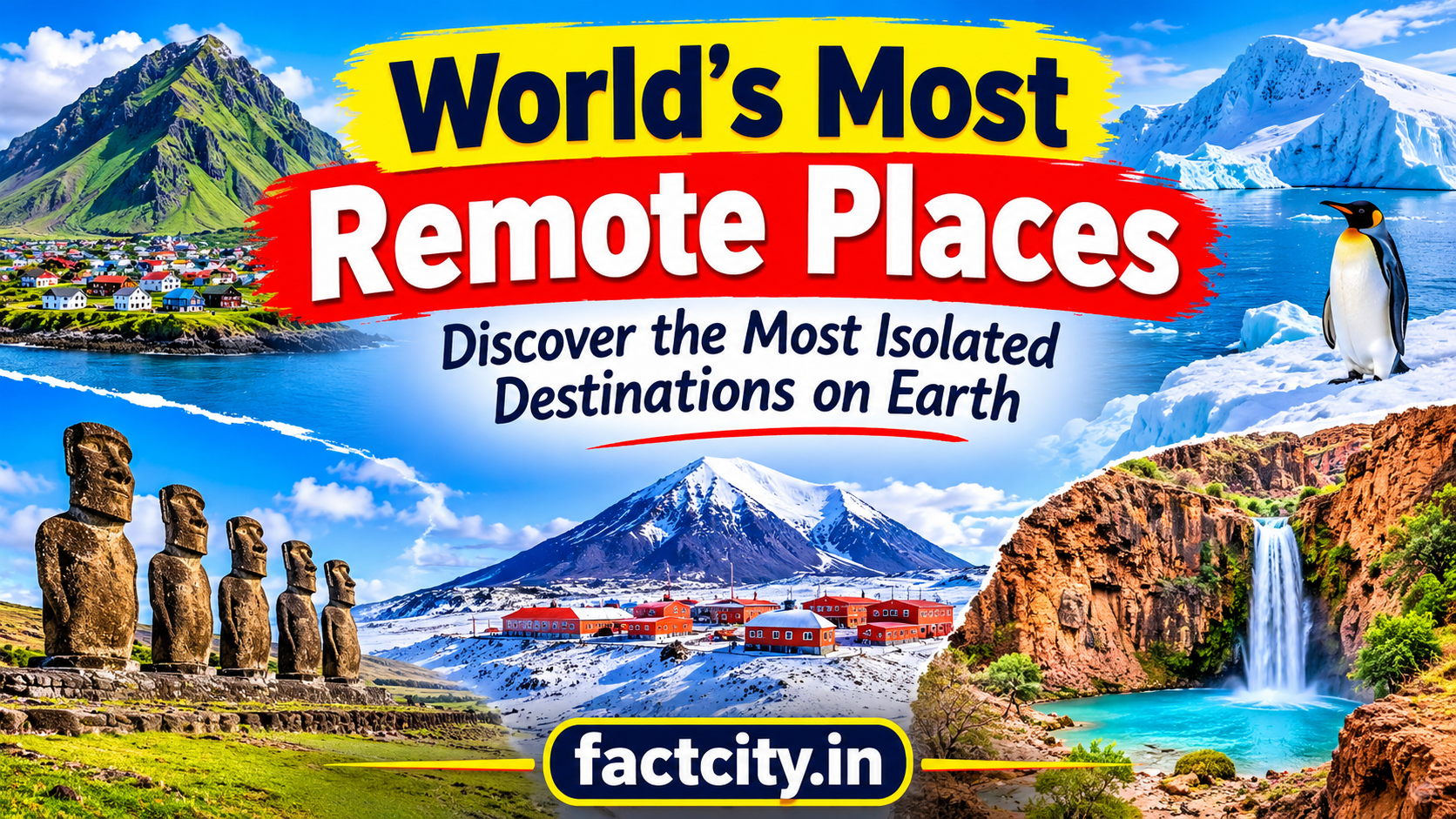
World’s Most Remote Places: Have you ever imagined visiting a place where there are no crowded streets, busy shopping malls, or noisy cities? Somewhere you can experience complete silence, explore untouched landscapes, and feel as if you are far away from the rest of the world? Our planet is full of extraordinary destinations, but some places are so isolated that reaching them can take days of travel. These locations are known as the world’s most remote places.
From tiny islands in the middle of vast oceans to frozen Antarctic landscapes and distant mountain villages, remote destinations offer a completely different experience of life. Some have only a few permanent residents, while others are almost entirely uninhabited. Their isolation makes them fascinating for travelers, scientists, photographers, and adventure lovers.
In this article, we will explore some of the world’s most remote places, discover what makes them special, and understand why these isolated destinations are worth knowing about.
1. Tristan da Cunha – The Most Remote Inhabited Island
Tristan da Cunha is widely recognized as one of the most remote inhabited island communities in the world. Located in the South Atlantic Ocean, it lies thousands of kilometers from major populated areas. The nearest inhabited land is also extremely far away, making everyday travel a serious challenge. World’s Most Remote Places
The island is part of a British Overseas Territory and has a small community of residents. Its main settlement, Edinburgh of the Seven Seas, is surrounded by dramatic mountains and beautiful ocean scenery.
There is no airport on Tristan da Cunha. Visitors generally need to travel by ship from South Africa, and the journey can take several days. Weather conditions can also affect travel schedules.
Despite its isolation, the island has a functioning community with homes, a school, a hospital, and basic services. Its peaceful environment, volcanic landscapes, and unique wildlife make it one of the most fascinating remote destinations on Earth.
2. Easter Island – A Mysterious Island in the Pacific Ocean
Easter Island, also called Rapa Nui, is one of the most famous isolated islands in the world. It belongs to Chile and is located in the southeastern Pacific Ocean, far from mainland South America.
The island is particularly famous for its enormous stone statues known as Moai. These impressive figures were created by the Rapa Nui people centuries ago and remain an important part of the island’s cultural heritage.
Easter Island is surrounded by thousands of kilometers of ocean, which makes its geographical isolation remarkable. Although it receives visitors and has an airport, reaching it still requires considerable travel. World’s Most Remote Places
Beyond the Moai statues, visitors can discover volcanic craters, beautiful beaches, green hills, and traditional Polynesian culture. Its combination of history, mystery, and natural beauty makes Easter Island a remarkable destination.
3. Ittoqqortoormiit – One of Greenland’s Most Isolated Towns
Greenland is known for its enormous ice sheets, frozen landscapes, and scattered settlements. Among its most isolated communities is Ittoqqortoormiit, a small town located on Greenland’s eastern coast.
The town is surrounded by mountains, glaciers, and Arctic wilderness. It has a very small population, and its residents experience some of the harshest environmental conditions in the world.
For much of the year, the surrounding sea is covered with ice. Transportation is difficult, and reaching the town often requires a combination of flights and helicopter or boat travel, depending on the season.
Despite the challenging conditions, local residents maintain their traditional way of life. Hunting, fishing, and connections with the natural environment remain important aspects of the community.
Ittoqqortoormiit is an extraordinary example of how people can build communities in some of the most challenging environments on Earth.
4. Bouvet Island – One of the World’s Most Uninhabited Places
Bouvet Island is a small volcanic island located in the South Atlantic Ocean. It is a Norwegian territory and is often described as one of the most isolated islands in the world.
The island is covered mostly by glaciers and surrounded by steep cliffs. Its location is so remote that reaching it is extremely difficult, even for experienced explorers.
Bouvet Island has no permanent human population, airport, or regular transportation service. Most of its surface is covered with ice, leaving very little accessible land.
The island is home to wildlife such as penguins and seals, which depend on the surrounding ocean for survival.
Because of its extreme isolation and difficult terrain, Bouvet Island is mainly visited for scientific and research purposes rather than ordinary tourism.
5. The Falkland Islands – Remote Islands in the South Atlantic
The Falkland Islands are located in the South Atlantic Ocean, east of the southern tip of South America. Although they have an established population and transportation connections, their geographical location makes them feel far removed from many major cities.
The islands are famous for their dramatic coastal scenery, grasslands, wildlife, and peaceful settlements.
One of their biggest attractions is the large population of penguins, sea lions, and other marine animals. Wildlife enthusiasts often visit to observe these animals in their natural habitats.
Stanley, the capital, is the main settlement and provides essential services to residents and visitors.
The Falkland Islands demonstrate that remote places do not always need to be completely uninhabited. Some isolated communities have developed their own infrastructure and culture while maintaining a close relationship with nature.
6. Pitcairn Islands – A Tiny Community in the Pacific
The Pitcairn Islands are among the least populated inhabited territories in the world. Located in the South Pacific Ocean, they consist of several islands, although Pitcairn Island is the only permanently inhabited one.
The community has a small population, and its history is closely connected with the famous mutiny aboard HMS Bounty in 1789.
Reaching Pitcairn Island is not easy. There is no airport, and visitors generally travel by ship from Mangareva in French Polynesia.
The island features green hills, rocky coastlines, and beautiful ocean views. Its residents live in a close-knit community where daily life is very different from that in large cities.
Pitcairn is an excellent example of how geographical isolation can influence culture, transportation, and everyday living.
7. Alert, Canada – One of the Northernmost Permanently Inhabited Places
Alert is a research and military settlement located on Ellesmere Island in Nunavut, Canada. It is famous for being one of the northernmost permanently inhabited places on Earth.
The settlement is situated in an extremely cold Arctic environment, where winter temperatures can become dangerously low. During winter, darkness can last for months, while summer brings continuous daylight for an extended period.
Alert is not a conventional town. It primarily supports military operations, scientific research, and environmental monitoring.
Because of its location, supplies and transportation require careful planning. The surrounding landscape consists of frozen ground, snow, and Arctic wilderness.
Its extreme geographical position makes Alert one of the most unusual inhabited locations on the planet.
8. Socotra Island – A Natural Wonder Far from the Mainland
Socotra is an island group located in the Arabian Sea near the Horn of Africa. It belongs to Yemen and is famous for its unusual plants, wildlife, and distinctive natural environment.
One of its most recognizable features is the dragon blood tree, which has an unusual umbrella-shaped appearance and produces a red-colored resin.
Socotra is sometimes described as one of the most biologically unique islands in the world because many of its plant and animal species are found nowhere else.
Its isolation over millions of years has helped create an extraordinary ecosystem. Visitors can discover white sandy beaches, limestone caves, mountains, and unusual forests.
Although Socotra is geographically remote, travel conditions and security considerations can change. Anyone considering a visit should check current official travel advice before making plans.
9. The Kerguelen Islands – The Desolation Islands
The Kerguelen Islands are located in the southern Indian Ocean and are often called the Desolation Islands because of their extreme isolation.
They belong to the French Southern and Antarctic Lands. The islands have no permanent civilian population, but scientific and technical personnel work at research stations.
The landscape is characterized by rugged mountains, glaciers, strong winds, and cold weather. The surrounding waters are also known for their rich marine ecosystems.
Getting to Kerguelen is difficult because there are no commercial airports or regular passenger flights. Access is generally provided through specialized research and supply voyages.
Scientists study the region to understand climate change, ocean systems, glaciers, and wildlife.
Kerguelen is a remarkable destination for understanding how nature survives in remote and challenging environments.
10. McMurdo Station – A Remote Research Base in Antarctica
McMurdo Station is the largest research station in Antarctica. It is located on Ross Island and serves as an important center for scientific research and logistical operations.
Unlike ordinary cities, McMurdo is designed mainly to support researchers, technicians, and other personnel working in Antarctica.
The station experiences extremely cold weather, strong winds, and long periods of darkness during winter. Its isolated location means that food, fuel, equipment, and other supplies must be transported carefully.
Scientists conduct research in areas such as climate science, glaciology, biology, geology, and atmospheric studies.
Although McMurdo is not a typical tourist destination, it plays a major role in international scientific research and our understanding of the Antarctic environment.
11. Longyearbyen – A Remote Town in the Arctic
Longyearbyen is located on the Norwegian archipelago of Svalbard, far north of mainland Norway. It is one of the world’s northernmost permanent settlements with a substantial civilian population.
The town is surrounded by mountains, glaciers, and Arctic wilderness. During winter, the sun disappears below the horizon for an extended period, creating the polar night. In summer, the midnight sun provides continuous daylight.
Despite its remote location, Longyearbyen has modern facilities, including hotels, restaurants, schools, and research institutions.
Polar bears inhabit the surrounding wilderness, so visitors must follow local safety rules when traveling outside the settlement.
Longyearbyen offers a rare opportunity to experience Arctic life while learning about the importance of protecting fragile polar environments.
12. Supai Village – A Hidden Community in the Grand Canyon
Supai is a small village located deep inside the Grand Canyon in Arizona, United States. It is the home of the Havasupai people and is famous for its beautiful blue-green waterfalls.
Unlike most American communities, Supai has very limited road access. Reaching the village generally involves a long hike, horseback travel, or helicopter transportation when available.
The village is surrounded by towering canyon walls and dramatic desert scenery. Its remote location has helped preserve a distinctive community lifestyle and cultural heritage.
Havasu Falls, Mooney Falls, and other nearby waterfalls attract visitors from around the world. However, access is controlled through a permit system, and visitors must respect local rules and traditions.
Supai shows that remote communities can exist even within countries that have highly developed transportation networks.
Why Are Some Places So Remote?
Several factors can make a destination extremely isolated. Geography is one of the biggest reasons. Islands surrounded by thousands of kilometers of ocean naturally have limited transportation connections.
Climate also plays an important role. Extremely cold regions, deserts, and mountainous landscapes can make building roads, airports, and other infrastructure difficult.
Another important factor is population size. Places with very few residents may not have enough demand to support regular flights, public transportation, or large commercial services. countries-with-the-most-natural-lakes-in-the-world
In some locations, governments also restrict access to protect wildlife, cultural heritage, or sensitive scientific environments.
What Makes Remote Places So Special?
Remote destinations offer experiences that are difficult to find in crowded cities. Their natural landscapes are often less developed, allowing visitors to experience unusual wildlife, dramatic scenery, and peaceful surroundings.
These places also help scientists understand important environmental processes. Research conducted in isolated regions can provide information about climate change, ocean circulation, glaciers, biodiversity, and the history of our planet.
Remote communities are equally fascinating because they demonstrate how people adapt to difficult conditions. Their traditions, transportation systems, food supplies, and lifestyles often reflect their unique surroundings.
However, visiting such destinations requires responsible planning. Travelers should respect local cultures, follow environmental regulations, and avoid disturbing wildlife.
Final Thoughts
The world’s most remote places remind us how vast and diverse our planet really is. From Tristan da Cunha and Pitcairn Island to Antarctica and the Arctic wilderness, these destinations show that extraordinary places still exist far away from crowded cities and modern transportation networks.
Some remote locations are home to small communities that have adapted to challenging conditions, while others remain almost untouched by human activity. Each has its own natural beauty, history, and importance.
Exploring the world’s most isolated destinations helps us appreciate the remarkable variety of life on Earth. It also reminds us that protecting these fragile environments is essential for future generations.