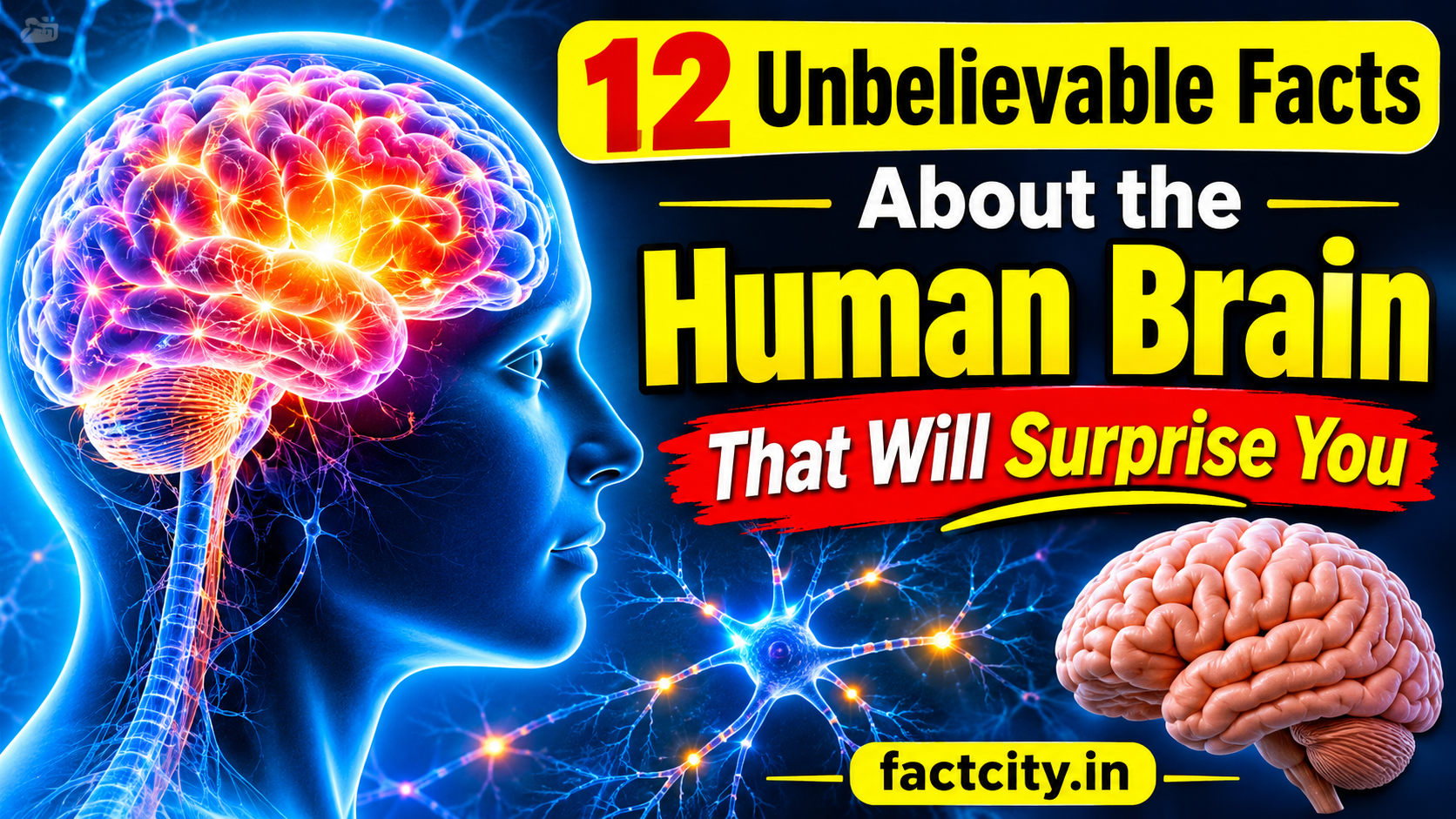
12 Unbelievable Facts About the Human Brain. The human brain is one of the most fascinating and complex organs in the entire body. It controls almost everything we do, from thinking and learning to breathing, remembering, feeling emotions, and moving our muscles. Even when we are sleeping, the brain continues working behind the scenes to keep the body functioning properly. Although scientists have studied the brain for many years, there are still many things about it that we do not fully understand.
What makes the human brain so amazing is its ability to process information, solve problems, recognize faces, create memories, and adapt to new experiences. It contains billions of nerve cells that communicate with one another through an incredibly complicated network. Every thought, movement, and feeling involves different areas of this remarkable organ.
Some facts about the brain are so surprising that they sound almost impossible. From its ability to change throughout life to the way it creates dreams, the brain has many secrets worth exploring. Here are 12 unbelievable facts about the human brain that will help you understand how this incredible organ works.
1. The Human Brain Contains Around 86 Billion Neurons
One of the most unbelievable facts about the human brain is the enormous number of neurons it contains. Scientists estimate that the average adult human brain has approximately 86 billion neurons. These specialized nerve cells are responsible for receiving, processing, and transmitting information throughout the nervous system.
Neurons communicate with one another through electrical and chemical signals. These signals allow us to think, remember information, recognize people, and respond to situations around us. Every time you learn something new or make a decision, different groups of neurons become active and exchange information. 12 Unbelievable Facts About the Human Brain
However, neurons do not work alone. They connect through tiny junctions called synapses, creating an enormous communication network. This complicated system allows the brain to perform thousands of different tasks at the same time. The number of neurons and their connections is one of the reasons the human brain is so powerful.
2. Your Brain Uses About 20 Percent of Your Body’s Energy
Although the brain represents only about 2 percent of an adult’s body weight, it uses approximately 20 percent of the body’s energy while resting. This is surprising because the brain is relatively small compared with other organs, yet it requires a constant supply of energy to function properly.
The brain mainly uses glucose as its energy source. It needs this energy to maintain communication between neurons, process information, regulate body functions, and support everyday mental activities. Even when you are sitting quietly or sleeping, your brain continues using energy.
This is why proper nutrition, hydration, and healthy sleep habits are important for brain function. The brain never completely switches off because it must continuously manage essential processes such as breathing, body temperature, and heartbeat.
3. The Human Brain Can Change and Adapt Throughout Life
Another amazing fact about the human brain is its ability to change. This ability is known as neuroplasticity. It means the brain can reorganize its connections and adjust how different areas work in response to learning, experiences, and environmental changes.
For example, when you learn a new language, practice playing a musical instrument, or develop a new skill, your brain creates and strengthens neural connections. Repeated practice can make these connections more efficient, helping you perform the activity more easily over time.
Neuroplasticity also plays an important role in recovery after certain brain injuries. In some situations, other parts of the brain can adapt and help take over functions that were affected by damage. Although recovery depends on the type and severity of the injury, this ability demonstrates how flexible the human brain can be.
The most interesting part is that the brain does not stop changing after childhood. Learning and new experiences can continue shaping it throughout adulthood.
4. Your Brain Is Active Even When You Are Sleeping
Many people believe that the brain rests completely during sleep, but that is not true. In reality, the brain remains highly active throughout the night. While your body gets physical rest, your brain continues performing several important activities.
During sleep, the brain helps organize memories, process information, and regulate different biological functions. It also goes through different sleep stages, including rapid eye movement (REM) sleep, during which many vivid dreams occur.
Sleep is especially important for memory. Information collected during the day can be processed and strengthened while you sleep. This is one reason why getting enough quality sleep can support learning and concentration.
Your brain also helps control breathing, heartbeat, and other essential body functions throughout the night. So, even when you are completely unaware of what is happening around you, your brain is still working continuously.
5. The Brain Itself Does Not Have Pain Receptors
One of the strangest facts about the human brain is that the brain tissue itself does not contain pain receptors called nociceptors. These receptors detect painful sensations and send signals to the nervous system.
This means the brain cannot directly feel pain in the same way your skin, muscles, or other body tissues can. However, several structures surrounding the brain, including the meninges, blood vessels, and certain nerves, do contain pain-sensitive receptors.
This explains why headaches can occur even though the brain itself does not directly feel pain. Headaches may involve changes or irritation in surrounding structures, muscles, nerves, and blood vessels.
Interestingly, this characteristic also makes certain types of brain surgery possible while a patient is awake under carefully controlled medical conditions. Doctors can monitor brain functions during surgery without the brain tissue itself producing pain, although surrounding tissues still require appropriate anesthesia.
6. Your Brain Can Generate Thousands of Thoughts Every Day
The human brain is constantly processing information, even when you are not consciously paying attention to it. It receives signals from your senses, evaluates situations, stores memories, and helps you make decisions throughout the day.
You may be thinking about your work, remembering an old conversation, planning tomorrow, or simply noticing sounds around you. These activities involve different brain networks working together.
You might have heard that humans experience exactly 60,000 or 70,000 thoughts every day. However, there is no reliable scientific measurement that establishes a universal number of thoughts per person. The exact number is difficult to define because thoughts can be brief, overlapping, and sometimes unconscious.
What scientists do know is that the brain handles an enormous amount of information every moment. Its ability to switch between tasks, connect ideas, and respond to changing situations makes everyday thinking possible.
7. Memories Are Stored Through Changing Connections Between Neurons
Memory is one of the most impressive abilities of the human brain. It allows us to remember childhood experiences, recognize familiar faces, learn new information, and use past experiences to make decisions.
However, memories are not stored in one single location like files on a computer. Instead, they involve networks of connected neurons distributed across different brain regions. The hippocampus plays an important role in forming new memories, while other areas help store and retrieve different types of information.
When you learn something new, communication patterns between neurons can change. These changes help strengthen certain connections, making it easier for the brain to access information later.
Another interesting detail is that memories can change over time. Remembering something is not always like watching an exact recording of the past. Your current emotions, experiences, and new information can influence how you remember an event.
This is why human memory is powerful but not always perfectly accurate.
8. Your Brain Produces Electrical Activity All the Time
The human brain works through a combination of electrical and chemical signals. Whenever neurons communicate, they produce tiny electrical changes that help information travel through the nervous system.
Although the electricity produced by individual neurons is extremely small, the combined electrical activity of large groups of neurons can be measured using a test called an electroencephalogram (EEG).
An EEG records electrical patterns from the brain through sensors placed on the scalp. Doctors and researchers use this technology to study brain activity, investigate certain neurological conditions, and examine sleep patterns.
Different types of brain activity are associated with different mental states. For example, certain brainwave patterns are commonly associated with alertness, relaxation, and sleep.
This means your brain is constantly producing measurable electrical activity, whether you are reading a book, solving a problem, listening to music, or resting.
9. The Human Brain Is More Active Than You Might Think
The brain is responsible for controlling a remarkable number of activities at the same time. While you are reading this article, your brain is recognizing words, understanding sentences, connecting ideas, and storing information.
At the same time, it is helping you maintain balance, control eye movements, regulate breathing, and process sounds from your surroundings.
Different brain regions have specialized responsibilities, but they work together through complicated networks. The cerebral cortex is involved in higher-level activities such as thinking, language, and decision-making. The cerebellum helps coordinate movement and balance, while the brainstem controls several essential automatic functions.
This teamwork allows the body to respond quickly to different situations without requiring conscious attention for every action.
The brain’s ability to manage many processes simultaneously is one of the reasons human beings can perform complicated activities in everyday life.
10. Dreams Can Happen in Different Stages of Sleep
Dreams are among the most mysterious experiences created by the human brain. Many people associate dreaming only with REM sleep, but dreams and dream-like experiences can also occur during other stages of sleep.
During REM sleep, brain activity becomes relatively active, and dreams are often more vivid, emotional, and story-like. Your eyes move rapidly beneath closed eyelids, while most of your voluntary muscles remain temporarily inactive.
Scientists believe dreaming may be connected to memory processing, emotional experiences, and the brain’s natural activity during sleep. However, the exact purpose of dreams is still being investigated.
Sometimes dreams include familiar people, unusual locations, or situations that would never happen in real life. The brain can combine memories, emotions, and imagination to create these experiences.
Another interesting thing is that people often forget their dreams shortly after waking up. This is why you may remember a dream clearly in the morning but struggle to recall it a few hours later.
11. The Brain Controls Emotions and Influences Your Decisions
Your brain does much more than help you think logically. It also plays a major role in controlling emotions such as happiness, fear, anger, sadness, and excitement.
Several brain regions work together to process emotional experiences. The amygdala is involved in detecting emotionally important information, including potential threats. The prefrontal cortex helps with planning, decision-making, and regulating emotional responses.
For example, when you face a stressful situation, your brain evaluates what is happening and helps your body prepare to respond. Your heartbeat may increase, your attention may become sharper, and your body may release stress-related hormones.
Emotions can also influence everyday decisions. Your feelings, memories, and previous experiences may affect how you react to people and situations.
This connection between emotions and thinking shows that human decisions are not based on logic alone. The brain combines emotional information with reasoning to help guide behavior.
12. The Human Brain Is Still One of Science’s Biggest Mysteries
Despite decades of research and major technological advances, scientists still have many unanswered questions about the human brain. Researchers have learned a great deal about neurons, memory, emotions, sleep, and brain development, but understanding how all these processes work together remains a major scientific challenge.
One of the biggest mysteries is consciousness. Scientists continue investigating how electrical and chemical activity in the brain creates our personal experience of being aware, thinking, and feeling.best-indexed-universal-life-insurance-for-retirement-planning
Researchers are also studying how memories form, why people dream, how creativity develops, and what makes every individual’s brain unique.
Modern technologies such as functional magnetic resonance imaging (fMRI), EEG, and advanced brain-mapping methods are helping scientists explore these questions. However, the brain is so complex that there is still much more to discover.
Every new discovery brings researchers closer to understanding how this remarkable organ works. The human brain remains one of the most fascinating subjects in modern science.
Why the Human Brain Is So Amazing
The human brain is much more than an organ that controls our thoughts and movements. It is the center of our memories, emotions, imagination, learning, and personal experiences. Its billions of neurons communicate through complicated networks, allowing us to understand the world and respond to everything happening around us.
From using a large share of the body’s energy to changing through neuroplasticity, the brain has abilities that continue to surprise scientists. It remains active during sleep, helps create dreams, stores memories, and manages countless essential functions without requiring conscious effort.
Although science has made impressive progress in understanding the brain, many of its secrets remain unexplained. That is what makes studying the human brain so exciting. The more researchers discover, the more they realize how much there is still to learn.
Understanding these unbelievable facts about the human brain can also encourage us to take better care of it. Getting enough sleep, eating a balanced diet, staying physically active, learning new skills, and maintaining social connections can all support overall brain health.