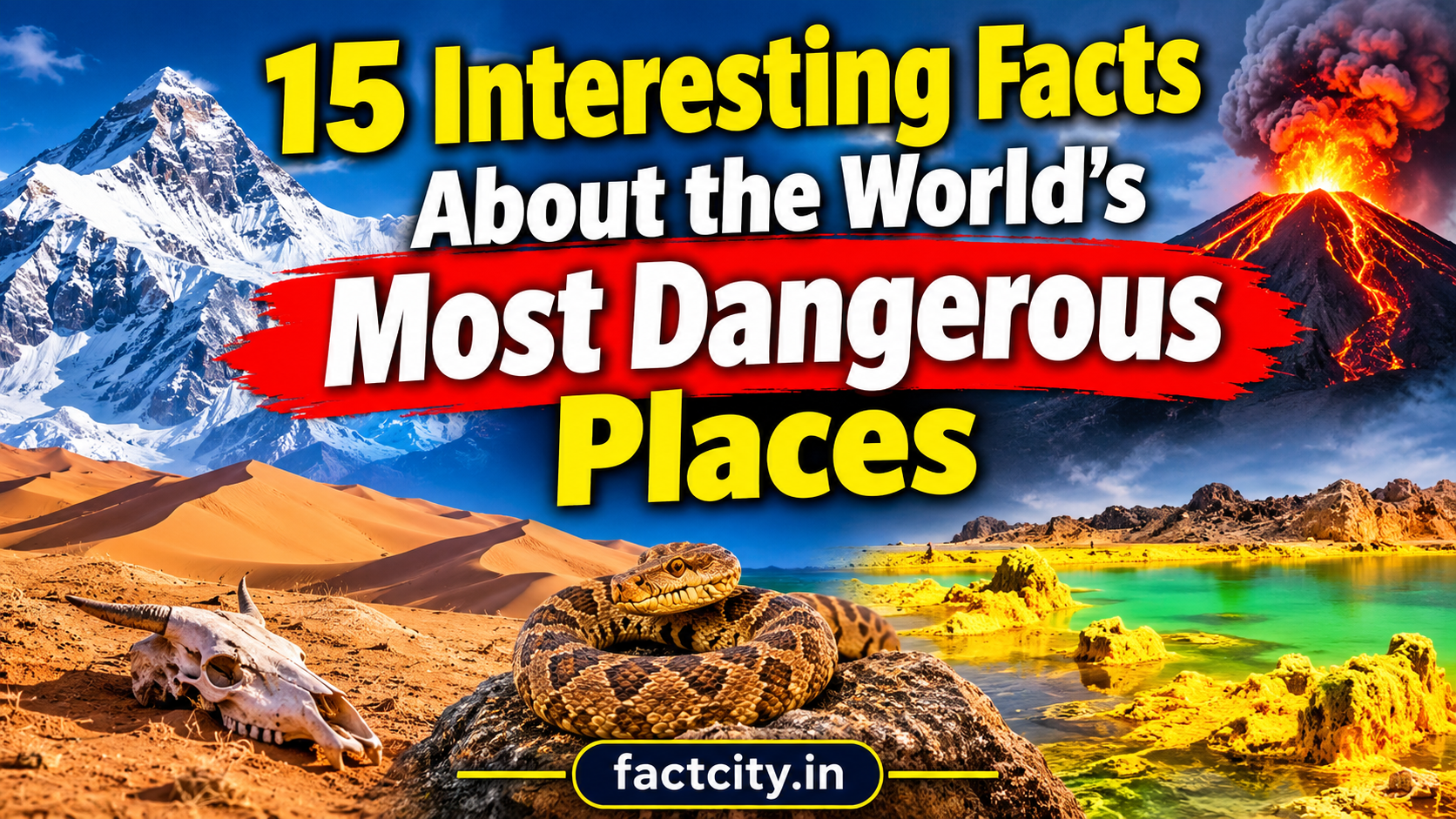
15 Interesting Facts About the World’s Most Dangerous Places. The world is full of beautiful destinations, fascinating landscapes, and extraordinary natural wonders. However, not every place on Earth is safe to visit or live in. Some locations are famous for their extreme weather, dangerous wildlife, active volcanoes, deadly natural conditions, or unpredictable environments. While these places may look fascinating from a distance, they can present serious risks to anyone who enters them without proper preparation.
From scorching deserts and freezing mountain peaks to poisonous lakes and isolated islands, some of the world’s most dangerous places have conditions that are difficult for humans to survive. Interestingly, many of these locations are also home to unique ecosystems, rare wildlife, and incredible natural features that cannot be found anywhere else.
Understanding these dangerous destinations helps us learn more about the power of nature and the challenges people face in extreme environments. Here are 15 interesting facts about the world’s most dangerous places that reveal just how unpredictable and powerful our planet can be.
1. Death Valley Is One of the Hottest Places on Earth
Death Valley, located in California and Nevada in the United States, is famous for its extreme temperatures and dry desert environment. It is considered one of the hottest places on Earth. In July 1913, a temperature of 134°F (56.7°C) was recorded at Furnace Creek, a measurement recognized as the highest reliably recorded air temperature.
The valley’s geography plays an important role in creating its extreme heat. It sits below sea level and is surrounded by mountains that help trap hot air. During summer, temperatures can become dangerous for visitors, especially those who spend too much time outdoors without enough water.
Despite these harsh conditions, Death Valley supports several plants and animals that have adapted to desert life. Visitors can explore its colorful mountains, salt flats, and unusual rock formations, but proper preparation is essential. Carrying enough water, avoiding midday heat, and staying near safe routes can help reduce the risks.
2. The Danakil Depression Has Extremely Harsh Conditions
The Danakil Depression in northeastern Ethiopia is one of the most extreme environments on the planet. Located in the Afar region, this unusual landscape is known for its intense heat, volcanic activity, acidic hot springs, and colorful mineral deposits. 15 Interesting Facts About the World’s Most Dangerous Places
Temperatures can become extremely high, making outdoor activity difficult and potentially dangerous. Some areas contain pools of highly acidic water and mineral-rich formations that are unsafe to touch. The region also has active geological features, including volcanic landscapes and areas where gases may escape from the ground.
What makes the Danakil Depression particularly interesting is its extraordinary appearance. Bright yellow sulfur deposits, green mineral pools, and orange salt formations create a landscape that looks almost unreal. Scientists also study the region to understand how life survives in extreme environments.
Although it attracts adventurous travelers and researchers, visiting the area requires careful planning, local guidance, and awareness of environmental hazards.
3. Mount Everest Can Become Deadly Because of Its Extreme Altitude
Mount Everest, located in the Himalayas on the border between Nepal and China, is the highest mountain above sea level, reaching approximately 8,849 meters. It attracts climbers from around the world, but reaching its summit is one of the most challenging adventures a person can attempt.
The biggest danger is not simply the cold weather or steep slopes. At such high altitudes, the amount of available oxygen is much lower than at sea level. This can cause altitude sickness, which may become life-threatening if climbers do not descend when symptoms become serious.
The mountain is also known for sudden storms, powerful winds, avalanches, and unstable ice formations. The region above 8,000 meters is commonly called the death zone because the human body struggles to survive there for extended periods.
Even experienced climbers face serious risks. Proper training, acclimatization, suitable equipment, and careful decision-making are essential for anyone attempting to climb this famous mountain.
4. Snake Island Is Home to Thousands of Venomous Snakes
Ilha da Queimada Grande, commonly known as Snake Island, is located off the coast of Brazil. It is famous for its population of venomous golden lancehead pit vipers, a snake species found naturally on the island.
These snakes are considered particularly dangerous because their venom can cause serious tissue damage and other severe medical complications. The island’s isolated environment has allowed the snake population to develop separately from mainland populations over time.
Snake Island has become one of the world’s most well-known examples of a dangerous wildlife habitat. However, some popular stories about the number of snakes on the island are exaggerated, and exact population estimates vary.
Access to the island is heavily restricted by Brazilian authorities, with entry generally limited to authorized researchers and other permitted visitors. This helps protect both people and the island’s unique wildlife.
5. Lake Natron Can Be Dangerous for Wildlife
Lake Natron in northern Tanzania is one of the most unusual lakes in the world. Its water contains high concentrations of dissolved minerals, making it extremely alkaline. The lake’s chemistry can be dangerous for many animals that are not adapted to these conditions.
During certain periods, the water can become reddish because of salt-loving microorganisms. The surrounding landscape is also known for its dramatic volcanic scenery and mineral-rich formations.
One of the most fascinating things about Lake Natron is that it provides an important breeding environment for lesser flamingos. These birds are specially adapted to conditions that many other species cannot tolerate. The lake’s harsh environment can also help protect flamingo breeding areas from some predators.
Although the lake is sometimes described as a place that turns animals into stone, this is not literally true. Its chemical conditions can damage animals that become trapped or die in the water, but popular descriptions often exaggerate the science.
6. The Sahara Desert Can Be Extremely Dangerous Without Preparation
The Sahara is the largest hot desert in the world, covering a huge part of North Africa. It stretches across several countries and contains enormous sand dunes, rocky plateaus, dry valleys, and isolated settlements.
One of the biggest dangers of the Sahara is extreme heat. During the day, temperatures can rise significantly, increasing the risk of dehydration and heatstroke. At night, temperatures can drop sharply, especially in certain seasons and locations.
Another challenge is the lack of reliable water sources. Travelers who become lost or run out of supplies can quickly find themselves in a life-threatening situation. Sandstorms can also reduce visibility and make navigation difficult.
Despite these challenges, the Sahara supports communities, wildlife, and unique desert ecosystems. People have lived in and traveled across this enormous region for generations, using traditional knowledge to survive its difficult conditions.
7. The Bermuda Triangle Is Famous for Mysterious Disappearances
The Bermuda Triangle is a region of the North Atlantic Ocean generally described as an area between Bermuda, Florida, and Puerto Rico. It has become famous because of stories about ships and aircraft that reportedly disappeared in the region.
Over the years, the Bermuda Triangle has inspired countless books, documentaries, and theories. Some people have suggested unusual explanations involving magnetic forces, underwater mysteries, or extraterrestrial activity.
However, scientific investigations have not established that the area has a higher rate of unexplained disappearances than other heavily traveled parts of the ocean. Severe weather, strong currents, navigation mistakes, and mechanical problems can explain many maritime and aviation accidents.
The region remains interesting because of its reputation and the many stories associated with it. Nevertheless, it is important to separate documented events from fictional explanations when discussing its dangers.
8. The Valley of Death in Russia Has Dangerous Volcanic Conditions
The Valley of Death is a name associated with a remote area near the Kikhpinych volcano in Russia’s Kamchatka Peninsula. The region is known for dangerous volcanic conditions, particularly the presence of gases that can accumulate in low-lying areas.
Volcanic gases such as carbon dioxide and hydrogen sulfide can create serious health risks. In high concentrations, these gases may reduce the amount of breathable oxygen or cause poisoning. Animals entering certain hazardous areas may be affected before they recognize the danger.
The Kamchatka Peninsula itself is famous for its active volcanoes, geothermal activity, and dramatic natural landscapes. Scientists study the region to better understand volcanic processes and the environmental effects of gases released from the ground.
Its remote location and difficult environmental conditions make this area especially challenging to explore safely.
9. North Sentinel Island Is One of the Most Restricted Places on Earth
North Sentinel Island is located in the Andaman Islands in the Bay of Bengal. It is home to the Sentinelese people, one of the world’s most isolated Indigenous communities.
The island is famous because its inhabitants have maintained their traditional way of life and generally reject contact with outsiders. Attempts to approach the island have sometimes resulted in hostile encounters, making unauthorized visits extremely dangerous.
There is another important reason why contact is restricted. Outside diseases could seriously threaten the Sentinelese because their community has limited exposure to many illnesses common elsewhere.
The Indian government protects the island and prohibits unauthorized entry into the surrounding restricted area. These restrictions are intended to protect the community’s safety, privacy, and right to remain isolated.
North Sentinel Island reminds us that not every mysterious place should be explored. Respecting the rights and boundaries of isolated communities is far more important than satisfying curiosity.
10. The Arctic Is One of the Harshest Environments for Human Survival
The Arctic is a vast polar region surrounding the North Pole. It includes parts of several countries and is known for freezing temperatures, sea ice, powerful winds, and long periods of darkness during winter.
Surviving in this environment can be extremely difficult without specialized clothing, shelter, food, and equipment. Exposed skin can develop frostbite, while prolonged exposure to extreme cold can lead to hypothermia.
The Arctic also contains dangerous wildlife, including polar bears. These powerful animals are natural predators and can pose a serious threat to people who encounter them in the wild.
Despite its harsh conditions, the Arctic supports a remarkable variety of life, including seals, whales, Arctic foxes, and migratory birds. Indigenous communities have also lived in the region for thousands of years, developing traditional methods of surviving its extreme climate.
11. Lake Kivu Contains Large Amounts of Dissolved Gas
Lake Kivu is located along the border between Rwanda and the Democratic Republic of the Congo. At first glance, it looks like a peaceful freshwater lake surrounded by beautiful mountains. However, beneath its surface lies an unusual geological feature that makes it scientifically important.
Deep water in Lake Kivu contains large quantities of dissolved carbon dioxide and methane. Under certain conditions, a sudden release of these gases could create a dangerous event known as a limnic eruption.
A limnic eruption occurs when dissolved gases rapidly escape from deep lake water into the atmosphere. Such an event could release large quantities of gas and create serious risks for nearby communities.
Lake Kivu is considered one of the world’s most important examples of a gas-rich lake. Scientists monitor its conditions, while methane extraction projects also use some of its natural resources to produce energy.
12. The Afar Triangle Is Located in a Region of Extreme Geological Activity
The Afar Triangle, located in northeastern Africa, is one of the most geologically active regions on Earth. It is part of a major tectonic area where several plates are slowly moving away from one another.
This movement creates earthquakes, volcanic activity, and deep cracks in the Earth’s surface. The region is especially important to scientists because it provides an opportunity to study how continents gradually separate.
The Afar Triangle is also home to the Danakil Depression, which contains some of the hottest and most unusual landscapes in the world.
Although the region is scientifically fascinating, its extreme temperatures, volcanic hazards, and remote terrain make exploration difficult. Researchers working there must follow strict safety procedures and prepare for challenging environmental conditions.
13. The Amazon Rainforest Contains Dangerous Wildlife
The Amazon Rainforest is the largest tropical rainforest on Earth and stretches across several South American countries. It is famous for its incredible biodiversity, but some of its wildlife can be dangerous to humans.
The rainforest is home to venomous snakes, poisonous frogs, large predators, and insects that can transmit diseases. Some species, such as the jaguar and green anaconda, are powerful animals that require people to maintain a safe distance.
Another danger comes from the environment itself. Dense vegetation, heavy rainfall, difficult river crossings, and limited access to medical facilities can make emergencies especially challenging.
Despite these risks, the Amazon is essential to the planet’s ecological balance. It supports millions of plant and animal species and plays an important role in regulating regional and global climate systems.
14. Mount Nyiragongo Is Known for Its Dangerous Lava Flows
Mount Nyiragongo in the Democratic Republic of the Congo is an active volcano famous for its unusually fluid lava and dramatic crater.
Nyiragongo has experienced several destructive eruptions. In 2002, lava flows reached parts of the nearby city of Goma, destroying buildings and forcing thousands of people to flee. Another major eruption occurred in May 2021, causing further destruction and displacement.
One of the biggest dangers associated with this volcano is the speed at which its lava can move under certain conditions. Unlike some thicker lava flows, Nyiragongo’s lava can travel rapidly down the mountain.
The volcano is monitored by scientists because its activity can create serious risks for nearby communities. Its history demonstrates why living close to active volcanoes requires continuous monitoring and emergency planning.
15. The Dead Sea Area Has Extreme Environmental Conditions
The Dead Sea, located between Jordan and Israel and the West Bank, is one of the saltiest bodies of water in the world. Its extremely high salt concentration makes it difficult for most aquatic organisms to survive.
The lake is also famous for its unusually low elevation. Its surface is more than 430 meters below sea level, making it the lowest exposed land elevation on Earth.
Although the Dead Sea is a popular tourist destination, it has some risks. Swallowing its highly salty water can be dangerous, and getting water into the eyes can cause severe irritation. Visitors should also avoid swimming with open wounds and follow local safety instructions.
Another serious issue is the gradual shrinking of the Dead Sea. Reduced water inflow and human activities have contributed to its falling water level, creating environmental problems such as sinkholes along parts of its shoreline. best-indexed-universal-life-insurance-for-retirement-planning
Why Are Some Places on Earth So Dangerous?
The world’s most dangerous places are not all dangerous for the same reasons. Some experience extreme temperatures, while others contain toxic chemicals, dangerous animals, unstable geological conditions, or unpredictable weather.
Natural geography plays a major role in determining how difficult an environment can be for humans. Deserts may lack water, high mountains have dangerously low oxygen levels, and volcanic regions can release harmful gases or experience sudden eruptions.
Human activity can also increase environmental risks. Deforestation, climate change, pollution, and poor land management can make certain locations more difficult to live in or visit safely.
Understanding these dangers is important because it helps travelers, researchers, and local communities make better decisions. Proper preparation, scientific research, environmental protection, and respect for local regulations can reduce many risks.
Final Thoughts
The world’s most dangerous places reveal just how powerful and unpredictable nature can be. From the extreme heat of Death Valley and the harsh conditions of the Danakil Depression to the isolated environment of North Sentinel Island and the volcanic activity of Mount Nyiragongo, every destination has its own unique challenges.
Interestingly, many of these locations are also scientifically valuable and naturally beautiful. They provide important opportunities to study wildlife, geology, climate, and the limits of human survival.
Although these destinations may attract adventurous travelers and curious explorers, safety should always come first. Some places require special permission, professional guidance, or scientific expertise before they can be explored.