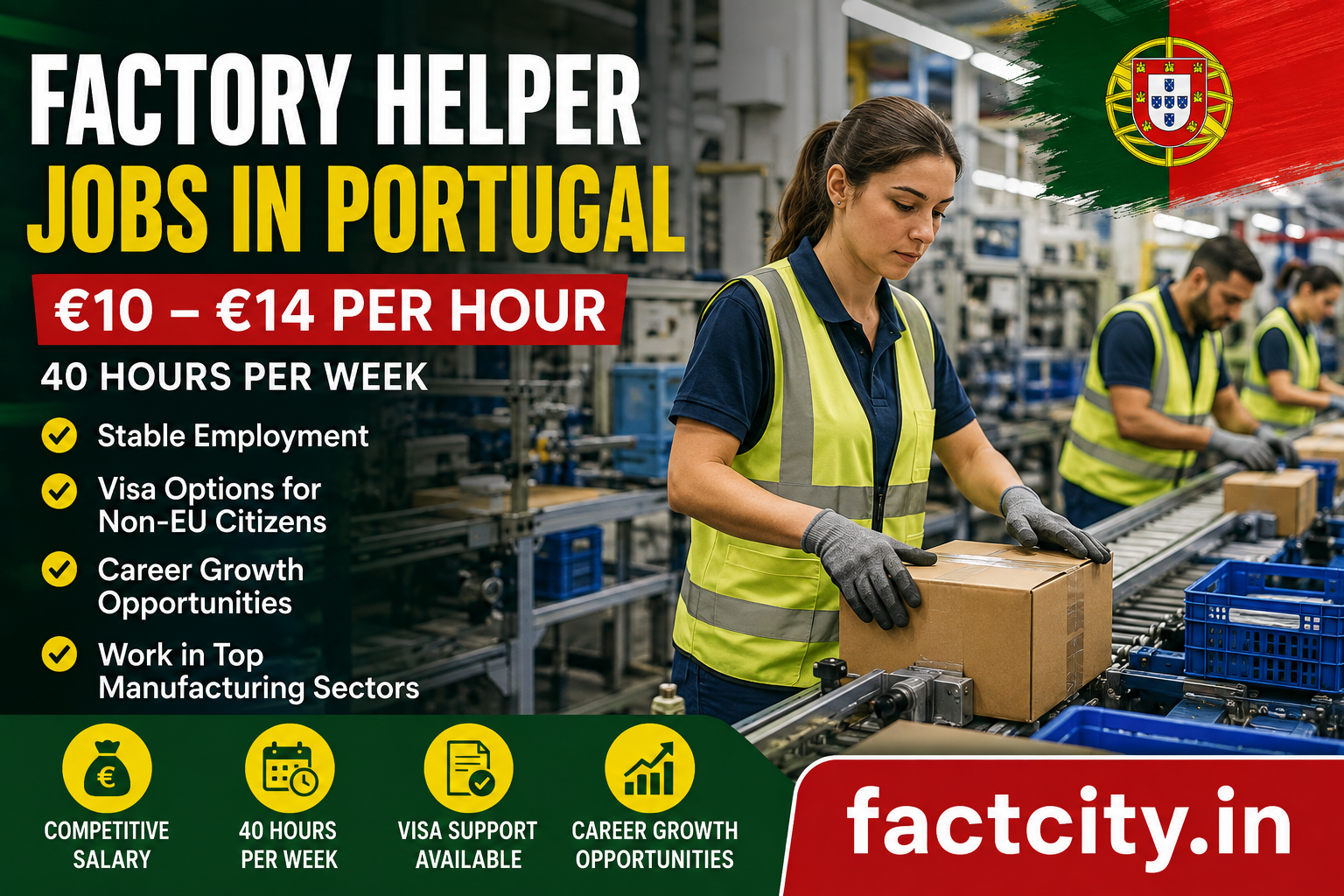
Factory Helper Jobs in Portugal, offer stable employment in the manufacturing sector with competitive wages. These roles, known locally as Auxiliar de Produção, are essential to production lines across industries ranging from food processing to plastics manufacturing. This comprehensive guide examines the realistic salary expectations, daily responsibilities, qualification requirements, and—most critically—the immigration pathways for non-EU citizens considering these opportunities.
Realistic Salary Expectations: €10–€14/hour Examined
The advertised €10–€14/hour range requires careful examination against actual market data. According to SalaryExpert’s 2026 compensation survey, the average factory worker in Portugal earns €15,855 annually, translating to approximately €7.62 per hour. Entry-level positions with 1-3 years of experience start around €12,885 annually, while experienced workers with 8+ years earn approximately €17,325. Factory Helper Jobs in Portugal
Recent job postings provide concrete examples of actual wages. A production helper position in Castelo de Paiva offers a base salary of €920 monthly with a €9 meal allowance. Similarly, a continuous production role in Marinha Grande lists salaries up to €1,000 per month. A food industry production assistant position in Santarém offers €920 gross monthly, with overtime compensation at €10.46 per hour.
The €10–€14/hour range cited in some listings is significantly above market averages. The average Manufacturing Operator, a role requiring more specialized skills, earns approximately €20,035 annually or €9.63 per hour. Even this higher-skilled position falls below the €10/hour threshold. Factory helper roles commanding premium wages typically require additional qualifications, such as forklift certification or experience with specific machinery like injection molding equipment.Factory Helper Jobs in Portugal
Daily Responsibilities and Work Environment
Factory helpers perform essential production support functions that keep manufacturing operations running smoothly. Understanding these duties helps clarify why these roles are valued and what employers expect.
Production Line Support forms the core of the role. Workers feed equipment with raw materials and consumables, collect finished products from production zones, and ensure continuous workflow. In food industry settings, this includes preparing and supplying the production line, monitoring processes, and removing non-conforming products. Factory Helper Jobs in Portugal
Quality Control and Inspection responsibilities require attention to detail. Workers perform visual quality checks on products, identifying and flagging any irregularities or defects. This involves following quality control plans and ensuring products meet specifications before they progress through the production chain.
Packing and Acondicionamento tasks involve weighing or measuring products when applicable, packaging according to specified quantities, sealing packages, and labeling with reference numbers, batch codes, and dates. This ensures products are properly prepared for distribution.
Equipment and Workspace Maintenance includes keeping workstations clean and organized according to hygiene and safety standards. In food production environments, this means following HACCP (Hazard Analysis and Critical Control Points) protocols and using personal protective equipment correctly.
Internal Logistics Support may involve moving boxes and pallets within the facility and preparing shipments when necessary. Some positions require forklift certification, particularly in industries dealing with heavy materials.
The work typically involves 40-hour weeks, often in shift patterns. Common schedules include rotating shifts covering 06h-14h, 14h-22h, and sometimes night shifts 21h-05h in continuous production environments. Factory Helper Jobs in Portugal
Qualification Requirements and Career Progression
Most factory helper positions prioritize practical skills and reliability over formal education. Approximately 53% of factory helpers have a high school diploma, while 47% have less than high school education.
Educational Requirements typically range from minimum compulsory schooling (9th year) to preference for 12th year education. Previous experience in an industrial environment is valued but often not mandatory, as many employers provide initial and ongoing training.
Essential Qualities employers seek include:
- Dynamic and resourceful profile with a sense of responsibility
- Physical fitness for standing and manual work
- Punctuality and reliability
- Good teamwork and interpersonal skills
- Willingness to learn and positive attitude
- Availability for shift work and flexibility
Preferred Qualifications that command higher wages include:
- Forklift operator certification
- Experience with injection molding or specific manufacturing processes
- Knowledge of printing technologies (flexography, rotogravure)
- Mechanical and electrical maintenance experience
Career progression opportunities exist for motivated workers. Manufacturing operators and line leaders often start as production helpers and advance through experience and additional training. The manufacturing operator role offers average salaries of €20,035 annually, representing a significant career advancement pathway. Factory Helper Jobs in Portugal
Visa and Immigration Reality for Non-EU Citizens
This is the most critical consideration for international applicants. Portugal has specific restrictions on unskilled labor for non-EU citizens. The country generally does not grant work permits for basic factory helper positions to non-EU workers, as Portugal’s immigration policy favors skilled workers such as machine operators, CNC technicians, and quality controllers.
Employment Pathways for Non-EU Citizens
For periods of less than one year, non-EU citizens must obtain a Temporary Stay Visa for seasonal work or a Seasonal Work Visa. These require a valid work contract or promise of contract and are limited to specific sectors defined by Portuguese authorities. The approved sectors include agriculture, hospitality, food industry, commerce, construction, and land transport. Factory production support may fall under the food industry category, but seasonal restrictions apply.
The Institute for Employment and Professional Training (IEFP) evaluates all temporary appointment offers submitted by employers. Offers must be published on specific websites, and job seekers can apply directly to employers. If successful, the visa application is submitted at Portuguese consulates in the country of origin or residence.
For long-term employment (over one year), a residence visa (Type D) is required. The employer must provide a signed employment contract and demonstrate that the job could not be filled by qualified Portuguese, EU, or EEA citizens through a labor market test. Job offers are advertised by the IEFP and transmitted to Portuguese embassies and consular posts abroad. Factory Helper Jobs in Portugal
Required Documentation
The residence visa allows four months to apply for a residence permit with AIMA (the immigration authority). Applications are submitted at Portuguese consulates in the applicant’s home country. Factory Helper Jobs in Portugal
Why Factory Helper Visas Are Unlikely for Non-EU Citizens
Given the abundance of local labor for entry-level factory positions, obtaining approval for a non-EU factory helper is highly challenging. Employers must prove they could not find suitable candidates within Portugal or the EU through the IEFP job posting system. Since factory helper roles do not require specialized skills and thousands of Portuguese and EU workers are available, the labor market test effectively blocks non-EU recruitment for these positions. Factory Helper Jobs in Portugal
The D1 work visa route requires proving the employee has necessary qualifications, competencies, and expertise for the job. Basic production support roles do not meet this threshold. Employers seeking to sponsor non-EU workers must typically offer roles requiring specific technical skills or higher qualifications.
Alternative Pathways
Skilled Manufacturing Roles: Machine operators, CNC technicians, and quality controllers are more likely to receive work permit approval. The manufacturing operator role pays €20,035 annually and offers a viable pathway. Factory Helper Jobs in Portugal
Intra-Company Transfers: Employees already working for multinational companies can transfer to Portuguese branches without a labor market test.
EU Blue Card: Highly qualified workers with university degrees and higher salaries may qualify for this pan-European work permit.
Seasonal Work: Non-EU citizens may qualify for seasonal work in specific sectors, though factory production roles are less common in this category. Factory Helper Jobs in Portugal
Comprehensive Comparison Table: Factory Helper vs. Other Manufacturing Roles
This table clearly illustrates why the advertised €10–€14/hour rate represents the upper end of the market and typically requires additional skills or certifications. The production engineer role commands significantly higher compensation but requires advanced education and qualifications. Factory Helper Jobs in Portugal
Where Factory Helper Jobs Are Available
Manufacturing hubs across Portugal offer the most opportunities for production helpers:
Marinha Grande is a plastics manufacturing center with continuous production roles requiring shift work and often forklift certification. Companies in this region produce plastics for the food and utility sectors. Factory Helper Jobs in Portugal
Castelo de Paiva hosts industrial clients recruiting production helpers with 9th-year education minimum, offering €920 base salaries with meal allowances.
Santarém (Ferreira do Zêzere) has food industry production positions requiring HACCP compliance and shift availability, with overtime compensation at €10.46 per hour.
Porto offers opportunities in flexible packaging manufacturing, with roles involving printing technology support and quality control. These positions require 12th-year education preference and rotating shift availability.
Viseu hosts food production facilities recruiting production helpers for line operations and equipment monitoring. Factory Helper Jobs in Portugal
Conclusion
Factory helper jobs in Portugal offer steady employment with annual salaries averaging €15,855, though the advertised €10–€14/hour range exceeds market rates and typically applies to roles with specialized requirements like forklift certification. The work involves production support, packing, and basic quality checks, with 40-hour weeks often including shift work. Factory Helper Jobs in Portugal
The most significant barrier for international applicants is Portugal’s restriction on unskilled labor permits for non-EU citizens. The labor market test requires employers to prove no local or EU workers are available, effectively blocking recruitment for basic factory helper positions. Non-EU citizens seeking manufacturing work in Portugal must pursue skilled roles like manufacturing operators or production engineers, explore intra-company transfers, or consider seasonal work in approved sectors. Factory Helper Jobs in Portugal
For EU citizens and those already with Portuguese work rights, genuine opportunities exist across Portugal’s manufacturing hubs, with proper training and career progression potential available for motivated workers. Factory Helper Jobs in Portugal