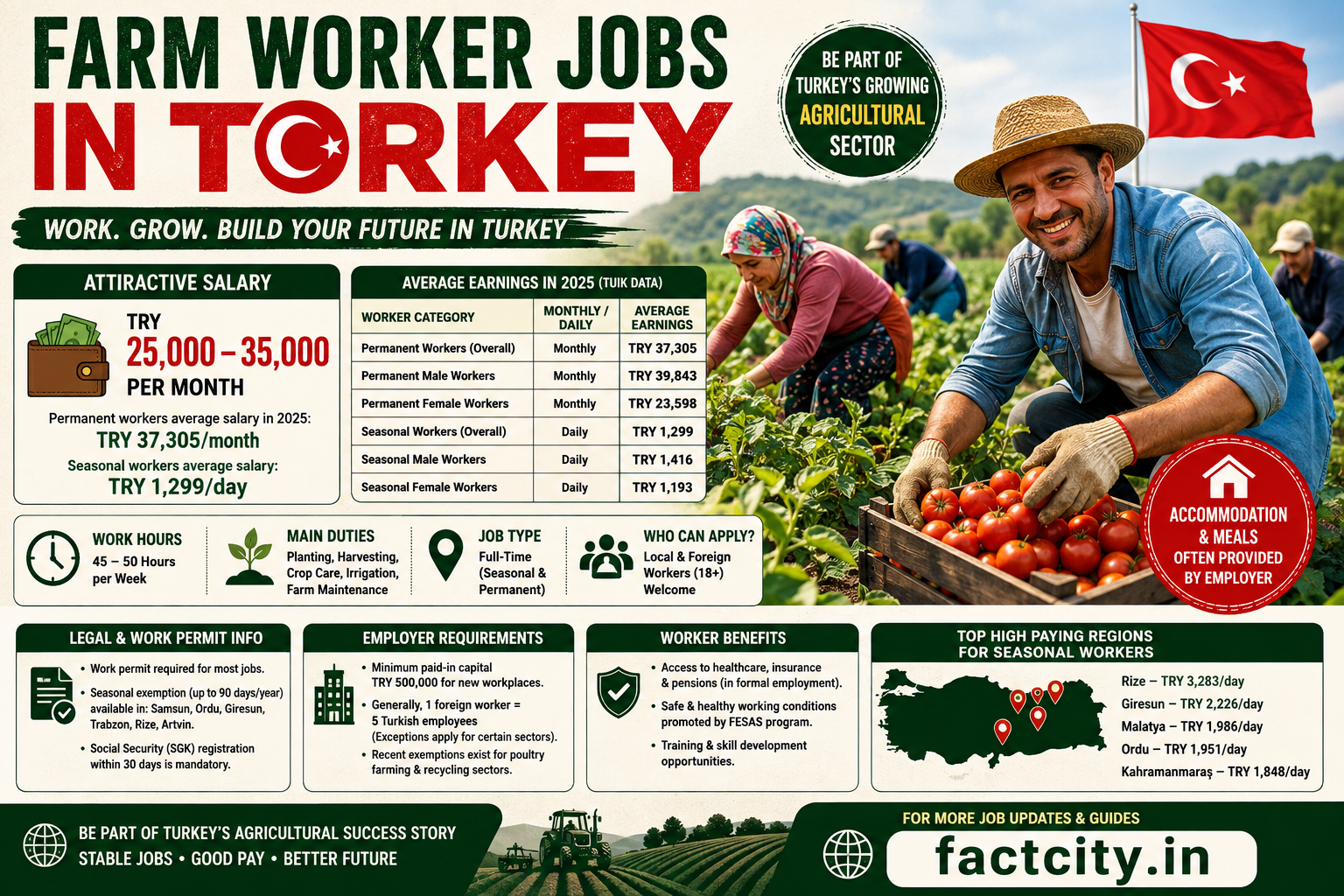
Farm Worker Jobs in Turkey, Turkey’s agricultural sector is experiencing a significant transformation, creating robust opportunities for farm workers. This comprehensive guide explores everything you need to know about farm worker jobs in Turkey, including up-to-date salary data, legal requirements, and the realities of working in this vital industry.
Salary and Compensation: What Farm Workers Actually Earn
Recent data from the Turkish Statistical Institute (TUIK) reveals substantial wage growth in the agricultural sector. In 2025, permanent agricultural workers saw their monthly earnings increase by 42.1% to an average of TRY 37,305 . This places the advertised range of TRY 25,000–35,000/month squarely within the current market average. Farm Worker Jobs in Turkey
The breakdown by worker type and gender provides a clearer picture:
| Worker Category | 2024 Average Wage | 2025 Average Wage | Increase |
|---|---|---|---|
| Permanent Workers (Overall) | TRY 26,259/month | TRY 37,305/month | +42.1% |
| Permanent Male Workers | TRY 27,788/month | TRY 39,843/month | +43.4% |
| Permanent Female Workers | TRY 19,328/month | TRY 23,598/month | +22.1% |
| Seasonal Workers (Daily) | TRY 943/day | TRY 1,299/day | +37.8% |
| Seasonal Male Workers | TRY 1,007/day | TRY 1,416/day | +40.6% |
| Seasonal Female Workers | TRY 890/day | TRY 1,193/day | +34.1% |
Source: TUIK 2025 Tarımsal İşletme İşgücü Ücret Yapısı verileri
These figures demonstrate that farm work in Turkey offers competitive compensation, particularly for permanent positions with year-round employment. Farm Worker Jobs in Turkey
Regional Variations in Farm Worker Pay
Salaries vary significantly depending on location, crop type, and local demand for labor. The highest daily wages for seasonal workers are found in the Black Sea region, particularly in tea and hazelnut growing areas:
Highest Paying Provinces for Seasonal Workers:
- Rize: TRY 3,283/day (male), TRY 3,075/day (female)
- Giresun: TRY 2,226/day
- Malatya: TRY 1,986/day
- Ordu: TRY 1,951/day
- Kahramanmaraş: TRY 1,848/day
For permanent workers, the highest monthly salaries for male workers were recorded in Niğde (TRY 53,927/month), while female permanent workers earned the most in İzmir (TRY 25,521/month) .
Work Schedule and Job Duties
Farm worker positions typically require 45–50 hours per week, though seasonal demands can extend working hours during planting and harvest peaks. Farm Worker Jobs in Turkey
Primary Responsibilities:
- Planting Crops: Preparing fields, sowing seeds, and transplanting seedlings
- Harvesting Produce: Hand-picking fruits, vegetables, and grains; operating machinery where applicable
- Maintaining Farm Areas: Cleaning equipment, managing irrigation systems, and general farm upkeep
- Crop Care: Pruning, weeding, fertilizing, and pest control
Working Conditions
The work is physically demanding and often performed outdoors in challenging weather conditions. In regions like Hatay, where summer temperatures reach 35°C, workers begin at 6 AM and finish by 2 PM to avoid the worst heat, earning approximately TRY 1,100 per day for their efforts . Farm Worker Jobs in Turkey
Legal Requirements and Work Permits for Foreign Workers
Understanding the legal framework is essential for foreign nationals seeking farm work in Turkey.
General Rule: Work Permit Required
In most cases, foreign nationals must obtain a work permit before commencing employment in Turkey. Employers who hire undocumented workers face substantial administrative penalties . Farm Worker Jobs in Turkey
Seasonal Agricultural Exemptions
Special provisions exist for seasonal agricultural work in specific provinces. Workers employed in seasonal tea and hazelnut harvesting in Samsun, Ordu, Giresun, Trabzon, Rize, and Artvin may be eligible for a work permit exemption for up to 90 days per calendar year .
This exemption requires:
- Registration through the YUMI-Net system
- Submission of required documentation to district governorships
- Compliance with the 90-day annual limit
Employer Sponsorship Requirements
For permanent positions requiring a work permit, employers must meet specific criteria:
- Paid-in capital: Minimum TRY 500,000 for newly established workplaces
- Employment criteria: Generally, for each foreign worker, the employer must employ at least five Turkish nationals (exceptions exist for manufacturing and poultry sectors)
Recent regulations (effective August 3, 2026) have introduced specific exemptions for certain sectors, including poultry farming and recycling . Farm Worker Jobs in Turkey
Social Security Registration
All legally employed foreign workers must be registered with Turkey’s Social Security Institution (SGK) within 30 days of starting work, regardless of whether they hold a full work permit or a seasonal exemption .
The Role of Labor Brokers (Dayıbaşı)
An important feature of Turkey’s agricultural labor system is the role of labor brokers, known regionally as dayıbaşı, elci, or çavuş. These individuals typically manage teams of 30 to 150 farmworkers and serve as intermediaries between workers and farm owners . Farm Worker Jobs in Turkey
Brokers are usually men who emerge from farmworker ranks and leverage extensive kinship and community connections. They govern recruitment, retention, and remuneration, often drawing on patriarchal family relations to maintain authority . Understanding this system is important for foreign workers navigating Turkey’s agricultural labor market.
Formal Employment Initiatives
Informal employment has historically been widespread in Turkey’s agricultural sector, with over 80% of agricultural workers employed informally before the Syrian refugee crisis . However, significant efforts are underway to formalize the sector. Farm Worker Jobs in Turkey
FESAS Program
The Formal Employment Support in Agriculture Sector (FESAS) project, backed by the World Bank and European Union, has been instrumental in promoting formal employment. Key achievements include:
- 12,200+ formal jobs created during the first phase
- 1,638 farmers participated in the program
- Nearly 40% of supported workers were women
- Over half of participating farmers employed refugees
- Extensive training provided on occupational health and safety, accounting, and legal requirements
A second phase began in 2026 to continue supporting formal agricultural employment . Farm Worker Jobs in Turkey
Worker Welfare and Working Conditions
Living Conditions
Seasonal migrant farmworkers often live in camps provided by employers or brokers. These conditions can be challenging, with workers required to bring and maintain all personal possessions. Despite difficulties, many workers cultivate solidarity networks and mutual support systems within their teams . Farm Worker Jobs in Turkey
Gender Dynamics
Women play a crucial role in Turkey’s agricultural workforce, facing distinct challenges and opportunities. Research demonstrates that women are doubly exploited—as both wage laborers and unpaid workers within households—while also leveraging farm work to negotiate greater autonomy in decisions about marriage and childbearing . Farm Worker Jobs in Turkey
Application Process and Documentation
For foreign nationals seeking farm worker positions:
Step 1: Secure a Job Offer
Find a reputable employer willing to sponsor your work permit or exemption application.
Step 2: Gather Required Documents
- Valid passport
- Biometric photographs
- Employment contract
- Visa application forms
- Professional qualifications (where applicable)
Step 3: Application Submission
- For work permits: Employer submits to the Ministry of Labor and Social Security
- For seasonal exemptions: Application through YUMI-Net and local district governorships
Step 4: Residence Rights
A valid work permit provides a lawful basis for residence in Turkey during the permit period. Most workers do not need a separate residence permit while their work authorization remains valid . Farm Worker Jobs in Turkey
Career Outlook and Future Prospects
The agricultural sector remains a cornerstone of Turkey’s economy, ensuring continued demand for labor. Salary projections indicate strong growth potential, with estimates suggesting experienced farm workers could see wages increase significantly in coming years.
The push toward formal employment through programs like FESAS is creating more stable, permanent positions with better access to healthcare, pensions, and insurance benefits . This trend benefits both domestic and foreign workers seeking long-term employment in Turkish agriculture. Farm Worker Jobs in Turkey
Frequently Asked Questions
Do I need a work permit for seasonal farm work in Turkey?
Generally yes, but exemptions exist for seasonal agricultural work in specific Black Sea provinces (Samsun, Ordu, Giresun, Trabzon, Rize, Artvin) for up to 90 days per calendar year .
What is the average salary for a farm worker in Turkey?
Permanent agricultural workers earned an average of TRY 37,305/month in 2025, with seasonal daily wages averaging TRY 1,299/day . Farm Worker Jobs in Turkey
How many hours do farm workers typically work?
Most positions require 45–50 hours per week, with extended hours during peak seasons.
What are the main duties of a farm worker?
Planting crops, harvesting produce, maintaining farm equipment and irrigation systems, and general farm upkeep .
Are there benefits available to farm workers?
Formal employment through programs like FESAS provides access to healthcare, pensions, and insurance. Many employers also offer accommodation and meals . Farm Worker Jobs in Turkey
What are the working conditions like?
Work is physically demanding and often performed outdoors in challenging weather conditions. Workers in hot regions like Hatay typically begin early morning shifts and work half-days during extreme heat .