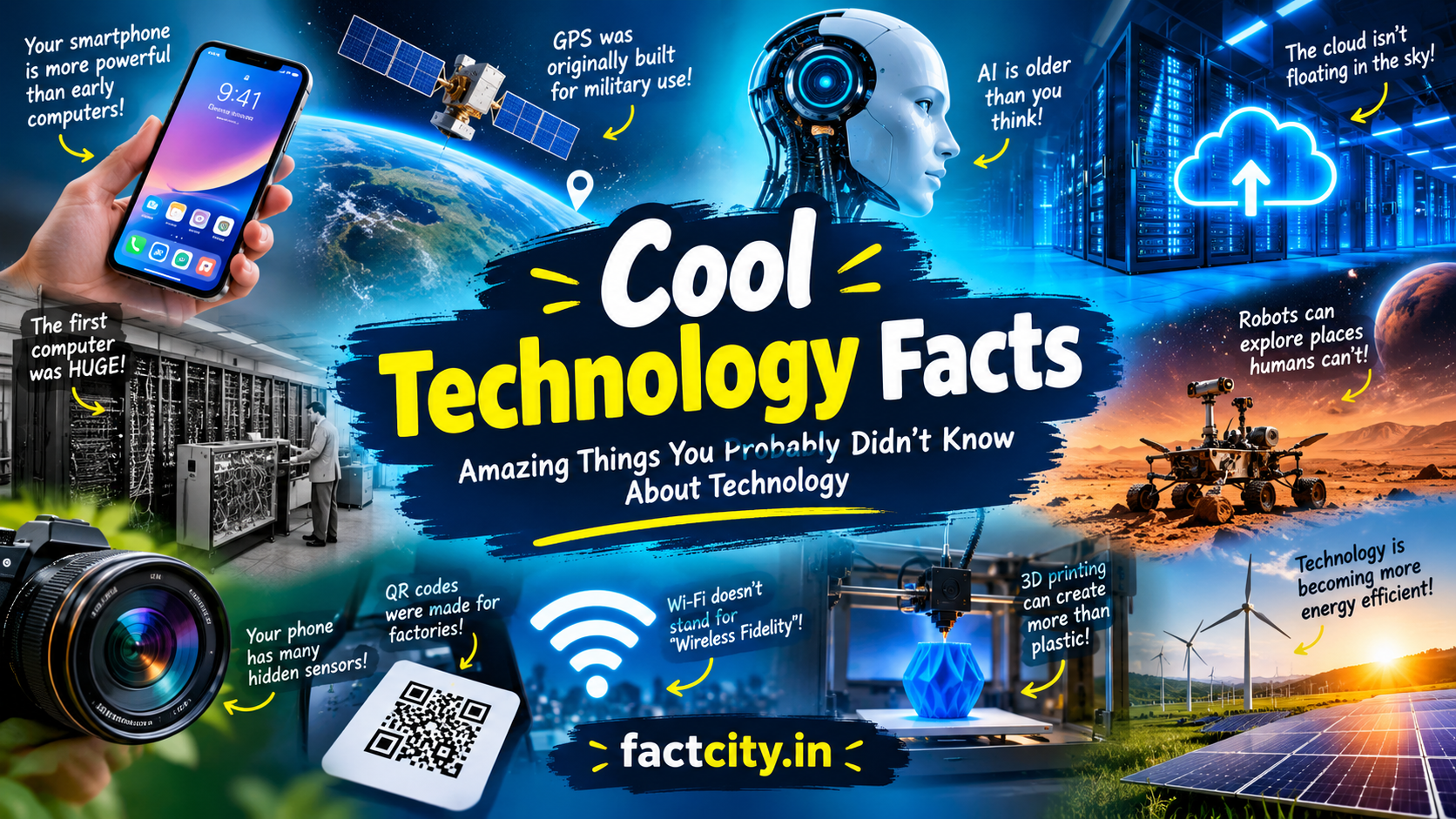
Cool Technology Facts. Technology is so much a part of our everyday lives that we often forget just how amazing it really is. From the smartphone in your pocket to satellites orbiting the Earth, modern technology has transformed how we communicate, work, travel, learn, shop and entertain ourselves.
But behind these familiar devices and services, there are some really interesting ideas and inventions.
If you love learning about surprising things, these cool technology facts will change your view of the digital world. Some of the facts are related to computers and the internet while others look at smartphones, artificial intelligence, space technology, robotics and the future of innovation.
Let’s take a look at some interesting technology facts that you probably didn’t know.# 1. The First Computer Was Massive
Modern laptops are small enough to carry around in a backpack. Early electronic computers were huge.
A famous example is ENIAC, an early electronic general-purpose computer built in the United States in the 1940s. It took up a large room and used thousands of vacuum tubes. “Cool Technology Facts“
Compared to today’s smartphones and laptops, early computers were very limited in their computing power. One of the most amazing things that has happened in technology is the dramatic shrinking of computers.## 2. Smartphones Are Smarter Than Early Computers
Every day, you use a smartphone that contains processors, memory, cameras, sensors, communication hardware and complex software.
The computing power in a modern smartphone is far greater than that in many of the first computers.
Your phone can perform calculations, connect to worldwide networks, record quality video, navigate with satellites, identify images, and run complex programs – all from a device that fits in your hand.
That’s one of the reasons smartphones are some of the most impressive examples of technological miniaturization.# 3. The Internet and World Wide Web Are Not the Same thing
People often use the words internet and web interchangeably, but they are not the same thing.
The Internet is a worldwide network of linked computers and devices.
The ** World Wide Web ** is a system of interlinked web sites and web pages that use the internet to deliver information .
Tim Berners-Lee designed the basic technologies of the web, which were then released to the public in the early 1990s .
The web is technically a single service that runs on the much larger internet.## 4. The first website is still online
Tim Berners-Lee built the world’s first website at CERN.
It was designed to describe the World Wide Web and for information on how people could use it.
The original website was very simple, unlike today’s websites with videos, ads, animations and interactive features. “Cool Technology Facts“
GPS was originally designed for military purposes
We use GPS, or the Global Positioning System, to get driving directions and to track our fitness.
But the technology was originally developed as a satellite-based navigation system for military purposes.
GPS technology is the backbone of many civilian uses today. Smartphones, cars, planes, ships, delivery services, emergency systems and many other technologies use satellite positioning.
Your phone’s ability to help you find a restaurant or navigate a new city is the work of an advanced satellite network.# 6. Artificial Intelligence Has Been Around Longer Than Many People Think
Sounds like a modern invention, right? Well, Artificial Intelligence has been researched by scientists for years.
The field took off in the 20th century with researchers wondering if machines could do things that humans can do because of intelligence .
Artificial intelligence systems today can handle huge amounts of information, find patterns, create text and images, translate languages, analyze data and help with complicated tasks.
Rapid progress in the technology has been driven by advances in computing power, algorithms, data availability, and specialized hardware.7. Robots Can Operate in Areas Difficult for Humans to Reach
Robotics isn’t just for factories and warehouses.
Robots can be made to work under water, in extreme hot or cold environments, inside dangerous industrial plants and even on other planets.
ROBOTIC SPACECRAFT AND PLANETARY ROVERS HAVE BEEN SENT BY SPACE AGENCIES TO INVESTIGATE ENVIRONMENTS THAT WOULD BE DIFFICULT OR IMPOSSIBLE FOR HUMANS TO VISIT DIRECTLY.
Scientists use robotic technology to gather data and to minimize the dangers of sending people into hazardous environments.8. Some robots are able to learn from their environment
Most traditional machines tend to do what people tell them to do.
But modern robots can be much more sophisticated. “Robots can understand their surroundings and adjust their actions accordingly with sensors, computer vision, machine learning and artificial intelligence.
For instance, autonomous machines can identify objects, measure distances, detect obstacles and make decisions based on the information they receive. “Cool Technology Facts“
Robotics and AI are playing an ever-more important role in manufacturing, transportation, healthcare, logistics and research.## 9. Cloud Computing Doesn’t Mean Your Data is in the Sky
The word “cloud” sounds mysterious, but cloud computing runs on physical infrastructure.
Cloud services store photos, documents and other information on computers, typically servers in data centers.
These facilities house lots of powerful machines, networking equipment, cooling systems, backup systems and security technologies.
Cloud computing simply means that users can access computing resources and data over the networks without being entirely dependent on their own devices .# 10. Data centers require massive amounts of electricity
Huge computing infrastructure is needed for modern digital services.
Data centers are the backbone of search engines, streaming services, social networks, online shopping, cloud apps, and artificial intelligence (AI) systems.
These facilities need electricity not just to power computers and networking gear, but to maintain it at proper operating temperatures.
Energy efficiency has become a major field of technological research as the need for AI and other computationally intensive services increases.# 11. QR Codes Were Designed For Industry Originally
QR codes are everyplace now. You’ll find them on restaurant menus, product packaging, advertisements, tickets, payment systems and websites.
But QR codes were originally created in Japan for tracking parts in the automotive manufacturing sector.
At last their capacity to record information in a compact two-dimensional pattern made them useful in many other areas.
Today, a simple smartphone camera can scan the QR code in almost no time. 12. Touchscreens Did Not Invented By Smartphones
Touchscreen technology predates the current explosion of smartphones.
For decades, researchers and engineers fiddled around with touch-sensitive interfaces.
Eventually the technology became practical for consumer electronics and was incorporated into phones, tablets, computers, information kiosks, vehicles and industrial equipment.
Touchscreen interfaces are now a normal part of everyday life thanks to smartphones. 13. Your Phone Has Lots of Sensors
A smartphone is a lot more than a small computer with a screen.
Modern phones can include many sensors like accelerometers, gyroscopes, proximity sensors, ambient light sensors, magnetometers, cameras, microphones and sometimes more specialized sensors.
They allow your phone to detect motion, orientation, light, nearby objects, sound and other environmental information.
This is how your phone can rotate the screen automatically, count steps, adjust brightness, support navigation and many other functions.# 14. Major Camera Changes
We’ve gone from film to digital sensors and now smartphones have put quality cameras in the hands of billions of people.
Modern phone cameras pair physical camera hardware with sophisticated software.
Computational photography can combine multiple images, adjust exposure, reduce noise, improve dynamic range and enhance details.
So the final image from a smartphone can be very much influenced by software processing – not just the camera sensor itself.Bluetooth Was Named After a King 15
The name “Bluetooth” has an interesting history.
It is a reference to Harald Bluetooth , the king of Denmark and Norway during the Viking Age .
The developers of the technology decided on the name as a temporary code name because Harald Bluetooth was known for uniting groups The idea fit the purpose of connecting different electronic devices with Bluetooth technology.
The name was temporary, but it stuck and became permanent.16. Wi-Fi Doesn’t Actually Stand for “Wireless Fidelity”
“Wi-Fi” is not short for “Wireless Fidelity.” That is a common misconception.
The term Wi-Fi originated as a brand name for wireless networking technology. It became well known as the name associated with wireless internet connectivity.
Wi-Fi is one of the most familiar technologies today in our homes, schools, offices, hotels, airports and other public places.## 17. Computers Can Spot Patterns Faster Than People on Certain Tasks
Computers aren’t better than humans at everything, but they can be very good at certain pattern-recognition tasks.
Machine-learning systems can process huge sets of data and detect statistical patterns that would be difficult for a person to analyze by hand.
This skill is used in areas like image analysis, fraud detection, recommendation systems, language processing, scientific research and industrial inspection.
The point is that computers and humans have different strengths, and so human-machine collaboration is becoming more and more valuable.18. 3D Printing Is Not Just for Printing Plastic Objects
Most people, when they hear the words “3D printing,” think of little plastic models.
However, 3D printing technologies can work with many different materials depending on the printing method used.
Researchers and industries have been researching and developing 3D printing of metals, ceramics, specialized polymers, biological materials and other materials.
Applications are from prototypes and industrial components to medical research and building experiments.19. Technology Is Assisting Us in Space Exploration
Space exploration depends on advanced technology.
Satellites gather data on Earth, robotic spacecraft explore the solar system, telescopes gaze at distant objects, and navigation systems assist spacecraft in determining their locations.
Much of space technology also has use on the Earth.
The technology in space enables communication systems, weather monitoring, satellite navigation, earth observation and scientific research.## 20. Technology is becoming more energy efficient
The advances in technology are not only about making the gadgets faster.
Engineers also are working to make computers, smartphones, vehicles, appliances, networks and data centers more energy efficient.
You can reduce energy consumption by using more efficient processors, batteries, cooling systems, integrating renewable energy, and using smarter software.
As the number of connected devices and digital services grows, energy efficiency is becoming increasingly important.The Wonderful World of Technology Facts
cool technology facts are so fascinating because technology often hides amazing engineering behind everyday experiences.
When you unlock your smartphone with your face, stream a movie, use a navigation app or make a video call, several complex systems might be working together.
Wireless networks send information. Processors do calculations. Software understands data. Sensors gather information. Servers accept requests. Communications are protected by security systems.
All of this can happen in a matter of seconds.
What seems simple to the user may be the result of the work of thousands of engineers, researchers, machines and interconnected systems that work together.## The Future of Technology
Technology is still rapidly evolving.
Some of the areas researchers are developing are artificial intelligence, robotics, quantum computing, biotechnology, renewable energy, autonomous systems, advanced materials and space technology.
Some technologies we consider experimental today may become common in everyday life in the future, just as smartphones and cloud computing seemed futuristic a while ago.
The best thing about technology is that it never really stops innovating. What seems revolutionary today may become commonplace tomorrow.# Abstract
These cool technology facts reveal how much engineering and scientific innovation is behind the devices and services we use every day.
In a very short space of time technology has changed beyond recognition, from the massive computers of the past to powerful smartphones, satellite navigation, artificial intelligence, robotics, cloud computing and sophisticated cameras.
Next time you reach for the phone, connect to Wi-Fi, scan a QR code, or ask an AI system, think: You’re using something that’s been decades in the making, through scientific research and engineering.
Technology is not just machines. It’s about linking people and solving problems, about exploring new possibilities and finding better ways all the time to interact with the world.