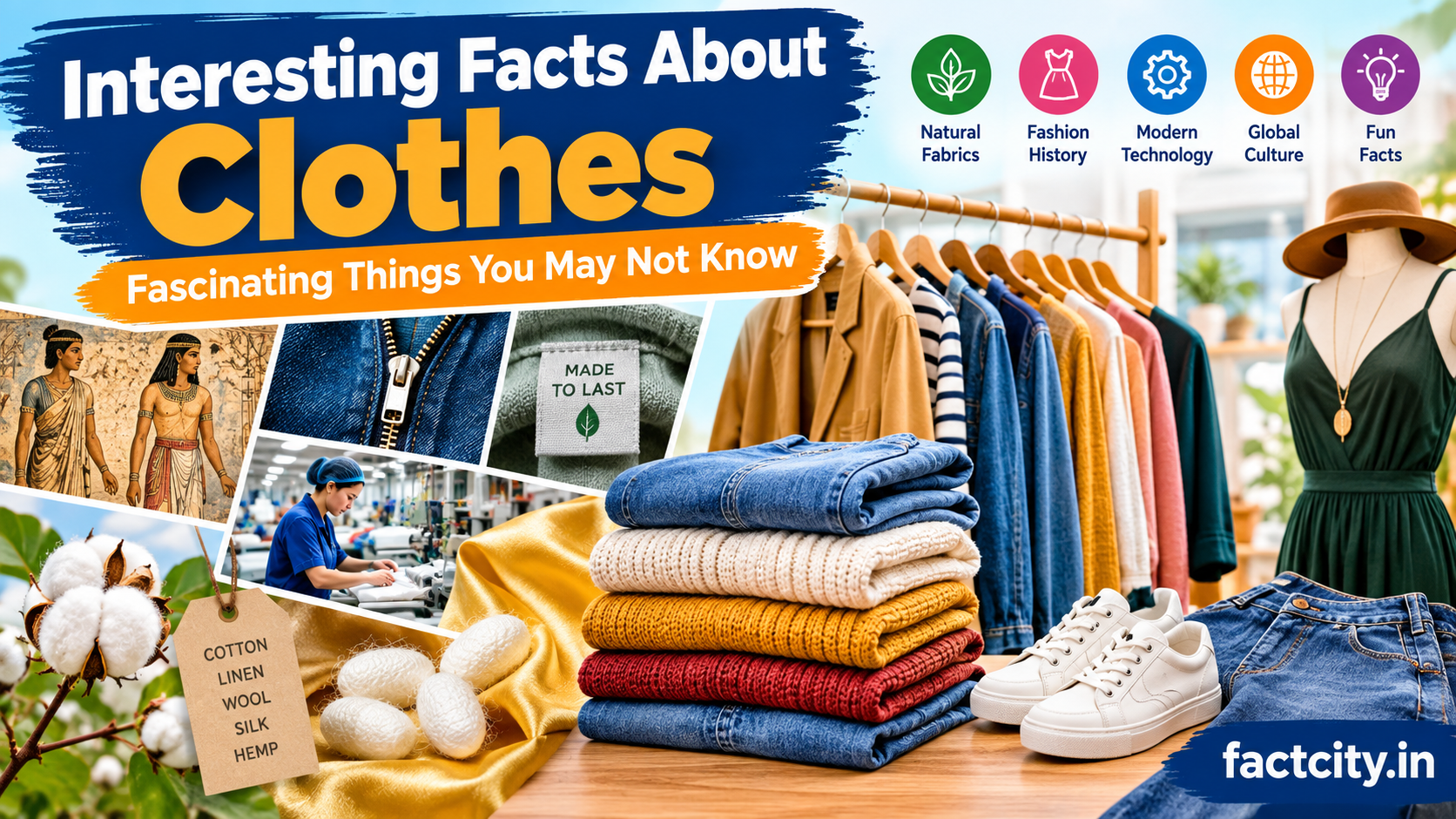
We wear clothes every day, but how often do we stop to think about their history, their materials, their cultural value and their amazing impact on our lives? Clothing has evolved radically over the centuries, from primitive animal skins to today’s high-tech fabrics.
There are so many interesting facts about clothes that tell a story about how fashion evolved, why certain articles of clothing became popular, and how clothing reflects technology, culture, climate and social traditions.
If you love fashion, love learning strange facts, or just want to learn something new, these fascinating facts about clothing will give you a different perspective on the clothes in your wardrobe.
Clothes Are as Ancient as the Hills
Humans have been dressed for a long time. Scientists think that early humans likely used animal skins, plant fibres, grasses, and other natural materials to shield their bodies from the cold, sun, wind, and rough surroundings.
Early clothing was generally for protection rather than for fashion, unlike modern clothing. But over the years clothing became much more than a basic necessity.
Originally Clothing is About Survival
One of the most interesting facts about clothes is that the clothes were not made for fashion in the beginning.
Early clothing helped people to survive in different climates. In cold regions, animal hides and thick fibres provided insulation, while lighter materials were useful in warmer climates.
Today, clothing still has a protective function. Then come the clothes made for work: uniforms, raincoats, winter jackets, helmets and protective gear.
History of Cotton is Thousands of Years Old
Cotton is one of the most used natural fibres of textiles in the world. People have been growing and processing cotton for thousands of years.
It has become popular because of its many useful properties. Cotton is soft, breathable, absorbent and fairly easy to dye. These properties make it good for everything from T-shirts and shirts to bedding and other everyday textiles.
Silk from the silkworm.
Silk is one of the most well-known luxury fabrics in the world. It is made from the cocoons of the silkworms especially the larvae of the silk moths.
Silk production requires the careful handling of the fibres that constitute the cocoon. Because silk is soft, light, and shiny, it has historically been associated with luxury and special clothing.
Denim Was Made to Last
Denim is most associated with jeans, but the fabric’s popularity comes from its durability.
Cotton was good for work clothes, because it was closely woven and could take a lot of wear and tear. Over time, jeans evolved from functional workwear into mainstream fashion and eventually became a ubiquitous staple in wardrobes everywhere.
Denim can be found in jeans today, but also in jackets, skirts, shirts, bags and many other products.
Jeans Were Not Always Cool
Modern jeans are a common sight from children to grandparents, but they weren’t always considered fashionable like they are today.
The heavy denim trousers were especially useful for those who needed clothing that could withstand the rigours of hard physical labour. Eventually their practical qualities made them a large part of popular culture and fashion.
Buttons Used to be Decorative
Buttons are a centuries-old invention, and the earliest buttons weren’t always used to close clothing.
Most of the early examples were ornamental only. Gradually, buttons grew more and more functional as fasteners.
Today buttons are made from plastic, metal, wood, glass, shell, and many other materials.
Zippers Are a Recent Invention
Zippers are relatively recent compared to the long history of clothing.
Before the introduction of zippers , clothes were often fastened with buttons , hooks , ties , buckles or other mechanisms . The zip became popular because it could fasten or unfasten two sides of a garment in a hurry.
Today, zippers show up on jeans, jackets, dresses, bags, shoes, luggage and countless other products.
The ‘Little Black Dress’ Became a Fashion Icon
The little black dress (LBD) became a significant part of the history of modern fashion.
Its simplicity is part of its appeal, as is its versatility. A simple black dress can be dressed up or down for different occasions with shoes, jewellery, jackets, bags or other accessories.
The idea is that this simple item of clothing can become a lasting fashion idea.
Clothing Can Convey Identity
Clothes are not just about covering the body. They can convey information about identity, occupation, culture, personality and social traditions.
A police uniform, a medical uniform, a school uniform, a sports jersey, a business suit – all of these can tell you something about the person wearing it.
Even the casual choice of clothes can reflect personal taste.
Traditional Clothing Shows Culture
Traditional dress is often the history of culture in centuries.
Examples include saris, kimonos, kilts, hanboks, lederhosen, dashikis and many other regional clothes. Their designs, fabrics, colours, patterns and ways of wearing them can be indicative of local traditions and history.
So traditional clothing is more than fashion, it can be an important cultural symbol.
Some Clothes Are Meant for Specific Weather
How dramatically clothing changes with the climate.
People living in very cold environments need garments that help retain body heat, while people living in hot climates often go for lightweight and breathable fabrics.
Clothing technology nowadays has made this even more specialised. Examples of clothing designed to respond to environmental conditions are waterproof jackets, thermal layers, moisture-wicking sportswear and UV-protective garments.
Wool Insulates Naturally
Wool is a popular choice for winter clothing because of the way it can help trap air and insulate.
Wool fibres can also absorb moisture without feeling wet right away. That makes wool a great material for cold-weather clothing such as sweaters, coats, socks, scarves and more.
Wool comes in many varieties with different textures and characteristics, depending on the animal it is taken from and how it is processed.
Linen, One of Oldest Textile Fibres
Linen is made from flax plant fibres and has been used for thousands of years.
It is known for being light and breathable and is especially popular in warm weather clothing.
Linen also has a particular tendency to wrinkle easily. These wrinkles are often part of the fabric’s natural look rather than a flaw.
Clothes don’t have a universal size.
Clothing sizes vary a lot by country and brand, which is a surprisingly useful piece of information about clothes.
A given size from one manufacturer may not fit the same as the equivalent size from another manufacturer.
This is because of different sizing systems, measurements, cuts and manufacturing standards. So sometimes the measurements of measurements can be more reliable than just choosing a familiar size.
The History of Pockets is Interesting
Pockets are a simple part of modern clothing, but the design and placement of pockets has changed over time.
In the past, some clothing included separate pouches for this purpose instead of pockets being built in. Eventually, pockets were added to trousers, coats, dresses, jackets, and other garments.
Today, pockets are both practical and stylish.
Our clothes can affect how we feel
What we wear affects how we feel about ourselves and how we present ourselves to others.
Someone might wear formal clothes to an important event because it makes them feel professional and prepared. Someone might have comfortable clothes at home because they value comfort.
Clothes don not make the man (or woman) but they can be a part of who you are and can help you feel confident.
Sportswear is the new everyday wear
Sports clothes were once reserved for physical activity. You’ll now often see athletic-inspired gear outside the gym and playing field.
Sneakers, sweatshirts, leggings, tracksuits and athletic jackets are now everydaywear.
This trend exemplifies how functional clothing can ultimately influence mainstream fashion.
Sneakers Have a Long Past
From basic gym shoes to an integral part of the global fashion game, trainers have evolved.
There are different types of trainers for running, basketball, walking, training, hiking and everyday use. Limited-edition trainer collecting has also become a major part of popular fashion culture.
Visual Identification by Uniforms
Uniforms make it easier to identify people who are working at certain jobs.
Distinctive clothing can be worn by airline staff, hotel employees, healthcare workers, school students, sports teams and emergency workers.
Uniforms can also have practical advantages such as hard wearing fabrics, pockets, reflective materials or other features suited to the job.
Some clothes are made from recycled materials
Modern textile technology makes it possible for manufacturers to convert some waste materials into new fibres.
For example, used plastic materials can be converted into recycled polyester. Other recycled fibres can come from textile waste.
A recycled garment isn’t automatically green, but recycling can be part of a larger effort to reduce material waste.
Fast Fashion Changed How People Shop for Clothes
The term fast fashion is used broadly to describe business models that produce and distribute clothing quickly to keep pace with changing fashion trends.
It has made cheap and often changing styles readily available. The industry has also spurred conversations about textile waste, resource use, labour practices and clothing consumption.
That’s why learning about how clothes are made can be as interesting as learning about their history.
Clothing Can Be Made From Amazing Stuff
Not all cloth is made of cotton or wool.
Modern textiles can be made from materials such as polyester, nylon, acrylic, rayon, bamboo-derived fibres, recycled materials and specialised synthetic fibres.
Researchers are also investigating new materials that offer different combinations of strength, comfort, flexibility and environmental performance.
Smart clothing becomes a reality
More and more clothing is being augmented with technology.
Smart clothing could contain sensors or other electronic components designed to monitor movement, temperature, activity or other information.
Smart clothing is still being developed, but it’s a good example of how the traditional idea of clothing is changing from just fabric and stitching.
Reflective clothing can help you be seen.
Reflective materials are frequently used in safety clothing.
In low-light environments, reflective surfaces can increase visibility when light strikes them. This is particularly good for road workers, cyclists, runners, emergency workers and people working around vehicles.
Black Clothing Became Associated with Various Meanings
Black has meant different things to different cultures and different points in history.
According to the setting, it may mean elegance or formality, simplicity or mourning, authority or rebellion.
This demonstrates the ability of clothing colours to hold meanings that are variable according to culture and context.
Fashion trends often return.
Fashion is often called cyclical because styles that are old can come back years, even decades, later.
Styles from the past decades can be re-designed and added to modern clothing. Fashion often revisits vintage-flavoured jeans, jackets, footwear, prints and accessories.
But the return trends are never exact copies. Designers often take old ideas and give them a new twist for today.
Hand-Made Clothing Takes Many Hours
Some clothes are made fast in large factories and some are made with a lot of handwork.
Embroidery, tailoring, beadwork, lace-making, weaving and other techniques can take a lot of skill and time.
Traditional handmade garments can therefore represent both the clothing itself and the craft that went into its making.
Clothing Can Protect Workers
Protective clothing is important in many jobs.
Firefighters have special protective clothing. Construction workers may wear hi-vis clothing and protective shoes. Laboratory workers may wear gloves, coats and other protective equipment
This kind of clothing shows that clothing can sometimes have an important safety role.
Clothing Has a Language of Its Own
Different parts of garments are called hem, cuff, collar, sleeve, seam, waistband, lining, pleat, pocket and buttonhole.
Learning these terms can help make fashion, sewing, tailoring and caring for clothes easier to understand.
Clothing Can Be Altered to Appear Different
Fitting can be greatly changed by tailoring.
A good tailor can take in length, waist, sleeves, shoulders or whatever else. This is one reason why two people can wear the same basic style and look very different.
Washing Clothes May Alter Life Span
How long you can wear your clothes depends a lot on how you take care of them.
Hot water, over-washing, harsh detergents, vigorous drying cycles, and improper ironing can damage some fabrics.
Reading care labels and following appropriate washing instructions can help garments maintain their shape and appearance longer.
Some fabrics get softer over time
Some natural fabrics could change their texture after washing and repeated wearing.
Denim, cotton, linen and some wool products may feel different when you use them. This slow change is sometimes appreciated because it gives clothes a more personal and lived-in character.
You can pass clothing down through generations
Good clothes will last many years.
You may inherit vintage clothes from your parents, or you may buy them second-hand. This can prolong the life of clothing and cut down on the need to buy something new.
Used clothes have become fashionable.
Buying second-hand clothes isn’t a new idea, but second-hand fashion is becoming ever more visible in modern shopping culture.
Thrift stores, vintage shops, resale websites and clothing exchanges are a way to find garments that might not be available in regular stores anymore.
Fashion and technology are inextricable
Modern clothing is increasingly benefiting from advances in textile engineering.
Technology has influenced clothing in many ways including water-resistant fabrics, stretch materials, lightweight insulation, breathable sportswear, stain-resistant textiles and temperature-regulating materials.
Different fabrics have different stretchiness.
The amount of stretch in a fabric depends on the type of fibre and the construction of the fabric.
Elastane is often combined with other fibres to provide the material with stretch. This is especially helpful for activewear, jeans, knickers, sportswear and fitted clothes.
Clothing Helps Regulate Body Temperature
Clothing works with the body’s own system for controlling temperature.
This is especially useful because people can add or remove clothing as the conditions change. Different purposes might require different base layers, insulating layers, and outer shells.
The Colour of Clothes Can Impact How Much Heat They Absorb
Dark coloured surfaces tend to absorb more of the visible light than light coloured surfaces. Therefore, garment colour may affect the warmth of a garment in direct sunlight.
But actual clothing comfort is also a function of fabric, thickness, air flow, fit, humidity, and other environmental factors.
Clothing Is Functional and Artistic
Perhaps the biggest lesson from the history of clothes is that clothes combine practical needs with human creativity.
People need clothes for protection and comfort but they also use it to express their culture, personality, profession, traditions, creativity and individual taste.
Why Learning About Clothes Is So Exciting
Clothing is a convergence of many different things. It covers history, science, technology, art, business, culture, agriculture, manufacturing and everyday life.
For example, a simple cotton shirt can involve farming, fibre processing, spinning, weaving, dyeing, cutting, sewing, transportation, retail and finally the person who wears it.
That is to say, the clothes in your wardrobe have a much more complicated story than they might appear to have.
Final Thoughts on Interesting Facts About Clothing
These are some interesting facts about clothes that show us clothes are not just something we wear to cover our bodies. Clothing has allowed humans to adjust to a variety of environments, to convey cultural heritage, to differentiate between professions, to play sports, and to express personal styles.
From natural fibres in ancient times to smart textiles, clothing has evolved with human society and technology.
The next time you slip on a T-shirt, pair of jeans, jacket or your favourite pair of shoes, take a moment to think about the history and craftsmanship that went into making them. Even something as ordinary as putting on clothes can connect you with thousands of years of human ingenuity and creativity.