How Is The Human Lifestyle Responsible For Extension Of Deserts, Deserts are natural parts of the Earth’s environment, but some desert areas are growing due to climate change, land use and human activities. This process is often linked to desertification, a process whereby land that is productive gradually loses its vegetation, soil quality and its ability to support plants and agriculture.
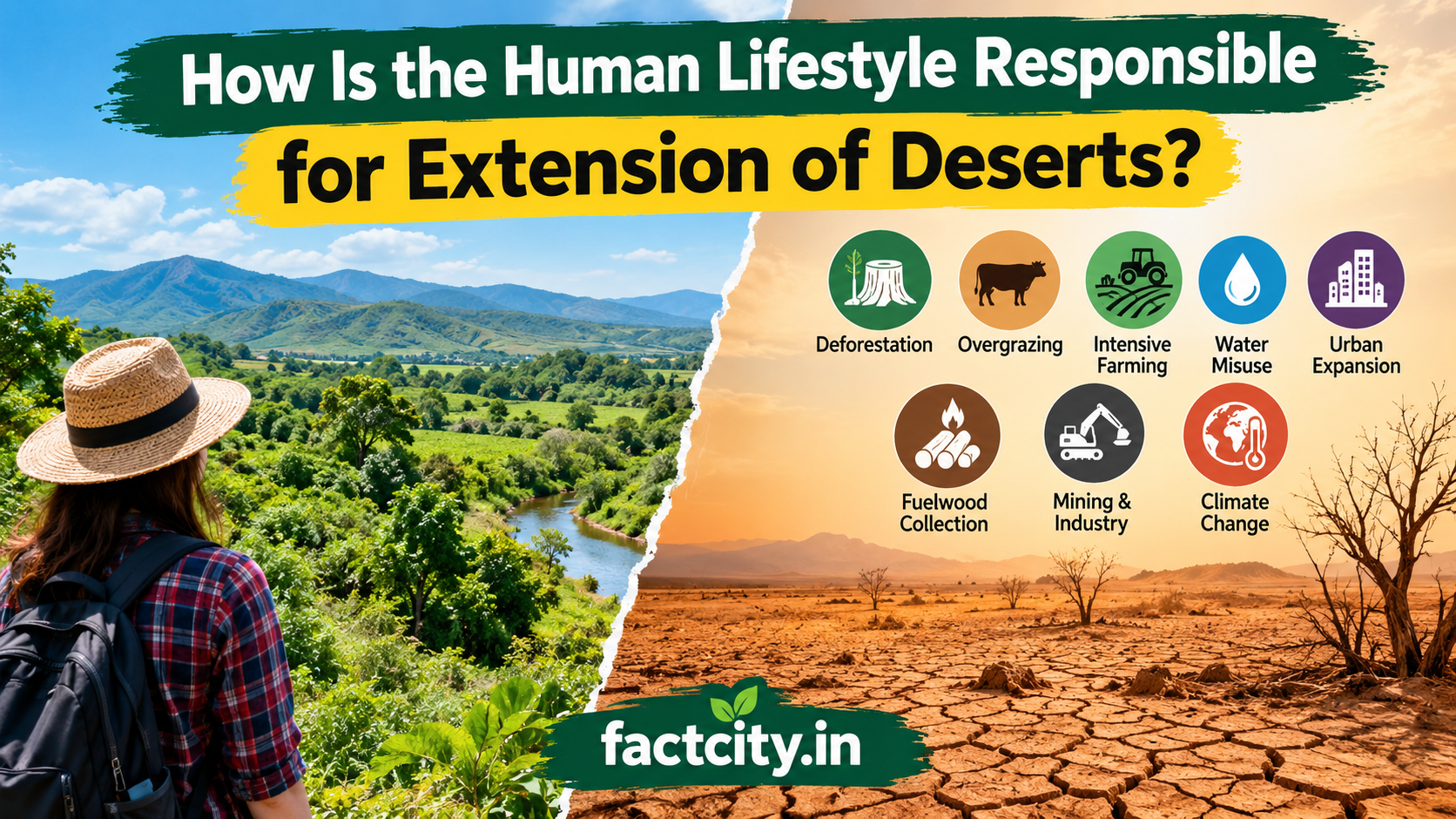
A common question is: what is the human lifestyle to blame for the desert expansion? The answer lies in how people use the land, water, forests, animals and other natural resources. Population growth, over-farming, deforestation, overgrazing, water misappropriation and unsustainable development can have a significant impact on dry and fragile ecosystems.
These links are important because desertification can affect food production, water resources, biodiversity, livelihoods and local communities.
What does it mean that deserts are extended?
Desertification does not mean that all deserts are growing physically outwards, like a moving wall of sand. It is often used to refer to land degradation and desertification, especially in dry, semi-dry and drought prone areas.
When vegetation disappears and the soil becomes degraded land can become less productive. If this continues for many years the landscape can start to look like desert conditions.
This process can be aided by natural factors, such as long periods of drought or changing patterns of rainfall. But human activity can turn a vulnerable land into a much harder place to recover. “How Is The Human Lifestyle Responsible For Extension Of Deserts“
1.Deforestation takes away natural protection
Human activity causes land degradation in several major ways, one of which is deforestation.
Trees and other plants protect the soil from being blown or washed away. Their roots help to bind the soil and the leaves and branches lessen the direct impact of rain on the ground.
The protective vegetation cover is reduced by clearing forests for agriculture, roads, buildings, fuel or other purposes. This bare soil can then be blown away by high winds or heavy rain.
This can be especially damaging in arid areas where plants may already have limited access to water. If forests and natural vegetation are not allowed to regenerate, land can become less productive over time.
2. Excessive Grazing Can Harm Grasslands
Cattle feed and earn for millions of people all over the globe. But when there are too many animals on one piece of land, they can put serious pressure on the environment.
This is called overgrazing.
If animals graze on grasses and other plants repeatedly, before the plants have had a chance to recover, the vegetation becomes thinner. Livestock can also cause soil compaction by repeatedly walking over the same areas.
Less plants to cover the ground means wind and water can carry away valuable topsoil. In the long term, the land may become less suitable for agriculture or grazing.
Sustainable grazing practices can alleviate this pressure by providing vegetation with sufficient time to regenerate.
3. Intensive Farming Can Deplete the Soil
Agriculture is essential for human beings, but farming can lead to desertification if land is overused beyond its natural capacity.
Continuous cropping without proper soil management can deplete soil fertility. Without putting nutrients back in or protecting the soil, the structure and productivity of the soil can decline as crops are continually grown.
Some farming methods also increase erosion. When natural vegetation is removed , steep or sensitive land is farmed and the soil is left exposed , it is easier for the wind and rain to wash the soil away .
Good farming techniques can help protect agricultural land. These include crop rotation, keeping the land covered with vegetation, planting trees among crops and better management of the soil.
4. Overuse of water
Water is one of the most critical resources in dry areas. Population growth, agriculture, industry and the expansion of settlements has led to increasing human demand for water.
Agriculture is a thirsty business, particularly in places where the rain is unreliable.
Water levels may fall if water is pumped from the ground faster than natural systems can replenish the water. Excessive withdrawals can also put pressure on rivers, lakes, wetlands and underground water sources.
Another problem can be poor irrigation practices. Irrigation in some dry areas without adequate drainage can cause soil salinity . Salts accumulate in the soil, making it difficult for many crops to grow .
Therefore, efficient use of water is an important element in preventing land degradation.
5. Increasing Population and Urbanisation
Population growth is not a cause of desertification in itself. The bigger problem is the increasing demand for land and natural resources.
As populations grow, communities require more homes, roads, food, energy and water. Natural areas may be transformed into the following: farmland, settlements, industrial areas or infrastructure.
Vegetation can be removed and soil disturbed in the course of development without proper environmental planning.
This can result in urban expansion indirectly leading to desertification by putting overpressure on the surrounding ecosystems.
6. Collection of Fuelwood and Vegetation Loss
In some societies wood and other plant materials continue to be important sources of energy for households.
Cutting down trees and shrubs more quickly than they can grow back naturally can result in less plant cover. This is especially problematic in dry areas where the growth of plants might be sluggish.
Fuel clearing for vegetation can leave the soil exposed to erosion. The effects can be worse if combined with grazing, drought and farming pressure.
Access to reliable and sustainable energy sources can decrease pressure on forests and natural vegetation.
7. Industrial and Mining Activities
Mining can change landscapes in profound ways. Vegetation can be cleared, soil can be excavated and the physical structure of the land can be disturbed.
Mining operations can also result in the development of roads, waste sites and other infrastructure that alters local ecosystems.
Industrial development does not cause desertification per se, but poorly managed projects can contribute to land degradation, especially in environmentally fragile dry areas.
Good land management, rehabilitation and environmental monitoring are important to reduce these impacts.
8. Drylands Under Climate Change Could Face Increased Human Pressure
Another important aspect of the discussion about the expansion of desert-like conditions is climate change.
Changes in temperature and precipitation may exacerbate water stress in naturally dry regions. Droughts that are more frequent or last longer can make it more difficult for vegetation to recover from grazing, farming or other disturbances.
Climate-related pressures can therefore interact with human activities. Land that can recover from a brief dry period might struggle to bounce back if drought hits repeatedly, all while the land is also being heavily utilised.
The implications are that desertification is rarely caused by a single factor but a combination of environmental factors and human land use pressures.
9. Bad land management worsens the problem
Many human activities are environmentally damaging when done without long term planning.
For example, farming can be sustainable if soil fertility is preserved. Grazing can be sustainable, provided the number of animals grazing is kept in balance with the land’s ability to support them. Carefully controlled withdrawals can keep water use manageable.
The problem is that natural resources are being used up faster than the ecosystems can reproduce them.
Sustainable land management aims to reconcile human needs with the environment’s ability to recover.
“Combating Desertification: How Can We Stop It?”
Some of the same human activities that contribute to land degradation can also be part of the solution.
There are a number of ways to protect vulnerable land:
- We can restore vegetation cover by planting trees and protecting them.
- Rotational grazing allows grassland to rejuvenate.
- Good irrigation means less water is wasted.
- Rainwater harvesting can enhance water supply in arid areas.
- Crop rotation can keep soil healthy.
- Agroforestry is the practice of growing trees together with crops or livestock.
- Natural ecosystems are protected by reducing deforestation.
- Degraded land restoration can help to restore vegetation and soil productivity.
- Better city planning means less destruction of natural areas.
- Sustainable farming can keep soil healthy and maintain productivity.
- Why we need to stop desertification
Desertification is not merely an environmental problem. It can also become a social and economic issue.
Farms may not produce enough food or generate enough income when agricultural land loses productivity. Water shortages impact households, agriculture, and businesses. Loss of vegetation also can reduce wildlife habitat.
In extreme cases, the degradation of the environment can lead to migration as people look for more productive land, dependable supplies of water and employment.
Protecting drylands is therefore important for both nature and people.
Summary
So how does the human lifestyle cause deserts to expand? Human lifestyles can cause desertification when natural resources are used faster than ecosystems can regenerate. The destruction of fragile landscapes may result in their gradual weakening via deforestation, overgrazing, intensive agriculture, excess water use, uncontrolled development and unsustainable resource consumption.
However, desertification is not an inevitable result of human activity. “More planning, vegetation restoration, sustainable agriculture, water conservation, responsible land management can help protect the vulnerable areas.
Ultimately, people rely on healthy land. To protect that land, we must use natural resources in a way that allows ecosystems to continue functioning for future generations.