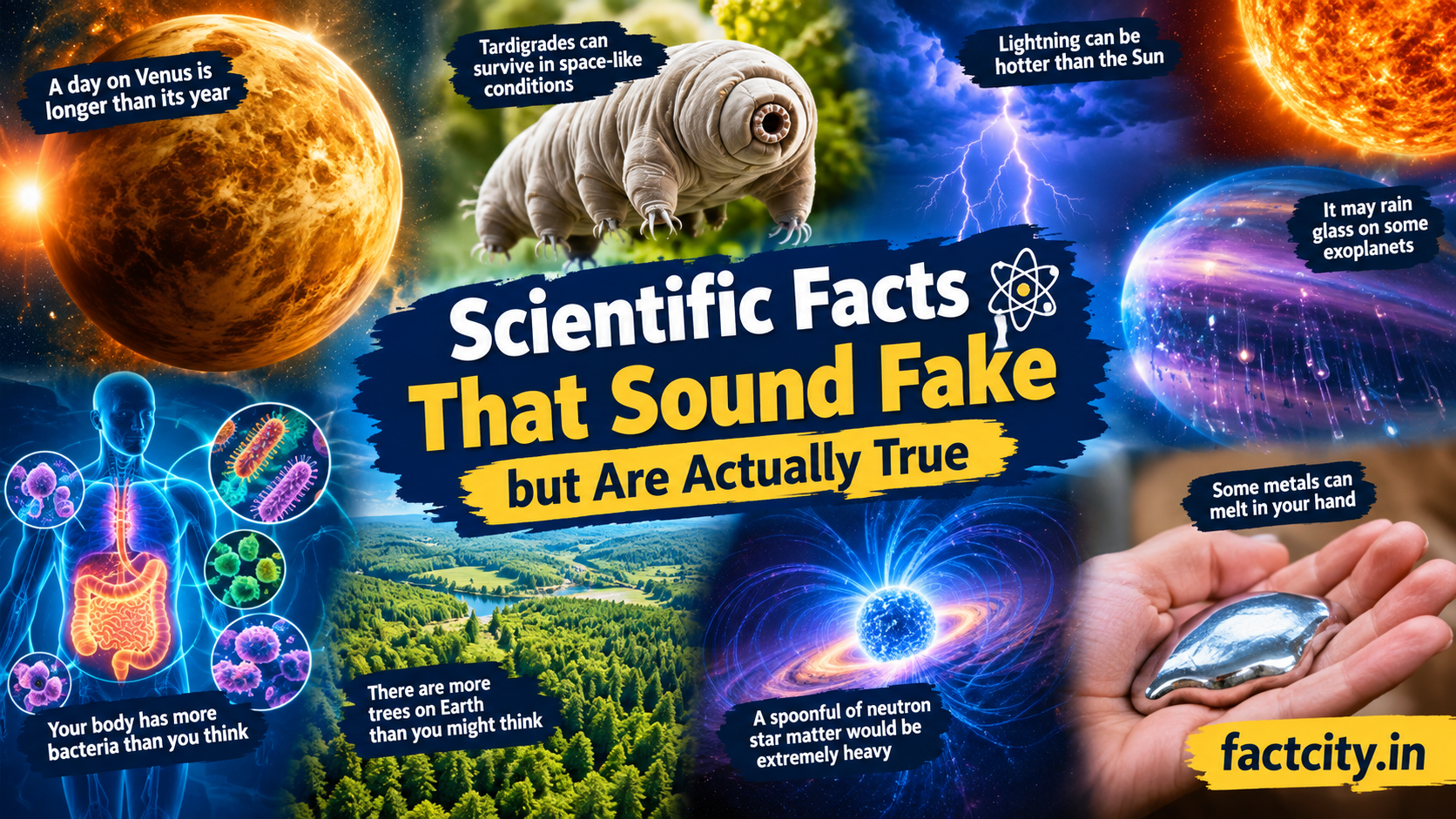
Scientific Facts That Sound Fake, Science is full of discoveries that seem too weird to be true. There are many things in the natural world that can surprise us, like animals that can live in extreme conditions and planets where it may rain diamonds. Some scientific facts sound like science fiction, but are backed by observations, experiments, and research.
If you like to learn weird facts these scientific facts that seem like they are not real are a great way to find out how amazing our universe really is. They can also remind us that real life is often weirder than fiction.
1. One day on Venus is longer than its year
Venus rotates in a very peculiar way. It takes approximately 243 Earth days to complete one rotation on its axis, and about 225 Earth days to complete one orbit around the Sun.
That means a day on Venus – measured by one full rotation – is longer than a year.
Venus also spins in the reverse direction of most of the planets in our solar system. This odd combination makes Venus one of the more interesting planets to study.” Scientific Facts That Sound Fake“
2. Certain Animals are Able to Live in Space-Like Conditions
Tardigrades, also known as water bears, are microscopic animals with an incredible ability to survive.
Tardigrades can enter a state of cryptobiosis in response to extreme environmental conditions. They can withstand conditions that would kill most other living organisms . They have a very low metabolism .
Experiments show that tardigrades can survive exposure to extreme environments including vacuum and radiation under certain conditions.
They are a great example of life’s ability to adapt in unexpected ways.”
3. Water Can Be Solid, Liquid, and Gaseous
This sounds simple, but water does some surprisingly complex things.
Under the right temperature and pressure conditions, water can exist as ice, liquid water and water vapor. There is a particular point, called the triple point, at which all three phases can coexist in equilibrium.
This is a fundamental idea in physics and chemistry and shows how changes in pressure and temperature can have a dramatic effect on matter.
4. Space Contains Clouds of Alcohol
In space there are huge clouds of gas and dust . Some of these clouds contain organic molecules .
A good example is Sagittarius B2, a giant molecular cloud near the center of the Milky Way. They’ve detected molecules such as ethanol, the kind of alcohol found in alcoholic drinks.
You couldn’t just go there and drink it, of course. The alcohol is distributed through a gigantic, very thin cloud of gas.
The detection indicates that complex molecules can exist far from the earth.
5. You Have More Bacteria in Your Body Than You Think
Billions and billions of microorganisms – bacteria, fungi and other microbes – are found in the human body. Many live on the skin and in the digestive tract.
These microorganisms are not necessarily dangerous. Indeed many play vital roles in digestion, metabolism and interaction with the immune system.
The human body is therefore more like an ecosystem than a single isolated organism.
6. Lightning is hotter than the sun’s surface
A lightning bolt can heat the air around it to about 30,000 kelvin for a very short period of time.
The surface of the Sun is about 5,500 °C.
That’s not to say lightning has more power than the sun. The Sun is enormously bigger and is always producing huge amounts of energy. Lightning just creates an incredibly high temperature in a very small area for a very short time.
That great heating makes the air expand quickly, and this produces the thunder we hear.
7. Certain Metals Melt in Your Hand
Gallium is an interesting metal . It melts at about 29.8 C ( 85.6 F ) .
Since the normal human body temperature is higher than this, a piece of gallium can start to melt when held in a warm hand.
It looks like a normal silvery metal but it has a relatively low melting point which makes it very unusual compared to metals like iron or copper.
This is one of those scientific facts that sounds like a trick but is simply a consequence of the physical properties of the metal.
8. There Are More Trees on Earth Than You Think
It is estimated that there are trillions of trees on Earth.
Researchers have used satellites, ecological surveys and computer models to estimate tree populations in forests and other environments.
However, forests are in a constant state of change due to natural events, agriculture, urban development, fires and reforestation.
The abundance of trees on the Earth emphasizes the enormous scale of terrestrial ecosystems.
9. A teaspoonful of neutron star matter would weigh a ton.
Neutron stars are super-dense remnants of some massive stars.
Their matter is crushed to incredible densities. If you could somehow get a small amount of neutron-star material to the surface of the Earth and it remained that way it would have an enormous mass.
Neutron-star matter is under extreme gravitational pressure, so the comparison is hard to picture. It cannot be picked up and carried away like ordinary things.
But neutron stars are a window on how wildly matter can behave under extreme conditions.
10. Sound Can Not Propagate Through Vacuum
Space movies always have space explosions with loud sounds. But in the real world, this would not happen in a vacuum.
Sound is a mechanical wave that needs a medium like air, water, or solid material to travel.
Since outer space is almost a vacuum, there is no typical atmosphere through which sound can travel between far-off objects.
Light, however, can travel through a vacuum . That is why we can see the far away stars, even if we could not hear them.
11. Some Plants Can Talk Using Chemical Signals
Plants do not have brains or nervous systems such as animals do, but they can still respond to their environment and communicate chemically with other organisms.
For instance, if insects attack plants, the plants can release chemical compounds into the air. These compounds may affect the plants nearby and attract the predators or parasitoids that attack the herbivores.
That is not to say plants “talk” like people. Instead, chemical signaling is one of the sophisticated tools plants use to communicate with their environment.
12. There May Be Planets That Rains Glass
Astronomers have found planets beyond our solar system that are so hot that the atmosphere is very different from anything on Earth.
One well known example is HD 189733 b, a hot Jupiter at a distance of about 64 light-years away. Its atmosphere may contain silicate particles and have extremely strong winds, researchers have suggested.
Theoretically, under such extreme conditions, particles of a glass-like substance could be blasted through the atmosphere at very high speeds.
That sounds like something out of a fictional story, but it is based on the chemistry and physics of hot exoplanet atmospheres.
13. Your Bones Are More Powerful Than They Appear
Compared with many solid substances human bones are light in weight, but they are remarkably strong.
Bone is a composite of minerals and flexible organic material. This structure can withstand compression and still have a relatively low weight.
Bones are living tissue, too. Bone is constantly being remodeled, a process where old bone is broken down and new bone formed.
That means that your skeleton is not a static structure. It is in a constant state of flux through your life.
14. Animals That Can Regenerate Missing Body Parts
Some animals have amazing powers of regeneration.
Some salamanders, for example, are able to regenerate limbs and repair damaged tissue. Some sea stars can grow back their arms and some flatworms can replace large parts of their bodies.
Humans have far less regenerative power, but we still manage to heal wounded skin, bones and other tissues.
Scientists studying animals that regenerate are finding out more about how cells talk to each other and rebuild tissue.
15. The Universe Contains Stars That Are Extremely Bigger Than Our Sun
The Sun is huge compared to Earth, but it is not one of the largest stars known.
Some giant and supergiant stars have radii that are hundred times the radius of the Sun. If a star like this were to take the place of our Sun, its outer layers could extend far beyond the orbits of the inner planets.
These giant stars also tell us that stars can be very different sizes, temperatures, colors and lifetimes.
Why Scientific Facts Seem So False
Many scientific facts seem incredible to us because man experiences so little of nature.
In our daily lives we hardly ever come into contact with neutron stars, microscopic organisms, exotic atmospheric chemistry or astronomical distances. Our brains are better at understanding familiar objects than phenomena that are extremely large, tiny, hot, cold, or distant.
Science expands our knowledge beyond the ordinary human experience.
So a fact can sound impossible, but still be perfectly consistent with the laws of physics, chemistry and biology.
Concluding thoughts
These scientific facts that sound fake are just a testament to how amazing nature can be. Venus takes longer to rotate than to orbit the sun . Tiny tardigrades can withstand extreme conditions . Lightning can get really hot . Distant planets could have really strange weather .
Science is most exciting because things that don’t sound real can still be real. Scientists can test even the strangest of ideas with careful observations, experiments, measurements and repeated evidence.