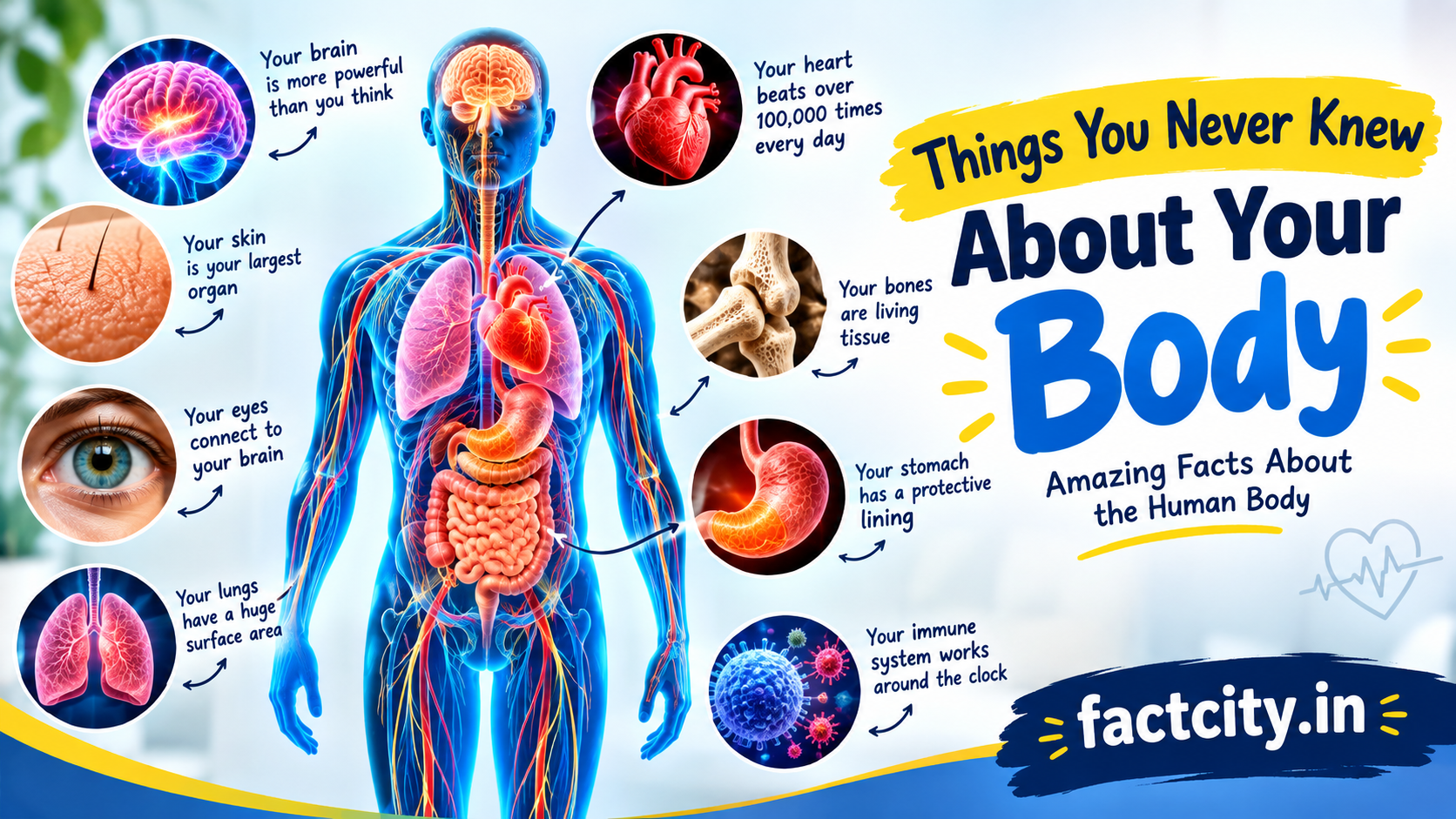
Things You Never Knew About Your Body, The human body is one of nature’s most interesting things. Every day your heart beats, your lungs breathe, your brain processes information and your cells quietly repair and replace damaged tissue. But considering that it’s always living inside us there are many things we may never pause to consider.
Your body can do so many things you didn’t know about, from surprising things your skin can do to incredible work your brain does. Knowing these facts can help you realize how complex and amazing the human body really is.
Your Body Is Made Up of Trillions of Cells
Your body is made from trillions of cells. Each cell has a special job. Some cells transport oxygen, some keep you safe from infection, others help your muscles move, or allow your brain to communicate.
Cells are continually broken down, replaced and renewed. This ongoing process enables your body to grow, heal, and maintain itself throughout life.
Your skin: your largest organ
Most people think of organs as things inside the body, but your skin is an organ as well. It is also the body’s largest organ in terms of surface area.
Your skin is a barrier that protects the inside of your body from the outside world. It helps regulate body temperature, prevents too much water loss, and contains sensory receptors which enable you to feel pressure, temperature, and pain. “Things You Never Knew About Your Body“
Your skin is always dying and being replaced . Old cells shed , and new ones replace them .
Your Brain Consumes A Lot Of Energy
Although the brain is only a small percentage of the total body weight, it uses a large proportion of the energy to run.
Your brain is working even when you are asleep. It controls breathing, regulates many automatic body functions, processes memories, interprets sensory information and helps coordinate movement.
That’s one reason why normal brain function requires adequate sleep, nutrition and hydration.
Your heart beats thousands of times a day.
Your heart is a powerful muscle that just keeps on going. It contracts and relaxes over and over to push blood around your body.
The heart’s beat drives oxygen and nutrients to the tissues and takes waste products away. Your heart, like many muscles you consciously control, normally beats on its own, thanks to electrical signals generated inside your heart.
The heart does an enormous amount of work in an average lifetime without taking a normal rest.
Your bones are living tissue.
Bones are living tissues, although they may seem hard and inactive. Blood vessels, nerves, bone-forming and bone-removing cells are all present.
Your skeleton supports and protects the major organs and helps your muscles to cause movement. Bones also store minerals like calcium and phosphorus.
Throughout life old bone tissue is removed and new bone tissue is formed. This is a normal process of bone remodeling.
Your Stomach Has a Lining to Protect It
Your stomach is full of strong digestive acids to help digest food. You may wonder why this acid doesn’t just damage the stomach itself.
The answer is the stomach’s protective lining and other defense mechanisms. The stomach makes mucus and bicarbonate, which protect its lining from the acid inside it.
The lining of the stomach is also regularly renewed, which helps to protect the barrier.
Your Eyes Are Linked to Your Brain
You do not see with your eyes alone, but the eyes cooperate with your brain. Light enters the eye and is converted into electrical signals by specialized cells in the retina. These signals are then sent to the brain via the optic nerve.
Then your brain processes that information to produce what you perceive as vision.”
Thus, seeing is not just something the eyes do. It is a co-ordinated process between the eyes, nerves and brain.
Your Nose Can Do More Than Smell
Your nose plays an important role in breathing and also smell. The nose warms, humidifies, and filters the air that comes in through the nasal passages.
Some particles might get trapped in little hairs and mucus and not go any further down the respiratory system.
Your sense of smell can also affect taste. This is why food might taste a bit bland when you have a stuffy nose.
Your Body Has Its Own Defense System
Your immune system is always at work protecting you against harmful germs and other dangers.
The immune system is a network of specialized cells, tissues, organs and chemical signals that work together to identify and respond to potential threats.
Some immune cells have a memory of past encounters with specific pathogens. If the body encounters the same threat again this memory can help it react more efficiently.
Your Blood Circulates All Over Your Body
Blood is so much more than a red liquid. It is a complex tissue consisting of red blood cells, white blood cells, platelets and plasma.
Red blood cells carry oxygen and white blood cells help to defend against infection. Platelets are part of blood clotting and plasma transports nutrients, hormones, proteins and waste products.
These parts are able to travel between different parts of the body thanks to the circulatory system.
The Surface Area of Your Lungs is Enormous
Millions of tiny air sacs, called alveoli, line your lungs. These structures have a large surface area for the oxygen to move into the blood and for the carbon dioxide to move out of.
This trade-off happens constantly as you breathe.
Normally you don’t have to think about every breath you take, because breathing is largely controlled automatically by the nervous system.
Your Muscles Are Still Working When You Don’t Exercise
When people think of muscles, they think of sports, or running, or weight lifting. However, your muscles are working all day long.
Muscles help keep the body in place, move food through parts of the digestive system, control breathing, and support countless everyday movements.
Even when you are sitting still, there are many muscles that can work hard to keep your body balanced and stable.
Your Body Temperature Is Carefully Controlled
The body works hard to maintain internal temperature within a fairly narrow range.
If you get too warm, your body can increase sweating and send more blood to your skin to help release heat. When you get cold, muscles can also contract involuntarily and quickly in a process known as shivering .
The brain is a major player in this temperature regulation, especially an area called the hypothalamus.
The body talks to itself with electrical signals.
Your nervous system uses electrical and chemical signals to send information.
These signals allow your brain to communicate with muscles and organs, and they carry information from sensory receptors back to the brain.
This communication is very fast and allows you to respond to your environment, move your body and process sensations.
Your body changes over your life
The human body is never resting. Tissues and organs are transformed from childhood to adulthood to old age.
Growth, aging, exercise, nutrition, hormones, environment and genetics are all factors that can influence how the body develops and functions.
As an adult, your body continues to repair tissues, create new cells, adjust to new conditions and respond to your daily habits.
Why It’s Important to Learn about Your Body
It’s not only interesting to learn about the human body. It can also help you understand why sleep, good nutrition, physical activity, hygiene, and regular medical care are important.
Your body does a thousand things without you even thinking about them. Understanding this complexity can help us to better care for ourselves and to notice changes that may need professional medical attention.
Summary and Conclusion
There are so many things you didn’t know about your body and science is still finding out more and more about how the human body works. Your body is an amazing biological machine. Your brain is always working, your heart is beating, your skin is renewing itself, your bones are alive, your immune system is strong.
The coolest thing is these processes happen every day and you don’t even know it. Take a moment to reflect on your body, and the simple things like breathing, eating, sleeping, moving, and healing become much more incredible.