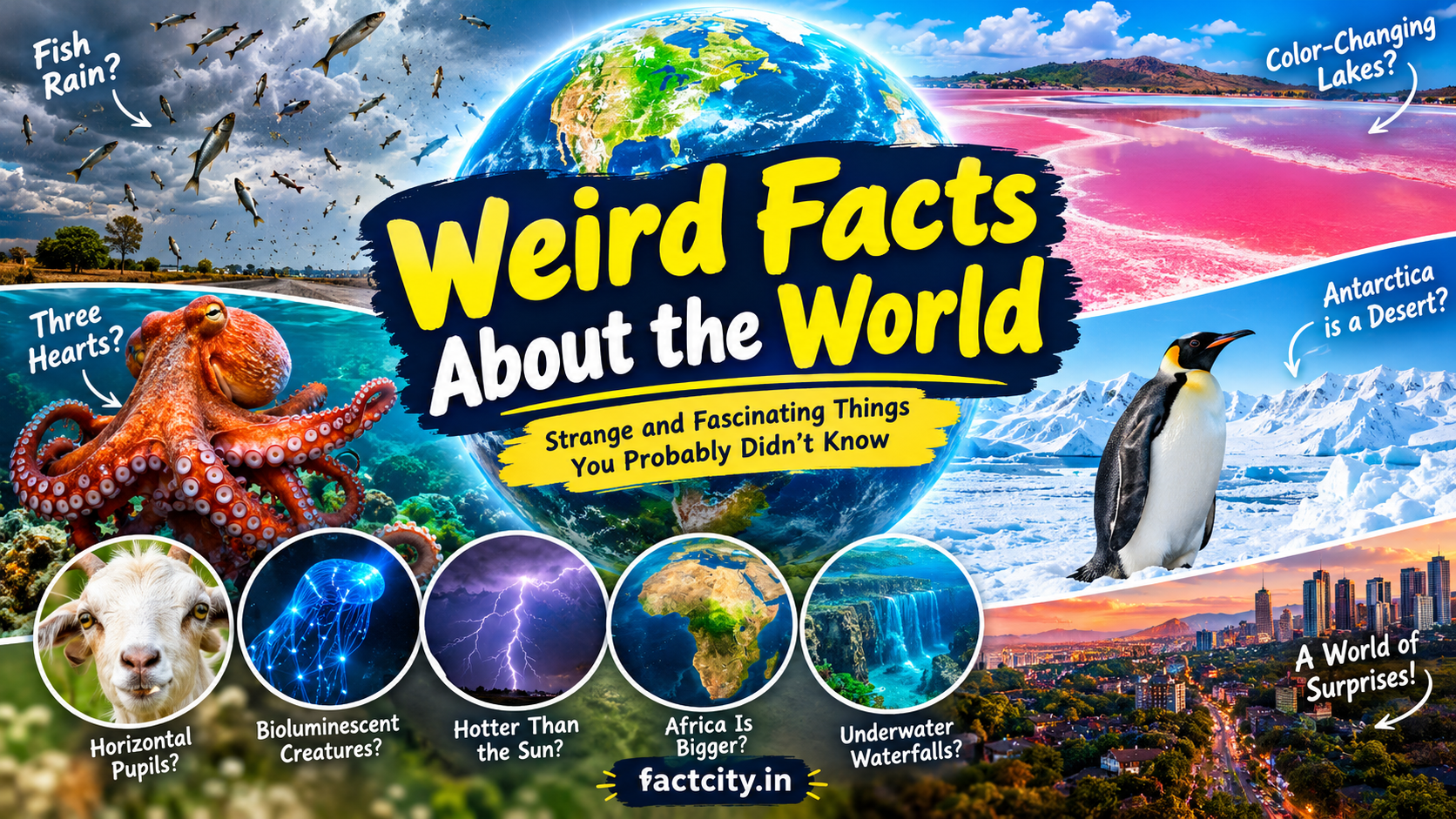
The world is full of unusual places, surprising natural phenomena, strange customs and little-known facts that can completely change the way we look at everyday life. Some facts sound incredible at first, but they are tied to real science, history, geography or human behavior.
If you love learning strange facts about the world, then this collection will take you on a journey from strange animals and mysterious natural phenomena to interesting facts about countries, oceans and the human planet.
The World Is Full Of Weird Natural Phenomena
Nature does not always work the way we expect. In various parts of the world, strange weather, geological activity and natural processes combine to produce scenes that seem almost unreal.
1. There are places where it rains fish
One of the strangest weather phenomena is called animal rain. Rarely, small animals like fish or frogs have been reported to fall from the sky.” Weird Facts About The World“
Powerful waterspouts or storms might be one explanation. Strong winds can lift small aquatic animals living in lakes or shallow water and blow them some distance before dropping them when the storm dies down.
This phenomenon is reported in different parts of the world, although it is extremely rare.
2. Some lakes may seem to change their colors.
There are some lakes around the world that can show strange colors, due to minerals, microorganisms, algae, temperature and other environmental conditions.
For example, very salty or mineral-rich lakes can appear pink, red, green, or even orange in some conditions. Its color changes according to the sunlight, the chemistry of the water and the organisms that live in it.
It is a fascinating reminder of how nature can generate colors without artificial dyes or human technology.
3. Lightning Is Hotter Than the Surface of the Sun
Lightning is one of the most powerful natural electrical occurrences on earth. The air around a lightning channel can become very hot, but only for a very short time.
The temperature of a lightning channel can reach about 30,000 kelvin , many times hotter than the surface of the Sun .
This great heat expands the air around it very quickly. That rapid expansion produces the sound we call thunder.
So the next time you see lightning in a storm, remember that a brief electrical flash can create some exceptional temperatures.
4. Antarctica Is Actually a Desert
Desert. The word usually conjures images of hot sand, high temperatures and barren land.
But technically a desert is defined by very low precipitation not by high temperature .
Most of the interior of Antarctica is very dry with little snow or rain and is the world’s largest desert.
It has huge amounts of ice covering it . That does not make it a desert .
5. Some plants can talk to each other
Plants look quiet and still, but the underground ecosystems can be surprisingly active.
Many plants have relationships with fungi in the soil. These fungal networks can link plant roots, and help to shuttle nutrients, and chemical signals around the ecosystem.
Scientists are still researching how plants communicate and respond to environmental threats. Descriptions of plants ‘talking’ are so easy to get carried away with in the popular notion. The biological interactions are actually quite interesting.
Curious facts about animals
Some of the world’s weirdest facts come from the animal kingdom. From odd survival skills to weird body shapes, animals have come up with solutions that seem almost impossible.
6. Octopuses have three hearts;
Octopuses have three hearts.
Two hearts pump blood through the gills, and a third heart pumps oxygenated blood around the rest of the body.
Even more interesting is that the main heart stops beating temporarily while the octopus swims. One reason is that octopuses often prefer to crawl along the ocean floor instead of swimming continuously.
7. The cow’s vision is almost 360 degrees
Cows have their eyes on the sides of their heads, which gives them a very wide field of vision.
This arrangement allows them to pick up possible predators while they are feeding. They see very differently from us – in ways that are suited to the needs of grazing animals for survival.
8. Some Turtles Can Breathe Through Their Butts
Some species of turtles have a wonderful adaptation called cloacal respiration.
This allows them to take up oxygen from water through special tissues near the cloaca. It may allow some turtles to remain underwater for longer periods of time, particularly when it’s cold and their metabolism slows down.
It’s strange but it’s a real biological adaptation.
9. Weird Goats on Pupils
Goats have horizontal, rectangular pupils.
Their strange eye structure gives them a broad field of view, which can be useful for spotting predators while they are grazing.
A great example of the close connection between an animal’s physical characteristics and its environment and lifestyle is its eyes.
Weird Ocean Facts
The oceans cover most of the Earth’s surface, but much of it is unexplored. Scientists continue to find strange life forms and geological features under the waves.
10. The deep ocean can be black as pitch
Sunlight never penetrates the deepest parts of the ocean.
Sunlight is very weak in nature and eventually fizzles out below certain depths. One of the most fascinating adaptations of animals living in these environments is bioluminescence.
Bioluminescent creatures are able to produce light through chemical reactions. They use it to lure prey, to communicate, to confuse predators or to find potential mates.
11. Underwater waterfalls exist
Underwater waterfalls? Sounds impossible. But they can happen due to differences in the density of water.
Cold , salty , or sediment – laden water can be heavier than other water around it , and flow downhill along the ocean floor . Some of these movements look like waterfalls when seen over underwater geologic formations.
The most prominent examples have to do with deep ocean circulation.
weird facts about countries & geography
In the geography of Earth there are many surprises that can challenge what we normally learn from maps.
12. Russia Spread Across Several Time Zones
Russia is a very big country. It has 11 time zones.
The country is so vast from west to east that the local time can vary greatly from one region to another.
This makes Russia one of the largest countries in the world by geographical coverage.
13. Africa is larger than it looks on many maps
It is hard to make a flat map of a round earth . Because of this , common world maps can make countries and continents look bigger or smaller than they should .
Africa is hit hard by this visual misinterpretation. Some countries that are closer to the poles appear disproportionately large when placed on some map projections compared with regions near the equator.
And this is why sometimes a globe can give a better feel for relative land size.
14. There Are Places Where Four Countries Nearly Touch
Bizarre geographic situations can arise from countries’ borders. One of the well-known examples is the region surrounding the borders of Botswana, Namibia, Zambia and Zimbabwe.
The location of these boundaries has been of considerable geographic interest, since the two countries come very near to meeting at one point.
International borders are not always simple lines on a map; rivers, historical agreements, and changing political boundaries can make them surprisingly complex.
Weird Facts About the Human World
Humans have invented many bizarre traditions, buildings, languages and systems.
15. There Are Thousands Languages
There are thousands of different languages spoken by people around the world.
Some have millions, even billions of speakers . Others are spoken by fairly small communities .
Languages can change a lot over time as people move around, interact and invent new words and expressions. With the death of their last speakers, some languages have died out.
That is what makes language one of the most interesting aspects of human culture.
16. Some Cities Have Worlds Below Them
Big cities often have huge underground areas – tunnels, transport networks, shops, storage facilities and historic buildings.
These underground places were built with various purposes like transportation, protection from harsh weather, mining or deficiency of space on the surface.
In some places, there are whole second worlds under the streets that millions of people walk over every day.
Why Do We Find Strange Facts About the World So Interesting?
Weird facts are not just fun trivia. They can help us to understand how varied and complex our planet really is.
Evolution is how a weird animal adaptation can show . A strange geographical feature can reveal Earth’s history. A bizarre weather event can serve as an example of the power of atmospheric science.
Most interesting facts invite us to ask another question: Why is this happening?
That’s the curiosity that makes learning enjoyable.
Last Thoughts
The world is a much stranger and more interesting place than it appears to be in everyday life. Our planet is full of surprises, from three-hearted octopuses and strange breathing turtles to deserts covered with ice and mysterious deep-ocean worlds.
These weird facts about the world prove that the truth is sometimes stranger than fiction. If you like science, geography, animals, nature, history or human culture, there is always something new to find out.