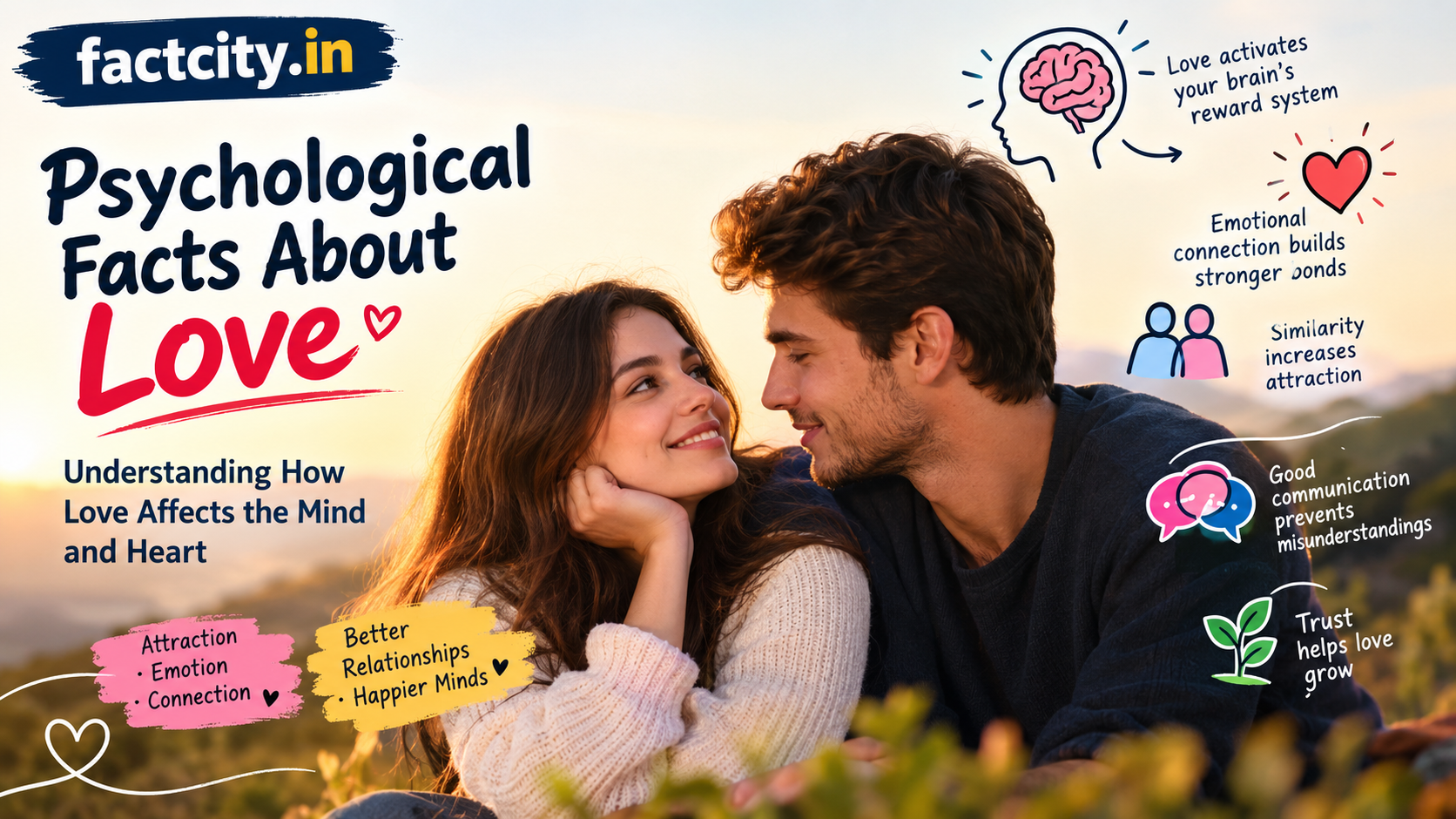
Psychological Facts About Love, Love is one of the most powerful, and fascinating of human experiences. It can make us feel happy, excited, safe, connected and sometimes even confused. In poems, songs, movies and stories there is often talk about love, but psychology has a lot to say about what happens when people fall in love.
Love has many fun psychological facts that explain why we are attracted to some people, why we can’t stop thinking about someone, why relationships can change our moods, and why emotional connection is so important.
Love is not only a feeling. It includes thoughts, memories, behavior, hormones, attachment, expectations, social experiences. Everyone feels love differently but there are some common psychological patterns.
In this article, we will take a look at some interesting psychological facts about love and what they can tell us about human relationships.
1. Love Can Strongly Impact Your Attention
When someone becomes important to you, it’s natural for your mind to pay more attention to them.
You might notice small things about their personality, recall things they said weeks ago, or pick up their name in a discussion easily. That is, our brains pay more attention to people who matter emotionally to us. “Psychological Facts About Love“
This is one reason why someone you love can appear to pop into your thoughts over and over. Your brain has learned that this person is important for you.
2. When You’re Falling in Love, You Think About Them All the Time
One of the most recognizable experiences of being attracted to someone romantically is thinking a lot about that person.
What they are doing, remember your last conversation, imagine your next meeting, replay a special moment in your mind.
That doesn’t necessarily mean that something is wrong. Strong emotional experiences are naturally attention-getting.” In the beginning of romantic attraction, thoughts about the person may come with special regularity because the relationship seems new, exciting and emotionally satisfying.
3. Physical appearance isn’t everything in terms of attraction
Of course, physical appearance is a factor in attraction, but psychology teaches us that attraction is far more complex.
Attraction may be a function of personality, kindness, confidence, humor, communication style, shared interests, values, proximity, and emotional compatibility.
“Knowing more about their personality can make someone more attractive to you. Similarly, an individual who looks good on paper could be less attractive if their behavior conflicts with your values.
This shows that attraction can be created through experiences and is not based on looks alone.
4. Building an Emotional Connection Can Strengthen Your Relationship
A solid relationship is often more than just physical attraction. Emotional connection is what makes people feel understood, respected, supported and accepted.
Freely talking about feelings can give partners a sense of security with each other. It’s the little things like truly listening, remembering the important things, being there for the tough times or just spending quality time together that over time add up to strengthen the emotional connection.
Love is often born from repeated experiences of trust and understanding.
5. The Brain Is Part of Romantic Love
Romantic experiences may seem mysterious, but love is really about the brain.
There are several brain systems and chemical messengers involved when people feel attraction and emotional bonding. Dopamine is associated with reward and motivation and oxytocin is associated with social bonding and attachment.
These biological processes do not fully explain love, as human relationships also involve memories, beliefs, experiences, culture and personal choice. But they do provide a glimpse of why love can seem so powerful.
6. Shared Experiences Can Bring People Closer
People tend to get closer when they have meaningful moments together.
Traveling, solving problems, celebrating achievements or supporting each other through stressful periods may help a couple to develop a stronger bond or simply create everyday memories.
Shared experiences make stories that are theirs, together. Over time, these memories can be woven into the fabric of the relationship’s identity.
7. Familiarity Can Affect Attraction
Repeated exposure to things and people often leads to greater comfort. Psychologists sometimes call this the mere-exposure effect.
Repeated exposure does not mean someone will be romantically attracted to you, but it can make someone feel more familiar and comfortable.
This could be why people sometimes develop feelings for someone they see all the time at school, at work, at social events or in their community.
8. Similarity Might Matter in Romantic Relationships
People don’t have to be alike to fall in love but similarities can make some relationships easier to develop.
Common ground can be shared values , interests , goals , communication styles or lifestyles . Couples with some similar interests also may have more opportunities to spend quality time together.
At the same time, it is possible for people with different personalities and interests to have healthy relationships. Compatibility isn’t about being the same.
9. Healthy Love Is Trustful
Trust is one of the pillars of a stable relationship.
Trust can help people feel more comfortable with honest communication, with vulnerability. Trust is built through consistent action.
Trust is built by keeping promises, respecting boundaries, telling the truth, and being reliable.
Trust is not built on words alone. It is usually developed through repetition of actions over time.
10. love can change your mood
Being in a romantic relationship can affect your emotional health.
A supportive relationship may offer companionship, encouragement, affection and a sense of belonging. Positive interactions can foster feelings of happiness and emotional security.
However, relationships can also include conflict, uncertainty, jealousy, disappointment or stress. This is the reason why love doesn’t necessarily mean feeling happy all the time.
Healthy relationships make room for good feelings and tough conversations.
11. People Often Remember Emotional Moments Vividly
Emotionally meaningful experiences can stay with us for a long time.
Maybe you remember where you were the first time you met someone important, the details of a special date, a conversation that meant something, or a time when someone was there for you.
Strong emotions make experiences especially memorable. One reason for this is that memories of relationships can stay meaningful for years.
12. Physical Touch Can Help Establish Emotional Connections
Physical touch that is welcomed by both people can help foster feelings of closeness.
Affectionate touch such as holding hands, hugging and cuddling can convey warmth and reassurance without a lot of words.
But remember, physical affection needs to be consensual and comfortable for both parties. People are different in what they like in physical touch, and respecting that boundary is a key part of a healthy relationship.
13. Communication Is More Important Than Mind Reading
It is a common misconception about love that if two people love each other they should know what the other person is thinking.
Even close partners can misjudge each other in practice.
Open communication allows people to voice their expectations, concerns, needs, and feelings. So many unnecessary conflicts can be avoided by asking questions instead of assuming.
Love does not remove misunderstandings. And good communication helps people work through them.
14. Love Could Be Influenced By Attachment Styles
Attachment is the emotional ties people develop with significant others.
Psychologists often talk about different attachment styles, including secure and insecure styles. These patterns can affect how people respond to closeness, conflict, reassurance and separation.
But attachment isn’t a label that forever defines a person’s future relationship. With experience and self-awareness, people learn to communicate and relate to each other in healthier ways.
Understanding attachment helps people to understand why they may react strongly in certain situations within relationships.
15. You Don’t Have to Agree on Everything to Be in Love
Healthy couples can have disagreements.
Partners can disagree about money, hobbies, family traditions, work, social activities, or even daily routines. Disagreement doesn’t automatically mean a relationship is unhealthy.
The point is how we handle disagreements.
Couples can learn to handle differences constructively through respectful communication, listening, compromise and avoiding personal attacks.
16. The Little Things Are Big
In relationships those big grand romantic gestures can be memorable, but it’s often the everyday kindness that matters.
You can show you care by making someone a cup of tea, asking how their day has been, helping with a hard task, remembering an important occasion or offering emotional support.
These small behaviors can build repeated positive experiences and reinforce a sense of partnership.
17. Some People May Worship Someone in the Early Stages of Love
Sometimes people can overlook the negative traits of a person due to early romantic feeling.
People can get so excited about a new relationship that they focus more on the strengths and ignore the weaknesses. As the relationship progresses they usually learn more about the whole personality of the person.
This is a normal change. Long-term love means accepting that another person has strengths and imperfections.
18. Love Evolves Over Time
Love is not just one emotion that stays the same in a relationship.
The excitement of a new relationship can grow into a deeper companionship, trust, familiarity and commitment.
That does not mean that a relationship is less meaningful if the emotional experience changes. Different kinds of intimacy and connection characterize long-term relationships.
19. The Power of Feeling Understood
People tend to love relationships where they are heard and understood.
When a person listens to you without judging you or dismissing your feelings immediately, it creates emotional safety.
Understanding does not mean agreeing with everything someone says. It can just be trying to see things from their point of view.
This is an important part of emotional closeness.
20. Healthy Love Leaves Room for Individuality
Falling in love does not mean losing yourself.
Healthy relationships respect the need of partners to have friendships, hobbies, personal goals, interests and time for themselves.
It’s important to spend time together, but personal independence can also make a relationship balanced.
You don’t have to do everything together in a strong partnership.” It can also mean supporting each other’s individualities.
21. Jealousy Is a Complicated Emotion
There are many different reasons that jealousy may arise in romantic relationships, such as insecurity, fear of losing someone, past experiences, or uncertainty.
Being jealous doesn’t automatically mean that someone is hopelessly in love. Jealousy, too, does not show commitment.
What counts is how you react to the emotion. “You’re better off with open communication and healthy boundaries than controlling behavior.”
22. Love and Respect Must Go Together
Love by itself does not make a healthy relationship.
Respect means respecting the boundaries, opinions, choices, time and individuality of the other person.
Someone can love someone and need to learn better communication or conflict-management skills. Both an emotional connection and respectful behavior are often the support systems of strong relationships.
23. Loneliness and love are not the same
Being in a relationship doesn’t mean it automatically keeps loneliness at bay.
You might be together for a long time, but if you don’t feel emotionally connected or understood, you can still feel lonely.
Hence the importance of real communication and emotional presence. Sometimes, the quality of the connection is more important than physical proximity.
24. Love That Lasts Usually Has Commitment
Romantic feelings can arise naturally but it generally takes choices and actions to sustain a relationship.
Commitment might be honesty in communication, helping each other, respecting boundaries, working through issues, and making time for the relationship.
So long-term love isn’t just about how people feel. You can see it in the way they always treat each other too.
Why You Need To Know The Psychology Of Love
Understanding the psychology of love can help us learn more about ourselves and our relationship patterns.
It can tell us why we get attached, why some memories are powerful, why communication matters, and why relationships can be difficult.
At the same time, psychological facts should not serve to reduce love to a simple formula. Every relationship is influenced by personal personality, culture, life experiences, expectations and circumstances.
There is no one rule that applies to all couples.
Conclusion: Psychological Facts about Love
The most interesting psychological facts about love prove that love is much more than just feeling attracted to someone. It’s about the brain, feelings, memories, attachment, communication, trust, behavior and shared experiences.
Falling in love may begin with attraction or curiosity, but lasting relationships are usually about how people communicate, respect each other, handle disagreements, and provide emotional support.
Love can bring excitement and meaning to life, but to be healthy it also needs understanding, boundaries, honesty and mutual respect.
The better we understand the psychology of love, the easier it can be for us to identify our feelings and build relationships based on genuine connection rather than unrealistic expectations.