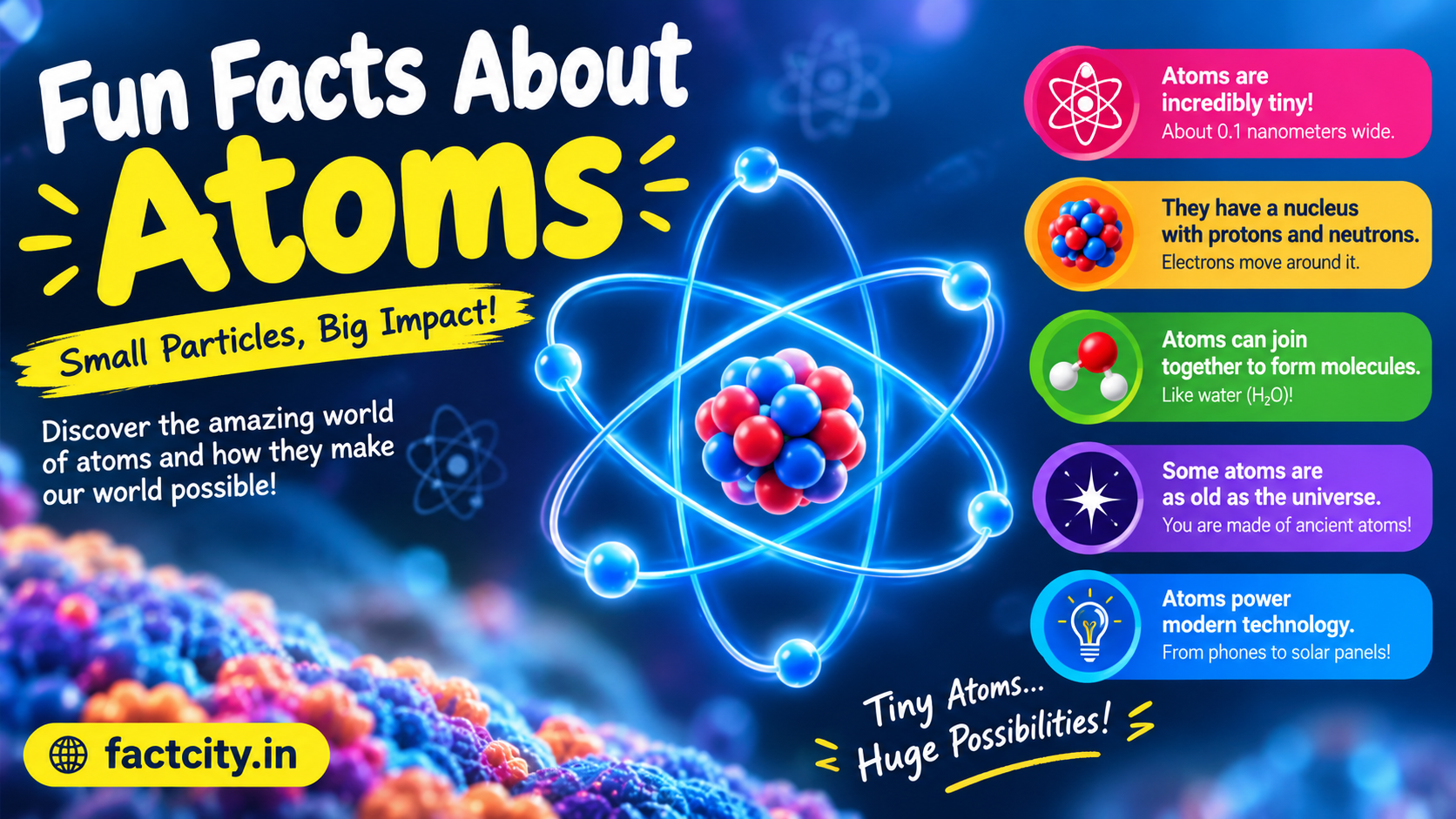
Fun Facts About Atoms: Atoms are all around. The air you breathe, the water you drink, the food you eat, your phone, your home, and even your own body are made up of atoms. Atoms are unbelievably small, yet they are the building blocks of all the matter that we see and touch around us.
Learning about atoms can make science a lot more fun, because these little building blocks have some surprisingly interesting properties. In this article, we will discuss some fun facts about atoms and discover why these microscopic particles are so important.
What Is an Atom?
An atom is the smallest particle of an element that maintains the chemical properties of the element. We are surrounded by matter, and matter consists of atoms. Atoms consist of three primary types of subatomic particles:
- Protons have a positive charge.
- Neutrons carry no electric charge.
- Electrons carry a negative electric charge.
The protons and neutrons are inside the nucleus of the atom. The electrons are in regions around the nucleus. Which element an atom belongs to is determined by the number of protons. For example, every hydrogen atom contains one proton and every carbon atom contains six protons.
Atoms are incredibly small
The size of atoms is one of the most amazing facts about them. A typical atom is about one-tenth of a nanometre across, but atoms do vary in size depending on the element. To give you an idea of how small an atom is, think of a single strand of human hair. That hair could be the width of millions of atoms. Normal microscopes can not see atoms because they are far too small. With sophisticated instruments and indirect methods, scientists study their structures and behaviour.
Atoms Make Up Almost Everything
Your body is composed of atoms. So is your desk, your computer, the ground beneath your feet and the air around you. Atoms combine in different ways to form molecules and compounds. For example, water consists of hydrogen and oxygen atoms. The human body is composed of important elements such as carbon, hydrogen, oxygen, nitrogen, calcium, and many others. This means that the world around us is just a big collection of atoms, arranged in a variety of different ways.
Atoms Are Mostly Empty Space
This may sound odd, but most of an atom is empty space. The nucleus is very small compared to the size of an atom. Electrons do not sit in a solid shell like the surface of a tiny ball but rather in regions around the nucleus. If the atom were very large, the nucleus would still be a small part of the whole volume. The rest would be almost empty space. This is why the microscopic world is so different from the world we see in our daily life.
The Nucleus Accounts for Most of an Atom’s Mass
The nucleus is very small, but it contains almost all of the mass of an atom. That’s because protons and neutrons are much heavier than electrons. The nucleus is made up of tightly packed protons and neutrons, while electrons are tiny in mass compared to them. The strong nuclear force is one of the basic forces of nature that holds the nucleus together.
Atoms Can Form Bonds
Atoms are not always independent things. They can bond with other atoms to make molecules and compounds. For example, a water molecule, H₂O, is formed when two hydrogen atoms combine with one oxygen atom. Atoms can combine in different combinations, forming different types of chemical bonds. There are many combinations. These combinations result in the wide variety of materials and substances that we find in nature. From salt and sugar to proteins and plastics, everything owes its existence to the chemical bonding between atoms.
There are many different factors
More than 100 chemical elements have been found by scientists. The number of protons varies from element to element. Hydrogen has the fewest protons: one. Heavier elements can have many more protons and neutrons. Scientists arrange elements in the periodic table to help them understand the pattern of their chemical and physical properties. The periodic table is so much more than a list of elements. It is a useful chart of the building blocks of matter.
Atoms Can Lose or Acquire Electrons
Electrons can be gained or lost by atoms. This turns them into electrically charged particles called ions. An atom loses electrons and becomes positively charged. If it picks up electrons, it becomes negatively charged. Ions play a significant role in numerous chemical and biological processes. They also play a role in batteries, electrical systems, nerve signals, and the chemistry of living organisms.
Atoms Can Have Different Versions Called Isotopes
The atoms of any one element always have the same number of protons, but they may have different numbers of neutrons. These various forms are called isotopes. For example, carbon is often present in the form of carbon-12 and carbon-14. Both are carbon because they both have six protons, but different numbers of neutrons.
Some isotopes are stable, while others are radioactive and change over time.
Certain Atoms Are Radioactive
Some atomic nuclei are unstable. They can emit radiation in their conversion to more stable forms.
This process is known as radioactive decay.
Radioactive atoms are very useful for many applications. They are used in applications such as medical diagnosis, cancer therapy, scientific research, archaeology, and power production. Radioactivity is a natural phenomenon, but when radiation levels are high, it has to be handled with care.
Atoms are always in motion
While atoms may appear as stationary objects in diagrams, matter on the atomic level is not entirely still. Atoms and molecules move differently depending on the environment and the temperature. Particles in gases tend to move around freely. In liquids, they flow past one another. Particles in solids typically vibrate about fixed points. In general, as the temperature increases, the average motion of the particles also increases.
Atoms Can Absorb and Emit Energy
Atoms can be in different energy states. If an atom has absorbed the right amount of energy, an electron may be raised to a higher energy state. When the electron falls back down to a lower energy state, the atom can lose some energy, sometimes in the form of light . This is one reason why different elements can produce characteristic colours in flames, lamps and other scientific experiments. Astronomers can also analyse the light from stars to find out what elements they contain.
You Are Made of Old Atoms
One of the most interesting fun facts about atoms is that many of the atoms in your body have been around for a really long time. Atoms are not created for any individual person. The atoms that form your body have been through many natural processes before they became part of you. Some of these elements were produced in the early universe, but many of the heavier elements were produced in processes taking place within stars and during stellar explosions.
The atoms that make up our bodies are part of a much bigger cosmic story in a way.
Atoms Aren’t the Smallest Things We Know
People considered atoms to be the last indivisible fragments of matter for a long time. Modern science has shown that atoms themselves are made up of smaller particles. Protons and neutrons are made of even smaller particles called quarks. Electrons are members of a different family of elementary particles called leptons. So the word “atom” does not mean that scientists have arrived at the smallest possible level of nature.
Scientists Can’t See Atoms Like Ordinary Objects
When people say scientists have “seen” atoms, they don’t mean scientists just looked at them with a normal optical microscope. Visible light has a wavelength much larger than an atom. So scientists use sophisticated instruments and techniques to study and map the structure of atoms. Certain technologies can produce detailed images or representations of single atoms and surfaces at very small scales.
Atoms Power Modern Technology
Atoms and electrons are the foundation of modern technology. Our grasp of matter at very small scales is the foundation for computers, smartphones, solar panels, lasers, medical imaging devices, and many other technologies. So, the study of atoms has changed not only science but also daily life. interesting-historical-facts-you-probably-never-knew
Why are atoms so important?
Atoms are important because they are the building blocks of normal matter. Atoms are the building blocks of matter. Learning about atoms helps scientists learn more about chemistry, physics, biology, material science, astronomy, etc.
Atomic science has resulted in the creation of medicines, advanced materials, energy technologies, electronic devices, and tools to explore the universe. The behaviour of atoms is interesting even in something as simple as a glass of water.
Fun Facts About Atoms: Final Thoughts
Atoms are too tiny to be seen with our eyes, but they have a huge impact on our world. They bond together to make molecules, to make new elements, to react with energy, to participate in the chemical reactions that make life possible.
From the tiny particles inside an atom to the ancient atoms travelling around the universe, there’s something interesting at just about every level.
These fun facts about atoms prove science is so much more interesting when we look beyond what we can see. So next time you grab an object, drink water, or simply take a breath, remember that you are engaging with a world made of unimaginably tiny and fascinating building blocks.
Fast Atom Facts
- Atoms constitute ordinary matter.
- Protons have a positive charge
- Electrons are negatively charged.
- Neutrons carry no electrical charge.
- Protons and neutrons make up the nucleus
- Atoms are very, very small.
- The majority of an atom’s volume is empty space.
- An element is defined by the number of its protons.
- Atoms can join together to make molecules.
- Isotopes are different versions of an element.
- Some isotopes are radioactive
- Atomic behaviour is important in modern technology.
- Many of the atoms in our bodies have long cosmic histories.