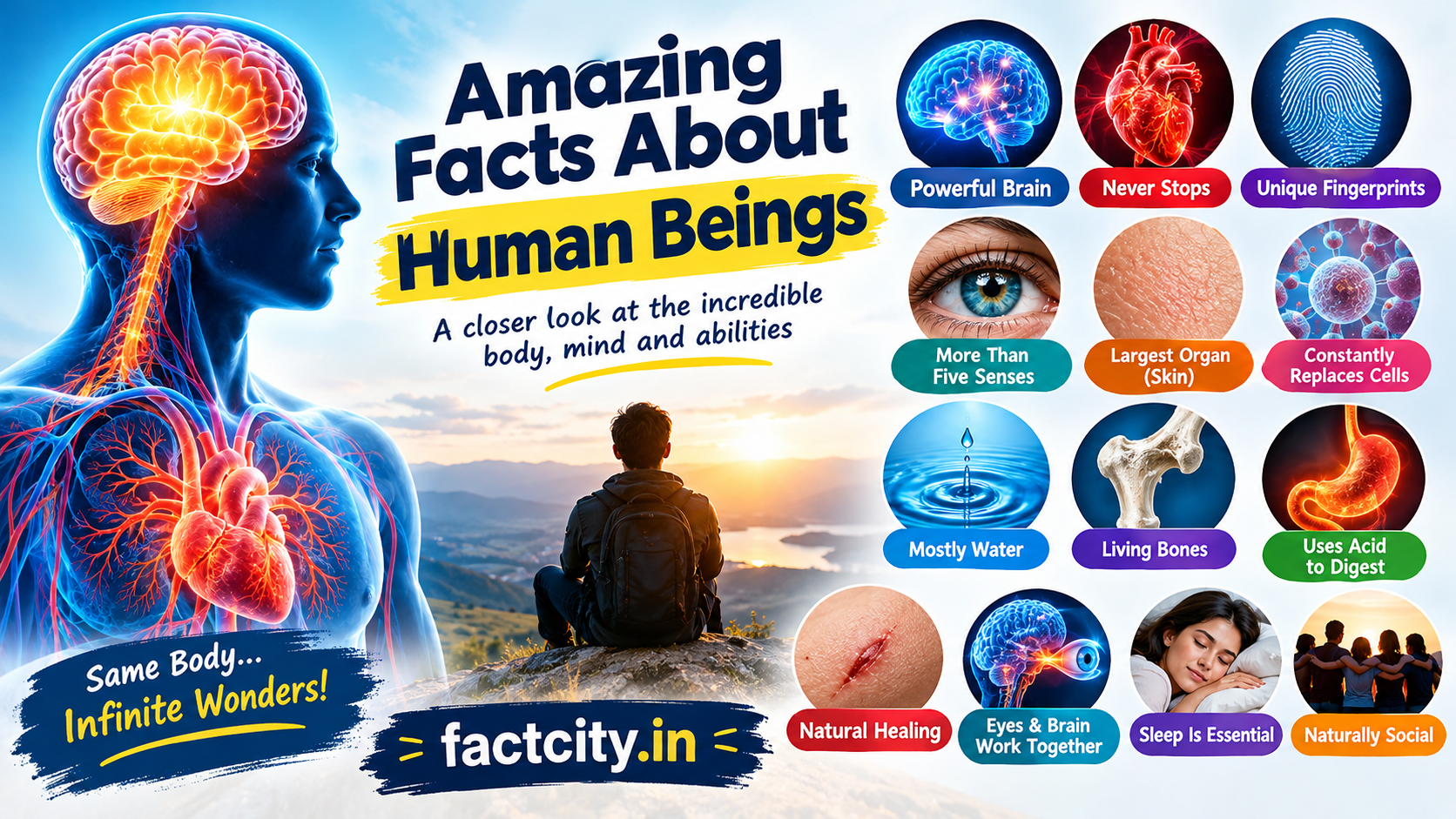
Some Facts About Humans: Humans are one of the most interesting living beings on Earth. The human body and mind work together in so many ways that it is hard to imagine. Every day, our bodies do thousands of things without us having to think about them. We breathe, we digest food, we think, we remember things, we move, we heal injuries. We react to the world around us almost automatically. There are so many interesting facts about humans that can make us appreciate just how unique and complicated we really are.
The Human Brain is Remarkably Strong
One of the most amazing things about human beings is the ability of the human brain. The brain controls almost all important activities in the body, including movement, breathing, emotions, memory, learning, and decision-making. It has billions of neurons. They communicate with each other through electrical and chemical signals. Your brain never sleeps. It still regulates critical bodily functions, processes information, and interacts with memories. The brain is also responsible for many of the characteristics that make humans different from other species, such as complex language, creativity, problem-solving, and abstract thinking. “Some Facts About Humans“
The Human Heart Never Takes a Break
Another amazing thing about the human body is the heart. It works throughout life by pumping blood to the various parts of the body. Blood transports oxygen and nutrients to cells and assists in removing waste products from tissues. The heart has its own electrical system to help control its rhythm so you don’t have to think about it when it beats. Your heart keeps working constantly whether you’re sleeping, walking, studying, or working out. This simple-looking organ is vital to supplying almost every part of the body with what it needs.
Fingerprints Are Unique For All Humans
Another fascinating feature of our bodies is human fingerprints. The patterns on the fingertips of each person are different, and even twins do not have exactly the same fingerprints. These patterns emerge before birth and typically stay the same throughout a person’s life. One reason why fingerprinting has been used for identification for many years is their uniqueness. Fingerprints may appear to be simple lines and curves, but their individual patterns are remarkably unique.
Humans Have More Than 5 Senses
We are taught that humans have 5 basic senses. These are sight, hearing, smell, taste, and touch. But the human body can actually feel much more than these traditional five. For example, proprioception allows you to know where your arms and legs are without looking at them. Your balance system tells you whether you are standing, moving, or turning. Humans can also sense temperature, pressure, pain, and changes inside the body. These different senses are always working together to help us make sense of our surroundings and control our movements.
Skin: The Body’s Biggest Organ
The skin is much more than the body’s outer covering. It is the largest organ and performs several important functions. It creates a barrier between the body and the external environment that aids in reducing water loss and protects underlying tissues. Our skin contains many sensory receptors that allow us to feel touch, pressure, heat, cold, and pain. The skin is also important in regulating body temperature. When the body gets hot, it loses heat by sweating and changes in blood flow.
All the time your body is replacing cells.
The human body is constantly changing, even if we can’t see it. Old cells are constantly eliminated and replaced by new cells in many parts of the body. A good example is the skin, where old skin cells slowly slough off, and new skin cells grow underneath. And this happens in other tissues as well. This constant renewal is an important part of maintaining the body in its normal structure and functions. It means that the human body is not a static entity, but a living system that is constantly repairing and maintaining itself.
Water makes up a large part of the human body.
Water is essential for human life. Water constitutes a large part of the human body, but the amount varies from person to person. Water aids in nutrient transport, temperature regulation, chemical reactions, and waste removal. It also has an important role in the normal functioning of cells. Keeping well hydrated is an important part of supporting normal health and everyday physical function, as so many processes in the body rely on water.
Human bones are living tissue.
Bones may seem hard and lifeless, but they are living tissues. They contain blood vessels, nerves and specialised cells that constantly maintain and remodel bone tissue. The skeleton gives the body shape and support. It also protects important organs. For example, the skull protects the brain and the ribs help protect organs in the chest. Bones are the storage place for minerals and contain bone marrow, which is important for making blood cells. This makes the human skeleton much more active and important than may appear at first glance.
The Stomach Uses Acid to Digest Food
The digestive system is another fascinating illustration of how the human body functions. The stomach makes acid that helps to break down food and digest it. This acid is strong, but the stomach has defences that help protect its own lining. The stomach is protected by a layer of mucus and other processes that help maintain the internal environment of the stomach. Digestion doesn’t just happen in the stomach. The intestines, liver, pancreas, and other organs work to digest food, absorb nutrients, and eliminate waste from the body.
Humans Possess an Innate Ability to Heal
The human body is amazing in its ability to heal itself after injury. When you get a small cut or injury, your body immediately begins a series of processes to stop the bleeding and protect the damaged area. Then cells and tissues collaborate to repair the injury. The immune system is also important in helping the body fight against harmful microorganisms. The body’s natural healing system is always working to maintain and restore tissues, though serious injuries may need medical treatment.
Human Eyes and Brain Work in Concert
Our eyes gather information about the world around us, but vision is not created by the eyes alone. Light enters the eyes and is converted to signals that are sent to the brain. These signals are then interpreted by the brain, allowing us to perceive shapes, colours, motion, depth, and other visual information. So vision is really a cooperative process between the eye and brain. The human eye helps us navigate our surroundings, recognise people we know, read, work and enjoy our environment.
Sleep Is Important to Humans
You may think that when you are asleep your body is doing nothing. Nothing could be further from the truth. While we sleep, the body and brain keep working hard. Sleep helps the body recover and supports memory, learning, emotional stability, and normal brain function. During the night, people move through different sleep stages, each one with a different pattern of brain and body activity. Regularly getting enough good sleep can help support concentration, mood, memory, and everyday performance. This is one reason sleep is viewed as an important part of a healthy lifestyle.
Human Memory Is Much More Complicated Than We Think
Our memory helps us to learn from experience, to recognise people, to remember information and to sharpen skills. However, memory does not function in quite the same way as a computer does, storing information in one defined location. Different brain regions and networks are involved in forming and retrieving memories. Memories can also change over time, as emotions, new experiences, and later information can influence how we remember an event. This makes human memory both powerful and surprisingly complicated.
Humans Are Social by Nature
Another important fact about people is that people are social beings. Human relationships are a central part of daily life, whether they are within families and friendships or in the workplace and larger communities. People communicate not only through spoken or written words, but also with facial expressions, gestures, body language, eye contact, and voice tone. Humans also have a great ability to cooperate, to share knowledge, to teach each other, and to build communities. These social skills have been an important factor in the development of human civilisation.
The Human Body Works 24 Hours a Day
Maybe one of the most incredible things about humans is that the body never really ceases to function. Even when you are lying still or sleeping, your heart is pumping blood, your lungs are exchanging gases, your digestive system is digesting nutrients, and your brain is performing important tasks. Cells are performing chemical reactions, tissues are being maintained, and the immune system is always looking out for the body. Most of these processes are done without conscious effort, so that we can attend to everyday life. crazy-facts-about-life-amazing-things-you-never-knew
Some Facts About People – Final Thoughts
There are so many interesting facts about human beings, and the more we learn, the more interesting the human body and mind become. Our brains think and create, our hearts pump blood, our senses help us understand the world, and our bodies can heal and maintain themselves in astonishing ways. Even simple things like sleeping, breathing, eating, and walking need complex systems working together.
It is interesting to learn some facts about human beings, and a good way to know ourselves better. The human body, from the smallest cells to the complex brain, has an important role for every part. The human body is a very organised and constantly changing system. There is still much to learn about what makes humans unique .