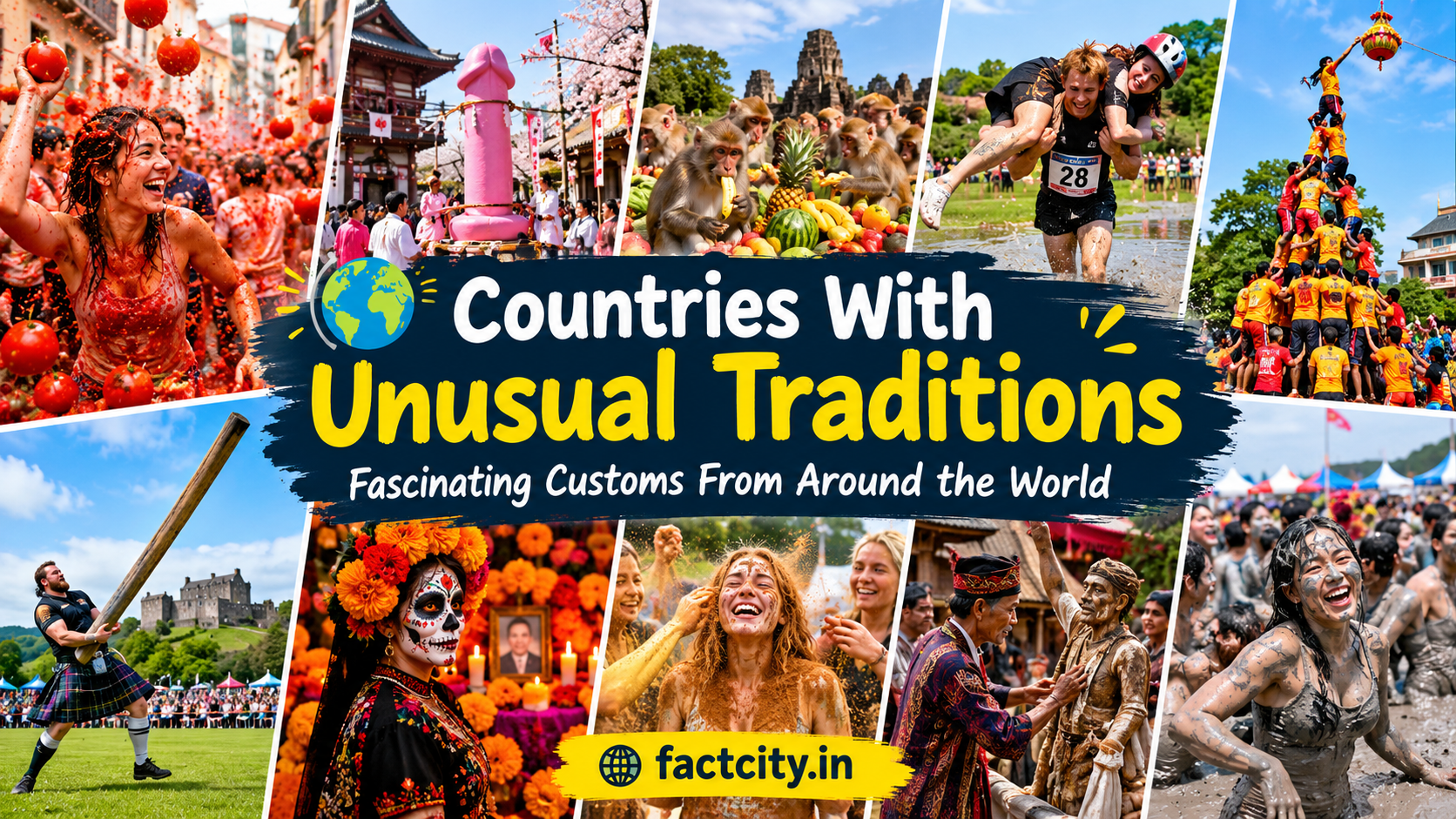
Countries With Unusual Traditions: Every country has its own culture, history, and traditions that make it unique. While some customs may seem familiar to people around the world, others can be surprising, unusual, or completely different from what visitors expect. From colorful festivals and unusual competitions to special wedding ceremonies and ancient cultural practices, countries with unusual traditions offer a fascinating look at how people celebrate life, honor their ancestors, and maintain their cultural identity.
Many of these traditions have been passed down through generations and continue to play an important role in local communities. Some are connected to religion, while others celebrate seasonal changes, historical events, or important stages of life. Learning about these customs helps us understand the diversity of human culture and appreciate the different ways people express happiness, respect, and belonging.
In this article, we will explore some countries with unusual traditions and discover what makes their customs so interesting.
1. Spain: The Tomato-Throwing Festival
Spain is famous for its lively festivals, and La Tomatina is one of the country’s most unusual celebrations. This festival takes place in the town of Buñol, where participants gather to throw tomatoes at one another in a large, organized food fight.
The event usually takes place in August and attracts visitors from different parts of the world. During the celebration, streets become covered in crushed tomatoes, creating a colorful and messy scene. Participants wear comfortable clothing and follow event rules designed to make the activity safer. Countries With Unusual Traditions
La Tomatina is believed to have started in the 1940s, although accounts of its exact origin differ. Today, it has become an internationally recognized festival and an important part of Buñol’s local identity. For many visitors, the experience is an unforgettable example of how a simple activity can develop into a major cultural attraction.
2. Japan: The Kanamara Matsuri Festival
Japan has many traditional festivals that reflect its history and religious beliefs. One particularly unusual celebration is Kanamara Matsuri, commonly known as the Festival of the Steel Phallus. It takes place in Kawasaki and is associated with a Shinto shrine.
The festival features colorful processions, traditional decorations, food stalls, and objects shaped around fertility symbolism. Although some visitors may find the celebration surprising, it has deeper cultural and religious connections. The event is associated with prayers for fertility, protection, childbirth, and good fortune.
In modern times, the festival has also become known for promoting awareness of sexual health. Its cheerful atmosphere and distinctive symbols make it one of Japan’s most recognizable cultural events for international visitors.
3. Thailand: The Monkey Buffet Festival
Thailand is home to a unique celebration in the city of Lopburi, where monkeys are given a large feast of fruits and vegetables. Known as the Monkey Buffet Festival, the event attracts tourists who want to see hundreds of monkeys gathering around food arranged especially for them.
The festival is connected to the city’s long-standing relationship with its monkey population and its historical attractions. Tables are decorated with bananas, watermelons, and other foods that the animals enjoy.
The celebration also serves as a tourism attraction, drawing attention to Lopburi’s cultural heritage. However, monkeys are wild animals, so visitors should maintain a safe distance and follow local guidance. The festival demonstrates how wildlife can become closely associated with a city’s identity and traditions.
4. Finland: The Wife-Carrying Competition
Finland is known for its beautiful landscapes, saunas, and unusual sporting events. One of its most entertaining competitions is wife-carrying, which is particularly associated with the town of Sonkajärvi.
During the event, competitors race through an obstacle course while carrying a partner. The course may include water, uneven ground, and other challenges that test balance, strength, and coordination. The winning team is determined according to the competition’s rules.
Despite its unusual name, participants do not necessarily have to be married. The event has developed into an international competition in which couples and partners from different backgrounds can take part.
Wife-carrying combines athletic ability with humor and teamwork. It also shows how a local sporting event can grow into a popular attraction that brings visitors and competitors together.
5. India: The Dahi Handi Celebration
India is a country with a remarkable variety of festivals and cultural traditions. One distinctive celebration is Dahi Handi, which is especially popular in Maharashtra during the Krishna Janmashtami festivities.
The tradition is associated with stories about Lord Krishna’s childhood and his fondness for butter and curd. During the celebration, an earthen pot or decorated container filled with curd and other items is suspended at a height. Teams of participants form human pyramids to reach and break it.
Crowds gather to watch the teams compete, cheer, and celebrate. Music, dancing, and colorful decorations add to the festive atmosphere. Because forming human pyramids can be dangerous, organizers may introduce safety measures, including protective equipment and restrictions on participation.
Dahi Handi is more than a competition. It represents teamwork, enthusiasm, and devotion, making it an important cultural event for many communities.
6. Scotland: The Highland Games
Scotland is famous for its historic castles, traditional music, and distinctive cultural heritage. The Highland Games are among its best-known traditional events and combine athletic competitions with music, dancing, and community celebrations.
Some of the most recognizable activities include the caber toss, hammer throw, and stone put. In the caber toss, competitors attempt to lift and turn a long wooden pole so that it lands in a particular direction. These events require strength, technique, and considerable practice.
Highland Games also feature bagpipe performances, traditional Scottish dancing, and displays of regional clothing. Although individual events differ from one location to another, the games provide an opportunity to celebrate Scottish identity and preserve traditional sporting activities.
For visitors, attending a Highland Games event offers a chance to experience Scotland’s cultural heritage beyond its famous historical landmarks.
7. Mexico: The Day of the Dead
Mexico celebrates Día de los Muertos, or the Day of the Dead, with colorful decorations, family gatherings, and special offerings honoring deceased loved ones. Although the subject is death, the occasion is generally a celebration of remembrance rather than a frightening event.
Families often create ofrendas, which are decorated altars featuring photographs, candles, flowers, and favorite foods of the people being remembered. Marigolds are especially associated with the celebration because of their bright colors and cultural symbolism.
In many communities, people visit cemeteries, decorate graves, share meals, and tell stories about family members who have passed away. The customs vary between regions and families, reflecting Mexico’s rich cultural diversity.
The Day of the Dead illustrates how traditions can help people preserve memories, strengthen family connections, and approach loss through cultural expression.
8. Denmark: Birthday Celebrations With Cinnamon
Denmark has a birthday custom that may surprise visitors. In some Danish communities, unmarried people who reach the age of 25 may be playfully covered with cinnamon by friends and family.
The custom is generally associated with a humorous celebration among friends. Participants may decorate the birthday person’s clothing or surroundings with cinnamon powder while others gather to enjoy the occasion.
It is often described as a lighthearted social tradition rather than a formal national ceremony. The practice is not followed by everyone, and celebrations can differ depending on personal preferences and local customs.
This unusual birthday tradition demonstrates how humor and friendship can become part of cultural celebrations. It also reminds visitors that traditions within a country are not always shared by every family or community.
9. Indonesia: The Ma’nene Tradition
In parts of South Sulawesi, Indonesia, particularly among the Toraja people, a distinctive ancestral tradition known as Ma’nene is practiced by some families. The ceremony involves caring for the remains of deceased relatives as an expression of continuing family bonds and respect for ancestors.
During the ritual, families may bring ancestral remains from their resting places, clean them, and replace their clothing. The details and timing of the ceremony vary among communities and families.
Ma’nene reflects Toraja beliefs about family relationships, death, and the importance of remembering those who came before. Although the practice may seem unfamiliar to outsiders, it has deep cultural meaning for the people who observe it.
The tradition offers an important lesson about cultural differences: customs surrounding death and remembrance can vary greatly from one society to another, and they should be understood with sensitivity and respect.
10. South Korea: The Boryeong Mud Festival
South Korea is known for its modern cities, popular music, and technological achievements, but it also hosts unusual public festivals. The Boryeong Mud Festival is a well-known example, attracting visitors who enjoy playing in mud, participating in games, and taking part in outdoor activities.
The festival developed in connection with Boryeong’s mud-based cosmetic products. Its activities commonly include mud wrestling, mud slides, obstacle courses, and other entertainment, although the program can change from year to year.
Visitors gather to enjoy the lively atmosphere, take photographs, and participate in group activities. The event has become an important tourism attraction and provides an opportunity for people from different countries to experience a playful side of South Korean culture.
Unlike ancient ceremonies passed down through many generations, this festival is a relatively modern event. Nevertheless, it demonstrates how a local resource can inspire a distinctive celebration and become part of a region’s public identity.
Why Do Countries Have Unusual Traditions?
Unusual traditions often develop because of a country’s history, religion, environment, and social values. Some customs began as religious ceremonies, while others grew from agricultural practices, community gatherings, or historical events. Over time, people continued these activities because they helped preserve a shared identity and brought communities together.
Traditions can also change as societies develop. Some are adapted for modern audiences, while others become popular tourist attractions. For example, festivals may introduce new safety rules, expand their programs, or welcome international visitors while maintaining important cultural elements. what-happens-if-you-stop-sleeping-for-24-hours
It is also important to remember that no single tradition represents an entire country. Customs may differ between regions, generations, and communities. Understanding this diversity helps us avoid stereotypes and appreciate the complexity of different cultures.
Conclusion
Countries with unusual traditions show us how diverse and fascinating human culture can be. From Spain’s tomato-throwing festival and Finland’s wife-carrying competition to Mexico’s Day of the Dead and Indonesia’s Ma’nene ceremony, each custom offers a different perspective on history, family, religion, and community life.
Some traditions are playful and entertaining, while others carry deep spiritual or emotional meaning. What may seem strange to one person can be a cherished expression of identity for another. By learning about these customs with curiosity and respect, we can develop a better understanding of the world and the people who live in it.
Exploring unusual traditions is not just about discovering surprising facts. It is also about recognizing that different cultures have their own ways of celebrating, remembering, and connecting with one another. These traditions make our world richer, more interesting, and full of stories worth discovering.