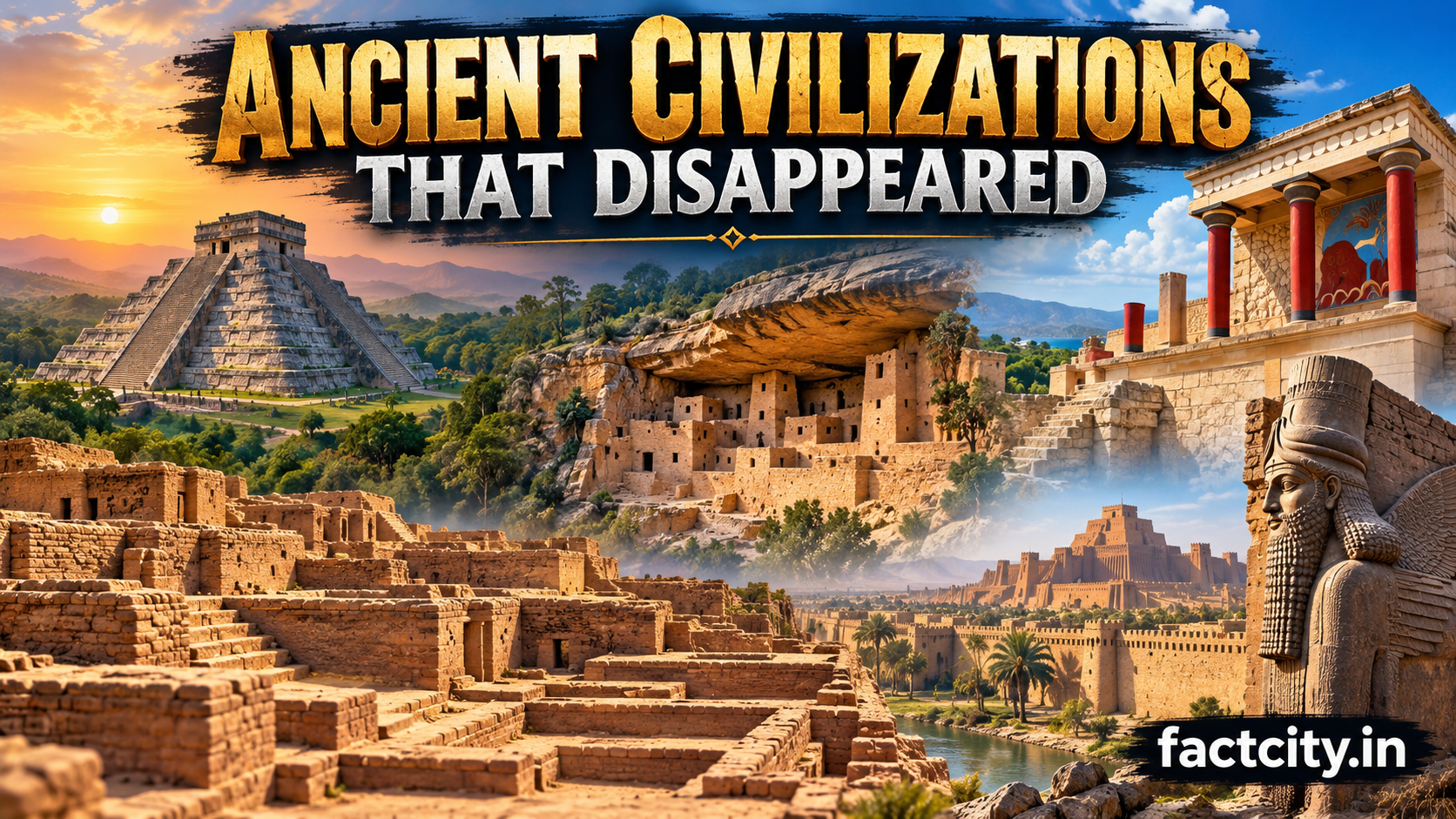
Ancient Civilizations That Disappeared: Human history is full of remarkable civilizations that built magnificent cities, developed advanced technologies, created unique cultures, and left behind extraordinary monuments. However, not every civilization survived the passage of time. Some declined because of climate change, natural disasters, wars, economic problems, or the gradual transformation of their societies. Others left behind impressive ruins that continue to puzzle historians and archaeologists today. These ancient civilizations that disappeared remind us that even the most powerful societies can face challenges that change their future forever.
Although many of these civilizations lost their political power or abandoned their major cities, their achievements continue to influence the modern world. From the mysterious cities of the Maya to the carefully planned settlements of the Indus Valley, each civilization has a unique story worth exploring. Understanding what happened to these ancient societies helps us learn more about human history, the development of cities, and the relationship between people and their environment.
1. The Indus Valley Civilization
The Indus Valley Civilization was one of the earliest major urban civilizations in the world. It flourished around 2600 BCE to 1900 BCE in areas that are now part of Pakistan and northwestern India. Important cities such as Mohenjo-daro and Harappa demonstrate the impressive planning skills of the people who lived there. Their settlements included organized streets, brick houses, drainage systems, and structures designed to manage water efficiently. These features show that the civilization had a sophisticated understanding of urban life. Ancient Civilizations That Disappeared
Despite its achievements, many of its major cities gradually declined after approximately 1900 BCE. Researchers have suggested several possible explanations, including changing river systems, variations in monsoon rainfall, environmental pressure, and shifts in trade. There is no single explanation that accounts for every aspect of its decline. Many people likely moved to smaller settlements and adapted to changing conditions rather than disappearing completely. The Indus Valley Civilization remains fascinating because its writing system has not yet been conclusively deciphered, leaving many details about its government, beliefs, and daily life unknown.
2. The Maya Civilization
The Maya civilization developed in parts of present-day Mexico, Guatemala, Belize, Honduras, and El Salvador. It became famous for its impressive pyramids, detailed calendars, mathematical knowledge, and advanced understanding of astronomy. Maya cities such as Tikal, Palenque, and Copán were important centers of political power, religion, and trade. The Maya also developed a writing system that recorded historical events, royal achievements, and religious traditions.
During the eighth and ninth centuries CE, many major Maya cities in the southern lowlands experienced significant population decline and political collapse. Historians believe several factors may have contributed, including prolonged droughts, warfare between competing cities, environmental damage, and pressure on agricultural resources. However, the decline did not affect every Maya region in the same way. Some cities continued to flourish, and Maya communities survived throughout the region. Millions of Maya people and their descendants continue to preserve their languages, traditions, and cultural heritage today. Therefore, it is more accurate to describe the event as the decline of particular ancient city-states rather than the disappearance of the entire Maya civilization.
3. The Ancestral Puebloans
The Ancestral Puebloans lived in parts of the southwestern United States, including present-day Arizona, New Mexico, Colorado, and Utah. They developed distinctive communities featuring carefully constructed stone buildings, farming settlements, and impressive cliff dwellings. Places such as Mesa Verde demonstrate their ability to build homes in challenging landscapes while making effective use of local resources.
Between approximately the late twelfth and thirteenth centuries, many communities in the Mesa Verde region were abandoned or greatly reduced in population. Extended drought, changing environmental conditions, pressure on agricultural land, and social changes may have contributed to these movements. The people did not simply disappear; many migrated to other areas, where their descendants continued established traditions. Modern Pueblo communities maintain cultural connections to these ancestors. Their history demonstrates how environmental challenges can encourage communities to relocate rather than disappear entirely.
4. The Minoan Civilization
The Minoan civilization flourished on the island of Crete in the eastern Mediterranean during the Bronze Age. It is particularly known for its elaborate palaces, colorful artwork, maritime trade, and distinctive architecture. Knossos was one of its most important centers, containing large buildings, storage areas, courtyards, and sophisticated decorative designs. Minoan traders maintained connections with other societies across the Mediterranean, helping the civilization develop a strong commercial network.
During the second millennium BCE, the Minoan world experienced major changes. A powerful volcanic eruption on the nearby island of Thera, now known as Santorini, caused widespread destruction and may have affected maritime activities and coastal settlements. Later political changes and the growing influence of Mycenaean Greeks also played important roles in the transformation of Minoan society. The exact relationship between the eruption and the civilization’s decline remains debated. Rather than disappearing overnight, Minoan culture changed over time, leaving behind archaeological evidence that helps researchers reconstruct life in the ancient Mediterranean.
5. The Akkadian Empire
The Akkadian Empire emerged in Mesopotamia around the twenty-fourth century BCE and is often regarded as one of the earliest empires in recorded history. Under rulers such as Sargon of Akkad, it brought several cities and territories under centralized political control. Akkadian rulers used military power, administration, and regional trade to maintain authority across a large area. The Akkadian language also became important in the ancient Near East.
The empire declined around the late third millennium BCE, although the exact sequence of events remains uncertain. Internal political instability, conflicts, economic difficulties, and environmental changes may all have contributed. Some researchers have examined evidence suggesting that drought and reduced agricultural productivity affected parts of the region. However, the relative importance of climate compared with political and social factors is still debated. The Akkadian Empire eventually lost its centralized power, but Akkadian language and cultural traditions continued to influence later Mesopotamian societies.
6. The Hittite Empire
The Hittite Empire was a major Bronze Age power centered in Anatolia, mainly in what is now Türkiye. At its height during the second millennium BCE, it controlled extensive territories and competed with powerful neighboring kingdoms, including ancient Egypt. The Hittites developed a sophisticated political system, maintained diplomatic relationships, and became known for their military strength. Their capital, Hattusa, contained massive defensive walls, temples, and administrative buildings.
Around 1200 BCE, the Hittite imperial system collapsed during a wider period of upheaval that affected several eastern Mediterranean societies. Possible causes include warfare, disruptions to trade, internal political struggles, population movements, and food shortages. The exact combination of factors is not fully understood. Although the central empire disappeared, several smaller Neo-Hittite states survived in parts of southeastern Anatolia and northern Syria. Archaeological discoveries at Hattusa have helped historians learn about Hittite laws, diplomacy, religion, and relations with neighboring civilizations.
7. The Nabataean Kingdom
The Nabataeans were an ancient people who established a powerful kingdom in the region surrounding present-day Jordan and parts of the Arabian Peninsula. Their most famous city, Petra, became an important center of commerce and is recognized for its monumental buildings carved directly into sandstone cliffs. The Nabataeans developed impressive water-management systems that allowed them to collect and store water in an environment where rainfall could be limited.
Their wealth came partly from controlling trade routes that transported valuable goods, including spices and other commodities, between Arabia, the Mediterranean, and surrounding regions. In 106 CE, the Roman Empire formally annexed the Nabataean Kingdom and incorporated its territory into the Roman provincial system. Over time, changes in trade routes, political administration, and regional economic activity reduced Petra’s importance. Earthquakes and other environmental events also affected the city. The Nabataean kingdom ended as an independent political entity, but its architectural achievements remain visible today.
8. The Olmec Civilization
The Olmec civilization developed along the Gulf Coast of present-day southern Mexico, particularly in the states of Veracruz and Tabasco. It flourished during the second millennium BCE and is widely regarded as one of the earliest major civilizations of ancient Mesoamerica. The Olmecs are famous for their enormous stone heads, ceremonial centers, and artistic traditions. Their communities also participated in regional trade and developed complex religious and political practices.
Important Olmec centers, including San Lorenzo and La Venta, eventually declined as major population and ceremonial centers. Researchers have proposed explanations involving environmental changes, shifts in rivers, political transformations, and changing regional relationships. However, there is no universally accepted explanation for the decline of every Olmec center. Olmec traditions may have influenced later Mesoamerican cultures, although the precise connections are complex. Their monumental sculptures and archaeological sites continue to provide valuable evidence about early civilization in the Americas.
9. The Tiwanaku Civilization
The Tiwanaku civilization developed near Lake Titicaca in the Andes, close to the present-day border between Bolivia and Peru. Its major ceremonial and political center, Tiwanaku, became an important regional hub between approximately 500 and 1000 CE. The civilization is known for monumental stone architecture, carefully designed ceremonial spaces, and agricultural techniques adapted to high-altitude conditions.
Around the eleventh century, Tiwanaku’s political system declined, and its central urban center lost much of its former importance. Studies suggest that prolonged drought may have damaged the agricultural systems that supported its population. Political changes and the weakening of regional networks may also have contributed. The civilization did not disappear without leaving a legacy; its cultural practices and agricultural knowledge continued to influence communities in the Andes. Tiwanaku remains an important archaeological site for understanding how people developed successful societies in demanding mountain environments.
10. The Khmer Empire
The Khmer Empire dominated much of mainland Southeast Asia for several centuries, reaching its greatest influence between approximately the ninth and thirteenth centuries CE. Its capital region included Angkor, in present-day Cambodia, where rulers built enormous temples, reservoirs, canals, and carefully organized settlements. Angkor Wat, one of the world’s most celebrated religious monuments, reflects the architectural and engineering skills of the Khmer civilization.
During the fourteenth and fifteenth centuries, the political importance of Angkor declined. Researchers have investigated several possible causes, including changing rainfall patterns, severe droughts, intense monsoon floods, infrastructure problems, and regional warfare. Political shifts and the growing importance of other centers, including those near the Mekong and coastal trade routes, also contributed to changes in the kingdom. Angkor was not simply abandoned in a single event, and people continued to live in the wider region. Cambodia’s cultural and religious traditions preserve a strong connection to the Khmer past.
Why Did Ancient Civilizations Disappear?
The stories of these societies reveal that civilizations rarely decline for just one reason. Environmental changes could reduce food supplies, while droughts and floods could damage agricultural systems. Warfare and political instability sometimes weakened governments, and disruptions to trade could reduce the wealth that supported cities and public projects. In many cases, several problems occurred together, making it harder for societies to recover.
It is also important to understand that the abandonment of a capital or the collapse of an empire does not necessarily mean that its people became extinct. Communities often migrated, adopted new political systems, or continued their traditions in different locations. Archaeological discoveries frequently reveal that cultural change was more complicated than the simple disappearance of an entire population. places-on-earth-that-look-like-another-planet
What Can We Learn from These Lost Civilizations?
Ancient civilizations offer important lessons about adaptation, resource management, leadership, and resilience. Their achievements show how human societies developed complex architecture, trade networks, agricultural techniques, and systems of government long before modern technology existed. Their decline also demonstrates that even successful societies can become vulnerable when environmental pressures combine with political and economic challenges.
Modern researchers continue to study ancient ruins, inscriptions, human remains, and environmental evidence to understand what happened to these civilizations. New discoveries can change earlier interpretations, reminding us that history is an ongoing process of investigation rather than a collection of fixed answers.
Conclusion
The ancient civilizations that disappeared left behind some of the most fascinating stories in human history. From the organized cities of the Indus Valley to the monumental temples of the Maya, the stone architecture of the Nabataeans, and the engineering achievements of the Khmer Empire, each society contributed something valuable to humanity’s shared past.
Although many of these civilizations lost their political power or saw their major cities decline, their influence did not always end with them. Their descendants, cultural traditions, inventions, and architectural achievements continue to shape our understanding of the ancient world. By exploring why these societies changed, we gain a deeper appreciation of human creativity and resilience, as well as the challenges that every civilization must face to survive and thrive.