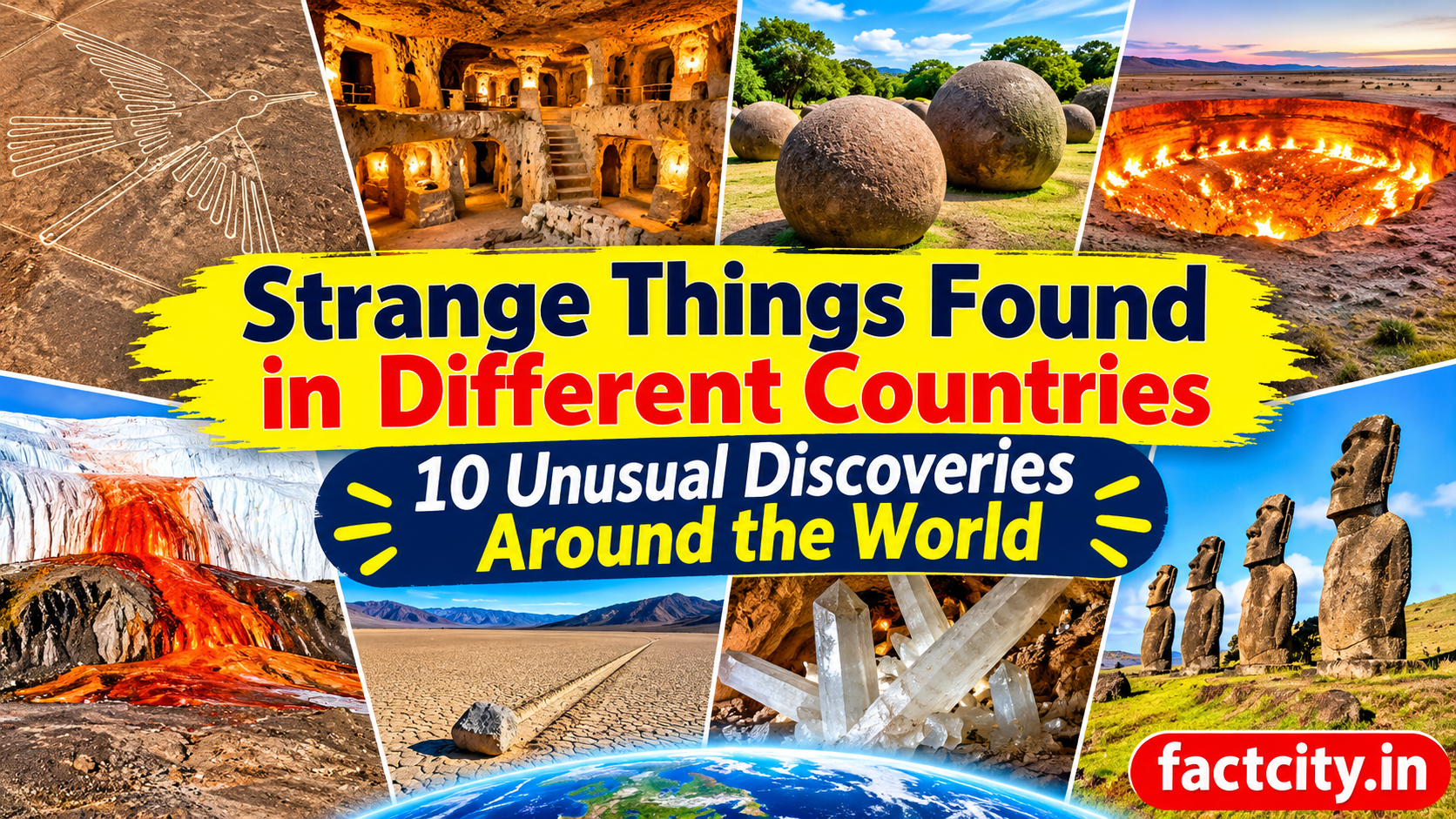
Strange Things Found in Different Countries: Our planet is full of strange, fascinating discoveries that continue to surprise people worldwide. Some of these discoveries were made by ancient civilizations, while others result from unusual natural processes that took thousands or even millions of years to develop. From mysterious underground cities and giant stone structures to unusual lakes and unexplained desert patterns, these incredible places reveal how much there is still to learn about Earth. Many of them have become popular attractions because of their unusual appearance, fascinating history, and the questions they raise. Exploring strange things found in different countries is an exciting way to discover the hidden wonders of our world and understand the remarkable stories behind them.
1. The Mysterious Nazca Lines in Peru
One of the most fascinating discoveries in Peru is the Nazca Lines, a collection of enormous drawings created on the surface of the Nazca Desert. These ancient designs include animals, birds, plants, geometric shapes, and human-like figures that are so large they can be properly recognized from the air. Created by the Nazca culture between approximately 500 BCE and 500 CE, the lines were made by removing the darker stones from the desert surface to reveal the lighter ground underneath. Researchers believe they may have had religious, ceremonial, or cultural purposes, although their exact meaning remains uncertain. The Nazca Lines are a remarkable example of ancient creativity and continue to attract historians, archaeologists, and travelers from around the world. Strange Things Found in Different Countries
2. The Underground City of Derinkuyu in Turkey
Turkey is home to one of the strangest ancient discoveries in the world, the underground city of Derinkuyu. Located in the Cappadocia region, this enormous underground settlement extends deep beneath the ground and contains multiple levels of rooms, tunnels, kitchens, storage areas, and ventilation shafts. The city was developed and used over different historical periods, particularly when people needed protection from invading forces or other dangers. Its carefully designed air shafts allowed fresh air to reach the lower levels, while large circular stone doors could be rolled into place to block entrances. The discovery of Derinkuyu shows how ancient communities used their knowledge, engineering skills, and creativity to build secure living spaces beneath the Earth’s surface.
3. The Giant Stone Spheres of Costa Rica
In Costa Rica, archaeologists have discovered hundreds of large stone spheres that look almost perfectly round. Many of these mysterious objects are located in the Diquís Delta region and were created by Indigenous communities before European contact. The spheres vary greatly in size, with some measuring several meters across, and were carefully shaped from hard stone using ancient tools and techniques. Although researchers believe they may have had social, ceremonial, or symbolic importance, their exact purpose is still debated. Some spheres were originally arranged in groups, suggesting that their placement may have carried meaning within the communities that created them. These unusual stone objects remain among the most fascinating archaeological discoveries in Central America.
4. The Door to Hell in Turkmenistan
One of the strangest sights in Turkmenistan is the Darvaza Gas Crater, commonly known as the Door to Hell. Located in the Karakum Desert, this enormous crater has been burning for decades, creating a dramatic display of flames and glowing gas in the middle of the desert. The crater is generally associated with a Soviet-era drilling operation during which the ground reportedly collapsed into an underground gas-filled cavity. Gas was ignited to reduce the danger of methane spreading, but the fire continued burning far longer than expected. The glowing crater has become a famous attraction and an unusual reminder of how human activities can sometimes create unexpected changes in the natural environment.
5. Blood Falls in Antarctica
Antarctica is known for its freezing temperatures and enormous ice sheets, but it is also home to a remarkable natural discovery called Blood Falls. This unusual waterfall flows from the Taylor Glacier and appears bright red, creating the impression that blood is coming out of the ice. Scientists discovered that the color comes from iron-rich, extremely salty water trapped beneath the glacier. When the water reaches the surface and comes into contact with oxygen, the iron undergoes oxidation and produces a rusty red color. The hidden water system also contains microorganisms that survive in extreme conditions, making Blood Falls an important location for scientific research into life in environments where sunlight is limited or absent.
6. The Moving Stones of Death Valley in the United States
Death Valley in California contains a strange natural phenomenon known as the moving stones of Racetrack Playa. Large rocks have been found on the dry lakebed with long trails behind them, suggesting that they move across the ground without anyone pushing them. For many years, scientists struggled to explain how such heavy stones could travel across the flat surface. Researchers eventually observed that the movement occurs under specific winter conditions when a thin layer of ice forms around the rocks. As the ice breaks into floating panels, gentle winds can push the rocks across the wet ground, leaving trails behind them. This discovery demonstrated that even a combination of light wind, water, and ice can move heavy objects under the right conditions.
7. The Giant Crystal Cave in Mexico
Mexico is home to the extraordinary Cave of the Crystals, located beneath the Naica mining area in Chihuahua. The cave contains some of the largest natural crystals ever discovered, with certain gypsum crystals reaching approximately 11 meters in length. These enormous formations developed over a very long period when mineral-rich groundwater remained at a stable temperature that allowed crystals to grow slowly. The cave is extremely hot and humid, making it dangerous for people to enter without specialized equipment and protection. Its giant transparent crystals look almost unreal and provide scientists with valuable information about geological processes. The Cave of the Crystals is a remarkable example of how nature can create structures that are far more impressive than many human-made designs.
8. The Giant Moai Statues of Easter Island, Chile
Easter Island, also known as Rapa Nui, is famous for its enormous stone statues called moai. These figures were created by the island’s Polynesian inhabitants and are believed to represent important ancestors or respected community leaders. Many statues have large heads, long faces, and carefully carved features, while some have bodies that extend beneath the ground. Archaeologists have studied how the islanders carved and transported these heavy statues across the island without modern machinery. Research suggests that some moai may have been moved upright using ropes and coordinated human effort. These remarkable statues reflect the artistic skills, cultural beliefs, and engineering knowledge of the people who created them centuries ago.
9. The Naturally Pink Lake of Australia
Australia contains several unusual pink lakes, including Lake Hillier in Western Australia. The lake is famous for its striking pink color, which creates a beautiful contrast with the surrounding green vegetation and blue ocean. Scientists believe the unusual color is associated with salt-loving microorganisms, including certain bacteria and algae that produce pigments under highly salty conditions. The intensity of the pink color can change depending on environmental factors such as sunlight, temperature, and salinity. Although the lake looks unusual, its color is the result of natural biological and chemical processes. Lake Hillier has become one of Australia’s most fascinating natural attractions and demonstrates how tiny organisms can create extraordinary landscapes.
10. The Mysterious Fairy Circles of Namibia
The Namib Desert in Namibia contains thousands of unusual circular patches of bare ground surrounded by grass. These formations are known as fairy circles because of their strange and almost perfectly organized appearance across the desert landscape. Scientists have investigated several possible explanations for their formation, including competition between plants for limited water and the influence of termites. Research suggests that environmental conditions and ecological processes may work together to create these patterns. The circles can appear in large groups, forming repeated shapes across vast areas of the desert. Although scientists have made progress in understanding them, fairy circles remain a fascinating example of how nature can create patterns that look almost designed. world-facts-that-sound-fake-but-are-actually-true
Why Are These Strange Discoveries Important?
Strange discoveries found in different countries are important because they help us understand the history of our planet and the people who lived on it. Ancient structures and mysterious objects provide clues about the beliefs, traditions, and engineering abilities of earlier civilizations, while unusual natural formations reveal information about geology, climate, and the environment. Scientific research has also shown that many discoveries that once appeared impossible can be explained through careful observation and investigation. These places encourage curiosity, support education, and remind us that the world still contains many fascinating stories waiting to be explored.
Conclusion
The strange things found in different countries reveal the incredible diversity and beauty of our planet. From the enormous Nazca Lines in Peru and the underground city of Turkey to the glowing gas crater in Turkmenistan and the mysterious red waterfall in Antarctica, every discovery has a unique story to tell. Some were created by ancient people using remarkable skills, while others developed through natural processes that continue to amaze scientists today. These unusual places remind us that Earth is full of surprises and that exploring its hidden wonders can help us learn more about history, science, and the natural world. Whether these discoveries are found beneath the ground, across remote deserts, or within icy landscapes, they continue to inspire people to explore and understand the world around them.