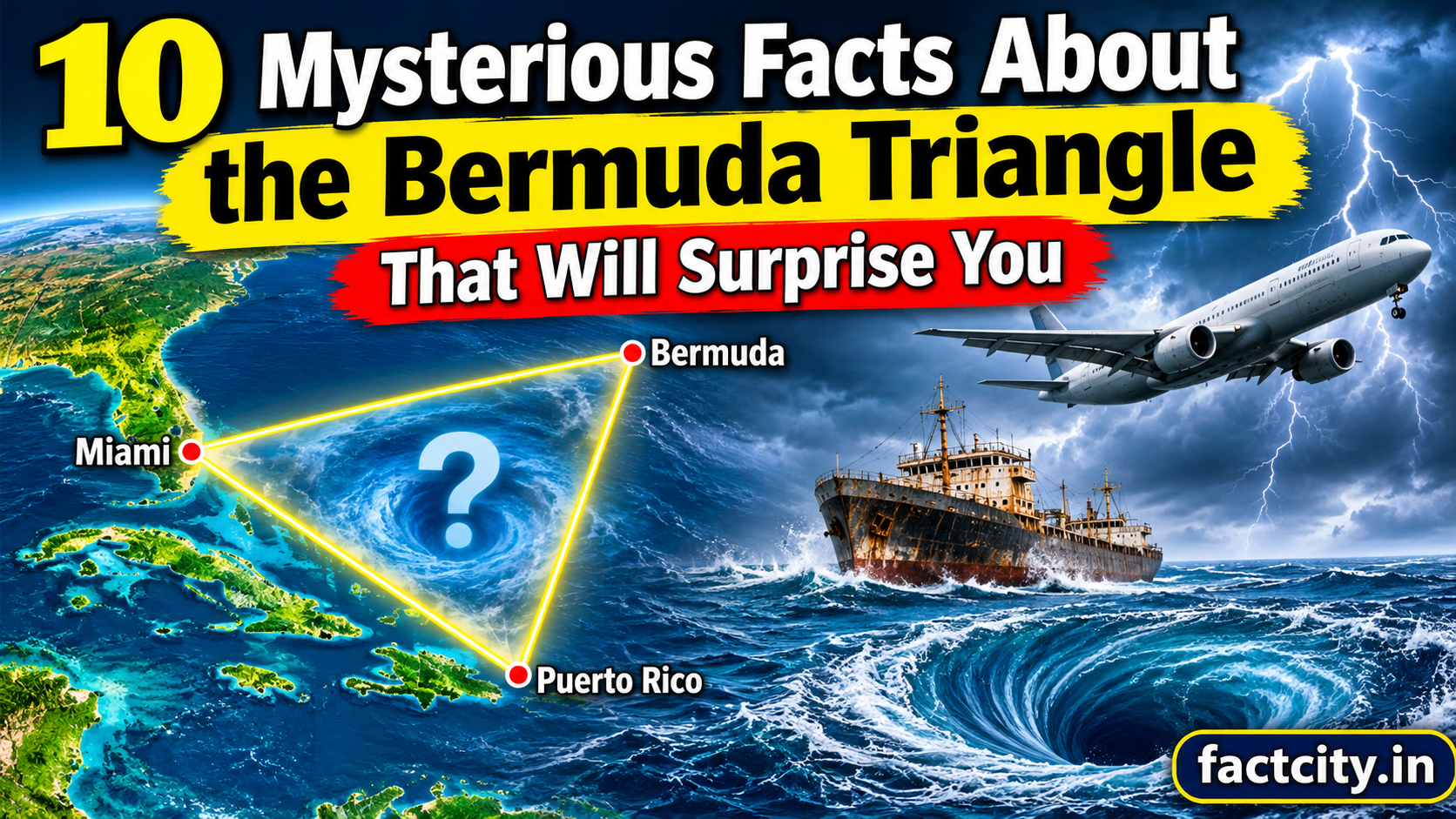
10 Mysterious Facts About the Bermuda Triangle The Bermuda Triangle is one of the most mysterious and fascinating regions in the world. For decades, it has attracted the attention of researchers, scientists, historians, travelers, and mystery lovers. Stories about missing ships, disappearing airplanes, strange weather conditions, and unexplained incidents have made this part of the Atlantic Ocean famous around the globe. Many people believe that something unusual happens inside this region, while others think that its reputation is mainly based on natural events, human mistakes, and exaggerated stories.
Located in the western part of the North Atlantic Ocean, the Bermuda Triangle is commonly described as an area between Bermuda, Miami in Florida, and Puerto Rico. Although it does not appear as an officially recognized geographical boundary, it has become a popular name associated with unexplained disappearances and unusual maritime stories.
Over the years, several incidents have contributed to its mysterious reputation. Some have reasonable scientific explanations, while others remain subjects of discussion because of incomplete historical records. From strange disappearances to powerful ocean currents, there are many interesting details worth exploring.
Here are 10 mysterious facts about the Bermuda Triangle that reveal why this region continues to capture people’s imagination.
1. The Bermuda Triangle Has No Officially Defined Boundaries
One of the most surprising facts about the Bermuda Triangle is that it does not have officially established geographical boundaries. Most descriptions place its three main points near Bermuda, Miami, and Puerto Rico, creating a roughly triangular region in the Atlantic Ocean. However, different books, articles, and researchers sometimes describe its size differently.
Unlike countries, oceans, or officially recognized geographical regions, the Bermuda Triangle is not a formally designated area on international maps. Its boundaries are based mainly on popular descriptions rather than scientific or governmental definitions. 10 Mysterious Facts About the Bermuda
This makes it difficult to determine exactly how many incidents have happened inside the triangle. Some reported disappearances may have occurred outside the commonly accepted area, while others have been included because they are connected to the region’s mysterious reputation.
The lack of fixed boundaries is one reason why the Bermuda Triangle remains a controversial subject.
2. Flight 19 Is One of Its Most Famous Mysteries
Flight 19 is probably the most famous incident associated with the Bermuda Triangle. On December 5, 1945, five United States Navy aircraft took off from Fort Lauderdale, Florida, for a routine training mission. The flight consisted of 14 crew members.
During the mission, the pilots reportedly became disoriented and experienced navigation difficulties. Radio communications indicated that they were uncertain about their position and direction. Eventually, all five aircraft disappeared over the Atlantic Ocean.
A rescue aircraft carrying 13 crew members was also sent to search for the missing planes. Unfortunately, it disappeared as well. Later investigations suggested that the rescue aircraft may have exploded, possibly because of a fuel-related accident.
The disappearance of Flight 19 became one of the biggest reasons behind the Bermuda Triangle’s worldwide reputation. Although navigation problems and difficult weather conditions are possible explanations, the incident continues to attract attention from mystery enthusiasts.
3. The Region Experiences Powerful Ocean Currents
Another interesting fact about the Bermuda Triangle is that it is located in an area influenced by the Gulf Stream, one of the world’s major ocean currents. This powerful current carries warm water from the Gulf of Mexico toward the North Atlantic.
The Gulf Stream can move floating objects, boats, and debris over considerable distances. If a ship experiences an accident, its remains may be carried far away from the original location before search teams can reach the area.
This can make rescue operations extremely challenging. Investigators may find it difficult to determine where an accident happened, especially when weather conditions are poor and ocean currents are strong.
The Atlantic Ocean is also extremely deep in several places within and around the commonly described Bermuda Triangle. Some underwater areas contain deep trenches and complicated seabed formations, making searches for sunken vessels difficult.
These natural conditions help explain why certain maritime accidents in the region can be difficult to investigate.
4. Some Compass Readings Can Appear Unusual
Compass-related stories are another important part of the Bermuda Triangle mystery. Several historical accounts describe sailors and pilots experiencing unusual compass readings while traveling through this region. These stories have encouraged theories that the area contains strange magnetic forces capable of confusing navigation systems.
However, there is a scientific explanation for some of these reports. A compass normally points toward magnetic north, which is different from geographic or true north. The angle between these two directions is called magnetic declination. In certain locations, magnetic north and true north can align, meaning a compass may point toward true north.
This is a natural geographical phenomenon and is not unique to the Bermuda Triangle. Nevertheless, sailors using older navigation equipment could become confused if they did not properly account for magnetic variation.
Today, modern GPS technology, satellite navigation, and advanced navigation systems have made traveling across this region much easier and safer.
5. The USS Cyclops Disappeared Without a Trace
The USS Cyclops is another famous mystery connected with the Bermuda Triangle. In March 1918, this large United States Navy cargo ship disappeared while traveling from Barbados toward Baltimore during World War I.
The vessel was carrying approximately 10,800 tons of manganese ore and had around 300 people aboard. Despite extensive searches, neither the ship nor its passengers were ever found. There was no confirmed distress signal or clear explanation for its disappearance.
Several theories have been suggested to explain what happened. Some experts have considered the possibility of structural problems, engine trouble, overloading, or dangerous weather conditions. The ship’s cargo was extremely heavy, and mechanical or structural difficulties may have contributed to the disaster.
The disappearance of the USS Cyclops remains one of the most significant unsolved maritime losses in American naval history. Although it is frequently connected with the Bermuda Triangle, there is no confirmed evidence that anything supernatural caused the incident.
6. The Bermuda Triangle Is Known for Sudden and Dangerous Weather
Weather conditions are among the most realistic explanations for many accidents associated with the Bermuda Triangle. The region lies in an area where tropical storms, hurricanes, thunderstorms, and sudden changes in atmospheric conditions can occur.
A calm ocean can quickly become dangerous when strong winds and heavy rainfall develop. Large waves can make it difficult for smaller boats to remain stable, while poor visibility can create serious problems for aircraft and ships.
Before modern weather forecasting systems became widely available, sailors and pilots had limited information about approaching storms. They could sometimes enter dangerous weather without receiving sufficient warning.
Waterspouts are another natural phenomenon associated with tropical and subtropical waters. These rotating columns of air and water can develop over the ocean and create hazardous conditions for nearby vessels.
Weather-related accidents are not unique to the Bermuda Triangle, but the region’s history of maritime and aviation incidents has made these natural dangers an important part of its mystery. National Ocean Service+1
7. The Ocean Floor Contains Extremely Deep Areas
One of the most fascinating geographical features of the Bermuda Triangle is the variation in its underwater landscape. The ocean floor in this region includes shallow coastal areas, underwater mountains, deep basins, and some remarkably deep ocean trenches.
The nearby Puerto Rico Trench is particularly impressive. It reaches depths of more than 8,000 meters in certain places, making it the deepest known part of the Atlantic Ocean.
These extreme depths create major challenges for underwater investigations. When an aircraft or ship sinks, locating its remains can be extremely difficult. Strong ocean currents, limited visibility, and enormous water pressure make deep-sea searches expensive and technically demanding.
In some historical disappearances, investigators have never recovered enough wreckage to establish exactly what happened. This lack of physical evidence has helped keep several stories alive.
The deep ocean does not prove that mysterious forces exist in the Bermuda Triangle. Instead, it demonstrates how difficult it can be to investigate accidents in one of the world’s largest natural environments.
8. Christopher Columbus Reported Unusual Experiences in the Region
Long before the Bermuda Triangle became famous, Christopher Columbus recorded unusual observations during his first voyage across the Atlantic in 1492.
Historical accounts of his voyage describe unusual compass readings and strange lights appearing near the horizon. At the time, sailors depended heavily on traditional navigation methods, and unfamiliar compass behavior could create uncertainty during long ocean journeys.
Some interpretations of Columbus’s observations have become part of the Bermuda Triangle legend. People interested in the mystery often connect these reports with theories about unusual energy fields or unexplained forces.
However, there are possible natural explanations. A light seen over the ocean could have been a meteor, while compass variations may have resulted from ordinary differences between magnetic north and true north.
It is also important to remember that sailors in the fifteenth century had limited scientific knowledge of ocean conditions, atmospheric effects, and navigation. Events that appeared extraordinary at the time may have had natural explanations.
Nevertheless, Columbus’s historical observations add an interesting chapter to the long history of stories associated with this region. HISTORY+1
9. The Bermuda Triangle Has Inspired Many Supernatural Theories
Perhaps the most entertaining fact about the Bermuda Triangle is the extraordinary number of supernatural theories associated with it. Over the years, writers, researchers, and mystery enthusiasts have proposed explanations that go far beyond ordinary science.
One popular theory suggests that the lost city of Atlantis may be connected to the disappearances. According to this idea, an advanced ancient civilization once existed beneath the ocean, and mysterious energy sources from its remains could affect ships and aircraft.
Another theory involves extraterrestrial activity. Some people believe that unidentified flying objects visit the region and take ships or aircraft into unknown locations. Others suggest that the Bermuda Triangle contains portals to different dimensions or mysterious time-travel zones.
There have also been theories involving sea monsters, underwater energy fields, and unusual gravitational forces.
Although these explanations have appeared in books, television programs, and documentaries, none has been supported by reliable scientific evidence. They remain popular mainly because people enjoy exploring mysterious possibilities.
The combination of real historical disappearances and imaginative storytelling has helped transform the Bermuda Triangle into one of the world’s most recognizable legends.
10. There Is No Scientific Proof That the Bermuda Triangle Is More Dangerous Than Other Oceans
The final fact may be the most surprising of all. Despite its frightening reputation, there is no convincing scientific evidence that ships and aircraft disappear more frequently in the Bermuda Triangle than in other heavily traveled ocean regions.
According to the National Oceanic and Atmospheric Administration (NOAA), many incidents associated with the region can be explained through natural environmental conditions and human mistakes. The organization also points out that the area has no officially recognized boundaries.
Thousands of commercial ships, private boats, and aircraft travel through the region. Most complete their journeys safely without experiencing anything unusual.
Modern technology has also significantly improved maritime and aviation safety. GPS navigation, satellite weather information, radar systems, emergency communication equipment, and improved aircraft monitoring help pilots and sailors identify potential dangers. best-key-person-life-insurance-for-small-businesses
The mystery continues partly because some historical incidents lack complete records or recovered wreckage. When people do not have clear answers, imagination often fills the gaps.
The Bermuda Triangle is therefore better understood as a fascinating combination of geographical realities, historical accidents, and popular legends rather than a proven supernatural danger zone. National Ocean Service+1
Why Does the Bermuda Triangle Continue to Fascinate People?
The Bermuda Triangle continues to attract attention because it combines real historical events with unanswered questions and fascinating stories. People are naturally curious about places where important details remain unknown, especially when ships and aircraft disappear without leaving clear evidence.
Books, movies, television documentaries, and online articles have helped spread its reputation across different generations. Every new discussion introduces another theory or interpretation, encouraging people to explore the subject further.
However, understanding the Bermuda Triangle requires separating historical facts from fictional explanations. Natural ocean currents, dangerous weather, navigation problems, mechanical failures, and human mistakes provide reasonable explanations for many incidents.
Even with modern technology, the deep ocean remains difficult to explore completely. That is why the Bermuda Triangle will probably continue to inspire curiosity for many years.
Conclusion
The Bermuda Triangle is undoubtedly one of the world’s most interesting geographical mysteries. From the disappearance of Flight 19 and the USS Cyclops to unusual compass stories and dangerous ocean conditions, its history contains many fascinating events.
Although supernatural theories have made the region famous, there is no reliable scientific evidence proving that mysterious forces are responsible for the disappearances. Natural weather conditions, powerful currents, navigation difficulties, and incomplete historical records provide more realistic explanations for many incidents.
The real fascination of the Bermuda Triangle lies in the combination of history, science, geography, and unanswered questions. Whether someone approaches it as a scientific subject or an exciting mystery, this famous region reminds us how much there is still to learn about our oceans.
1 thought on “10 Mysterious Facts About the Bermuda Triangle That Will Surprise You”