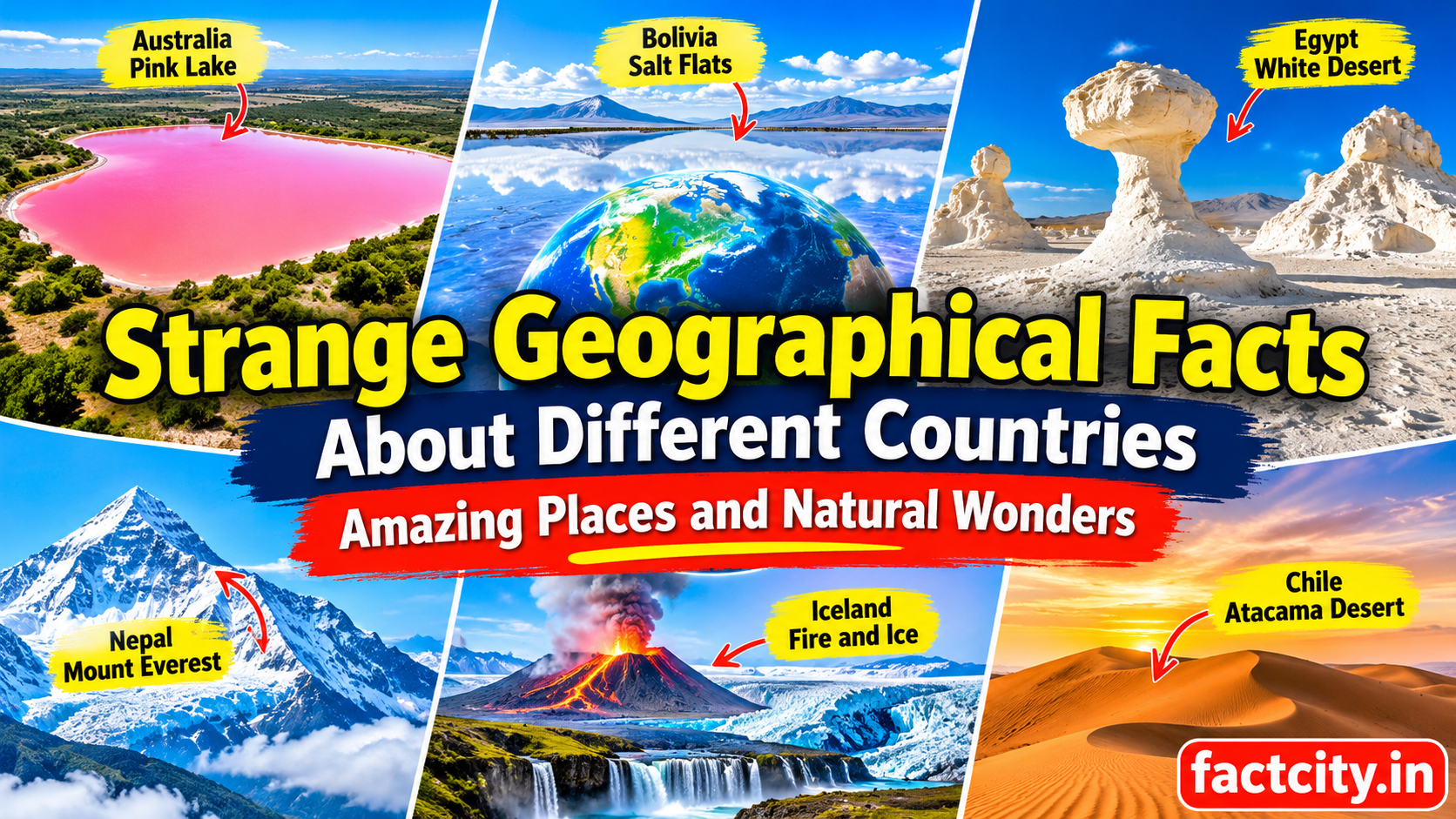
Strange Geographical Facts About Different Countries: The world is full of geographical surprises that make every country unique. From unusual borders and mysterious landscapes to deserts covered in ice and lakes with extraordinary colors, our planet contains countless natural wonders that are difficult to believe. Some countries have geographical features that seem almost impossible, while others are home to landscapes unlike anything found elsewhere. Exploring strange geographical facts about different countries is a fascinating way to understand how nature, climate, and Earth’s geological history have shaped the world we live in.
1. Russia Has More Than One Climate Extreme
Russia is the largest country in the world, covering an enormous area across Europe and Asia. Its size creates some of the most unusual geographical conditions on Earth. While parts of Russia experience freezing temperatures and long winters, other regions have relatively mild climates. Siberia is famous for its extreme cold, and the settlement of Oymyakon is often described as one of the coldest permanently inhabited places on Earth. In contrast, areas near the Black Sea have much warmer conditions. Russia’s immense size means that it contains forests, mountains, tundra, plains, and several different climate zones within one national boundary. Strange Geographical Facts About Different Countries
2. Bolivia Has a Natural Mirror That Covers the Ground
Bolivia is home to Salar de Uyuni, the world’s largest salt flat, covering approximately 10,582 square kilometers. During the dry season, the surface looks like an endless white desert made of salt. However, when a thin layer of water covers the ground during the rainy season, the salt flat becomes a giant natural mirror. The sky, clouds, and distant mountains are reflected across its surface, creating an extraordinary visual effect. This unusual landscape was formed from ancient lakes that gradually evaporated, leaving behind thick layers of salt and minerals.
3. Egypt Has a Desert That Can Turn White
Egypt is widely known for its golden sand dunes, but it also contains a remarkable white desert. The White Desert, located in the western part of the country, is famous for its unusual chalk formations that resemble mushrooms, animals, and giant sculptures. These shapes were created over thousands of years through wind erosion. The bright white rocks stand out against the surrounding desert, creating a landscape that looks almost like another planet. This natural wonder shows how wind can slowly transform ordinary rock into extraordinary geographical formations.
4. Canada Has More Lakes Than Any Other Country
Canada is famous for its enormous wilderness, forests, mountains, and freshwater resources. One of its most surprising geographical facts is that it contains more lakes than any other country. Canada is estimated to have more than two million lakes, many of which were formed by glaciers during the last ice age. These lakes range from small remote ponds to enormous freshwater bodies such as Great Bear Lake and Great Slave Lake. The country’s abundance of lakes plays an important role in its ecosystems, climate, wildlife habitats, and freshwater supply.
5. Chile Contains One of the Driest Places on Earth
Chile is home to the Atacama Desert, one of the driest non-polar deserts in the world. Some areas of this desert receive extremely little rainfall, and certain weather stations have recorded long periods without measurable precipitation. The Atacama’s unusual dryness is caused by a combination of the Andes Mountains, the cold Humboldt Current, and atmospheric conditions that prevent rain from reaching the region. Despite its harsh environment, the desert contains salt flats, volcanic landscapes, mineral-rich ground, and clear skies that make it an important location for astronomical observatories.
6. Australia Has a Pink Lake
Australia contains several lakes known for their unusual pink color. Lake Hillier, located on Middle Island in Western Australia, is particularly famous for its bright pink appearance. Scientists believe that its color is associated with salt-loving microorganisms, including certain algae and bacteria. The lake’s pink water contrasts sharply with the surrounding green vegetation and blue ocean. Although the intensity of the color can vary, this natural phenomenon makes Lake Hillier one of the most visually unusual geographical features in the country.
7. Nepal Has the World’s Highest Mountain
Nepal is home to Mount Everest, the highest mountain above sea level, reaching approximately 8,849 meters. The mountain lies along the border between Nepal and China and forms part of the Himalayas. What makes this region geographically fascinating is the continuing movement of tectonic plates. The Indian Plate is pushing against the Eurasian Plate, gradually raising the Himalayan mountain range. This geological process began millions of years ago and continues today, making the Himalayas one of the most active and remarkable mountain systems on Earth.
8. Iceland Has Fire and Ice in the Same Landscape
Iceland is one of the most geographically unusual countries because it contains active volcanoes, glaciers, hot springs, and lava fields within a relatively small area. The country sits on the Mid-Atlantic Ridge, where the North American and Eurasian tectonic plates are moving apart. This geological activity creates frequent volcanic eruptions and geothermal features. At the same time, large glaciers cover parts of the island. The combination of ice and volcanic activity creates dramatic landscapes that are rarely found together in other countries.
9. South Africa Has Three Different Capitals
South Africa has an unusual geographical and political arrangement because it has three capital cities. Pretoria serves as the executive capital, Cape Town is the legislative capital, and Bloemfontein is traditionally recognized as the judicial capital. The country’s geography is also remarkable because it contains coastlines along both the Atlantic and Indian Oceans. Its landscapes include mountains, grasslands, deserts, and coastal regions. The meeting of different ocean currents near its southern coast contributes to changing marine conditions and diverse ecosystems.
10. China Has a Desert That Moves Across the Landscape
China contains several major deserts, including the Taklamakan Desert, one of the largest sandy deserts in the world. The Taklamakan is surrounded by mountains and is known for its shifting sand dunes, extreme temperatures, and harsh conditions. Strong winds can move sand across the landscape, changing the shape and position of dunes over time. China also has the Gobi Desert, which stretches into Mongolia and contains rocky plains as well as sandy areas. These deserts demonstrate how different geographical forces create diverse environments within one country.
11. Denmark Is Connected to a Large Island Territory
Denmark is geographically unusual because the Kingdom of Denmark includes Greenland, the world’s largest island that is not considered a continent. Greenland is located in the Arctic region and is mostly covered by a massive ice sheet. Although it is part of the Danish Kingdom, it has extensive self-government. Greenland’s icy landscape contains glaciers, fjords, mountains, and coastal settlements. Its geography plays an important role in climate research because changes in its ice sheet influence global sea levels. world-facts-that-sound-fake-but-are-actually-true
12. Tanzania Has a Lake That Can Turn Animals Into Stone-Like Shapes
Lake Natron in Tanzania is known for its unusual reddish appearance and highly alkaline water. The lake contains large amounts of dissolved minerals, and its conditions can be extremely harsh for many animals. Its high alkalinity can preserve the remains of animals that die in or near the water, sometimes creating striking mineral-coated forms. Despite its extreme environment, Lake Natron is an important breeding area for lesser flamingos, which are specially adapted to feed in its shallow waters.
Conclusion
These strange geographical facts about different countries reveal how extraordinary and diverse our planet truly is. From Bolivia’s reflective salt flats and Iceland’s volcanic glaciers to Australia’s pink lakes and Tanzania’s mineral-rich waters, every region has something unique to offer. Many of these landscapes were created through millions of years of geological activity, changing climates, erosion, and natural processes. Learning about these unusual geographical features helps us appreciate the beauty of Earth and understand why protecting its natural environments is so important for future generations.