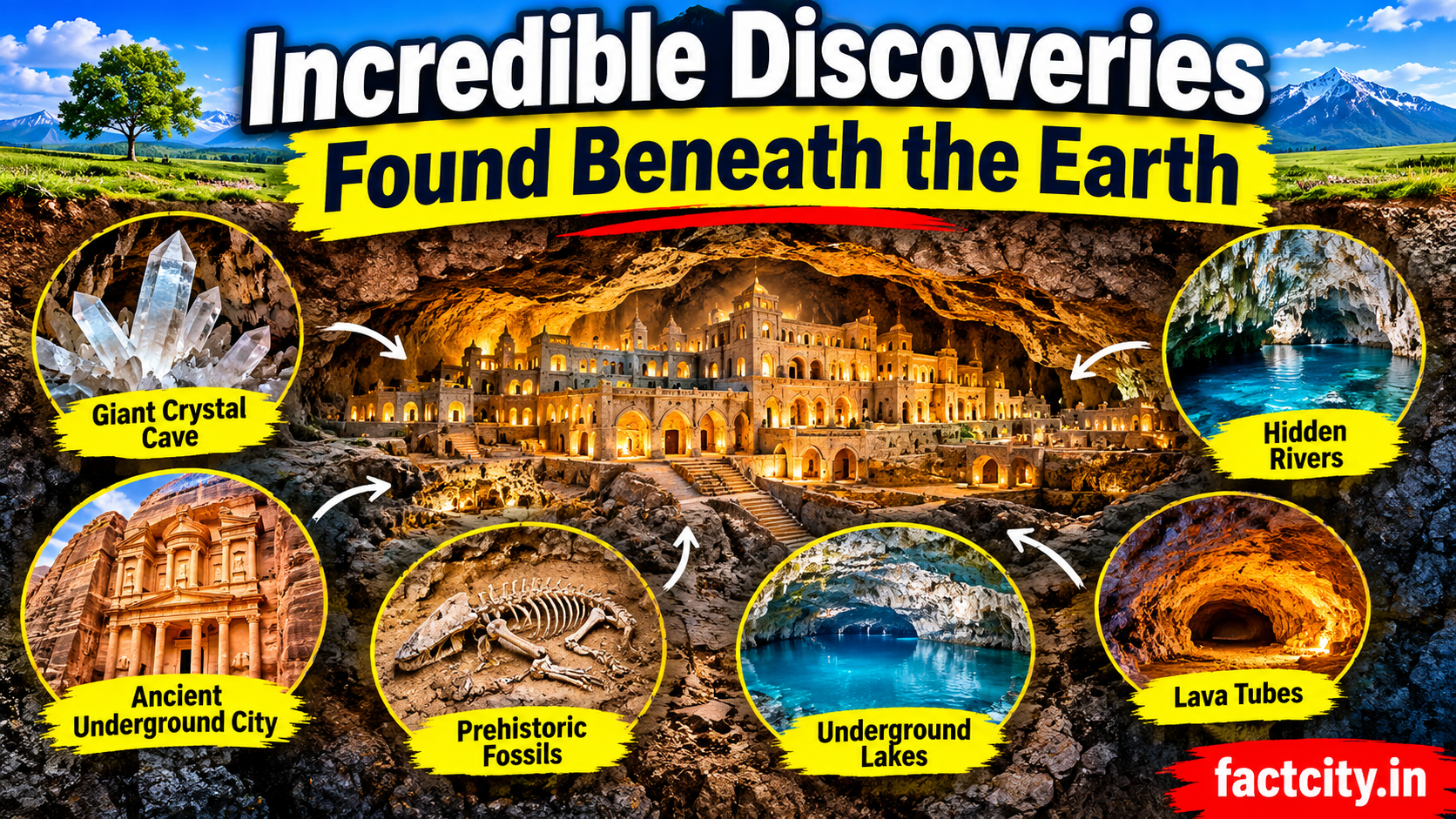
Incredible Discoveries Found Beneath the Earth. The Earth is full of mysteries that remain hidden beneath our feet. While we explore mountains, oceans, forests, and deserts, another fascinating world exists deep underground. From enormous caves and ancient underground cities to mysterious fossils and hidden rivers, incredible discoveries found beneath the Earth have changed our understanding of history, science, and the natural world. Some of these discoveries reveal how ancient civilizations lived, while others help scientists understand the planet’s formation and the evolution of life. What makes these underground wonders so fascinating is that many remained hidden for thousands or even millions of years before humans discovered them.
1. The Underground City of Derinkuyu, Turkey
One of the most incredible discoveries found beneath the Earth is Derinkuyu, an ancient underground city in Cappadocia, Turkey. This remarkable structure extends deep below the surface and contains multiple levels of tunnels, rooms, storage areas, kitchens, wells, and ventilation shafts. Archaeologists believe that the underground city was expanded and used by different communities over many centuries, particularly during periods when people needed protection from invading forces. Its carefully designed ventilation system allowed fresh air to reach even the deepest levels. Derinkuyu demonstrates the extraordinary engineering skills of ancient people and shows how entire communities could survive underground.
2. The Giant Crystal Cave in Mexico
Deep beneath the Naica Mine in Chihuahua, Mexico, lies one of the most extraordinary natural discoveries ever made. Known as the Cave of the Crystals, this underground chamber contains enormous gypsum crystals, some measuring more than 10 meters in length. The crystals formed over hundreds of thousands of years under special geological conditions involving mineral-rich water and stable temperatures. The cave’s extreme heat and humidity make it dangerous for humans to explore without specialized equipment. This discovery provides scientists with valuable information about crystal formation and the unusual environments in which minerals can grow.
3. The Lost Underground River Systems
Beneath the Earth’s surface, water travels through hidden networks of caves, cracks, and underground channels. These underground rivers are particularly common in regions with limestone landscapes, where water slowly dissolves rock and creates tunnels. Some of these systems extend for hundreds of kilometers and connect caves, lakes, and natural springs. One famous example is the Puerto Princesa Underground River in the Philippines, where a river flows through a spectacular limestone cave before reaching the sea. Such discoveries help scientists understand groundwater movement, water conservation, and the formation of underground landscapes.
4. The Ancient City of Petra’s Hidden Structures
Petra, located in Jordan, is famous for its magnificent buildings carved into sandstone cliffs. However, archaeological research has revealed that the ancient city contains much more than its visible monuments. Beneath the ground, researchers have discovered tombs, chambers, water channels, and other structures that reveal how the Nabataean civilization organized its society. Modern technologies such as ground-penetrating radar and satellite imaging have helped researchers identify hidden archaeological features without extensive excavation. These discoveries provide new clues about Petra’s population, religious practices, and sophisticated water management system.
5. The Deepest Known Cave on Earth
The Veryovkina Cave, located in the Caucasus Mountains of Georgia, is recognized as the deepest known cave explored by humans. Its depth reaches more than 2,200 meters below the entrance, making it an extraordinary natural formation. Exploring such a cave requires specialized equipment, careful planning, and considerable physical endurance. Researchers encounter narrow passages, underground streams, deep shafts, and challenging environmental conditions. The cave helps scientists study underground ecosystems, geological processes, and the limits of human exploration.
6. Ancient Fossils Hidden in Underground Caves
Caves around the world have preserved remarkable fossils that reveal the history of life on Earth. Some underground sites contain remains of extinct animals, ancient humans, and prehistoric species that lived thousands or millions of years ago. South Africa’s Rising Star Cave system became famous after researchers discovered fossils belonging to Homo naledi, an ancient human relative. The discovery provided important evidence about human evolution and raised new questions about the behavior and abilities of early human species. Underground environments often protect fossils from weathering, making caves valuable locations for archaeological and paleontological research.
7. The Underground Salt Cathedral of Colombia
Beneath the town of Zipaquirá in Colombia lies an extraordinary underground cathedral carved inside a former salt mine. The Salt Cathedral of Zipaquirá features tunnels, chambers, sculptures, and religious spaces created within enormous salt deposits. Although the modern cathedral was developed as a place of worship and tourism, the site reflects the region’s long history of salt mining. The underground structure demonstrates how humans can transform natural geological formations into impressive architectural spaces while preserving the industrial heritage of a location.
8. Massive Underground Lakes and Water Reserves
Scientists have discovered enormous underground water reserves in different parts of the world. These water systems, often stored in aquifers, can extend beneath entire regions and supply drinking water, agriculture, and ecosystems. Some underground water has remained trapped for thousands of years, making it an important source of information about ancient climate conditions. The discovery and study of deep aquifers help researchers understand how water moves through the Earth’s crust. However, excessive groundwater extraction can damage these systems, making sustainable management essential for future generations. countries-with-the-most-fascinating-hidden-places
9. The Hidden Lava Tubes Beneath the Earth
Lava tubes are natural tunnels formed when the surface of a flowing lava stream cools and hardens while molten rock continues moving beneath it. When the lava drains away, it leaves behind a hollow underground passage. These structures have been discovered in volcanic regions such as Hawaii, Iceland, and parts of the United States. Some lava tubes contain unique mineral formations and underground ecosystems. Scientists are also interested in studying similar structures on the Moon and Mars because they could potentially provide shelter for future space explorers.
10. The Mysterious Deep Biosphere
One of the most surprising scientific discoveries beneath the Earth is the existence of living organisms deep inside the planet’s crust. Researchers have found bacteria and other microscopic life forms in rocks, sediments, and underground water systems far below the surface. These organisms can survive without sunlight by using chemical energy from their surroundings. Their existence has changed scientific understanding of where life can survive. Studying the deep biosphere may also help scientists investigate whether life could exist beneath other planets’ surfaces.
Why Underground Discoveries Matter
Incredible discoveries found beneath the Earth are important because they reveal hidden chapters of our planet’s history. Underground cities explain how ancient people adapted to difficult conditions, while fossils provide evidence of evolution and extinct species. Caves and mineral formations help scientists understand geological processes, and underground water systems play a vital role in supporting modern life. These discoveries also remind us that much of the Earth’s interior remains unexplored.
Modern technologies, including advanced scanning systems, robotic equipment, and satellite imaging, help researchers investigate places once impossible to reach. As exploration continues, scientists may uncover new underground ecosystems, archaeological sites, and geological formations that challenge existing knowledge.
Conclusion
The world beneath our feet is far more fascinating than most people imagine. From ancient underground cities and giant crystals to hidden rivers, prehistoric fossils, and microscopic life living deep within rocks, these discoveries reveal the incredible diversity of the Earth’s hidden environments. Each discovery offers a new opportunity to understand our planet and the people who lived before us. As technology improves and exploration expands, many more incredible discoveries found beneath the Earth may still be waiting to be revealed.