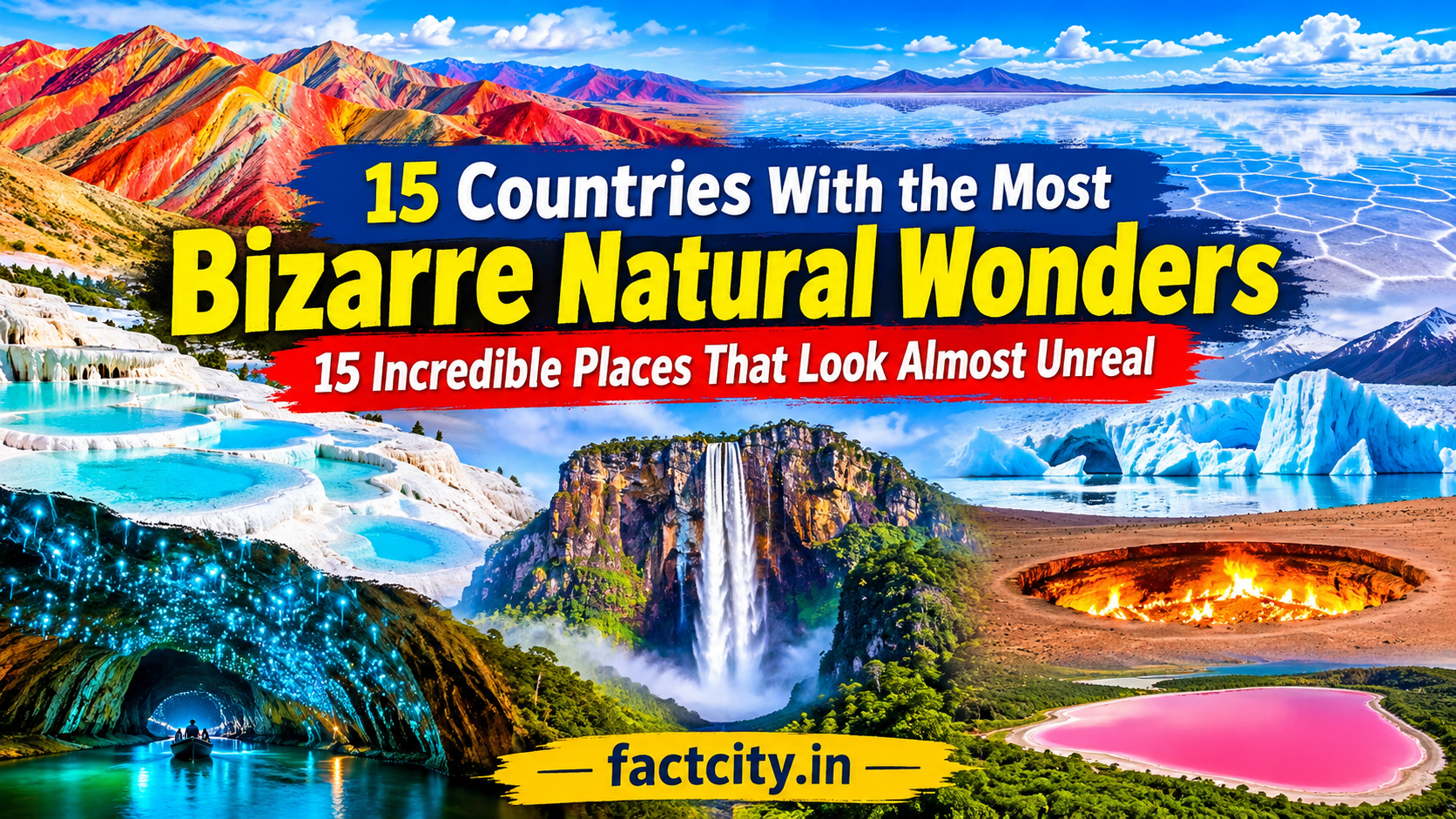
Countries With the Most Bizarre Natural Wonders: Nature has an incredible ability to surprise us with landscapes that seem almost impossible to exist. Around the world, there are places where mountains display rainbow colors, lakes look like giant mirrors, waterfalls drop from unbelievable heights, and underground caves shine like a sky full of stars. These extraordinary destinations are not created by artists or modern technology. They are natural formations shaped by thousands or even millions of years of geological changes, volcanic activity, erosion, minerals, and unusual environmental conditions. Some of these places look like scenes from science-fiction movies, while others seem to belong to a completely different planet. Every country has something special to offer, but a few are particularly famous for their bizarre and fascinating natural wonders. Exploring these destinations helps us understand how powerful nature can be and how many incredible secrets our planet still holds.
1. China – The Rainbow Mountains of Zhangye
China is home to one of the most colorful natural landscapes in the world, known as the Zhangye Danxia Landform Geological Park. Located in Gansu Province, these mountains are famous for their beautiful layers of red, orange, yellow, green, and other natural colors. From a distance, the mountains look as if someone has painted enormous colorful stripes across the landscape. However, these colors are completely natural. They developed over millions of years as different mineral-rich layers of sandstone and other rocks accumulated and were shaped by geological forces. Iron compounds and other minerals contribute to the different shades visible throughout the mountains. Wind, rain, and erosion gradually exposed these colorful layers, creating the unusual patterns visitors see today. The landscape looks especially spectacular when sunlight falls across the mountains, making the colors appear brighter and more dramatic. Zhangye Danxia is an amazing example of how natural geological processes can create artwork without any human involvement.
2. Bolivia – The Incredible Salar de Uyuni Salt Flats
Bolivia contains one of the most unusual natural landscapes on the planet: Salar de Uyuni, the world’s largest salt flat. Covering approximately 10,582 square kilometers, this enormous white surface stretches across the high-altitude Altiplano region. During the dry season, the ground looks like an endless white desert covered with beautiful geometric salt patterns. However, the landscape becomes even more extraordinary during the rainy season. A thin layer of water can cover the salt surface, creating a giant natural mirror that reflects the sky, clouds, and surrounding mountains. The horizon becomes difficult to distinguish, making visitors feel as though they are walking between two skies. Salar de Uyuni was formed from ancient lakes that gradually evaporated, leaving behind enormous deposits of salt and minerals. Besides its unusual beauty, the area is also important because it contains significant lithium resources. This natural wonder attracts photographers and travelers from around the world who want to experience its almost unreal appearance. Countries With the Most Bizarre Natural Wonders
3. Turkey – The White Terraces of Pamukkale
Turkey is famous for its historical architecture, but it also contains a natural wonder that looks like a frozen waterfall. Pamukkale, located in southwestern Turkey, is known for its brilliant white terraces filled with naturally heated mineral water. The name Pamukkale means Cotton Castle, which perfectly describes its unusual appearance. These terraces were formed when mineral-rich thermal water flowed down the hillside and gradually deposited calcium carbonate. Over time, the mineral deposits created beautiful white steps and shallow pools. The turquoise water flowing through these terraces creates a striking contrast against the bright white surface. Pamukkale is not just visually beautiful; it also has a long history because ancient communities valued its thermal springs. Nearby stands the ancient city of Hierapolis, which adds historical importance to the area. Together, the natural terraces and archaeological remains make this destination one of Turkey’s most remarkable attractions.
4. Iceland – The Land of Fire and Ice
Iceland is one of the most extraordinary countries for unusual natural scenery because it combines powerful volcanoes, massive glaciers, hot springs, waterfalls, and black sand beaches. Its nickname, the Land of Fire and Ice, describes the dramatic contrast between volcanic activity and frozen landscapes. One particularly unusual destination is Jökulsárlón Glacier Lagoon, where enormous pieces of ice break away from the Breiðamerkurjökull glacier and float slowly through a deep blue lagoon. Some icebergs appear bright white, while others have beautiful blue shades created by the way dense ice absorbs and scatters light. Another strange feature of Iceland is its black sand beaches, including Reynisfjara, where volcanic materials create dark shorelines and unusual rock formations. Iceland also has geothermal areas where steam rises naturally from the ground and hot water flows from underground. These features make the country feel like a completely different world and demonstrate the powerful relationship between volcanoes, glaciers, and water.
5. New Zealand – The Glowing Waitomo Caves
New Zealand is home to one of the most magical underground natural attractions in the world. The Waitomo Glowworm Caves are famous for thousands of tiny living organisms that produce a beautiful blue-green glow in complete darkness. These organisms are commonly known as glowworms and belong to a species of fungus gnat. They produce light through a natural chemical process called bioluminescence. The glow attracts insects, which can become trapped in sticky threads hanging from the cave ceilings. When visitors travel quietly through the underground waterways, they can see countless glowing points above them that resemble a star-filled night sky. The caves themselves were formed over long periods through the action of water dissolving limestone. Their underground rivers, chambers, and unusual rock formations make them fascinating geological environments. The combination of natural light production and underground scenery makes Waitomo one of the strangest natural wonders in New Zealand.
6. United States – The Mysterious Fly Geyser
The United States contains thousands of natural attractions, but Fly Geyser in Nevada is especially unusual. Its colorful appearance makes it look like a structure from a science-fiction movie. The geyser developed after geothermal drilling in the area, and hot water began rising through an opening in the ground. Over time, minerals from the water accumulated around the opening, creating unusual terraces and small formations. Heat-loving microorganisms also contribute to the striking red, orange, and green colors visible on its surface. Water continues to flow from the geyser, creating a constantly changing landscape. Unlike many natural attractions, Fly Geyser is located on private land, so public access is limited and generally requires an organized visit. Its unusual appearance demonstrates how geothermal activity and mineral deposits can transform an ordinary landscape into something extraordinary.
7. Australia – The Pink Lake Phenomenon
Australia is known for its unique wildlife and dramatic landscapes, but its pink lakes are among its most surprising natural features. Lake Hillier, located on Middle Island off the coast of Western Australia, became famous because of its unusual pink appearance. From above, the lake looks like a large pool of strawberry-colored water surrounded by green vegetation and blue ocean. Scientists associate the pink coloration of some salt lakes with microorganisms and pigments that thrive in extremely salty environments. However, the exact reasons behind the color of individual lakes can differ. Lake Hillier is particularly interesting because its pink appearance has been observed even when water is removed from the lake. Other pink lakes around the world may change color depending on weather, water levels, salinity, and biological conditions. This unusual natural phenomenon makes Australia’s pink lakes some of the most photographed landscapes in the world.
8. China – The Stone Forest of Yunnan
Another bizarre natural wonder in China is the Stone Forest, located in Yunnan Province. This unusual landscape contains thousands of tall limestone formations that rise from the ground like giant stone trees. Some formations resemble animals, people, towers, and sharp blades, making the area look like a forest made entirely of rock. The Stone Forest developed through a geological process called karst erosion. Rainwater gradually dissolves limestone and creates unusual shapes over extremely long periods. As softer material disappears, harder sections remain standing, forming the dramatic stone pillars visible today. The formations are spread across a large area and create narrow passages, natural corridors, and impressive rock gardens. This geological wonder is a reminder that even solid rock can change dramatically under the influence of water and time.
9. Turkmenistan – The Burning Gas Crater of Darvaza
Turkmenistan is home to one of the strangest and most dramatic sights in Central Asia: the Darvaza Gas Crater, often called the Door to Hell. Located in the Karakum Desert, this large crater has been burning for decades. The unusual phenomenon is associated with a Soviet-era drilling accident in the early 1970s, when a drilling area collapsed and released natural gas. The gas was reportedly ignited to prevent it from spreading, with the expectation that the fire would eventually burn out. However, flames continued burning for many years, creating an extraordinary sight in the middle of the desert. At night, the crater glows brightly against the darkness, making it look like a giant opening filled with fire. Although the crater has a human-made origin rather than being a completely natural formation, its connection to underground geological gas deposits makes it an unusual landscape worth understanding.
10. Chile – The Otherworldly Atacama Desert
Chile contains the Atacama Desert, one of the driest non-polar deserts on Earth. Some parts of this region receive extremely little rainfall, and certain locations have gone through long periods without measurable precipitation. Its dry climate has helped preserve unusual geological formations, salt deposits, and rocky landscapes. One of its most famous destinations is Valle de la Luna, or Moon Valley, where wind and erosion have shaped the ground into unusual ridges, valleys, and sharp formations. The landscape looks similar to the surface of another planet, which is why it has attracted scientific interest and served as a useful environment for testing equipment designed for extreme conditions. The Atacama is also famous for its exceptionally clear skies, making it one of the world’s leading locations for astronomical observation. Its combination of dryness, unusual rock formations, and impressive night skies makes it a remarkable natural destination.
11. Mexico – The Giant Crystals of Naica Cave
Mexico is home to one of the most extraordinary underground geological discoveries ever recorded: the Cave of Crystals in Naica. This remarkable cave contains enormous transparent gypsum crystals, some measuring several meters in length. The crystals developed under special underground conditions involving mineral-rich water and stable high temperatures over a very long period. Their incredible size makes the cave look like a giant crystal palace hidden beneath the Earth’s surface. However, the environment inside is extremely hot and humid, making it dangerous for people to enter without specialized protection. The cave was discovered by miners in 2000 while working underground. Because of the difficult environmental conditions and mining operations, public access is not available. Even so, the giant crystals remain an extraordinary example of how minerals can grow into massive natural structures under the right geological conditions.
12. Venezuela – The World’s Highest Waterfall
Venezuela is home to Angel Falls, officially recognized as the world’s highest uninterrupted waterfall. Located in Canaima National Park, the waterfall drops approximately 979 meters from the top of Auyán-tepui, a massive flat-topped mountain. The water falls from such a great height that some of it becomes mist before reaching the ground. The surrounding landscape contains ancient rock formations, dense forests, rivers, and enormous table mountains known as tepuis. These mountains are among the oldest geological formations on Earth and support unusual ecosystems with plants and animals adapted to isolated environments. Angel Falls is particularly impressive during the rainy season, when the increased water flow makes the waterfall even more dramatic. Its remote location and breathtaking height make it one of the most remarkable natural attractions in South America.
13. Madagascar – The Stone Forest of Tsingy de Bemaraha
Madagascar is famous for its unusual wildlife, but its natural landscapes are equally fascinating. Tsingy de Bemaraha National Park contains one of the strangest geological formations in the world. The word Tsingy is commonly associated with a place where one cannot walk barefoot, which describes the sharp limestone formations found throughout the area. Over thousands of years, rainwater gradually dissolved the limestone, creating deep cracks, narrow passages, caves, and towering stone pinnacles. Some sections look like a forest of sharp rocks rising toward the sky. These formations create unique habitats for several species of plants and animals, including lemurs that move through the surrounding forest and rocky environment. The area is also a UNESCO World Heritage Site because of its geological importance and biodiversity. It is one of the clearest examples of how erosion can create a landscape that looks almost impossible.
14. Namibia – The Fairy Circles of the Namib Desert
Namibia contains one of the most mysterious desert patterns on Earth. Across parts of the Namib Desert, thousands of nearly circular patches of bare ground appear among surrounding grasses. These formations are known as fairy circles. From above, they look like carefully arranged circles created by someone, but they are natural features. Scientists have proposed different explanations for their formation, including competition between grasses for limited water and the influence of sand termites. Research suggests that ecological and environmental factors may both play important roles in different locations. The circles can vary in size and form large patterns across the desert landscape. Their unusual appearance has made them a subject of scientific investigation for many years. The fairy circles demonstrate that even small changes in water availability and plant growth can create enormous patterns across an entire ecosystem.
15. Ethiopia – The Colorful Hydrothermal Landscape of Dallol
Ethiopia is home to Dallol, one of the most unusual and extreme geological environments on Earth. Located in the Danakil Depression, this region is famous for its bright yellow, orange, green, and white mineral formations. The colors come from mineral deposits, salt formations, and hydrothermal activity. Hot fluids rise from underground and interact with different minerals, creating unusual pools, crusts, and colorful surfaces. The region is also known for extremely high temperatures and harsh environmental conditions. Some of its hydrothermal pools are highly acidic and contain concentrated salts, making them unsuitable for ordinary contact. Dallol’s landscape looks almost like an alien world because of its unusual colors and bubbling mineral-rich formations. It is an extraordinary example of how volcanic and chemical processes can produce environments that are completely different from ordinary landscapes. countries-with-most-unusual-natural-phenomena
Why Are These Natural Wonders So Unusual?
The world’s most bizarre natural wonders are created through different geological, chemical, and biological processes. Some landscapes develop through volcanic activity, while others are shaped by water, wind, mineral deposits, or changing temperatures. For example, colorful mountains form when different mineral-rich rock layers become exposed through erosion, while salt flats develop after ancient lakes evaporate. Glowing caves demonstrate the fascinating ability of certain organisms to produce light through bioluminescence. Pink lakes and colorful hydrothermal areas show how microorganisms and minerals can influence the appearance of water and land. These natural processes often take thousands or millions of years, which makes the resulting landscapes even more impressive. Many of these places also support rare ecosystems and provide scientists with valuable opportunities to study Earth’s geological history.
Conclusion
The countries with the most bizarre natural wonders prove that our planet is full of surprises. From Bolivia’s giant reflective salt flats and China’s rainbow-colored mountains to Ethiopia’s colorful hydrothermal landscape and Madagascar’s sharp limestone formations, every destination offers something completely different. Some places look like scenes from science-fiction movies, while others appear as though they have been carefully designed by an artist. Yet these extraordinary landscapes are real and have been shaped by natural forces over enormous periods of time. They also remind us how important it is to protect Earth’s unique environments for future generations. Whether you love geography, science, photography, or travel, exploring these unusual natural wonders can help you appreciate just how beautiful, powerful, and mysterious our planet truly is.