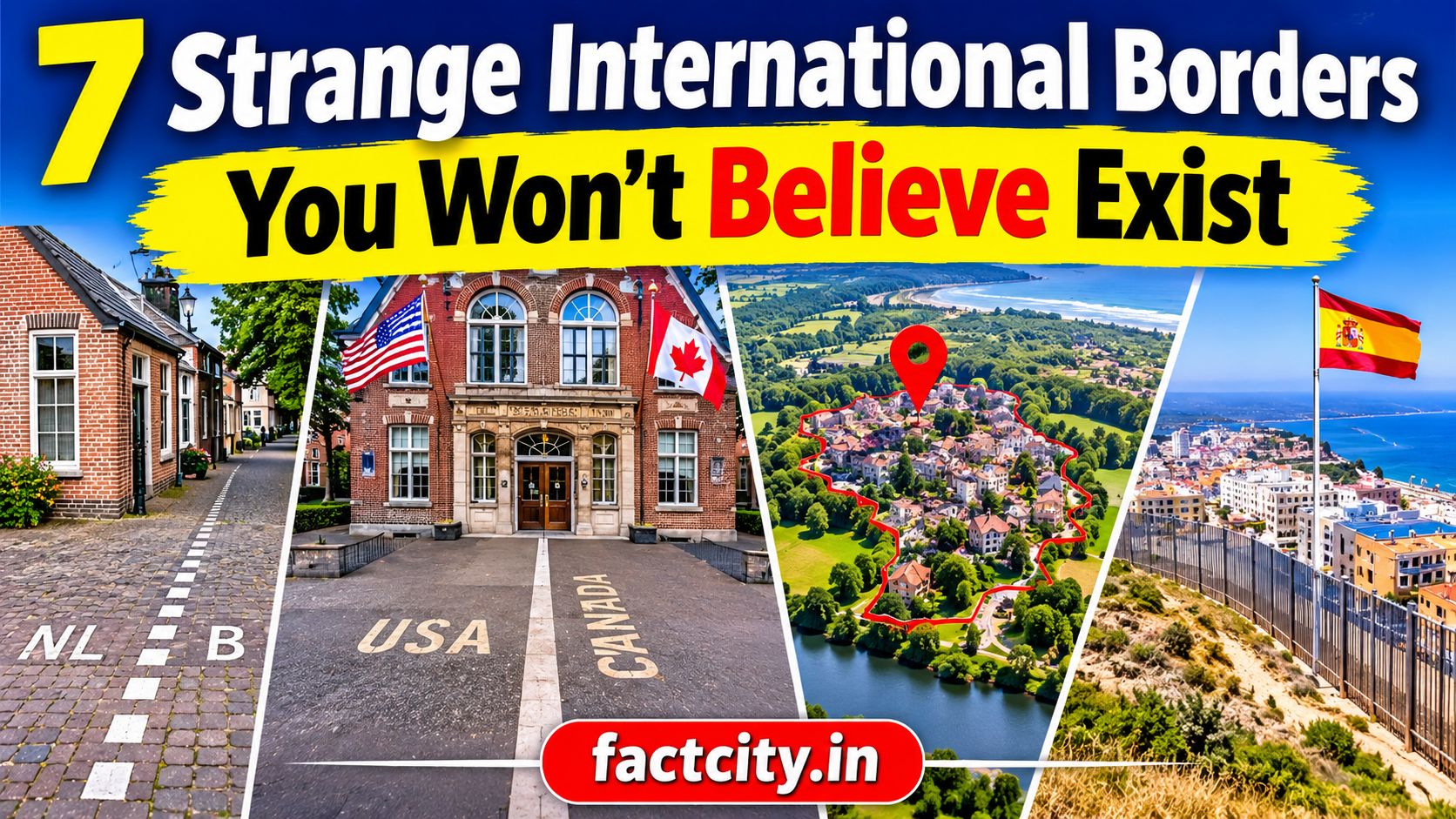
7 Strange International Borders. When we think about international borders, we usually imagine long fences, security checkpoints, rivers, mountains, or clearly marked lines separating one country from another. These borders help define national territories and determine where one country ends and another begins. However, not every international border follows the usual rules. Around the world, there are some incredibly unusual borders that pass through houses, divide small villages, cross streets, and even create situations where people can move between two countries without travelling very far.
Some international borders are so strange that they are difficult to believe until you see them on a map. In certain places, a person can have breakfast in one country and walk a few steps to have lunch in another. In other locations, a single building is divided between two nations, creating a completely unusual living arrangement.
These strange international borders exist because of historical agreements, wars, land ownership, political decisions, and geographical changes. Although they may look confusing, each border has an interesting story behind it. Here are seven strange international borders around the world that will make you look at country boundaries in a completely different way.
1. Belgium and the Netherlands – A Border That Runs Through Houses
One of the strangest international borders in the world can be found in the small towns of Baarle-Hertog in Belgium and Baarle-Nassau in the Netherlands. What makes this location so unusual is that the national border does not simply run along a road or through an open field. Instead, it passes through streets, gardens, shops, restaurants, and even private houses.
The area contains 30 enclaves, including 22 Belgian enclaves surrounded by Dutch territory and eight Dutch enclaves located within the Belgian enclaves. An enclave is a piece of land completely surrounded by another country’s territory. This unusual arrangement developed from historical land ownership agreements that eventually became international boundaries.
The border is marked with special signs and symbols on pavements, allowing visitors to see exactly where Belgium ends and the Netherlands begins. Some buildings are even divided between the two countries. In certain cases, the position of the main entrance determines which country’s rules apply to the property. Imagine living in a house where one part belongs to Belgium, and another belongs to the Netherlands. This is not a fictional situation; it is everyday life in Baarle. 7 Strange International Borders
2. India and Bangladesh – The Border That Once Created Countries Within Countries
The international border between India and Bangladesh has one of the most complicated histories in the world. For many years, this region contained unusual pieces of territory known as enclaves. These were small areas of one country completely surrounded by the land of another country, creating a confusing geographical arrangement.
Before the historic land exchange in 2015, India had 111 enclaves inside Bangladesh, while Bangladesh had 51 enclaves inside India. Some communities were surrounded by foreign territory, making everyday activities such as accessing schools, hospitals, government offices, and public services extremely difficult.
The situation developed through historical land arrangements and became more complicated after the partition of British India in 1947 and the creation of Bangladesh in 1971. Residents of these enclaves often faced difficulties because their home country’s main territory was separated from them by another nation.
Fortunately, India and Bangladesh reached an agreement to resolve these long-standing problems. On July 31, 2015, the exchange of enclaves was implemented under the Land Boundary Agreement. India transferred 111 former Indian enclaves to Bangladesh, while 51 former Bangladeshi enclaves became part of India. This historic agreement simplified the border and improved the situation for thousands of residents.
Although the complicated enclave system has largely become part of history, it remains one of the most remarkable examples of how unusual international borders can affect ordinary people’s lives.
3. United States and Canada – A Library Divided by an International Border
Imagine visiting a library where you can stand in the United States and look toward Canada without leaving the building. This unusual situation exists at the Haskell Free Library and Opera House, located on the border between Derby Line, Vermont, in the United States, and Stanstead, Quebec, in Canada.
The building was deliberately constructed across the international boundary and opened in 1904. It was designed to serve communities on both sides of the border. What makes it especially interesting is that the international boundary passes directly through the building, dividing parts of its interior between two countries.
Visitors can find a marked line on the floor showing where the United States ends and Canada begins. The building includes a library and an opera house, making it an unusual combination of cultural facilities located in two countries at the same time.
The Haskell Free Library is a wonderful example of how international borders do not always need to separate communities. Instead, this building was created to bring people together through education, literature, and entertainment.
However, visitors should be aware that access arrangements have changed. The sidewalk connecting the two countries beside the building was permanently closed from October 1, 2025, with a limited accessibility exemption. The building remains an extraordinary example of an international border passing through an everyday public place.
4. Belgium and Germany – A Railway Line That Changed the Border
The border between Belgium and Germany has another fascinating story involving an old railway line known as the Vennbahn. This railway once connected Aachen in Germany with areas farther south, providing an important transportation route for goods and passengers.
After the First World War, the Treaty of Versailles changed the political boundaries in this region. The railway line came under Belgian control, even though several sections of the track passed through German territory. As a result, the land occupied by the railway created unusual geographical situations along the border.
The arrangement left several small pieces of German territory separated from the rest of Germany and surrounded by Belgian territory. These areas became known as German exclaves. An exclave is a piece of a country’s territory that is geographically separated from its main territory.
Today, the railway is no longer used for regular train transportation. Instead, much of the former railway route has been transformed into a popular cycling and walking trail. The Vennbahn cycle route stretches approximately 125 kilometres through beautiful landscapes and historical locations.
This unusual border is a reminder that railway construction, political agreements, and historical events can sometimes change the geography of entire regions.
5. Germany and Switzerland – A German Village Completely Surrounded by Switzerland
Most people imagine that a country must be physically connected to its main territory. However, the small German village of Büsingen am Hochrhein challenges this idea. Although it officially belongs to Germany, it is completely surrounded by Swiss territory.
Located near the Swiss city of Schaffhausen, Büsingen is a German exclave covering approximately 7.62 square kilometres. This means residents must pass through Switzerland to reach the rest of Germany by road.
The unusual geographical situation developed because of historical land ownership arrangements. Changes involving neighbouring territories left Büsingen surrounded by Swiss communities. Over time, the village remained German even though its geographical position made it closely connected to Switzerland.
What makes this location even more interesting is that its political and economic arrangements are different. Büsingen belongs politically to Germany but has special customs and economic arrangements with Switzerland. Residents regularly interact with Swiss communities for everyday activities, including shopping, education, and employment.
The village even has some unusual identifying features, including German and Swiss postal codes. Its location demonstrates how a small piece of land can have a completely different relationship with neighbouring countries than its geographical position might suggest.
6. Spain and Morocco – European Territory Located in North Africa
When people think about Spain, they usually imagine European cities such as Madrid, Barcelona, and Seville. However, Spain also controls territories on the northern coast of Africa, creating one of the most unusual international border situations in the world.
Two important examples are Ceuta and Melilla. Both are Spanish autonomous cities located in North Africa and surrounded by Moroccan territory on their landward sides. They are separated from mainland Spain by the Mediterranean region and the Strait of Gibraltar.
The history of these territories goes back several centuries. Ceuta came under Spanish rule in the seventeenth century, while Melilla became a Spanish possession in 1497. When Morocco gained independence in 1956, both cities remained under Spanish administration.
The land borders between these Spanish cities and Morocco are particularly interesting because they mark the boundary between two different continents’ political and geographical worlds. These crossings are also important for trade, travel, migration, and border security.
The unusual location of Ceuta and Melilla makes them fascinating examples of how historical expansion and political decisions can leave a country with territory far away from its mainland.
7. Italy and Switzerland – An Italian Town Inside Swiss Territory
Another strange international border can be found between Italy and Switzerland. The small Italian town of Campione d’Italia is surrounded almost entirely by Swiss territory and sits beside the beautiful Lake Lugano.
Although Campione d’Italia is geographically located inside Switzerland, it officially belongs to Italy. This makes it an Italian exclave and creates an unusual situation for its residents, who are geographically separated from the rest of their country.
The town has a long and interesting history connected to the political and territorial arrangements of the region. Its location has made it closely connected to neighbouring Swiss communities, particularly because Switzerland surrounds it and provides the most direct routes to other nearby places.
For many years, Campione also had special customs and economic arrangements because of its unusual position. These arrangements changed when it entered the European Union’s customs territory in 2020, although its geographical location remained the same. countries-with-the-most-unusual-weather-conditions
The town is particularly interesting because it combines Italian identity, architecture, food, and culture with a geographical setting that is strongly connected to Switzerland. It shows that national identity and physical location do not always follow the same geographical pattern.
For visitors, Campione d’Italia offers a remarkable experience of seeing an Italian town surrounded by Swiss landscapes. It is another example of how European history has created some of the world’s most unusual international boundaries.
Why Do These Strange International Borders Exist?
These unusual international borders did not appear overnight. Most of them developed because of historical events, political agreements, wars, land ownership disputes, and geographical circumstances. In some cases, countries inherited complicated boundaries from earlier kingdoms and empires. In other situations, governments created special agreements to protect transportation routes, manage communities, or settle territorial disagreements.
One important thing to understand is that international borders are not always simple lines separating two countries. They can pass through buildings, surround entire villages, divide communities, or create small pieces of territory completely disconnected from their parent country.
For the people living in these places, such borders are more than interesting geographical features. They can influence citizenship, transportation, education, business, taxes, and everyday activities. Governments often need special arrangements to make life easier for people living in these unusual locations.
Conclusion
The world is full of geographical surprises, and these seven strange international borders are excellent examples of how complicated national boundaries can become. From houses divided between Belgium and the Netherlands to a German village surrounded by Switzerland, each location tells a unique story about history, politics, and geography.
Some borders were created through old agreements, while others developed because of historical conflicts and territorial changes. The former enclaves between India and Bangladesh also show how complicated boundaries can affect thousands of ordinary people and why peaceful agreements are important.