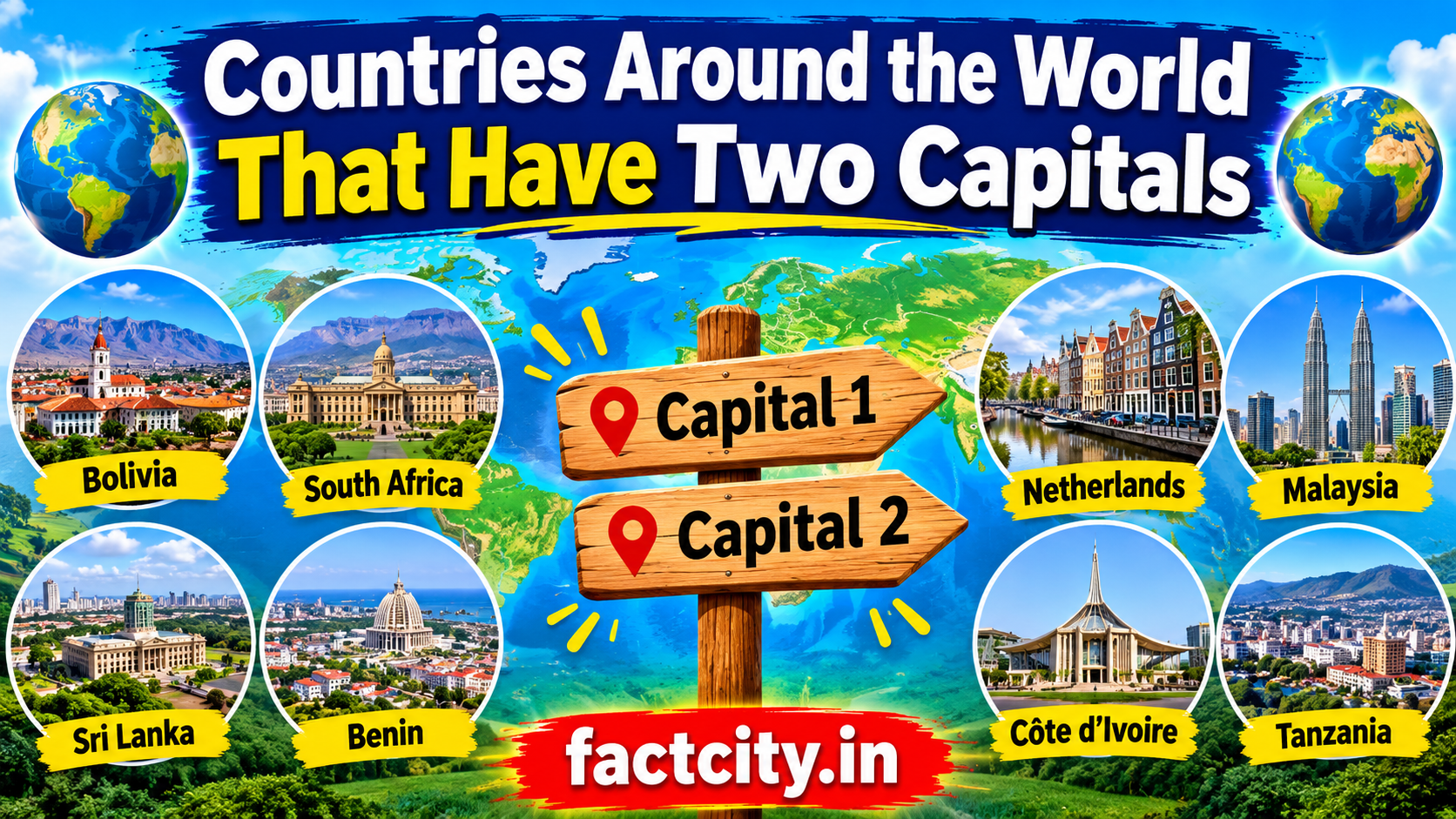
Countries Around the World: When people think about the capital city of a country, they usually imagine one major city where the government operates, important decisions are made, and national institutions are located. However, not every country follows this traditional system. Some countries around the world have two capitals, with important government responsibilities divided between different cities. In certain cases, one city serves as the official capital, while another is responsible for administrative, legislative, or judicial activities.
Having two capitals may sound unusual, but there are interesting historical, political, geographical, and practical reasons behind this arrangement. Some countries adopted this system to balance power between different regions, while others developed it because of historical circumstances or the need to move government institutions to a more suitable location.
These countries offer a fascinating look at how different nations organize their governments and manage their national responsibilities. Let’s explore countries around the world that have two capitals and understand what makes each arrangement unique.
What Does It Mean When a Country Has Two Capitals?
A country with two capitals usually has its important government functions divided between two cities. For example, one city may be the official or constitutional capital, while another may serve as the administrative centre where the president, ministers, and government departments work.
In some countries, the parliament operates in one city while the courts are located in another. Other nations have moved their administrative offices to a new city but kept their original capital for historical and cultural reasons. Countries Around the World
It is important to understand that not every country on this list officially recognizes two equal capital cities. Some have one constitutional capital and a separate seat of government. Nevertheless, both cities play important roles in the country’s national administration.
1. Bolivia – Sucre and La Paz
South America
Bolivia is one of the best-known examples of a country that divides its capital functions between two cities. Sucre is the constitutional capital of Bolivia, while La Paz serves as the seat of government and the main centre of political administration.
Sucre has enormous historical importance because it played a major role in Bolivia’s independence movement. It is also home to the country’s Supreme Court, making it an important centre for the judicial system. The city is known for its beautiful colonial architecture, historic buildings, and cultural heritage.
La Paz, on the other hand, is where the president, government ministries, and national legislature operate. It is one of the world’s highest major cities, surrounded by the impressive Andes Mountains. Its location and political importance make it one of the most recognizable cities in South America.
The division between Sucre and La Paz developed through historical and political conflicts in the late nineteenth century. Today, both cities remain important to Bolivia, but their responsibilities are different.
2. South Africa – Pretoria, Cape Town, and Bloemfontein
Africa
South Africa is particularly interesting because it does not have just two capitals. Instead, it has three capital cities, each responsible for a different branch of government.
Pretoria is the administrative and executive capital. It is where the president’s main government offices and many national departments are located. The city is also known for its historic buildings, beautiful gardens, and important monuments.
Cape Town is the legislative capital of South Africa. The country’s Parliament meets here, and important national laws are discussed and passed in the city. Cape Town is also a popular tourist destination because of Table Mountain, its beaches, and its attractive coastline.
Bloemfontein is traditionally known as the judicial capital because it has been home to an important part of South Africa’s judicial system, including the Supreme Court of Appeal. However, the Constitutional Court is located in Johannesburg, so the country’s judicial functions are not entirely concentrated in Bloemfontein.
This three-capital arrangement developed as a political compromise when the Union of South Africa was established in 1910. Instead of giving all national institutions to one city, different responsibilities were distributed among several locations.
3. Netherlands – Amsterdam and The Hague
Europe
The Netherlands is another fascinating example of a country where the official capital and the seat of government are located in different cities. Amsterdam is the constitutional capital, while The Hague serves as the centre of national government.
Amsterdam is famous for its historic canals, museums, beautiful architecture, and cultural attractions. It is also the country’s largest city and an important centre for tourism, business, and international trade.
However, most national political activities take place in The Hague. The Dutch parliament, government ministries, and many important government institutions are located there. The city is also home to the International Court of Justice and several other international organizations.
One interesting fact is that the Dutch monarch is formally inaugurated in Amsterdam, even though the government operates from The Hague.
This arrangement has historical roots. Amsterdam retained its status as the capital, while The Hague developed as the political and administrative centre of the country.
4. Malaysia – Kuala Lumpur and Putrajaya
Asia
Malaysia has two cities that perform different national roles: Kuala Lumpur and Putrajaya. Kuala Lumpur is the official national capital, while Putrajaya serves as the federal administrative centre.
Kuala Lumpur is one of Southeast Asia’s most famous cities. It is known for the Petronas Twin Towers, modern shopping centres, cultural attractions, and busy commercial districts. The Malaysian Parliament is located in Kuala Lumpur, and the city remains an important political and economic centre.
Putrajaya was developed to reduce the pressure on Kuala Lumpur and provide a more organized location for federal government offices. It became the administrative centre in the late 1990s, and many ministries and government departments moved there.
The city is famous for its wide roads, planned neighbourhoods, modern government buildings, and beautiful Putra Mosque. Its architecture gives it a different appearance from the crowded streets of Kuala Lumpur.
The decision to develop Putrajaya was mainly connected to the need for better government administration and improved urban planning. Today, both cities play important roles in Malaysia’s national system.
5. Sri Lanka – Colombo and Sri Jayawardenepura Kotte
South Asia
Sri Lanka is another country where two nearby cities share important national responsibilities. Sri Jayawardenepura Kotte is the legislative capital and the location of the national Parliament, while Colombo remains the country’s major commercial centre and an important location for government institutions.
Colombo is the largest city in Sri Lanka and has long played a major role in the country’s economy, business, transportation, and international trade. It is home to important financial institutions, government offices, and diplomatic missions.
Sri Jayawardenepura Kotte became the location of the national Parliament in 1982. The decision was part of an effort to develop a separate administrative and legislative centre outside the busy areas of Colombo.
Although the two cities are closely connected geographically, they have different identities and responsibilities. Colombo remains the more internationally recognized city, while Kotte has special importance in the country’s political structure.
6. Benin – Porto-Novo and Cotonou
West Africa
Benin is an interesting example of a country where the official capital and the main seat of government are located in different cities. Porto-Novo is the official capital, but Cotonou is the country’s largest city and the main centre of government activities.
Porto-Novo has historical importance and is known for its traditional architecture, cultural heritage, and colonial-era buildings. It is also the location of the national legislature.
Cotonou, however, plays a much larger role in everyday administration and economic activities. Many government offices, ministries, businesses, and international organizations operate from this busy coastal city.
Cotonou is also an important commercial and transportation centre because of its port, which supports international trade and economic activity.
The arrangement developed partly because Cotonou became the country’s dominant economic and administrative centre, even though Porto-Novo retained its official capital status.
7. Eswatini – Mbabane and Lobamba
Southern Africa
Eswatini, formerly known as Swaziland, is a small landlocked country in southern Africa. It has two important capital cities: Mbabane and Lobamba.
Mbabane is the administrative capital and the main location for many government offices. It is also the country’s largest urban centre and an important location for business and public services.
Lobamba has a different role. It is the traditional and royal capital, and it is home to important national institutions, including the Parliament and the royal residence. The city plays a major role in the country’s political and cultural traditions.
The division between these two cities reflects Eswatini’s unique system of government, which combines modern administrative institutions with traditional royal structures.
Although Mbabane is generally associated with everyday government administration, Lobamba remains central to the monarchy and national legislative activities.
8. Côte d’Ivoire – Yamoussoukro and Abidjan
West Africa
Côte d’Ivoire, also known as Ivory Coast, is another country with an interesting division between its official political capital and its main economic and administrative centre.
Yamoussoukro is the official capital of the country. It became the capital in 1983, replacing Abidjan in this role. The city is especially famous for the Basilica of Our Lady of Peace, one of the largest church buildings in the world.
Abidjan, however, remains the country’s largest city and its most important commercial and economic centre. Many government activities, businesses, financial institutions, and international organizations continue to operate there.
Abidjan is also an important port city and plays a major role in West African trade. Its modern skyline, busy markets, and developed infrastructure make it one of the region’s most influential urban centres.
The capital relocation was intended to promote development outside Abidjan and give greater importance to the country’s interior. However, Abidjan has retained much of its practical importance.
9. Burundi – Gitega and Bujumbura
East Africa
Burundi provides another example of a country that separates its political and economic responsibilities between two cities. Gitega is the political capital, while Bujumbura remains the economic capital.
Gitega became Burundi’s political capital in 2019. The decision was made to move important national institutions away from Bujumbura and encourage development in the country’s interior.
Gitega is located in the central part of Burundi and has historical and cultural importance. Its selection as the political capital was also intended to create a more balanced distribution of national development.
Bujumbura, meanwhile, remains the country’s largest city and a major economic centre. It is located near Lake Tanganyika and plays an important role in business, transportation, trade, and commercial activities.
Although the political capital changed, Bujumbura continues to be extremely important to Burundi’s economy and everyday life.
10. Tanzania – Dodoma and Dar es Salaam
East Africa
Tanzania is another country where the official capital and the former capital have different levels of importance. Dodoma is the official capital, while Dar es Salaam remains the country’s largest city and an important economic centre.
The decision to move the capital from Dar es Salaam to Dodoma was announced in 1973. The main idea was to establish a more centrally located capital that could improve administration and encourage development in different parts of the country.
Dodoma became the official capital, and important government institutions, including Parliament, were relocated there. The city has gradually developed into a major political and administrative centre.
Dar es Salaam, however, continues to be Tanzania’s largest city and an important centre for international trade, business, transportation, and industry. It also has a major seaport that connects Tanzania with international markets.
The transfer of government responsibilities took many years, which explains why Dar es Salaam continues to have considerable national importance.
Why Do Some Countries Have Two Capitals?
There is no single reason why countries divide their capital responsibilities between different cities. Each country has its own historical background, political situation, and administrative requirements. However, several common reasons explain why this arrangement exists.
1. Historical Reasons: Some cities became capitals because of their historical importance. Even after governments moved their main offices elsewhere, the original capital retained its official status and cultural significance.
2. Political Compromises: In some countries, different regions wanted equal political importance. Dividing government responsibilities between cities helped create a balance and avoid giving too much power to one region.
3. Better Administration: Large cities can experience overcrowding, traffic congestion, and pressure on public infrastructure. Moving government departments to another city can make administration more organized.
4. Economic Development: Establishing a new administrative capital can encourage investment, create employment opportunities, and improve infrastructure in less-developed regions.
5. Geographical Advantages: Sometimes, governments choose a different city because it offers a more central location, better transportation connections, or more suitable conditions for national administration.
Frequently Asked Questions About Countries With Two Capitals
Which country has three capital cities?
South Africa is famous for having three capital cities: Pretoria, Cape Town, and Bloemfontein. They are associated with executive, legislative, and judicial responsibilities, respectively. incredible-discoveries-found-beneath-the-earth
Which country has two capitals in South America?
Bolivia is a well-known example. Sucre is its constitutional capital, while La Paz is the seat of government and the main centre of national political administration.
Does the Netherlands have two capitals?
Amsterdam is the official constitutional capital of the Netherlands, while The Hague is the seat of government and the location of Parliament.
Why does Malaysia have two capital cities?
Malaysia maintains Kuala Lumpur as its national capital, while Putrajaya serves as the federal administrative centre. Putrajaya was developed to reduce administrative pressure on Kuala Lumpur.
Are two capitals officially recognized in every country on this list?
No. Some countries have two officially recognized capital roles, while others have one official capital and another city that serves as the administrative, legislative, or economic centre. Their arrangements are not legally identical.
Conclusion
Countries around the world that have two capitals demonstrate that there is no single way to organize a national government. While most countries concentrate their important institutions in one capital city, others divide responsibilities between different locations for historical, political, geographical, and administrative reasons.
From Bolivia’s Sucre and La Paz to Malaysia’s Kuala Lumpur and Putrajaya, every arrangement has its own interesting background. South Africa takes this concept even further by distributing important government responsibilities among three cities.
These unusual capital arrangements also show how countries adapt their political systems to changing needs. A city may remain the official capital because of its history, while another becomes the centre of everyday government activities. Understanding these differences makes world geography even more interesting and helps us discover how nations function beyond what we see on a map.