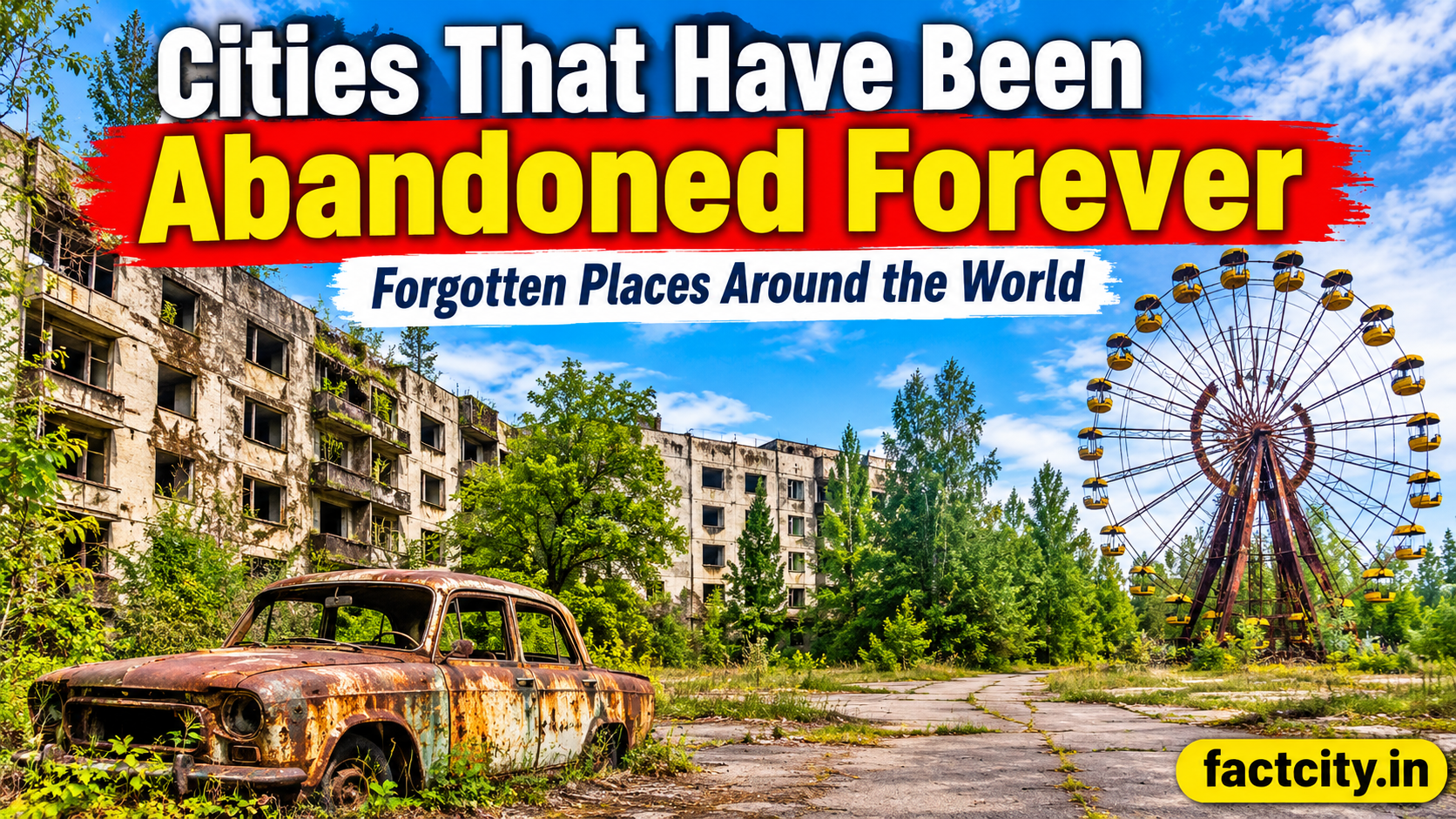
Cities That Have Been Abandoned Forever: Throughout history, people have built magnificent cities filled with homes, markets, roads, temples, and impressive buildings. Some of these cities once supported thousands of residents and played important roles in trade, culture, politics, and everyday life. However, wars, natural disasters, economic decline, environmental changes, and mysterious circumstances eventually forced people to leave them behind.
Today, many of these abandoned cities remain as silent reminders of the past. Their empty streets, damaged buildings, forgotten homes, and overgrown structures tell fascinating stories about the people who once lived there. Some places were abandoned suddenly, while others slowly lost their populations over several generations.
What makes these locations especially interesting is that many of them have never returned to their former lives. Although visitors and researchers may explore their remains, the original communities are gone. Here are some remarkable cities around the world that were abandoned and left behind.
1. Pripyat, Ukraine
The city abandoned after the Chornobyl nuclear disaster
Pripyat is one of the most famous abandoned cities in the world. Located in northern Ukraine, it was established in 1970 to provide housing for workers and families connected to the nearby Chornobyl Nuclear Power Plant. Before the disaster, Pripyat was a modern and growing city with schools, hospitals, shops, sports facilities, and entertainment centers. Cities That Have Been Abandoned Forever
Everything changed on April 26, 1986, when a reactor at the Chornobyl power plant exploded during a safety test. The accident released dangerous radioactive material into the surrounding environment. Although residents initially continued their daily routines, authorities ordered a mass evacuation the following day. Approximately 49,000 people were relocated from Pripyat.
Residents were told that their departure would be temporary, so many left behind furniture, photographs, toys, clothing, and personal belongings. However, they never returned to live in their homes. Today, empty apartment buildings, abandoned schools, and the famous amusement park create an unforgettable picture of a city frozen in time. Pripyat remains one of the strongest examples of how a technological disaster can permanently change an entire community.
2. Hashima Island, Japan
Hashima Island, also known as Gunkanjima or Battleship Island, is an abandoned industrial settlement located off the coast of Nagasaki, Japan. Its unusual appearance comes from the large concrete buildings and protective sea walls that surround the small island.
During the late 19th and 20th centuries, Hashima became an important coal-mining center. Thousands of workers and their families lived on the island because of the mines beneath the surrounding seabed. At its busiest period, it had an extremely high population density, with apartment blocks, schools, shops, and other facilities packed into a limited area.
However, Japan gradually shifted from coal to petroleum as its main energy source. As demand for coal declined, the mine became less economically useful. In 1974, the mining operation closed, and the remaining residents were forced to leave.
Since then, the island has remained largely uninhabited. Its concrete structures have been damaged by wind, rain, and seawater, making it look like the remains of a forgotten industrial world. Hashima is now recognized as part of a UNESCO World Heritage site connected to Japan’s industrial history.
3. Centralia, United States
Centralia is a former mining town in Pennsylvania that became famous because of an underground coal fire that has burned for decades. It was once a small but active community with homes, businesses, churches, and schools.
The major problem began in 1962 when a fire ignited coal deposits beneath the town. The flames spread through underground mining tunnels and became extremely difficult to control. Over time, the burning coal produced dangerous gases and caused sections of the ground to become unstable.
Residents faced serious risks, including toxic fumes, ground cracks, and the possibility of sudden collapses. Government authorities eventually organized relocation programs, and most people left their homes. The town’s population declined dramatically, and many buildings were demolished.
Unlike ordinary abandoned towns, Centralia still has an underground fire that has continued for generations. Although a small number of residents remained for years, the area is now mostly empty. It is an unusual example of how an environmental problem can make an otherwise ordinary town unsuitable for permanent settlement.
4. Kolmanskop, Namibia
Kolmanskop is a famous abandoned diamond-mining town located in the Namib Desert. At the beginning of the 20th century, diamonds were discovered in the region, attracting workers, investors, and business owners. The discovery quickly transformed a remote desert location into a wealthy mining settlement.
During its most prosperous years, Kolmanskop had impressive facilities, including large houses, a hospital, a school, a ballroom, and shops. Some buildings reflected European architectural styles, creating a striking contrast with the surrounding desert.
However, the diamond deposits gradually became less profitable, and richer diamond discoveries elsewhere attracted mining companies. As economic activity declined, residents began leaving the settlement. By the mid-20th century, Kolmanskop had been abandoned.
Today, desert sand has entered many of its buildings, filling rooms and hallways. Windows and doors have been damaged, while dunes have slowly covered the remains of the town. Kolmanskop has become a popular destination for photographers and tourists interested in abandoned places.
5. Craco, Italy
Craco is a beautiful medieval hilltop town in southern Italy that looks like something from a historical movie. Surrounded by dramatic landscapes and rocky hills, it once had a thriving community with stone houses, narrow streets, churches, and traditional Italian architecture.
For centuries, people lived in Craco and depended mainly on agriculture. However, the town gradually faced serious environmental problems. Landslides, soil instability, and flooding made everyday life increasingly difficult. The situation became particularly dangerous during the 20th century, when major landslides damaged buildings and threatened the safety of residents.
In 1963, the remaining population was evacuated, and the town was eventually left empty. An earthquake in 1980 caused further damage to the already weakened structures.
Today, Craco stands almost like a forgotten medieval world. Its abandoned buildings remain visible across the hillside, creating a fascinating landscape that attracts photographers, filmmakers, and history enthusiasts. The town is a reminder that even beautiful settlements can become uninhabitable when the surrounding land becomes unstable.
6. Oradour-sur-Glane, France
Oradour-sur-Glane is different from many other abandoned places because its disappearance was connected to one of the darkest events of World War II. Located in western France, this peaceful village once had ordinary homes, shops, restaurants, schools, and a close-knit community.
On June 10, 1944, German Waffen-SS soldiers entered the village and carried out a horrific massacre. A total of 642 people, including women and children, were murdered, while much of the village was burned and destroyed.
After the war, French authorities decided not to rebuild the original village. Instead, its ruins were preserved as a permanent memorial to the innocent people who lost their lives. A new settlement was established nearby, while the remains of the old village were protected.
Visitors can still see damaged buildings, burned vehicles, abandoned shops, and other objects that remained after the tragedy. Unlike other ghost towns, Oradour-sur-Glane was not simply forgotten because of economic decline or natural disasters. Its ruins have been deliberately preserved so future generations can understand the human cost of war and remember the victims. HISTORY
7. Varosha, Cyprus
Varosha is an abandoned coastal district in Famagusta, Cyprus, that was once a popular holiday destination. During the 1960s and early 1970s, it became famous for its beautiful beaches, luxury hotels, restaurants, and lively tourism industry.
Thousands of visitors travelled to Varosha every year, and the area was considered one of the most attractive holiday locations in the eastern Mediterranean. Its hotels welcomed international tourists, while shops and entertainment facilities supported a growing local economy.
However, everything changed in 1974 during the conflict that followed a coup in Cyprus and the Turkish military intervention. Residents fled the area, leaving their houses, hotels, and businesses behind. The district was subsequently placed under military control and remained inaccessible to most people for decades.
For many years, the empty hotels and streets became symbols of a community that had disappeared almost overnight. Although parts of Varosha have seen limited reopening in recent years, it has not returned to its former condition as a fully functioning tourist district.
Its abandoned buildings and damaged beachfront structures still reflect the dramatic changes caused by political conflict.
8. Pyramiden, Norway
Pyramiden is a former mining settlement located on the Svalbard archipelago in the Arctic region of Norway. It was once an important coal-mining community and later developed into a Soviet settlement with residential buildings, public facilities, and cultural institutions.
The town was designed to support workers and their families living in one of the coldest and most remote inhabited regions of the world. Despite its isolated location, Pyramiden had apartments, a school, a sports complex, a cultural center, and other facilities that made everyday life more comfortable.
However, the coal industry eventually became less profitable, and maintaining such a remote settlement became increasingly difficult. Mining operations ended in 1998, and most residents left the town.
Today, Pyramiden is known for its empty Soviet-style buildings, quiet streets, and impressive Arctic surroundings. A statue of Vladimir Lenin still stands in its central square, making the settlement particularly interesting to history enthusiasts.
Unlike completely inaccessible abandoned cities, Pyramiden receives organized visitors and has some tourism facilities. Nevertheless, it has never returned to its former role as a busy residential mining town.
9. Agdam, Azerbaijan
Agdam was once a large and active city in Azerbaijan, known for its residential neighborhoods, businesses, schools, religious buildings, and agricultural connections. Before the Nagorno-Karabakh conflict, thousands of people lived there and built their everyday lives around its growing community.
The situation changed dramatically during the conflict in the early 1990s. In 1993, Armenian forces captured the city, and most of its residents were displaced. Many buildings were damaged, destroyed, or left abandoned.
For many years, Agdam became known as a ghost city because its streets and structures remained largely empty. Some buildings were gradually reduced to ruins, while vegetation and natural elements took over parts of the former urban area.
However, Agdam is an important example where the word forever needs some qualification. Following Azerbaijan’s recovery of control over the area in 2020, reconstruction and redevelopment projects began. The city is therefore not simply an untouched abandoned settlement today. Its history demonstrates how conflict can destroy communities and how rebuilding may eventually begin after decades of displacement.
10. Kayaköy, Turkey
Kayaköy is a historic abandoned village in southwestern Turkey, near the popular coastal region of Fethiye. It was once home to a Greek Orthodox community and contained hundreds of stone houses, churches, schools, and narrow pathways.
The village experienced a major transformation following the population exchange between Greece and Turkey in 1923. Under the agreement, many Greek Orthodox residents of Turkey were relocated to Greece, while Muslim residents of Greece moved to Turkey.
As a result, Kayaköy lost much of its original population. The settlement was not successfully repopulated on its previous scale, and many houses were gradually left empty.
Today, the abandoned stone buildings cover the hillside, creating a remarkable historical landscape. Visitors can walk through the old streets and observe the remains of homes and religious structures that once supported a lively community.
Kayaköy is particularly interesting because its abandonment was connected to political decisions and population movement rather than a single natural disaster.
Why Do Cities Become Abandoned Forever?
There is rarely just one reason why an entire city becomes empty. In many cases, several problems develop together and eventually make it impossible for residents to continue living there.
Natural disasters are among the major reasons. Earthquakes, landslides, volcanic eruptions, floods, and underground fires can destroy homes and damage essential infrastructure. When rebuilding becomes too expensive or dangerous, residents may have no choice but to relocate.
War and political conflict can also lead to permanent abandonment. Cities such as Oradour-sur-Glane and Agdam demonstrate how violence and displacement can completely change the future of a community.
Economic decline is another important factor. Mining settlements such as Hashima Island and Kolmanskop depended heavily on specific industries. When valuable resources became unavailable, or businesses closed, residents moved elsewhere to find employment.
Environmental contamination, changing weather conditions, and a lack of essential resources can create additional challenges. Sometimes, even a city with beautiful buildings and a strong history cannot survive when its basic conditions for living disappear.
What Happens to Abandoned Cities After People Leave?
Once residents leave a city, nature gradually begins to change its appearance. Without regular maintenance, roads develop cracks, roofs collapse, windows break, and buildings become weaker. Rainwater enters empty houses, while plants grow through sidewalks and walls.
Wild animals may also move into abandoned neighborhoods. Birds build nests inside buildings, insects occupy empty rooms, and larger animals sometimes use deserted structures as shelter. In places such as Pripyat, nature has gradually reclaimed areas that were once filled with human activity.
Weather conditions also play an important role. In desert locations such as Kolmanskop, moving sand slowly fills abandoned buildings. In coastal settlements, salty air and strong winds damage concrete and metal structures.
However, abandoned cities do not always disappear completely. Some are protected as historical monuments, while others become tourist attractions or research locations. Their remaining buildings provide valuable information about architecture, industrial development, culture, and the everyday lives of earlier generations.
Can Abandoned Cities Become Active Again?
Yes, some abandoned cities can experience redevelopment, but returning them to their original condition is often extremely difficult. The possibility of recovery depends on why the settlement was abandoned in the first place.
If a city became empty because of economic decline, new industries and investment may help bring people back. If the problem was a natural disaster, authorities may need to repair infrastructure and ensure that the area is safe before allowing permanent settlement. worlds-hidden-natural-wonders-10-incredible-places
However, locations affected by radioactive contamination, severe environmental damage, or ongoing political disputes may face much greater challenges. In some cases, rebuilding an entirely new community nearby is more practical than restoring the original settlement.
Places such as Agdam demonstrate that a city can begin a new chapter after years of abandonment. Meanwhile, the preserved ruins of Oradour-sur-Glane show that some locations are more valuable as historical memorials than as rebuilt residential areas.
Conclusion
Cities that have been abandoned forever offer a fascinating look into the rise and fall of human communities. From the empty streets of Pripyat to the sand-covered houses of Kolmanskop and the historic ruins of Craco, every location has a different story to tell.
Some were destroyed by natural disasters, others lost their economic importance, and several were affected by wars and political conflicts. Although their original residents may never return, these forgotten places continue to attract attention from historians, researchers, photographers, and travellers.
More importantly, abandoned cities remind us that even the most successful communities are not permanent. Economic changes, environmental challenges, and unexpected events can transform a thriving city into an empty landscape. Their remaining structures preserve pieces of history and help us understand how quickly the world around us can change.