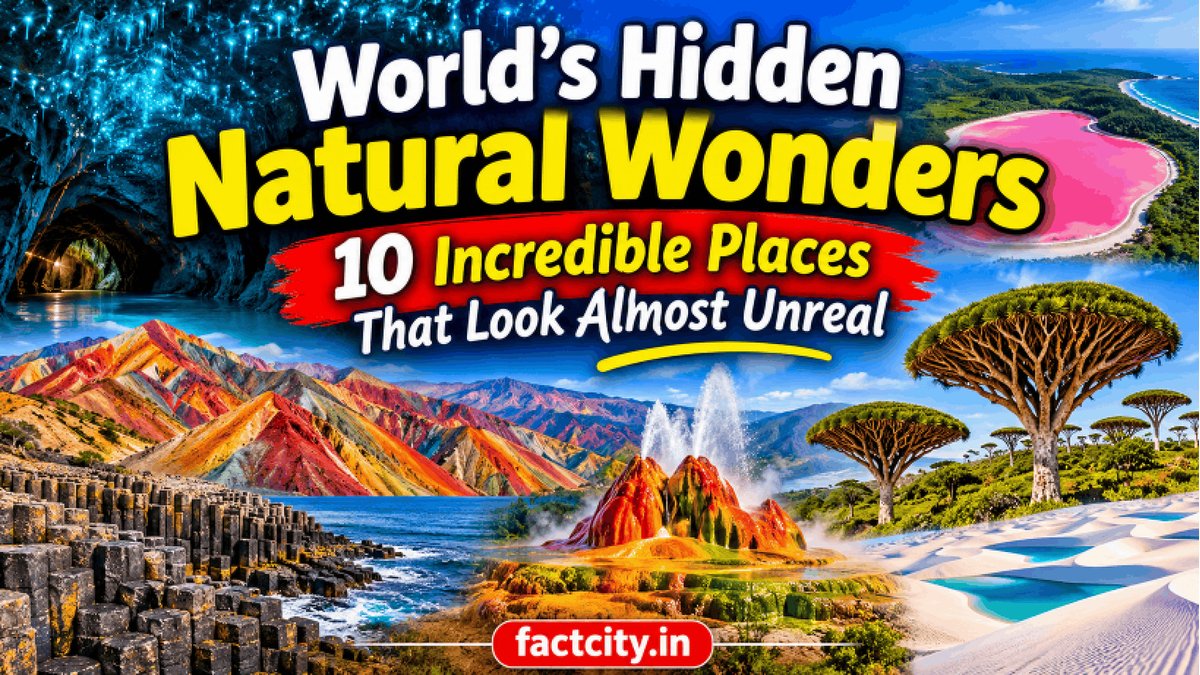
World’s Hidden Natural Wonders: Nature is full of surprises, and some of the most beautiful places on Earth remain hidden from the eyes of ordinary travelers. While famous destinations such as the Grand Canyon, Niagara Falls, and Mount Everest attract millions of visitors, there are countless lesser-known natural wonders waiting to be discovered. From colorful lakes and mysterious caves to glowing beaches, unusual rock formations, and breathtaking waterfalls, our planet is filled with places that look almost too beautiful to be real.
These hidden natural wonders remind us how creative and powerful nature can be. Some have been formed over millions of years through volcanic activity, erosion, and shifting tectonic plates, while others are the result of unusual weather conditions and natural chemical reactions. Many are located far away from crowded cities, making them peaceful destinations for people who love adventure and exploration.
If you enjoy discovering unusual places and learning interesting facts about our planet, these incredible natural wonders deserve a place on your travel bucket list. Here are ten of the world’s hidden natural wonders that showcase the extraordinary beauty of Earth.
1. Waitomo Glowworm Caves, New Zealand
Deep beneath the green landscapes of New Zealand lies one of the most magical natural attractions in the world. The Waitomo Glowworm Caves are famous for thousands of tiny glowworms that create a beautiful blue-green light across the cave ceilings. When visitors enter the dark underground chambers, the glowing lights look like a sky filled with stars.
These lights are produced by glowworm larvae belonging to a species known as Arachnocampa luminosa, which is native to New Zealand. The glowworms use their natural light to attract small insects into sticky threads hanging below them. This fascinating biological process creates an unforgettable sight for visitors.
One of the best ways to experience the caves is through a quiet boat ride along the underground river. As the boat moves through the darkness, visitors can look up and enjoy the glowing ceiling without disturbing the delicate environment. The Waitomo Glowworm Caves are a wonderful example of how even tiny creatures can create something extraordinary.
2. Lake Hillier, Australia
Imagine discovering a lake that looks like someone has filled it with bright pink paint. That is exactly what Lake Hillier looks like. Located on Middle Island off the coast of Western Australia, this unusual lake is famous for its naturally pink water.
Unlike ordinary lakes, Lake Hillier maintains its striking pink color throughout much of the year. Scientists believe that microorganisms, including certain algae and salt-loving bacteria, play an important role in producing its unusual appearance. The lake also contains extremely high concentrations of salt, creating an environment where only specially adapted organisms can survive.
One of the most fascinating things about Lake Hillier is the contrast between its pink water, surrounding green vegetation, and the deep blue ocean nearby. When viewed from above, the different colors create a remarkable natural picture.
Although the lake is visually impressive, visitors should respect its fragile ecosystem. Its unusual appearance makes it one of Australia’s most recognizable natural wonders.
3. Zhangye Danxia Rainbow Mountains, China
The Rainbow Mountains of Zhangye in China’s Gansu Province look like a giant painting spread across the landscape. Their colorful layers of red, orange, yellow, green, and purple create one of the most unusual geological sights on Earth.
These mountains developed over millions of years as layers of sandstone and other minerals accumulated, became compressed, and were gradually exposed through geological processes. Different minerals created the striking colors that can now be seen across the hills.
Weathering and erosion slowly shaped the landscape into its present form, producing beautiful ridges, valleys, and unusual rock patterns. The colors become particularly impressive when sunlight falls across the mountains during sunrise and sunset.
Zhangye Danxia is protected as part of a national geopark and is an important example of Earth’s geological history. It shows how natural processes that happen over enormous periods can create landscapes that appear almost impossible.
4. Chocolate Hills, Philippines
The Chocolate Hills of Bohol in the Philippines are among the country’s most unusual natural attractions. This remarkable landscape contains more than a thousand cone-shaped hills spread across a large area. During the rainy season, the hills are covered in green grass, but during the dry season, the vegetation turns brown, making them resemble enormous chocolate mounds.
Scientists generally associate their formation with limestone weathering, erosion, and the gradual shaping of the landscape by rainwater. Over a long period, these natural processes created the rounded hills that make the region so distinctive.
One interesting feature of the Chocolate Hills is their similar shapes and relatively uniform appearance. Although they vary in size, many of them look remarkably alike when viewed from a distance.
The best-known viewing areas allow visitors to enjoy panoramic views of the surrounding landscape. The Chocolate Hills are a reminder that nature does not always need dramatic mountains or deep valleys to create something extraordinary.
5. Fly Geyser, Nevada, USA
Located in Nevada’s Black Rock Desert, Fly Geyser is a colorful geothermal formation that looks like something from another planet. Its unusual appearance includes bright red, orange, yellow, and green colors surrounding several small water spouts.
Interestingly, the geyser was created partly because of human activity. During geothermal exploration in the twentieth century, drilling disturbed underground hot water systems. Later, another drilling operation contributed to the formation of the structure that can be seen today.
The continuously flowing mineral-rich water has gradually deposited layers of calcium carbonate, creating unusual terraces and mounds. Heat-loving microorganisms also contribute to the vivid colors around the geyser.
Fly Geyser is located on private land, so public access is restricted and generally requires an organized visit. Despite its limited accessibility, it remains one of the most unusual geothermal sights in the United States.
6. Puerto Princesa Underground River, Philippines
Hidden beneath the limestone landscapes of Palawan in the Philippines is the Puerto Princesa Subterranean River, one of the world’s most impressive underground waterways. This natural wonder flows through a spectacular cave system before reaching the South China Sea.
The underground river passes through enormous chambers decorated with stalactites and stalagmites. These formations develop slowly as mineral-rich water deposits calcium carbonate over thousands of years.
Visitors can explore accessible sections of the cave through guided boat tours. Inside, the darkness, unusual rock formations, and echoing sounds of water create an atmosphere unlike anything found above ground.
The surrounding national park is equally important because it protects tropical forests, wildlife, and coastal ecosystems. The area is home to different species of birds, reptiles, mammals, and marine life.
The Puerto Princesa Underground River demonstrates how much of Earth’s natural beauty exists beneath the surface, far away from everyday human activity.
7. Lençóis Maranhenses National Park, Brazil
Lençóis Maranhenses National Park in northeastern Brazil is one of the most unusual landscapes on the planet. From a distance, it looks like a vast desert filled with endless white sand dunes. However, during certain months of the year, the landscape transforms into something completely different.
Seasonal rainfall collects between the sand dunes, forming thousands of clear freshwater lagoons. These blue and green pools create a beautiful contrast against the white sand, making the area look like a natural paradise.
The lagoons are generally most impressive during and after the rainy season, particularly around the middle of the year. Their size and appearance change depending on rainfall and environmental conditions.
Unlike an ordinary desert, Lençóis Maranhenses receives significant seasonal rainfall. Its unusual combination of sand dunes and freshwater lagoons makes it a unique natural destination.
Visitors can explore the park through guided tours, enjoy the peaceful surroundings, and experience a landscape that changes dramatically throughout the year.
8. Giant’s Causeway, Northern Ireland
Along the northern coast of Northern Ireland lies a remarkable geological formation known as the Giant’s Causeway. It is famous for thousands of closely packed stone columns that look like a giant staircase leading into the sea.
Most of these columns have distinctive polygonal shapes, especially hexagons. They formed around 50 to 60 million years ago when volcanic lava cooled and contracted, creating cracks that gradually developed into the geometric columns visible today.
The unusual formation has inspired many legends and stories. According to Irish folklore, a giant named Finn McCool built the stone pathway to reach Scotland. Although the scientific explanation is very different, the legend adds another layer of fascination to the location.
The Giant’s Causeway is now a UNESCO World Heritage Site and attracts visitors interested in geology, photography, and natural landscapes. Its combination of unusual rock formations and powerful ocean views makes it one of Europe’s most memorable natural wonders.
9. Socotra Island, Yemen
Socotra Island, located in the Arabian Sea near the Horn of Africa, is often described as one of the most unusual natural environments on Earth. Its isolated location has allowed many plant and animal species to develop in ways that are rarely seen elsewhere.
One of the island’s most famous plants is the dragon blood tree. It has a strange umbrella-shaped appearance, with branches spreading outward like a giant mushroom. When its bark is damaged, the tree produces a reddish resin traditionally known as dragon’s blood.
Socotra is also home to unusual desert roses, distinctive landscapes, limestone caves, and beautiful beaches. A large proportion of its plant species are endemic, meaning they naturally occur nowhere else in the world.
Because of its remarkable biodiversity, Socotra is recognized as a UNESCO World Heritage Site. However, its fragile environment faces challenges from climate change, habitat damage, and human activities.
The island is a powerful reminder of why protecting rare ecosystems is so important. Losing such a unique environment would mean losing species and natural beauty that cannot easily be replaced.
10. Mosquito Bay, Puerto Rico
Some natural wonders become most beautiful after the sun goes down, and Mosquito Bay in Vieques, Puerto Rico, is a perfect example. This famous bioluminescent bay is known for its glowing blue water, which lights up when the surface is disturbed.
The magical effect is caused by tiny marine organisms called dinoflagellates. When water moves around them, these microscopic organisms produce flashes of blue light through a natural chemical reaction known as bioluminescence.
Visitors can experience the glowing water through guided kayaking tours or other permitted activities. When paddles move through the water, bright blue trails appear around them, creating an unforgettable experience.
The brightness of the bay depends on several environmental conditions, including the concentration of microorganisms, weather, and water quality. Protecting the bay from pollution and excessive disturbance is essential for maintaining this extraordinary natural phenomenon.
Mosquito Bay shows that nature can create breathtaking beauty even in complete darkness.
Why Are Hidden Natural Wonders So Special?
Hidden natural wonders are special because they reveal the incredible variety of environments found across our planet. Some are created by volcanic activity, while others develop through erosion, underground water movement, unusual biological processes, or millions of years of geological change.
Unlike heavily visited tourist destinations, many lesser-known natural attractions offer a quieter experience. Visitors can enjoy beautiful landscapes, observe unusual wildlife, and learn about the natural processes responsible for shaping the Earth.
These locations also have scientific importance. They help researchers understand climate patterns, geological history, biodiversity, and the relationship between living organisms and their surroundings.
However, many natural wonders are fragile. Tourism, pollution, deforestation, climate change, and uncontrolled development can damage the ecosystems that make these places special. Responsible tourism is therefore essential. Visitors should follow local guidelines, avoid disturbing wildlife, respect protected areas, and leave natural environments clean.
How to Explore Hidden Natural Wonders Responsibly
Exploring unusual natural destinations can be an unforgettable experience, but responsible travel should always come first. Before visiting a remote location, research local weather conditions, travel restrictions, safety guidelines, and conservation rules.
Choose authorized guides whenever an area requires them, particularly when exploring caves, protected islands, or sensitive natural habitats. Avoid leaving rubbish, damaging plants, collecting rocks or other natural materials, or disturbing animals for photographs.
It is also important to support local communities. Choosing local accommodation, guides, and responsible tour operators can help nearby residents benefit from tourism while encouraging the protection of their natural surroundings.
Small actions can make a significant difference in preserving these extraordinary places for future generations. facts-about-mercury
Conclusion
The world’s hidden natural wonders show just how extraordinary our planet can be. From the glowing caves of New Zealand and the pink waters of Australia to the rainbow-colored mountains of China and the unusual landscapes of Socotra Island, every destination has a fascinating story to tell.
These places are not simply beautiful travel destinations. They are living examples of the powerful natural processes that have shaped Earth over millions of years. Some reveal the creativity of geological formations, while others demonstrate the surprising abilities of plants and microscopic organisms.
Although many of these destinations remain less familiar than popular tourist attractions, their beauty and scientific importance make them worth discovering. The next time you think about exploring the world, remember that some of the most incredible sights are hidden in places you might never expect.