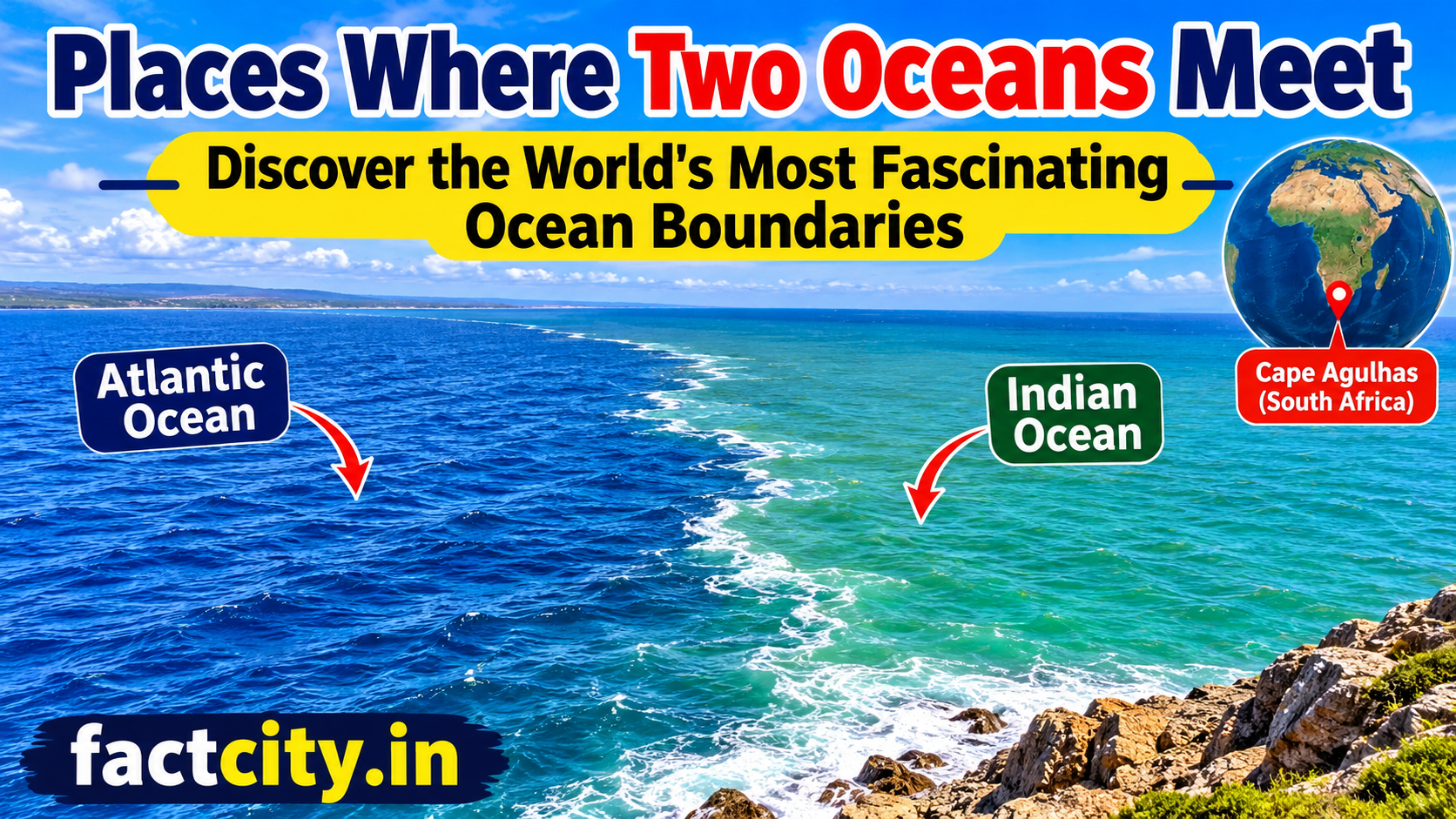
Places Where Two Oceans Meet: The world’s oceans are full of natural wonders, but some of the most fascinating places are where two oceans meet. These locations attract travelers, scientists, photographers, and nature lovers because they offer incredible views and interesting marine phenomena. Seeing two large bodies of water come together can feel like watching two different worlds meet in one place.
Many people imagine that when two oceans meet, they create a clear line, with one side looking blue and the other side appearing green or dark. In reality, ocean boundaries are often more complicated. Water from different oceans can have different temperatures, salinity levels, densities, and currents. These differences sometimes create visible patterns on the surface, although the waters gradually mix rather than remaining completely separate.
There are several remarkable places around the world where major ocean waters meet. From the southern tip of South America to the coastlines of Africa and Antarctica, these locations demonstrate the beauty and power of our planet’s interconnected oceans.
1. Cape Agulhas, South Africa: Where the Atlantic and Indian Oceans Meet
Cape Agulhas is one of the most famous places associated with two oceans meeting. Located at the southern tip of South Africa, it is officially recognized as the geographical meeting point of the Atlantic and Indian Oceans.
The area is known for its beautiful coastline, powerful waves, rocky landscapes, and historic lighthouse. Visitors often travel here to stand near the geographical boundary between these two enormous oceans.
The Atlantic Ocean is influenced by cold water currents, while the Indian Ocean brings warmer waters from the tropical regions. Their interaction contributes to changing marine conditions around southern Africa.
Cape Agulhas is also an important location for marine biodiversity. The surrounding waters support different types of fish, seabirds, and marine mammals. The region’s strong currents and changing weather conditions make it an interesting destination for ocean researchers.
2. Cape Horn, Chile: Where the Atlantic and Pacific Ocean Regions Connect
Cape Horn is located at the southernmost tip of South America’s Tierra del Fuego archipelago. It is one of the most famous maritime locations in the world because of its challenging sailing conditions.
The waters around Cape Horn connect the Atlantic and Pacific oceans through the Southern Ocean region. The area is known for powerful winds, enormous waves, and unpredictable weather.
For centuries, sailors considered this region one of the most difficult passages to navigate. Before the Panama Canal opened in 1914, ships traveling between the Atlantic and Pacific oceans often had to sail around Cape Horn.
Today, Cape Horn remains an important destination for adventure travelers and expedition cruises. Its dramatic cliffs, remote landscapes, and surrounding ocean waters create a truly unforgettable natural environment.
3. Drake Passage: Where the Atlantic and Pacific Ocean Waters Interact
The Drake Passage is a stretch of ocean between Cape Horn in South America and the Antarctic Peninsula. It is particularly interesting because it allows enormous amounts of water to circulate between the Atlantic and Pacific sectors of the Southern Ocean.
This passage is famous for its rough seas and powerful currents. One of the most important features of this region is the Antarctic Circumpolar Current, which flows continuously around Antarctica.
The current plays a major role in connecting the world’s oceans and influencing global climate patterns. It also helps transport nutrients that support marine ecosystems.
Travelers crossing the Drake Passage on their way to Antarctica may experience changing ocean conditions, seabirds flying above the water, and occasionally whales swimming nearby.
4. Cape of Good Hope, South Africa: A Famous Ocean Landmark
The Cape of Good Hope is another well-known coastal landmark in South Africa. It is often described as the meeting point of the Atlantic and Indian Oceans, although the officially recognized geographical boundary is farther southeast at Cape Agulhas.
The Cape of Good Hope is part of Table Mountain National Park and is famous for its spectacular cliffs, ocean views, and natural beauty.
Visitors can enjoy scenic hiking trails, watch waves crashing against rocky shores, and observe wildlife such as baboons, ostriches, and seabirds.
The surrounding waters are influenced by different ocean currents, making the region environmentally important. Its dramatic landscape and maritime history have made it one of South Africa’s most popular natural attractions.
5. Southern Ocean: The Great Ocean Connection Around Antarctica
The Southern Ocean surrounds Antarctica and connects the Atlantic, Pacific, and Indian Ocean regions.
Unlike many other ocean boundaries, this region is strongly influenced by the Antarctic Circumpolar Current. This powerful current moves water continuously around Antarctica without being blocked by a major continent.
The Southern Ocean is extremely important for Earth’s climate system. It absorbs heat and carbon dioxide from the atmosphere and helps distribute ocean water around the planet.
Its cold waters are home to penguins, seals, whales, krill, and many other marine species.
Although it is not a single meeting point where two oceans create a visible line, it is one of the most important places for understanding how the world’s oceans interact.
6. The Bering Strait: Where the Pacific and Arctic Oceans Meet
The Bering Strait is located between Alaska in the United States and Russia. It connects the Pacific Ocean with the Arctic Ocean through the Bering Sea and the Chukchi Sea.
This narrow waterway is approximately 85 kilometers wide at its narrowest point. It plays an important role in ocean circulation and the movement of marine life between the Arctic and Pacific regions.
The waters in this area are relatively cold, and sea ice can cover large sections during winter.
The Bering Strait is also an important migration route for marine mammals, including whales, seals, and walruses. Indigenous communities living in the region have depended on these waters for food, transportation, and cultural traditions for generations.
7. The Norwegian Sea and Greenland Sea: Arctic Ocean Connections
The Norwegian Sea and Greenland Sea are important parts of the North Atlantic and Arctic ocean system. Their waters interact through ocean currents that transport heat toward the Arctic.
The Norwegian Sea receives relatively warm Atlantic water, while the Greenland Sea is strongly influenced by cold Arctic conditions.
These different water masses help regulate temperatures in the North Atlantic region. They also influence sea ice formation, weather systems, and marine ecosystems.
The area supports whales, seals, seabirds, and several species of cold-water fish.
Although these seas are not officially two separate global oceans meeting at a single boundary, they provide an excellent example of how ocean water from different regions interacts.
8. The Mozambique Channel: Indian Ocean Water in Motion
The Mozambique Channel is located between Mozambique on the African mainland and Madagascar. It is an important part of the western Indian Ocean.
The channel contains powerful ocean currents that transport warm water toward the southern Indian Ocean. These currents influence regional temperatures, marine habitats, and weather patterns.
The region is particularly rich in marine biodiversity. Coral reefs, tropical fish, sea turtles, dolphins, and whales can be found in its surrounding waters.
It is not a meeting point between two officially separate oceans, but it is an excellent example of how different water masses and currents interact within the Indian Ocean system.
9. The Tasman Sea: Where the Pacific Ocean Meets the Indian Ocean Region
The Tasman Sea lies between Australia and New Zealand. It is part of the southwestern Pacific Ocean and is connected to the wider Southern Ocean circulation system.
The region experiences changing water temperatures, ocean currents, and weather conditions. These factors create diverse marine habitats that support dolphins, whales, seals, and numerous fish species.
The Tasman Sea is also important for international shipping and marine research.
Although it is not an official boundary between the Pacific and Indian Oceans, its waters are influenced by the broader circulation connecting these ocean regions.
10. The Arctic Ocean and North Atlantic: A Meeting of Cold and Warm Waters
The Arctic Ocean and North Atlantic Ocean interact through several important waterways, including the Fram Strait and areas around Greenland and Iceland.
Cold Arctic water moves southward, while warmer Atlantic water travels northward. This exchange helps regulate temperatures in the North Atlantic and influences the climate of nearby countries.
The interaction between these water masses is especially important because it affects sea ice, ocean circulation, and marine ecosystems.
Scientists study this region to understand climate change and the changing behavior of ocean currents.
Why Do Two Oceans Sometimes Look Different When They Meet?
One of the most common questions about places where two oceans meet is why their waters sometimes appear to have different colors.
There are several scientific reasons behind this phenomenon.
1. Differences in Water Temperature
Water from different ocean regions can have different temperatures. These temperature differences influence density and ocean circulation.
2. Differences in Salinity
Salinity refers to the amount of dissolved salt in seawater. Water with different salt concentrations can have different densities, affecting how water masses move and mix.
3. Ocean Currents
Ocean currents transport water across enormous distances. When two currents meet, they can create visible surface patterns and areas of turbulence.
4. Sediments and Minerals
Rivers and coastal areas can introduce sand, mud, and other materials into the sea. These particles may make water appear brown, green, or cloudy compared with clearer ocean water.
5. Marine Organisms
Tiny marine organisms called phytoplankton can influence ocean color. Depending on their concentration, they may make water appear greener or change its overall appearance.
It is important to understand that two oceans do not remain permanently separated by an invisible wall. Their waters continuously mix through currents, waves, turbulence, and other natural processes.
Why Are Ocean Meeting Points Important?
Places where ocean waters interact are important for several environmental and scientific reasons. countries-with-the-most-time-zones-in-the-world
First, ocean circulation helps distribute heat around the planet. Warm and cold water movements influence temperatures and weather conditions across different continents.
Second, these areas often support rich marine ecosystems. Different water masses can transport nutrients that help phytoplankton grow. Phytoplankton form the foundation of many marine food chains.
Third, ocean boundaries are valuable for scientific research. Researchers study these regions to understand climate change, marine biodiversity, pollution, and the movement of ocean water.
Finally, these locations can also have economic importance. Fishing, shipping, tourism, and scientific exploration depend on healthy and well-managed ocean environments.
Can You Actually See Two Oceans Meeting?
Yes, visitors can experience places where different ocean waters interact, but the experience may not always look like photographs shared online.
Some locations offer dramatic views of waves and changing water colors. However, the visibility of these differences depends on weather, lighting, currents, sediments, and other environmental conditions.
Cape Agulhas is one of the best-known destinations for people interested in seeing the geographical meeting point of the Atlantic and Indian Oceans.
Other places, such as Cape Horn and the Drake Passage, are better known for their powerful currents and the connection between major ocean regions.
Visitors should always follow local safety advice because strong currents, rough waves, and sudden weather changes can make ocean coastlines dangerous.
Conclusion
Places where two oceans meet are among the most fascinating natural features on Earth. From Cape Agulhas in South Africa to the Drake Passage near Antarctica, these locations demonstrate how interconnected our planet’s oceans really are.
Although some ocean boundaries are geographical rather than visible lines on the water, the interaction between different water masses plays an important role in global climate, marine biodiversity, and ocean circulation.
Understanding these remarkable places helps us appreciate the importance of protecting our oceans. They are not simply large bodies of water; they are connected ecosystems that support life, regulate the climate, and influence the natural world.
The next time you see a photograph of two differently colored ocean waters meeting, remember that there is a fascinating scientific process behind that beautiful natural phenomenon.