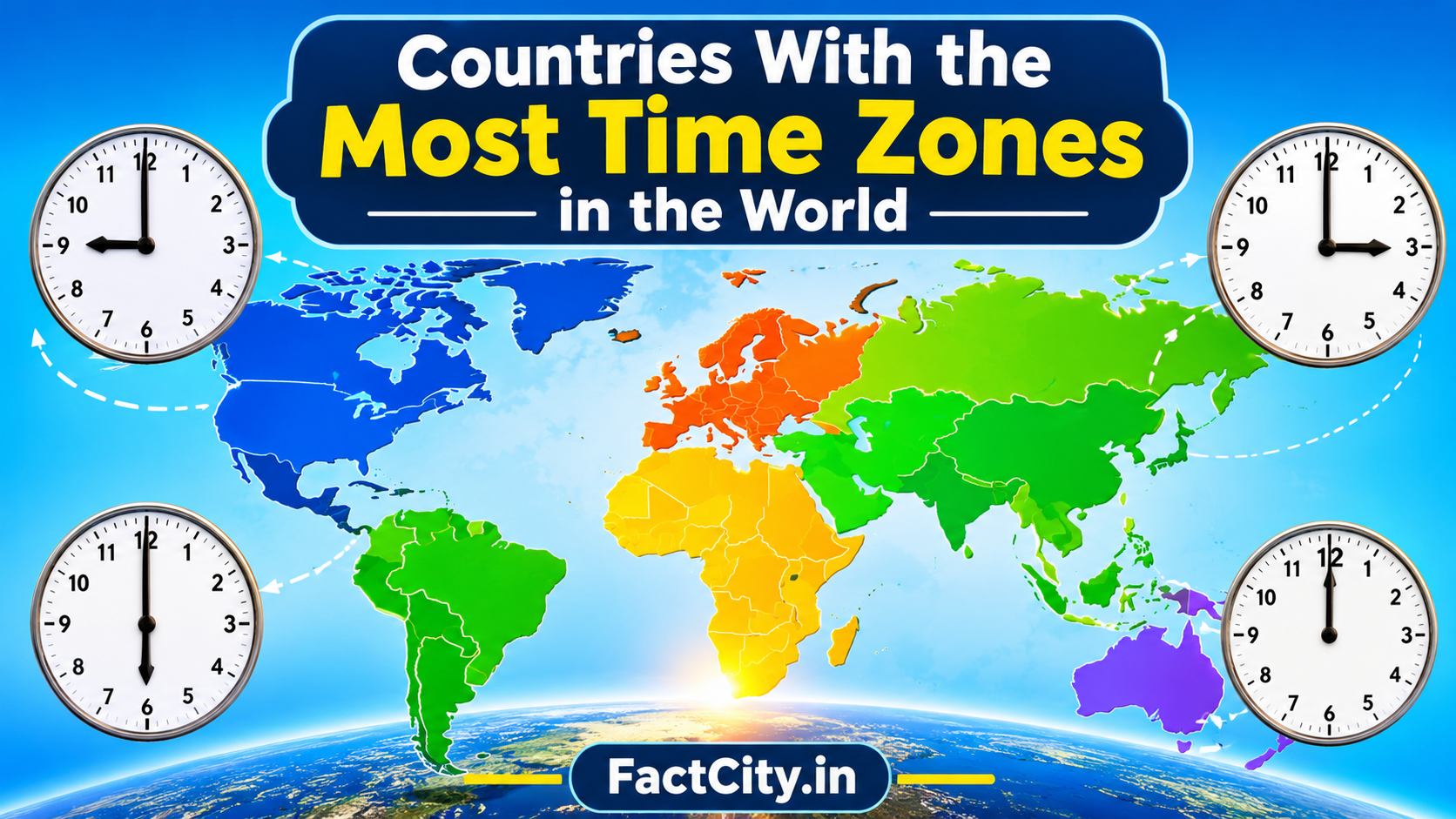
Countries With the Most Time Zones in the World. Have you ever wondered why the time can be completely different in two places belonging to the same country? While some countries follow just one standard time throughout their territory, others have multiple time zones because of their enormous geographical size or distant overseas territories. This makes timekeeping around the world much more interesting than it might seem.
Countries with the most time zones are fascinating examples of how geography, history, politics, and international boundaries influence everyday life. Some nations stretch across several continents, while others have islands located thousands of kilometres away from their mainland. As a result, people living in different parts of the same country may celebrate New Year, start their working day, or enjoy dinner at completely different times.
Russia, France, the United States, Australia, and Canada are among the countries known for having numerous time zones. However, their reasons for using multiple time zones are not always the same. In this article, we will explore the countries with the most time zones, understand why they have so many, and discover some interesting facts about how time works across their territories.
Why Do Some Countries Have Multiple Time Zones?
The Earth rotates from west to east, which means different places experience sunrise and sunset at different moments. To make everyday life easier, the world is divided into standard time zones. Each time zone generally represents a particular difference from Coordinated Universal Time (UTC). Countries With the Most Time Zones in the World
The main reason countries have multiple time zones is their geographical size. A country that stretches across a large distance from east to west may experience significant differences in daylight hours. Using one standard time everywhere could make mornings extremely dark in some regions or cause the sun to rise unusually early in others.
However, geographical size is not the only reason. Some countries have overseas territories, islands, and distant regions located far from their mainland. These territories may follow completely different local times even though they belong to the same nation.
Political decisions, historical developments, economic activities, and administrative convenience also influence how countries establish their time zones.
1. France – The Country With the Most Time Zones
France holds the record for having the most time zones in the world when its overseas territories are included. Although mainland France, where Paris is located, follows only one standard time zone, the country’s territories are spread across different oceans and continents. These distant locations create an extraordinary difference in local time.
French territories include French Polynesia in the Pacific Ocean, Guadeloupe and Martinique in the Caribbean, French Guiana in South America, Réunion in the Indian Ocean, and New Caledonia in the South Pacific. Each region follows its own local time according to its geographical position.
The time difference between French Polynesia and Wallis and Futuna can reach approximately 22 hours. This means that when people in one French territory are beginning their day, residents in another territory may already be approaching the next calendar day.
France’s unusual geographical arrangement is mainly the result of its overseas history and continuing administrative connections with distant territories. It is a perfect example of how a country does not need to be physically large to have many time zones.
2. Russia – The Largest Country With 11 Time Zones
Russia is the largest country in the world by land area, so it is not surprising that it has one of the highest numbers of time zones. The country stretches across northern Eurasia, covering a huge distance from Eastern Europe to the Pacific Ocean. Its territory is so wide that the local time changes significantly as people travel from west to east.
Russia uses 11 standard time zones, ranging from UTC+2 in Kaliningrad to UTC+12 in Kamchatka and Chukotka. Moscow follows Moscow Standard Time, which is UTC+3, and serves as the main reference point for many national activities.
For example, when people in Moscow are having breakfast, residents in eastern parts of Russia may already be enjoying their afternoon. This creates practical challenges for national television broadcasts, business meetings, transportation schedules, and communication between different regions.
Unlike France, Russia’s time zones are mainly caused by its enormous continuous landmass rather than distant overseas territories. Interestingly, Russia stopped observing seasonal daylight saving time in 2014 and now follows permanent regional standard times.
3. United States – A Country With 11 Time Zones
The United States is another country with an impressive number of time zones. Its geographical territory includes the mainland states, Alaska, Hawaii, and several overseas territories located in the Pacific and Caribbean regions.
The six commonly recognised time zones across the 50 states are Eastern, Central, Mountain, Pacific, Alaska, and Hawaii-Aleutian. However, when additional territories and remote islands are counted, the total can reach 11.
Places such as Puerto Rico, Guam, American Samoa, and the Northern Mariana Islands follow different local times. Some remote US islands also have unusual UTC offsets.
The time difference between the eastern and western parts of the country can affect everyday activities. A live television programme shown in the evening on the East Coast may be broadcast much earlier in the afternoon on the West Coast.
This is particularly important for businesses, sports events, airlines, financial markets, and government organisations. Companies operating nationally must carefully plan their schedules to avoid confusion between different regions.
4. Australia – Nine Time Zones Across Its Territory
Australia is widely known for its vast landscapes, deserts, coastal cities, and unique wildlife. It is also among the countries with the most time zones. Its mainland is generally divided into three standard time zones: Australian Western Standard Time, Australian Central Standard Time, and Australian Eastern Standard Time.
However, Australia’s total reaches nine when its external territories and island possessions are included. These include places such as Christmas Island, the Cocos (Keeling) Islands, and Norfolk Island.
One interesting feature of Australian timekeeping is that some regions use half-hour differences rather than full-hour differences. For example, Central Standard Time is 30 minutes behind Eastern Standard Time in the relevant regions.
Daylight saving time also makes the system more complicated. Some Australian states move their clocks forward during warmer months, while others do not. This means the time difference between two Australian cities can change during the year.
Australia’s multiple time zones are important for domestic flights, communication, tourism, and business operations because travelling across the country can involve several hours of time difference.
5. United Kingdom – Nine Time Zones
The United Kingdom may look relatively small on a world map, but its overseas territories give it a much wider geographical presence. Mainland England, Scotland, Wales, and Northern Ireland generally follow the same standard time system.
The country uses Greenwich Mean Time during winter and British Summer Time during summer. However, its overseas territories are scattered across different parts of the world, which creates several additional local times.
These territories include Bermuda, the Cayman Islands, the British Virgin Islands, the Falkland Islands, Gibraltar, and the Pitcairn Islands. The British Indian Ocean Territory also follows a different time from mainland Britain.
The difference between these locations can be significant. When people in London are starting their working day, residents in some British overseas territories may be experiencing a completely different part of the day.
This makes the United Kingdom an interesting example of how historical connections and overseas administration can influence a country’s total number of time zones.
6. Canada – Six Time Zones
Canada is the second-largest country in the world by total area, and its vast east-to-west geographical spread makes multiple time zones necessary. From the Atlantic coast to the Pacific coast, the country covers a considerable distance.
Its timekeeping system includes Pacific, Mountain, Central, Eastern, Atlantic, and Newfoundland time. Newfoundland is particularly interesting because it follows a half-hour offset rather than a full-hour difference from the neighbouring Atlantic time zone.
Different provinces and territories have their own rules regarding daylight saving time. Some regions change their clocks seasonally, while others follow different arrangements.
For people travelling across Canada, understanding local time is important because the clock can change several times during a long journey. Airlines, railway services, businesses, and television networks must also account for these differences.
Canada’s time zones reflect the country’s large geographical size and the need to coordinate daily life across distant communities.
7. Denmark – Five Time Zones
Denmark is another interesting country when it comes to time zones. Mainland Denmark follows Central European Time, but the Kingdom of Denmark also includes Greenland and the Faroe Islands, which are located far away from mainland Europe.
Greenland is particularly important because it covers an enormous area in the North Atlantic and Arctic regions. Different parts of Greenland follow different local time arrangements. The Faroe Islands also use a different time from mainland Denmark.
These geographical differences make the Danish Kingdom’s overall timekeeping system more complicated than its relatively small European mainland might suggest.
The time difference is important for government administration, communication, education, travel, and other activities connecting these distant territories.
8. New Zealand – Five Time Zones
New Zealand is famous for its beautiful islands, mountains, beaches, and natural landscapes. It also has several time zones when its associated territories are included.
The main islands of New Zealand follow New Zealand Standard Time, which is UTC+12 during standard time. The Chatham Islands are especially interesting because they operate 45 minutes ahead of the main islands.
Additional time differences come from territories such as the Cook Islands, Niue, and Tokelau. These islands are located across the Pacific Ocean and follow their own local clocks.
New Zealand also observes daylight saving time in its main regions, which changes the clock during part of the year.
This makes the country an interesting example of how island geography can create unusual time differences, even when the main population lives within a relatively limited geographical area.
9. Brazil – Four Time Zones
Brazil is the largest country in South America and has four standard time zones. Its enormous territory stretches from the Atlantic coastline towards the western borders of the continent, creating differences in local time.
Brasília Time, UTC-3, is the country’s main time reference and is followed by major cities such as São Paulo, Rio de Janeiro, and Brasília.
Other regions follow different time zones, including areas in the western part of the country and the islands of Fernando de Noronha. The time differences are especially noticeable between eastern coastal cities and communities near the western borders.
For businesses, television networks, transportation services, and government departments, these regional differences must be considered when planning activities.
10. Mexico – Four Time Zones
Mexico is another country with multiple time zones because of its wide geographical coverage. It stretches from the northern border with the United States to the southern regions of Central America.
The country’s main time zones include the Northwestern, Pacific, Mountain, and Southeastern regions. Baja California, for example, follows a different time from Mexico City, while Quintana Roo uses Eastern Standard Time.
Mexico has also changed its daylight saving time rules in recent years. Most of the country stopped changing clocks seasonally in 2022, although certain northern border municipalities continue to follow seasonal adjustments to remain aligned with neighbouring US communities.
These arrangements show how geography and economic connections with neighbouring countries can influence national timekeeping systems.
11. Indonesia – Three Time Zones
Indonesia is one of the world’s largest island nations, consisting of thousands of islands spread across Southeast Asia. Because its territory extends over a wide geographical area, the country uses three standard time zones.
These are Western Indonesia Time, Central Indonesia Time, and Eastern Indonesia Time. Major cities such as Jakarta follow Western Indonesia Time, while Bali follows Central Indonesia Time.
The eastern parts of the country, including regions around Papua, follow Eastern Indonesia Time.
The difference between western and eastern Indonesia is two hours. This means that when people in Jakarta begin their morning, residents in eastern Indonesia are already further ahead in the day.
12. Kiribati – Three Time Zones and a Unique Calendar Position
Kiribati is a small island country in the central Pacific Ocean, but its geographical position makes its timekeeping system especially interesting. Its islands are spread across a huge area of the Pacific, so the country uses three time zones.
The most unusual feature of Kiribati is its relationship with the International Date Line. In 1995, the country adjusted its time arrangements to keep its eastern and western island groups on the same calendar day.
The Line Islands, which include Kiritimati, use UTC+14. This makes them among the first inhabited places in the world to welcome a new calendar day.
Kiribati demonstrates that even a country with a relatively small population can have a complicated timekeeping system because of its scattered islands.
Interesting Facts About Countries With Many Time Zones
The world of time zones contains several surprising facts that show how differently countries manage their clocks. China, despite being geographically large enough to cover approximately five geographical time zones, officially follows just one standard time zone, known as China Standard Time (UTC+8). This means that people in western China may experience sunrise and sunset at very different clock times compared with residents in Beijing.
India also follows a single standard time zone across the entire country. Indian Standard Time is UTC+5:30, meaning it is five hours and thirty minutes ahead of Coordinated Universal Time. Even though India stretches across a considerable east-to-west distance, one national time makes administration and communication easier.
Another interesting fact is that not every time zone differs by exactly one hour. Some regions use 30-minute or 45-minute differences. Newfoundland in Canada, the Chatham Islands in New Zealand, and parts of Australia are examples of places with unusual time offsets.
Why Do Time Zones Matter in Everyday Life?
Time zones play an important role in modern society because people, businesses, and governments regularly communicate across international boundaries. Airlines depend on accurate local times to manage flight schedules, while international companies must coordinate meetings between employees working in different countries.
Time differences are also important for online education, international sports competitions, financial markets, tourism, and global news broadcasting. A business operating in France, the United States, and Australia must carefully plan its working hours to communicate effectively with customers and employees.
For travellers, understanding time zones can prevent missed flights, confusion about hotel bookings, and scheduling mistakes. It is also useful for people who have family members living in different parts of the world.
Frequently Asked Questions
Which country has the most time zones in the world?
France has the most time zones, with 12 standard time zones when its overseas territories are included. Its territories are spread across the Pacific, Atlantic, Indian Ocean, and South American regions.
Does Russia have more time zones than France?
No. Russia has 11 time zones, while France has 12 when overseas territories are counted. However, Russia has the most time zones across one continuous landmass.
How many time zones does the United States have?
The United States has 11 time zones when its overseas territories and remote islands are included. The 50 states themselves cover six commonly recognised time zones.
Which country has the largest time difference within its territory?
France has an impressive geographical time difference between its distant overseas territories, stretching from UTC-10 to UTC+12 under standard time.
Why does China have only one time zone?
China officially follows Beijing Time (UTC+8) throughout the country. This decision supports national coordination and administrative simplicity, even though the country is geographically wide enough to cover several natural time zones. factcity.in/10-ancient-structures-that-still-puzzle-historians
Conclusion
Countries with the most time zones show how geography, history, and government decisions can influence the way people measure time. France leads the world with 12 standard time zones because its overseas territories are scattered across different oceans and continents. Russia and the United States follow closely, with 11 time zones each when their territories are included.
Australia, the United Kingdom, Canada, Denmark, and New Zealand also demonstrate how distant islands and geographical size can create different local times within the same country. Meanwhile, countries such as Indonesia and Kiribati show that even island nations can have fascinating timekeeping arrangements.
Time zones may seem like a simple part of everyday life, but they play an important role in connecting the modern world. They help people organise their daily activities, coordinate international business, travel safely, and communicate across different regions. Understanding how countries manage their time makes world geography even more interesting and reveals just how connected our planet really is.