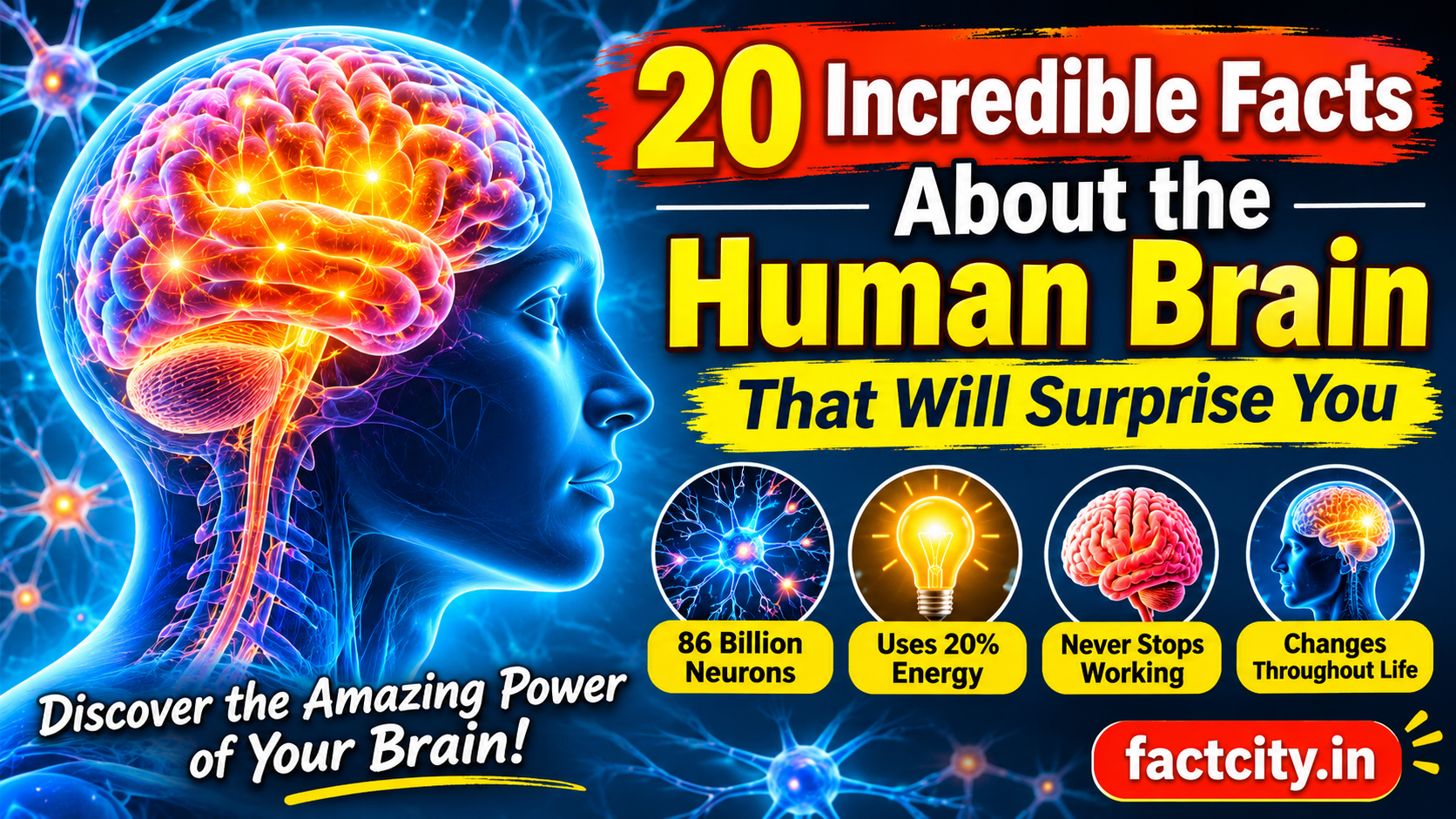
20 Incredible Facts About the Human Brain. The human brain is one of the most fascinating and complex organs in the human body. It controls almost everything we do, from thinking and speaking to walking, remembering, feeling emotions, and making decisions. Every movement, sensation, and thought begins with activity inside this remarkable organ. Although scientists have studied the brain for many years, there is still a great deal about it that remains unexplored. Its ability to process information, adapt to new situations, store memories, and control thousands of body functions makes it truly extraordinary.
What makes the human brain even more interesting is that it continues working throughout the day and night, even when we are sleeping. It processes information from our surroundings, controls essential body functions, and helps us understand the world. Some facts about the brain are so surprising that they sound almost impossible. From its incredible processing abilities to its remarkable capacity to learn, the brain has many secrets worth discovering.
In this article, we will explore 20 incredible facts about the human brain that explain how it works and why it is considered one of the most amazing organs in the human body.
1. The Human Brain Contains Approximately 86 Billion Neurons
One of the most incredible facts about the human brain is the enormous number of neurons it contains. Scientists estimate that an average adult human brain has approximately 86 billion neurons. Neurons are specialized nerve cells responsible for receiving and transmitting information throughout the nervous system. 20 Incredible Facts About the Human Brain
These cells communicate with one another through electrical and chemical signals. This communication allows people to think, remember information, recognize faces, understand languages, and perform complicated activities. Neurons form an extensive communication network that makes everyday brain functions possible. The number of connections between these cells makes the brain an incredibly complex biological system.
2. The Brain Uses Around 20 Percent of the Body’s Energy
Although the brain represents only about two percent of an adult’s body weight, it uses approximately 20 percent of the body’s energy at rest. This energy is necessary to keep neurons active, maintain communication between brain cells, and support essential biological processes.
The brain mainly depends on glucose as an energy source under normal conditions. Even when a person is sitting quietly or sleeping, the brain continues consuming energy. This is because it never completely switches off. It constantly manages breathing, heart rate, body temperature, memory processing, and other important activities.
3. The Human Brain Is Mostly Made of Water
Another surprising fact is that the human brain is approximately 73 percent water. Water plays an essential role in maintaining brain structure and supporting its normal functions. It helps transport nutrients, remove waste products, and maintain the chemical environment needed for communication between brain cells.
Proper hydration is important for overall brain health. When the body loses too much water, dehydration can affect concentration, mood, and mental performance. Drinking enough water throughout the day supports normal body functions, including those performed by the brain.
4. Your Brain Never Completely Stops Working
Many people believe that the brain rests completely when they fall asleep, but this is not true. The brain remains active throughout the night, performing several important tasks while the body rests.
During sleep, the brain processes information collected during the day, supports memory formation, and regulates different biological activities. Different sleep stages are associated with different patterns of brain activity. REM sleep, for example, is particularly associated with vivid dreaming and certain aspects of memory and emotional processing.
This is one reason why getting sufficient sleep is important for learning, concentration, and overall well-being.
5. The Brain Can Adapt and Change Throughout Life
The human brain has an amazing ability known as neuroplasticity. This means the brain can change its structure and connections in response to learning, experiences, practice, and certain types of injuries.
Whenever someone learns a new language, develops a skill, or practices playing a musical instrument, the brain creates or strengthens connections between neurons. These changes help the brain become more efficient at performing familiar tasks.
Neuroplasticity also plays an important role in recovery after certain brain injuries. Although recovery depends on the type and severity of the injury, other brain regions can sometimes reorganize their connections to help compensate for damaged areas.
6. Memories Are Stored Through Networks of Brain Connections
Memory is one of the most fascinating abilities of the human brain. People can remember childhood experiences, recognize familiar faces, learn new information, and recall important events from the past.
However, memories are not stored in one single location like files on a computer. Instead, they involve networks of connected neurons distributed across different brain regions. The hippocampus plays an important role in forming new memories, while other areas help store and retrieve different types of information.
Every time a person learns something new, changes occur in the connections between brain cells. These changes help create and strengthen memories.
7. The Brain Can Process Information Extremely Quickly
The human brain processes enormous amounts of information through electrical and chemical communication between neurons. Signals travel through the nervous system at different speeds depending on the type of nerve fiber.
Some nerve impulses can travel at speeds approaching 120 meters per second. This rapid communication helps people react to their surroundings, coordinate movements, recognize danger, and respond to unexpected situations.
For example, when someone touches a hot surface, sensory nerves quickly send information toward the nervous system. The body can respond by withdrawing the hand before the person has fully processed the pain consciously.
8. The Brain Itself Cannot Feel Pain
This fact may sound strange, but the brain tissue itself does not contain pain receptors called nociceptors. These receptors detect potentially damaging stimuli in other parts of the body and send signals to the nervous system.
However, the tissues surrounding the brain, including certain blood vessels, protective membranes, and nerves, can detect pain. This is why headaches are possible even though the brain itself cannot directly feel pain.
Interestingly, this property also allows certain brain surgeries to be performed while a patient is awake under carefully controlled medical conditions. Such procedures require specialized medical teams and are used only when clinically appropriate.
9. The Brain Controls Automatic Body Functions
The human brain does much more than support thinking and memory. It also controls many automatic functions that keep the body alive.
The brainstem plays an essential role in regulating breathing, heart rate, blood pressure, and other basic processes. These functions generally continue without requiring conscious attention.
For example, people do not need to remind themselves to breathe every few seconds. The brain automatically adjusts breathing patterns according to the body’s needs. It also works with other systems to maintain balance, regulate temperature, and coordinate internal activities.
10. Dreams Can Occur in Different Stages of Sleep
Dreaming is another fascinating activity associated with the human brain. Many people experience dreams during REM sleep, when brain activity becomes more similar to certain patterns seen during wakefulness.
However, dreams can also occur during non-REM sleep. Some dreams are vivid and emotional, while others are less detailed or difficult to remember after waking up.
Scientists continue studying why people dream and how dreams relate to memory, emotions, and everyday experiences. Although several theories exist, there is no single explanation that completely explains every aspect of dreaming.
11. The Brain Has Two Main Hemispheres
The human brain is divided into two major halves called the left and right hemispheres. These hemispheres communicate through a thick bundle of nerve fibers known as the corpus callosum.
Each hemisphere has specialized functions, but they work together to support most everyday activities. Certain language functions are more strongly associated with the left hemisphere in many people, while some aspects of spatial processing are more strongly associated with the right.
However, the popular idea that some people are entirely left-brained or right-brained is misleading. Both hemispheres participate in complex thinking, creativity, problem-solving, and communication.
12. Learning New Skills Strengthens Brain Connections
Learning something new is one of the best ways to challenge the brain. Activities such as reading, solving puzzles, learning a language, playing an instrument, or developing a new hobby require the brain to process and organize information.
When people repeatedly practice a skill, certain neural connections become stronger and more efficient. This process is associated with synaptic plasticity.
For example, someone learning to play the piano initially needs to concentrate carefully on finger movements and musical patterns. With practice, these activities often become more natural because the brain becomes better at coordinating the required actions.
13. The Human Brain Is Protected by Several Layers
The brain is one of the body’s most delicate organs, so it has several protective systems. The skull provides a strong physical covering, while three protective membranes called the meninges surround the brain and spinal cord.
These membranes are known as the dura mater, arachnoid mater, and pia mater. Between the arachnoid and pia mater is a space containing cerebrospinal fluid.
This fluid helps cushion the brain against sudden movements and provides additional protection. Together, the skull, meninges, and cerebrospinal fluid help protect the brain from everyday physical forces.
14. The Brain Can Recognize Thousands of Faces
Human beings have an impressive ability to recognize and remember faces. This skill helps people identify family members, friends, colleagues, and familiar individuals in different environments.
Several brain regions contribute to face recognition. One particularly important area is the fusiform face area, which is associated with processing facial information.
Recognizing a face involves more than identifying its physical features. The brain also connects facial information with memories, emotions, and previous experiences. This explains why a familiar face can immediately bring back memories of a particular person or situation.
15. Emotions Are Closely Connected to Brain Activity
Human emotions such as happiness, fear, sadness, anger, and excitement involve several interacting brain regions. The amygdala plays an important role in processing emotional information, particularly situations involving potential threats.
Other areas, including the prefrontal cortex, help regulate emotional responses and support decision-making. These regions work together to help people understand situations and respond appropriately.
Emotions are not controlled by one single part of the brain. Instead, they emerge through complex interactions involving brain activity, body signals, memories, and environmental experiences.
16. The Brain Changes as People Grow Older
The human brain develops throughout childhood, adolescence, and adulthood. During early life, the brain forms a large number of connections as children learn to speak, move, recognize objects, and understand their surroundings.
During adolescence and adulthood, some connections become more efficient through a process called synaptic pruning. This process helps the brain refine its communication networks.
As people grow older, certain brain functions may gradually change. Processing speed and some types of memory can become less efficient, but knowledge, vocabulary, and experience can remain strong. Healthy habits, regular physical activity, social interaction, and mental stimulation can support brain health throughout life. best-key-person-life-insurance-for-small-businesses
17. Exercise Can Improve Brain Health
Physical exercise is not only beneficial for muscles and the heart. It also supports the health of the brain. Regular physical activity improves blood circulation, helping deliver oxygen and nutrients to brain tissues.
Research suggests that exercise can support memory, attention, mood, and certain aspects of cognitive function. Physical activity is also associated with the release of chemicals that support communication between brain cells.
Walking, cycling, swimming, dancing, and other forms of exercise can contribute to a healthy lifestyle. Even moderate activities performed regularly can provide meaningful health benefits.
18. The Brain Communicates With the Entire Body
The brain is connected to almost every part of the body through an extensive network of nerves. These nerves carry sensory information toward the brain and send instructions from the brain to muscles, organs, and other tissues.
For example, when someone walks, the brain coordinates information from the eyes, inner ears, muscles, and joints to maintain balance and control movement.
The spinal cord acts as an important communication pathway between the brain and the rest of the body. Together, the brain, spinal cord, and peripheral nerves form the nervous system.
19. The Brain Can Sometimes Create False Memories
Human memory is impressive, but it is not always perfectly accurate. People sometimes remember events differently from how they actually happened.
This happens because memory is reconstructive rather than a perfect recording of past experiences. When someone recalls an event, the brain brings together stored information, personal experiences, emotions, and other details.
New information or suggestions can sometimes influence how a person remembers an earlier situation. This phenomenon is known as memory distortion and can lead to false memories.
That is why human memory should not always be treated as completely reliable, especially when recalling details from events that happened many years ago.
20. The Human Brain Is Still Full of Mysteries
Despite major scientific advances, the human brain remains one of the least completely understood organs in the body. Researchers continue investigating consciousness, dreams, intelligence, emotions, memory, and the biological processes behind human thought.
Modern technologies such as magnetic resonance imaging and advanced brain-recording techniques allow scientists to study brain activity in greater detail than ever before.
However, many important questions remain unanswered. Scientists are still exploring how conscious experiences arise from brain activity, how memories are organized, and why individual brains respond differently to similar experiences.
These unanswered questions make neuroscience one of the most exciting areas of modern scientific research.
Why Is the Human Brain So Important?
The human brain is essential because it coordinates the activities that make everyday life possible. It allows people to think, communicate, solve problems, experience emotions, recognize their surroundings, and make decisions. Without the brain, the body would not be able to coordinate its different systems effectively.
It also plays an important role in shaping individual personalities and experiences. Every person develops unique memories, interests, habits, and ways of understanding the world. These differences are connected to the brain’s complex networks and the experiences people collect throughout their lives.
Taking care of the brain is therefore an important part of maintaining overall health. Getting enough sleep, eating a balanced diet, exercising regularly, staying socially connected, and continuing to learn new things are useful habits that support general brain health.
Conclusion
The human brain is truly one of nature’s most extraordinary creations. From containing approximately 86 billion neurons to processing memories, controlling emotions, and coordinating the entire body, it performs an incredible range of functions every second. Its ability to adapt, learn, and change throughout life makes it even more remarkable.
These 20 incredible facts about the human brain show just how complex and fascinating this organ really is. Even after decades of scientific research, there is still much to discover about how the brain works. Understanding it better can help us appreciate the importance of mental activity, healthy habits, and lifelong learning.
The more scientists explore the human brain, the more they discover about the remarkable abilities that make human life possible. Perhaps the most amazing fact of all is that the brain is the very organ we use to understand itself.