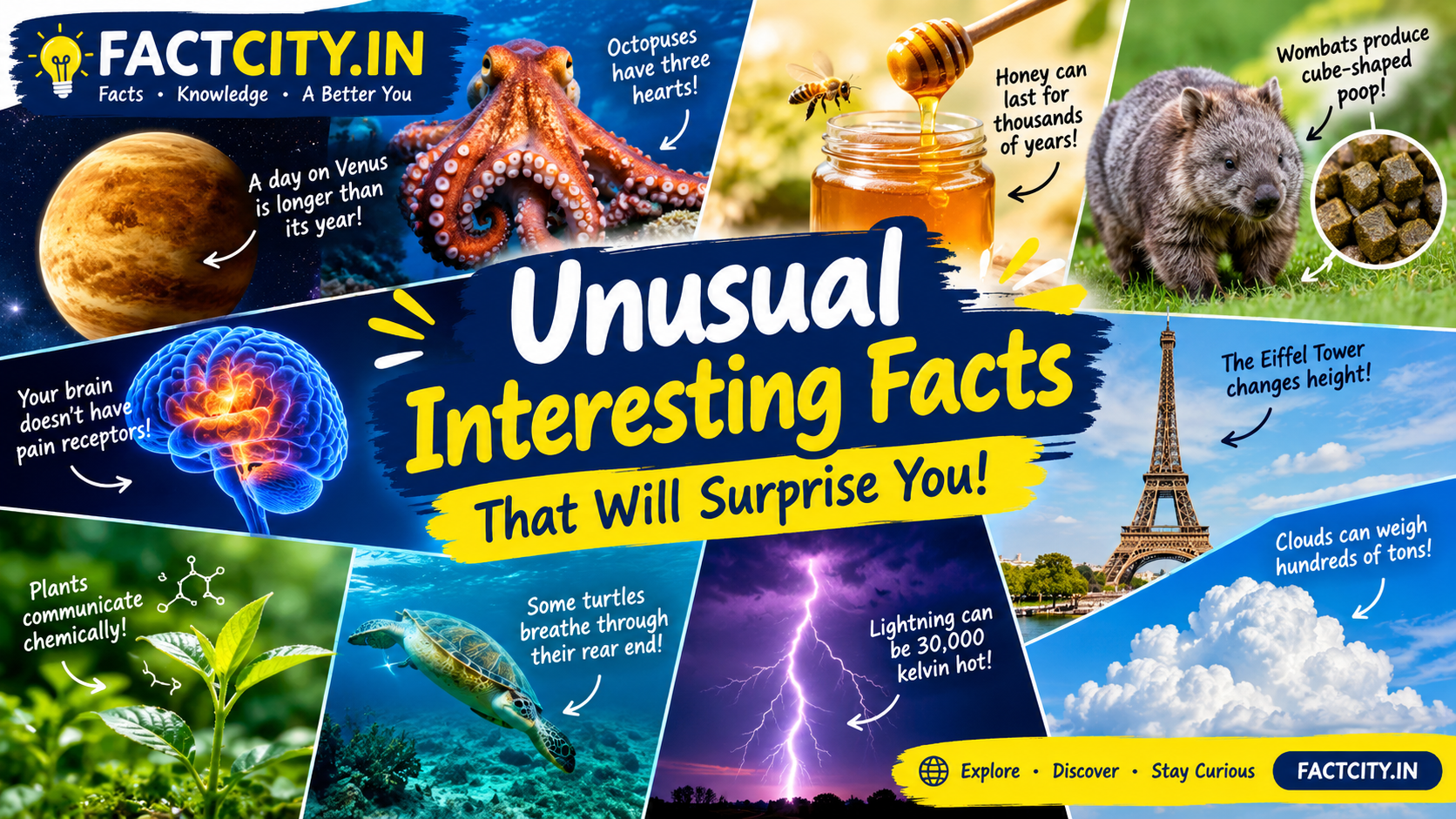
Most people never learn all the weird, surprising, and interesting things about the world. There’s always something new to learn, from odd animal and human body facts to surprising discoveries about space, nature, history, and even everyday objects.
These are unusual, interesting facts for those who love to learn surprising things in just a few minutes. Some facts seem unbelievable at first glance, but they show us how wonderfully complex and unexpected our world is.
Bananas are Berries, but Strawberries aren’t
. An interesting fact about everyday fruit. Bananas are berries, botanically speaking. However, strawberries are not technically berries despite having the word in their name. “Unusual Interesting Facts“
The classification is based on the development of the fruit from the flower. A botanical berry is a fleshy fruit that forms from a single flower with one ovary and usually contains seeds. Bananas fit this description; strawberries have a different growth pattern.
This is one of those weird interesting facts that can totally change the way you look at a fruit bowl.
Octopuses Have Three Hearts
Octopuses are some of the most interesting animals in the ocean, and their bodies are very different to ours. An octopus has three hearts.
Two hearts pump blood to gills, where oxygen is taken up. The third heart pumps oxygenated blood to the rest of the body.
What’s even more interesting is that the main heart stops beating for a while when an octopus is swimming. This is one of the reasons octopuses prefer to crawl rather than swim for long periods.
Honey Can Be Edible for a Very Long Time
Honey has some natural properties that prevent it from spoiling. It has a relatively low water content and acidic environment. Bees add substances that help inhibit the growth of many microorganisms.
Archaeologists have found ancient honey in jars connected to Egyptian tombs, and it was still edible. That said, the condition and safety of any ancient food is a crapshoot.
Honey will eventually crystallise if stored correctly, but this does not necessarily mean that the honey has gone bad. Crystallised honey can be liquefied again by gentle warming.
Venus Takes Longer To Rotate Than It Does To Revolve Around The Sun
Venus’ rotation is one of the strangest in the entire Solar System.
It takes about 243 days for the planet to rotate once on its axis but only 225 days to orbit the Sun.
That is to say, before it has once turned round in relation to its stars, it has completed one revolution about the Sun.
Venus also rotates in the opposite direction to most planets. It is thus one of the strangest worlds in our planetary neighbourhood.
Your Brain Has No Pain Receptors Of Its Own
The human brain processes pain signals from all over the body. The brain tissue itself does not contain pain receptors ( nociceptors ) .
This is not to say headaches are “all in your head.” Pain-sensitive structures around the brain, such as blood vessels, membranes, nerves, muscles, and other tissues, can be involved in headaches.
Perhaps one of the strangest facts about the human body is that the organ that interprets pain doesn’t actually directly feel pain.
Wombats Make Cube-Shaped Poo
Wombats are Australian mammals famous for their weirdly shaped droppings. Their droppings are somewhat cubic in shape.
Scientists have studied this oddity and found that the shape is formed in the wombat’s intestines, where different elasticity in the intestinal walls helps produce the distinctive shape.
Why cubes? One advantage could be that the shape helps keep the dropping in place when wombats use it to mark territory.
Some Turtles Can Breathe From Their Ass
Many freshwater turtles have special structures around the cloaca that allow them to absorb oxygen from the water.
This ability could be particularly helpful when turtles are submerged for long periods of time, including in cold conditions.
It’s not their main way of breathing when things are normal, but it’s a cool adaptation, and it demonstrates how animals can evolve odd ways to survive.
There Are Trees That Talk Chemically
Plants don’t talk like humans, but they can send chemical signals back and forth.
When some plants are attacked by insects, they can release chemical compounds into the air. Such chemicals can induce defence responses in nearby plants.
Plants communicate through underground networks of fungi associated with their roots as well. These relationships can help plants trade nutrients and chemical signals, although popular descriptions of plant communication sometimes oversimplify the science.
The chemical universe concealed in plants is much more complicated than it looks.
Certain Animals Can Regrow Lost Body Parts
One of nature’s most awesome powers is regeneration.
Starfish can regenerate some of their lost body parts, and salamanders such as axolotls are capable of regrowing limbs and other tissues.
Scientists are studying these animals because understanding how regeneration works could potentially aid future research into tissue repair and regenerative medicine.
Humans also have some regenerative capabilities, but they are far more limited than those of some animals.
The height of the Eiffel Tower changes
Metal expands when heated and contracts when cooled. The Eiffel Tower is mainly made of iron. So then the temperature makes it a little higher or lower .
Hot weather causes thermal expansion, which can make the tower several centimetres taller than it is in colder conditions.
This is a simple example of physics on a massive scale. A familiar landmark can even physically grow and shrink as normal temperature changes.
Lightning Can Be Very Hot
A lightning channel can reach temperatures of around 30,000 kelvin, several times hotter than the surface of the Sun.
Lightning heats the air very quickly around it, and this causes the air to expand very suddenly, and this creates the sound we call thunder.
The sheer amount of temperature and energy involved explains why lightning can damage trees, buildings, electrical systems, and other objects.
Some Animals Sleep With Half of Their Brain
One interesting way that dolphins and some other marine mammals sleep is called unihemispheric sleep.
This kind of sleep allows one hemisphere of the brain to be fairly active, while the other is sleeping. This allows the animal to keep coming up for air and stay aware of its surroundings.
It’s a remarkable adaptation to life in an environment where total loss of consciousness could be dangerous.
The Scent of Rain Has a Name
The fresh smell people notice after it rains is called petrichor.
The smell comes from a mix of chemicals released by soil, plants, and microbes. A major component is geosmin, a compound that is produced by some soil microbes.
Rain helps to disperse these compounds into the air, producing the characteristic smell that many people associate with the onset of a rainy day.
Some Clouds Weigh Hundreds of Tonnes
Clouds may seem light and fluffy, but a big cloud can contain an enormous amount of water.
A typical cumulus cloud can contain hundreds of thousands of kilograms of water in the form of tiny droplets or ice particles. The particles are very small and are dispersed in a large volume of air so they remain suspended.
So next time you look up at a cloud, remember that something that looks weightless can hold a surprising amount of water.
Your body is home to billions of microorganisms
The human body harbours large populations of microorganisms, particularly bacteria, that live on and in the body.
Many of these microbes live in the digestive system, where they help break down certain components of food and interact with the body’s biological systems.
The relationships between the human microbiome and nutrition, immunity, metabolism, and health are extremely complex, and scientists are still studying them.
Why do people love weird facts?
More than just conversation starters, unusual facts are. They can ignite curiosity and make learning fun.
A surprising fact can trigger a bigger question: Why is this happening? How did they find out? Is this happening everywhere? What is it saying about nature?
This sort of curiosity may encourage people to explore science, history, geography, biology, technology, and other areas.
Closing Thoughts
There are a lot of surprising details in the world, and a lot of them are hidden in places we see every day. Nature and science are full of surprises, from three-hearted octopuses to wombats that poop in cubes, to Venus having a longer rotation than its year of orbit.
These weird, interesting facts are a reminder that sometimes reality can be stranger than fiction. The more we learn, the more we understand that even the most ordinary things can have extraordinary explanations.
If you are looking for conversation starters, interesting facts for your students, trivia ideas, or just something interesting to read, unusual facts are a fun and easy way to keep on learning.