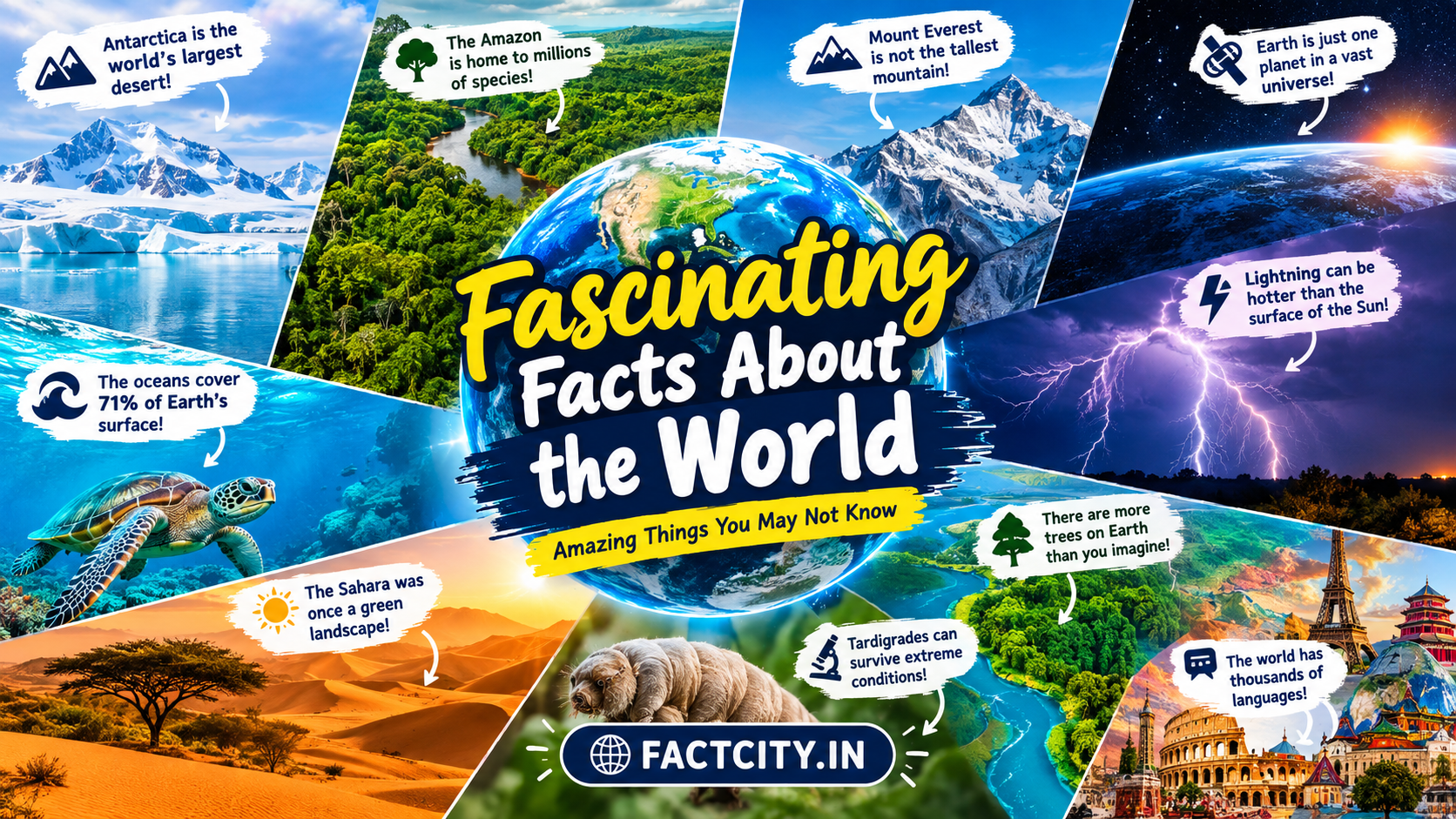
Fascinating Facts About the World: There are amazing places, natural wonders, strange traditions, wonderful animals, and scientific discoveries all over our world. Humans have seen a lot of the planet, but there are still innumerable things that can amaze us. Almost everywhere you look on Earth, from the deepest parts of the oceans to the highest mountains, there are fascinating stories.
If you are a lover of learning new things, these interesting facts about the world will give you enough reason to look at our planet differently. Some of the facts are about geography, some about nature, history, science, and everyday life.
The Earth Is Mostly Water
One of the most fundamental yet incredible facts about the world is that approximately 71% of the Earth’s surface is covered by water. Most of the water on the planet is in the oceans, and only a small part of it is fresh water. “Fascinating Facts About The World“
Most of the fresh water is frozen up in glaciers and ice sheets, and underground. So the amount of fresh water available for humans and ecosystems is much less than the total amount of water on Earth.
The world’s oceans also have an important role in regulating climate, producing oxygen through marine organisms and supporting millions of species.
Antarctica Is the Largest Desert in the World
When people hear the word “desert,” they often think of hot sand and glaring sun. But a desert is a place that has very low precipitation, by definition.
This is why Antarctica is known as the world’s largest desert. The continent receives very little rainfall, especially in its interiors. Despite being covered by huge amounts of ice, Antarctica is classified as a polar desert.
It is the coldest continent on Earth. It also contains the majority of the planet ‘s fresh water . ( In the form of ice) .
Mount Everest Isn’t the Tallest Mountain in Every Sense
Mount Everest is known as the highest mountain above sea level and is about 8,849 meters in height.
But if you take the height of a mountain from its base to its summit, an interesting comparison is Mauna Kea in Hawaii. Mauna Kea is mostly underwater in the Pacific Ocean, so it is taller from its base (underwater) to its summit than it is above sea level.
This illustrates how sometimes changing the way we measure something can change the answer to a seemingly simple question.
The Amazon Rainforest Has A Wealth Of Biodiversity
The Amazon rainforest is one of the most biodiverse places on Earth. It covers a vast area of South America and contains a fantastic diversity of plants, insects, birds, mammals, reptiles, amphibians, and microorganisms.
Scientists are still discovering new species and finding out more about how the various organisms in the rainforest are related to one another.
The Amazon is also important for the global carbon cycle and regional climate, thus making its conservation an important environmental issue.
There Are More Trees on Earth Than Most People Realise
Large areas of the land on Earth are covered by forests, and there is an unimaginable number of individual trees on Earth.
Scientists have estimated there are trillions of trees on Earth, but the number ebbs and flows as forests are planted, razed and reborn.
Trees are a part of the production of oxygen, affect rainfall, protect soil, sequester carbon, and provide habitats for wildlife. They deserve more than shade.
Certain Animals Can Survive in Extreme Conditions
Life on Earth has adapted to some pretty nasty environments. Some life can exist in extreme cold. Some life can exist in extreme heat. Some life can exist under high pressure. Some life can exist in very dry conditions.
Take the microscopic creatures known as tardigrades, for example. These are famous for surviving extreme conditions that would kill most other life forms. They can enter a dormant state called cryptobiosis, which enables them to survive environmental stress.
Tardigrades’ bizarre ability to survive has made them a subject of scientific intrigue.
The Deep Ocean Is Still a Mystery
Modern technology has mapped large parts of the ocean floor, but the deep ocean remains one of Earth’s least understood environments.
Deep-sea exploration is difficult because of extreme pressure, darkness, low temperatures, and difficult access. Scientists keep finding bizarre creatures living around underwater mountains, trenches and vents.
Some animals that live deep in the sea have special adaptations. These include bioluminescence – the ability to produce light.
Earth Has Very Long-Lived Organisms
Some living organisms can live for an amazingly long time. Certain trees are some of the oldest individual organisms on the planet.
In parts of the western United States, some bristlecone pines can live thousands of years. They grow slowly and are able to survive in the difficult mountain environment, making it difficult for many other trees to grow.
Ancient organisms can also provide scientists with information about past climate conditions and environmental change.
Lightning Is Very Hot
Lightning is one of the most magnificent sights of nature. For a very brief moment, a lightning channel can heat the air around it to temperatures many times that of the Sun’s surface.
The air expands quickly as it is suddenly heated, creating the sound we know as thunder.
Lightning is also involved in the natural nitrogen cycle of the Earth, helping with the conversion of nitrogen in the atmosphere into forms that can eventually be made available to plants.
The Sahara, More Sustainable
Today, the Sahara Desert is one of the most recognisable deserts in the world, but it wasn’t always as dry as it is now.
Some parts of the Sahara were much wetter, known at times as the African Humid Period. Lakes, grasslands, rivers and wildlife were present throughout what is now desert.
There are rock paintings and archaeological findings that give clues about the people and animals that lived here when these were greener.
Countries That Have More Than One Time Zone
As the Earth rotates, different parts of the planet get daylight at different times. So the world is divided into many time zones.
In some countries, the land area is so large that it covers several time zones. For example, Russia spans a large part of Eurasia, crossing multiple time zones.
Time zones are a fascinating reminder of how big and geographically diverse our planet is.
Our Planet Is Always Changing
From our day-to-day perspective, our planet seems stable. But Earth is constantly changing.
Tectonic plates move slowly, mountains are formed by erosion, rivers change landscapes, glaciers advance and retreat, and coastlines change over time.
Such processes are generally too slow for humans to view directly, but over thousands or millions of years they can alter landscapes utterly.
There are places where two oceans seem to meet
Boundaries between waters of different physical types occur in various parts of the world. Differences in temperature, salinity, density and currents can create visible or semi-visible boundaries.
Pictures of water in dramatically different colours are sometimes described online as two oceans “not mixing.” In fact, the waters usually do mix, but differences in their properties can cause noticeable boundaries for a time.
Here’s a good example of how nature can be mysterious and still have a scientific explanation.
There are thousands of languages in the world
Human cultures are very diverse. There are thousands of languages spoken around the world, from those spoken by millions of people to those spoken by relatively small communities.
Language is a repository for history, traditions, stories and cultural identity. Some languages are similar because they have common ancestors, while others have developed independently over long periods of time.
One of the most interesting things about human civilisation is the diversity of languages.
The Earth Is Just a Small Piece of the Universe
And the most wonderful thing is that Earth is just one among a vast number of planets.
Our planet orbits the Sun. The Sun is one star out of billions in the Milky Way galaxy. The Milky Way itself is but a single galaxy in a vast number of galaxies in the observable universe.
This scale puts human life and the environment of Earth into a far larger, cosmic perspective.
Why Learning About World Facts Is So Interesting
It’s not just a way to kill time to learn interesting facts about the world. It can help us understand geography, science, history, wildlife, cultures, and the environment.
A strange fact can also lead to a deeper question. For example, you could find out that Antarctica is a desert and then explore the definition of what a desert is. The notion that the Sahara was once a more verdant place raises questions about climate and human history.
The more we learn about Earth, the more we learn how interconnected its systems are.
The Bottom Line
Our planet is full of amazing places, incredible life, ancient landscapes, diverse cultures, and natural phenomena that still amaze scientists and explorers. Earth has something fascinating at almost every scale—from the deepest ocean to the highest mountain, from ancient forests to the shifting deserts.
These amazing facts about the world are just the tip of the iceberg. Each continent, each ocean, each country, each ecosystem tells its own remarkable story. So next time you look at a map or learn about a faraway place, remember that there’s probably a lot more to discover than you can see at first glance.