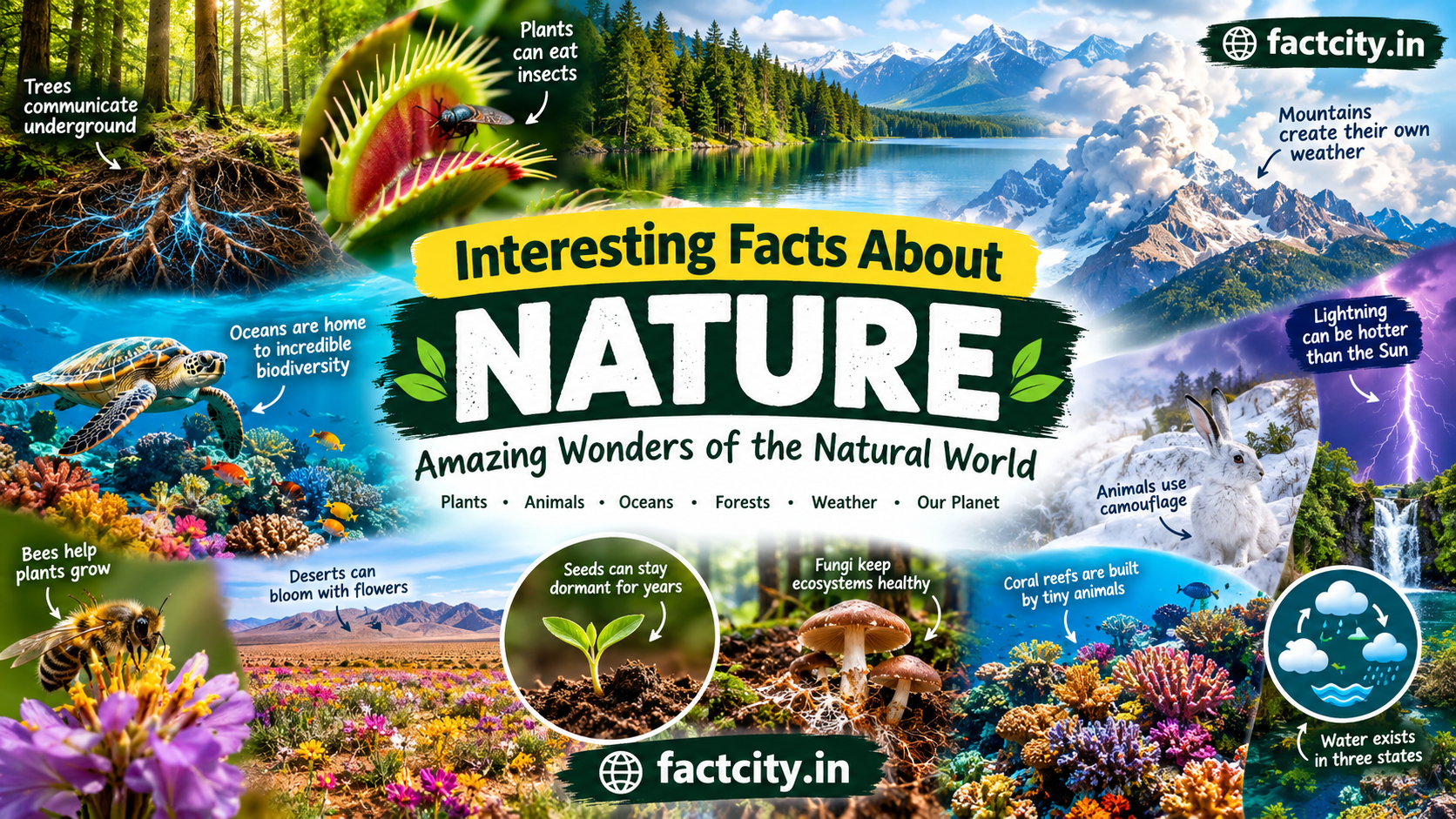
Interesting Facts About Nature: Nature is full of surprises. The natural world is full of countless mysteries and fascinating discoveries, from enormous oceans and towering mountains to tiny insects and microscopic organisms. There are many things that we see every day that have remarkable stories behind them, and some natural phenomena are so unusual that they seem almost impossible.
If you love learning about the world around you, these fun facts about nature will give you a new appreciation for plants, animals, oceans, forests, weather, and the planet itself.
Trees Talk to Each Other
Trees may seem like completely independent organisms, but forests can act as interconnected communities. Plant roots can interact with fungi underground, creating mycorrhizal networks.
Through these subterranean networks, plants can trade nutrients and chemical signals. Scientists’ evidence suggests these networks could be important in how plants respond to environmental stress.
That’s why forests are so much more complex than they look on the surface.
Certain Plants Eat Insects
Most plants obtain nutrients by using sunlight, water, and minerals from the soil. Carnivorous plants, however, have evolved strange adaptations that enable them to trap insects and other tiny animals.
The Venus flytrap is one of the best-known examples. Its modified leaves can snap shut on suitable prey when particular trigger hairs are stimulated.
For example, pitcher plants and sundews trap insects using very different approaches.
Nature always shows us that survival can lead to highly creative adaptations.
There Are Different Kinds of Forests on Earth
When people think of forests, they often picture tropical rainforests. But forests are found in many different environments.
Tropical rainforests, temperate forests, boreal forests, mangrove forests, cloud forests, and other specialised ecosystems. Each supports different plants and animals that are adapted to local conditions.
For example, boreal forests cover huge areas of the north and contain trees that can survive long, very cold winters.
The Ocean Has Huge Biodiversity
The oceans cover the majority of the Earth’s surface and are home to an incredible diversity of life. Marine environments are home to organisms of entirely different shapes, sizes and ways of life, from microscopic plankton to whales the size of a school bus.
Reefs of coral are of particular importance as they provide habitats for large numbers of marine species.
Despite their importance, scientists continue to discover new marine organisms, particularly in deeper and less explored parts of the ocean.
Some animals can grow lost body parts back
One of the most fascinating abilities in nature is regeneration. Some animals can regenerate lost or damaged body parts.
Some salamanders, for example, can regenerate limbs and other body tissues. Depending on the species and circumstances, starfish can also regenerate certain body structures.
By studying these animals, researchers gain a better understanding of how cells grow, how tissues are repaired, and how different body types develop.
Lightning is very hot
Lightning is one of nature’s most amazing shows. For a very brief instant, a lightning channel can become very hot, many times hotter than the surface of the Sun.
The rapid heating causes the air around it to expand suddenly, and this produces the sound we know as thunder.
Lightning is also important to ecosystems because it can help to convert atmospheric nitrogen to forms that eventually become available to plants through natural processes.
Water Can Naturally Exist in Three States
Water is unique in that it exists naturally on Earth in solid, liquid, and gaseous states.
Its solid form is ice, water in rivers, lakes, and oceans is liquid, and water vapour is in the atmosphere.
Water cycle: The water cycle is the constant movement of water from one of these states to another. The water cycle is the method by which water is cycled around the world through evaporation, condensation, precipitation, and collection.
This cycle is vital for life.
Some Animals Use Natural Camouflage
Camouflage lets animals blend in with their surroundings. It can assist predators in sneaking up on prey, and enable prey animals to not be noticed.
The Arctic hare, for example, will moult to a much lighter coat in winter in places where snow is common. Many insects also look like leaves, twigs, or pieces of bark.
Camouflage shows how evolution can change an organism’s appearance to match its environment.
Bamboo Can Grow Surprisingly Quickly
Bamboo is well known for its quick growth rate. Some species of bamboo can grow very rapidly if conditions are right.
Bamboo is a member of the grass family, not a traditional tree. And some species get impressively tall and are relatively light.
It’s fast-growing and versatile. Bamboo is a vital plant in many cultures and industries.
Little Animals Make Big Reefs of Coral
Corals may look like colourful rocks underwater, but they are animals.
Polyps are the individual coral organisms. They create hard calcium carbonate structures that build up over time, forming large reef systems.
Many marine organisms find shelter and feeding grounds on reefs of coral. Their health is tightly coupled to ocean temperature, water quality, and other environmental conditions.
Types of Clouds
Not every cloud is the same. Clouds are classified by meteorologists according to their form, altitude, and evolution.
Cumulus clouds often look like fluffy cotton balls, whereas cirrus clouds are thin and wispy and tend to be high in the sky. Cumulonimbus clouds grow vertically and are associated with thunderstorms.
Clouds are a key component of the Earth’s weather system. They influence the amount of rainfall, temperature, and amount of sunlight that reaches the Earth’s surface.
The Dormancy Of Several Years’ Duration May Be The Case Of Certain Seeds
Seeds have amazing survival strategies. Under adverse conditions, some seeds can go into a state of dormancy, remaining inactive until the time is right for growth.
Environmental factors that affect seed germination are temperature, moisture, and light.
This ability helps plants survive times when water or other resources are not available.
Bees are important pollinators
Beetles are some of nature’s most important pollinators. They can transfer pollen between flowers while foraging.
Pollination enables many flowering plants to reproduce and aids in the production of many fruits, vegetables, nuts and seeds.
Bees are well known for pollination, but many other animals, including butterflies, moths, birds, bats and other insects, also help with pollination.
Some Deserts Can Bloom
Deserts may seem barren, but surprisingly they can support quite diverse ecosystems. Given enough rain, dormant seeds will germinate quickly and make spectacular displays of flowers.
They are particularly visible in some desert areas following abnormal or seasonal rainfall.
Desert plants have evolved unique adaptations to survive with limited water, including deep roots, water-storing tissues, and reduced leaf surfaces.
Mountains Can Make Their Own Weather
Mountains play a large part in the weather. When moist air strikes a mountain range, it is forced to rise. As the air ascends, it cools, and this can lead to the formation of clouds and rain.
This process can produce wetter conditions on one side of a mountain range and significantly drier conditions on the other.
Thus, two places which are not far apart may have quite different climates.
In nature, there exist living organisms which are extremely old
Some things on Earth are very old. Given the right conditions, some trees can live for thousands of years.
Some ancient plant colonies and fungal organisms could also survive for extremely long periods.
Scientists learn a great deal about growth, environmental change, and the capacity of living systems to survive for long periods by studying long-lived organisms.
Fungi Are Crucial to Ecosystems
Fungi are often ignored, but they are very important in nature. Many fungi break down dead organic matter, helping return nutrients to the soil.
Other fungi associate with plant roots. These relationships can improve nutrient and water absorption for plants while providing fungi with carbohydrates made by plants.
Without decomposers like fungi and bacteria, ecosystems would struggle to recycle nutrients efficiently.
Nature Is Always Recycling Materials
One of the most important facts about nature is that ecosystems recycle matter in a continuous cycle.
Dead leaves fall to the ground, and organisms break them down, returning nutrients to the soil. Plants take up those nutrients and use them to grow. Plants are then eaten by animals. Animals then get energy and nutrients from plants or other animals.
This interconnected process allows the ecosystem to keep going year after year.
Why It’s Important to Know About Nature
Learning interesting facts about nature is more than just fun. It helps us appreciate how closely living things are related to their environment.
A forest is not just a collection of trees. An ocean is more than just a lot of water. There is more to a garden than simply plants. Each is a complex system of organisms interacting with each other and their environment.
Recognising these links can also help inspire people to value biodiversity and consider more carefully how human actions impact natural ecosystems.
Summary
There are many interesting details in the natural world that are easily overlooked. Trees engage with underground organisms, Animals learn extraordinary ways to survive, Plants trap insects, Minuscule coral animals build colossal reef structures.
These curious facts about nature prove that our planet is much more complex and surprising than it seems at first sight. There is always something new to discover whether you are interested in wildlife, plants, oceans, forests, weather, or geology.