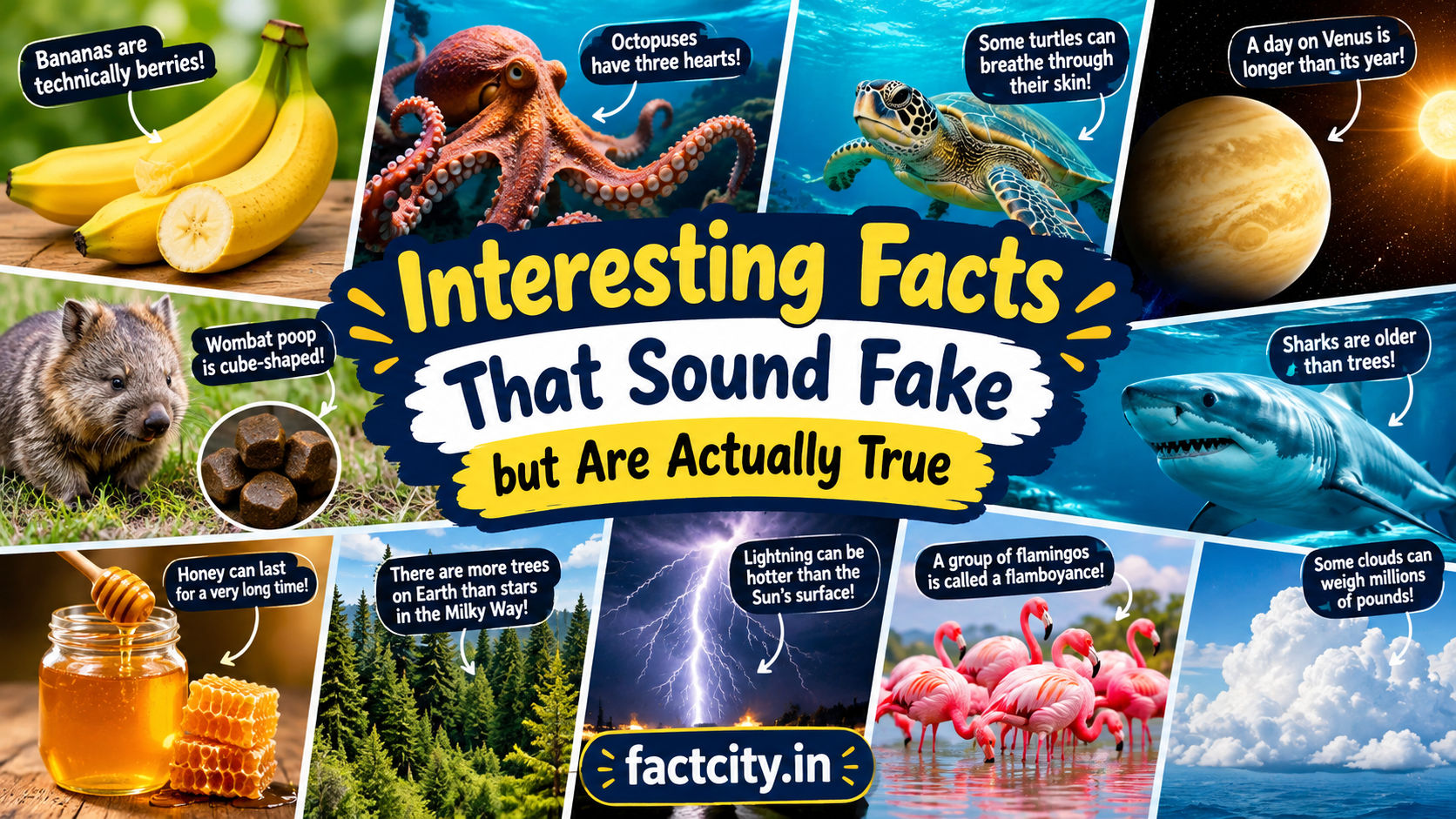
Interesting Facts That Sound Fake: The world is full of strange discoveries, weird natural phenomena, and surprising facts that are hard to believe at first sight. Some facts sound like they could have been written for a movie or a social media post, but science, history, and nature have proven that they are real.
If you like to learn unusual information, these interesting facts that sound fake are sure to make you stop and think. Weird things happen in nature, and animals have incredible powers. Here are some amazing facts that sound impossible but are surprisingly true.
Bananas Are Actually Berries
This is one of those facts that seems so incorrect. But botanically speaking, bananas are berries. They develop from a flower with a single ovary, and they have seeds inside the flesh. “Interesting Facts That Sound Fake“
Strawberries, however, are not technically berries by botanical standards. They don’t have the structure of a true berry.
So technically, next time someone asks you to name a berry, a banana could be part of the answer.
Octopuses Have Three Hearts
An octopus is already a pretty weird animal, but its internal biology is even weirder. Octopuses have 3 hearts.
Two hearts pump blood to the gills where they take up oxygen. The third heart pumps oxygenated blood to the rest of the body.
More amazing is the fact that the main heart stops beating when an octopus swims. This is one reason why octopuses often prefer to crawl rather than swim for extended periods.
Certain Turtles Can Breathe Through Their Skin
Some aquatic turtles have evolved an extraordinary way of obtaining oxygen in underwater environments. Oxygen can be absorbed by some species through specialised areas of their skin.
This ability can allow them to stay underwater for long periods of time, particularly in cold conditions when their metabolism slows down.
That doesn’t mean any old turtle can just breathe through its skin, but the ability is there in some species, and it’s a great example of animal adaptation.
Its Year Is Shorter Than Its Day
Venus rotates in the weirdest way of all the planets.
The planet spins on its axis once every 243 Earth days or so, and takes about 225 Earth days to orbit the Sun.
That means that a day on Venus, defined as the time it takes to complete one rotation on its axis relative to the stars, is longer than a year.
This odd fact is a great example of how much stranger our solar system can be than it appears from Earth.
Wombats produce cube-shaped poop
This may sound like a joke, but it is a genuine biological fact.
Wombats make droppings which are roughly cube-shaped. Scientists have studied how this weird shape is made in the wombat’s guts.
The cube-shaped pieces are used by wombats to mark territory, which may prevent the droppings from rolling away.
Nature has come up with some strange solutions to common animal problems, and wombat digestion is definitely one of them.
Sharks Pre-Date Trees Sharks
Sharks have been on Earth for hundreds of millions of years. Their ancient ancestors were present long before the evolution of many modern plants.
The first sharks appeared more than 400 million years ago, but the first trees only came much later.
That is, sharks have survived tremendous changes in the environment of the Earth, existing through several major geologic periods.
When you consider that sharks were swimming in the ancient oceans long before familiar forests existed, it makes this fact all the more incredible.
Honey Can Last for Extremely Long Periods
Pure honey has amazing preservation properties. Honey has a low water content, acidity, and other chemical properties that mean it will keep for a very long time when stored properly.
Archaeologists have even found ancient honey in Egyptian tombs that was said to be preserved. Honey is famous for its shelf stability, but the condition and edibility of individual archaeological samples may vary.
Honey is one of the most impressive examples of long-lasting food preservation in nature.
More Trees on Earth Than Stars in the Milky Way Galaxy
Scientists estimate there are trillions of trees on Earth. Estimates say there are hundreds of billions of stars in the Milky Way.
The exact numbers are still being fine-tuned, but the comparison is still staggering.
Every forest, every wood, every plantation, and every group of isolated trees form a vast worldwide population of trees. It’s a reminder of how much richer in biology Earth is than we sometimes think.
Lightning Is Hotter Than The Sun’s Surface
A lightning bolt is much more than a flash of light. The electrical discharge rapidly heats the surrounding air to very high temperatures.
For a short time, the air in a lightning channel can get hot enough to reach 30,000 degrees Kelvin. That’s several times hotter than the surface of the sun.
Fortunately, the extreme temperature of lightning is for a very short period and in a relatively narrow channel.
It is one of the most spectacular examples of the huge amount of energy released in a natural weather event.
Some animals can regenerate lost body parts
Regeneration is one of the most marvellous powers in nature.
There are some animals that can regrow body parts that humans can not naturally replace. Axolotls, for example, can regenerate a number of tissues, including the ability to regrow limbs.
Some starfish can regrow lost arms, too, and some flatworms can regenerate in amazing ways.
These creatures are studied by scientists because we might learn more about how to repair and heal tissue by understanding how regeneration works.
Flamingoes are a flamboyance
Animal group names are pretty creative. A group of flamingos is usually called a flamboyance, which is an appropriate name for these birds with their brilliant pink feathers and distinctive looks. Other collective animal names are equally bizarre, although some are traditional terms, not scientific classifications. These fun words add an extra fun factor to the study of wildlife.
Water can be in three states at the same time
There are some conditions, called the triple point, where a substance can be a solid, liquid and gas at the same time.
This is the case for water at a certain combination of temperature and pressure.
In everyday life, we usually see ice, liquid water, and water vapour as separate things. And the triple point shows how changes in pressure and temperature can cause surprising physical behaviour.
It’s a good reminder that even water, mundane as it is, has interesting scientific properties.
Some clouds weigh millions of pounds
Clouds look light and fluffy because they are floating in the atmosphere, but they can hold a lot of water.
Depending on their size and density, a typical large cumulus cloud can weigh hundreds of thousands of kilograms of water.
Why does it float? The water is dispersed as millions of tiny droplets and ice particles suspended in the surrounding air. The entire cloud system is subject to suspension by atmospheric motion.
A cloud appears weightless, but it can hold a surprising amount of water.
There Are Places Where Fish Can Rain
Fish falling from the sky have been reported in different parts of the world, although it is very rare.
Such strange happenings are usually blamed by scientists on powerful waterspouts or violent storms. A waterspout may pick up small aquatic animals out of the water, carry them, and then drop them somewhere else.
The concept of raining fish might sound like fiction, but weather can sometimes produce very strange events.
Your bones are tougher than they look
Human bones are surprisingly strong compared with many solid materials, but they are light.
Bone is hard, but it is also a little flexible, since it is made of minerals embedded in a collagen-based structure.
Bones are also constantly remodelled. The old bone material is broken down, and new material is made. This way the skeleton can adapt to evolving physical demands.
The human body is full of engineering solutions that can be almost unbelievable.
Why Do These Facts Sound So Fake?
Many amazing facts appear untrue because they contradict our daily experience.
We seldom consider the botanical definitions, the odd anatomy of animals, the turning of planets, the physics of the atmosphere, or the processes that are occurring inside living things on the microscopic scale. Therefore, something scientifically normal can sound absolutely impossible when we first hear it.
The best way to judge a surprising claim is to consult reliable scientific, educational, or historical sources, instead of taking it at face value or dismissing it because it sounds odd.
Final Remarks
Here are some surprising facts that sound fake, but demonstrate the amazing nature of our planet, solar system, and living world. Three-hearted octopuses, cube-shaped wombat droppings, ancient sharks and incredible weather events – reality is often stranger than fiction.
Some of the most interesting facts are not the most complicated ones. Sometimes, a simple fact about an animal, planet, or natural phenomenon can completely change the way we view the world.
If you like unusual knowledge, continue reading. The more you learn about science and nature, the more you find out that many things that sound impossible are, in fact, part of the real world.