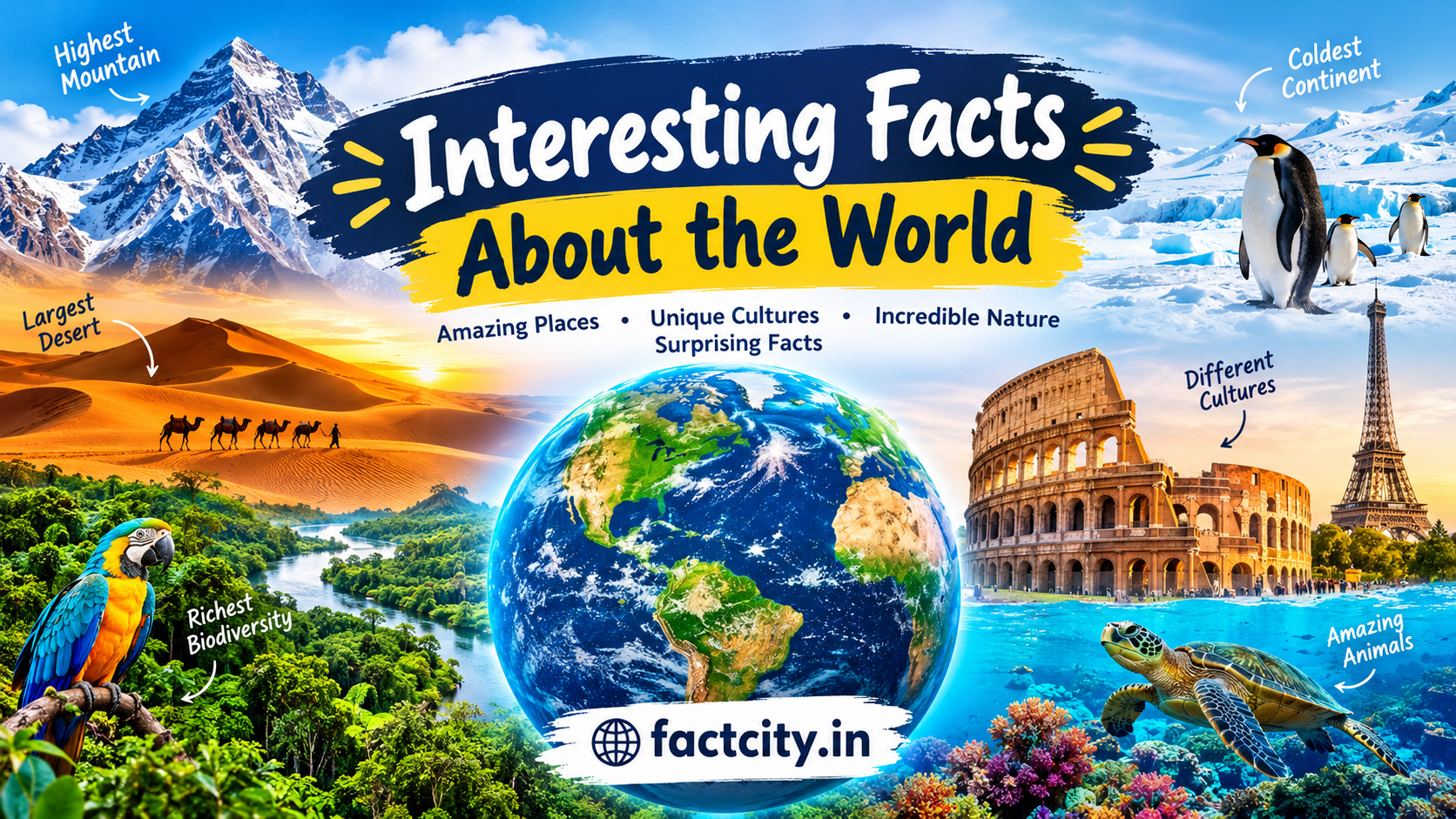
Interesting Facts About the World: There are many wonderful places in the world, strange traditions, incredible natural wonders, and astonishing facts that can change the way we see our planet. There are stories from the deepest ocean floor to the highest mountain that are both educational and entertaining. Earth is full of stories.
If you like to learn something new, these interesting facts about the world will give you plenty of reasons to be curious. Some facts are about geography, some are about animals, nature, history, people, and daily life.
Earth is mainly covered by water
One of the simplest and most amazing facts about our planet is that Earth is covered with lots of water. About 71% of the Earth’s surface is covered with oceans, seas, rivers, and lakes. The largest and deepest of the Earth’s oceans is the Pacific Ocean. It covers a huge area between Asia, Australia, North America and South America. But while our planet is covered with a lot of water, only a small percentage of it is readily available as freshwater for human use.
Antarctica is the Coldest Land
Antarctica is known for its extreme cold, but it is also one of the most fascinating places on Earth. It is the coldest continent and has a huge amount of the world’s freshwater in the form of ice. Interestingly, Antarctica is not a desert in the normal sense because it receives very little precipitation. The extreme dryness combined with freezing temperatures creates one of the harshest environments on the planet.
Mount Everest is the Tallest Mountain Above Sea Level
Mount Everest is world-famous as it is the highest mountain above sea level. It is located in the Himalayan mountain range on the boundary between Nepal and Tibet. It is super hard to climb Everest because of the low oxygen, the freezing temperatures, the high winds, and the difficult terrain. The mountain has become a symbol of adventure, determination, and the human spirit’s endurance facts-about-mercury
The Sahara is the World’s Largest Hot Desert
The Sahara Desert is the world’s largest hot desert and covers a huge part of North Africa. It is a large area and is made up of sand dunes, rocky landscapes, dry valleys, and mountains. The Sahara is known for its heat, but temperature swings from day to night can be extreme. Animals and communities have had to adapt to the harsh environment of the desert.
There are over 190 countries in the world
There are now some two hundred recognised countries and territories in the world, each with its own culture, language, government, traditions and landscapes. Every country has its own personality. Some are renowned for their ancient architecture, some for natural beauty, some for technology, food, wildlife, or cultural traditions. Looking at these differences gives us a sense of how diverse human civilisation is.
Russia is the biggest country in the world in terms of area
Russia is the world’s largest nation in terms of area. It covers a large chunk of Europe and Asia and covers several time zones. Russia is big. It has all sorts of different landscapes. Forests, mountains, plains, lakes, rivers, Arctic regions, etc. Its geography gives it very varied terrain and climate.
Smallest Country Is Vatican City
At the opposite extreme of size is Vatican City. It is the smallest independent country in the world by area and population, located within Rome, Italy. Vatican City is small in size but of huge cultural and religious importance. It is the home of the Roman Catholic Church, and it has many historic buildings and works of art.
The Amazon Rainforest is hugely biodiverse
The Amazon rainforest is one of the most biodiverse areas on the planet. It extends across several South American countries and is concentrated mainly in Brazil. The rainforest is home to millions of species of plants, insects, birds, fish, mammals, and other creatures. Scientists continue to study the region because new species and ecological discoveries continue to be made.
Some Trees Can Live for Thousands of Years
“Trees are one of the longest-living organisms on the planet.” Some species can live for thousands of years under the right conditions. Scientists can learn much about past climates and environmental changes from ancient trees. Their growth rings can reveal information about past droughts, fires, and other conditions from centuries ago.
The depths of the ocean are very mysterious
One of the least explored environments on our planet is the ocean. The deepest parts of the ocean are in the Mariana Trench in the western Pacific. The pressure is enormous at these depths, sunlight does not reach these areas, and temperatures are very low. But scientists have found organisms that can live in these extraordinary conditions.
Lightning Is Extremely Hot
Lightning is one of nature’s most dramatic displays. The temperature inside a lightning channel can be several times the temperature of the surface of the Sun. This great amount of heat makes the air around expand very fast and gives rise to the sound we call thunder. A lightning strike is a short-duration event, but it is a lot of energy.
Some Animals Can Do Amazing Things
The natural world is full of animals with amazing abilities. For instance, some birds are capable of navigating thousands of miles during their migrations, and some marine animals can communicate acoustically over long distances. Octopuses are also known for their intelligence and their ability to change colour and texture. These changes show how different species have changed to live in their environment.
The Human Brain Is Very Complicated
The human brain is one of the most complex biological structures in the world. It controls movement, memory, emotions, communication, learning, and countless automatic functions. Today, scientists still study the brain and how it works. Research on memory, consciousness, emotions, and decision-making continues to yield new insights into what makes humans unique.
Languages are very diverse
There are thousands of dialects and languages spoken by people around the world. Some languages are spoken by hundreds of millions of people. Other languages are spoken by relatively small communities. Language is not just a means of communication. It can maintain history, tradition, stories, and cultural identity. Sadly, many languages are endangered as younger generations move to more widely spoken languages.
Some places have months of daylight or darkness
The tilt of our planet also brings about unusual seasonal patterns near the polar regions of the Earth. In some places, there may be continuous daylight for part of the year and extended periods of darkness for other parts of the year. This phenomenon is generally associated with regions within or near the Arctic and Antarctic Circles. This is among the clearest examples of how the position and movement of the Earth have an effect on life on the planet.
The world has amazing underground structures
Not every amazing place on Earth can be seen from the surface. Deep underground are huge caves, tunnels, mineral formations, and underground rivers. Some cave systems have spectacular stalactites and stalagmites that have built up in thousands or even millions of years. Such environments can also host unusual organisms, specially adapted to darkness.
Volcanoes help to shape the planet
Volcanoes have been a dominant force in sculpting the Earth’s landscapes. When volcanoes erupt, they can spew out lava, ash, and gases that alter the environment around them. Volcanoes have also formed islands and mountains. The eruptions can be dangerous, but in the long term volcanic materials can create fertile soils suitable for agriculture.
The Earth Is Always Changing
The planet may appear stable, but the Earth is always changing. Beneath the surface, tectonic plates move slowly, mountains are built and eroded, rivers change course, glaciers grow and retreat, and coastlines change slowly. These changes tend to occur so gradually that humans are unaware of them in everyday life. But over thousands or millions of years they can carve landscapes that are completely different.
Why You Should Know Fun Facts About the World
Learning interesting facts about the world is more than a pastime. It helps us to understand geography, nature, science, history, and different cultures. Facts can also stimulate curiosity. When we learn something surprising, it often leads us to ask another question. That curiosity can lead us to study new topics, visit new places, read more books, or learn about scientific discoveries.
Ultimately
Our planet is much more fascinating than it seems at first glance. From vast oceans and primeval forests to extreme deserts, mighty volcanoes, strange animals, and varied cultures, there is always something new to discover. These fun facts about the world are just a tiny introduction to the incredible variety on Earth. We learn more about our planet; we see how much is still to be explored and understood.
If you enjoy geography, science, animals, history, or nature, the world is full of things to find out about. Sometimes it’s the one surprising fact that ignites a much deeper interest in the amazing planet we call home.
1 thought on “Interesting Facts About the World: Amazing Things You May Not Know”