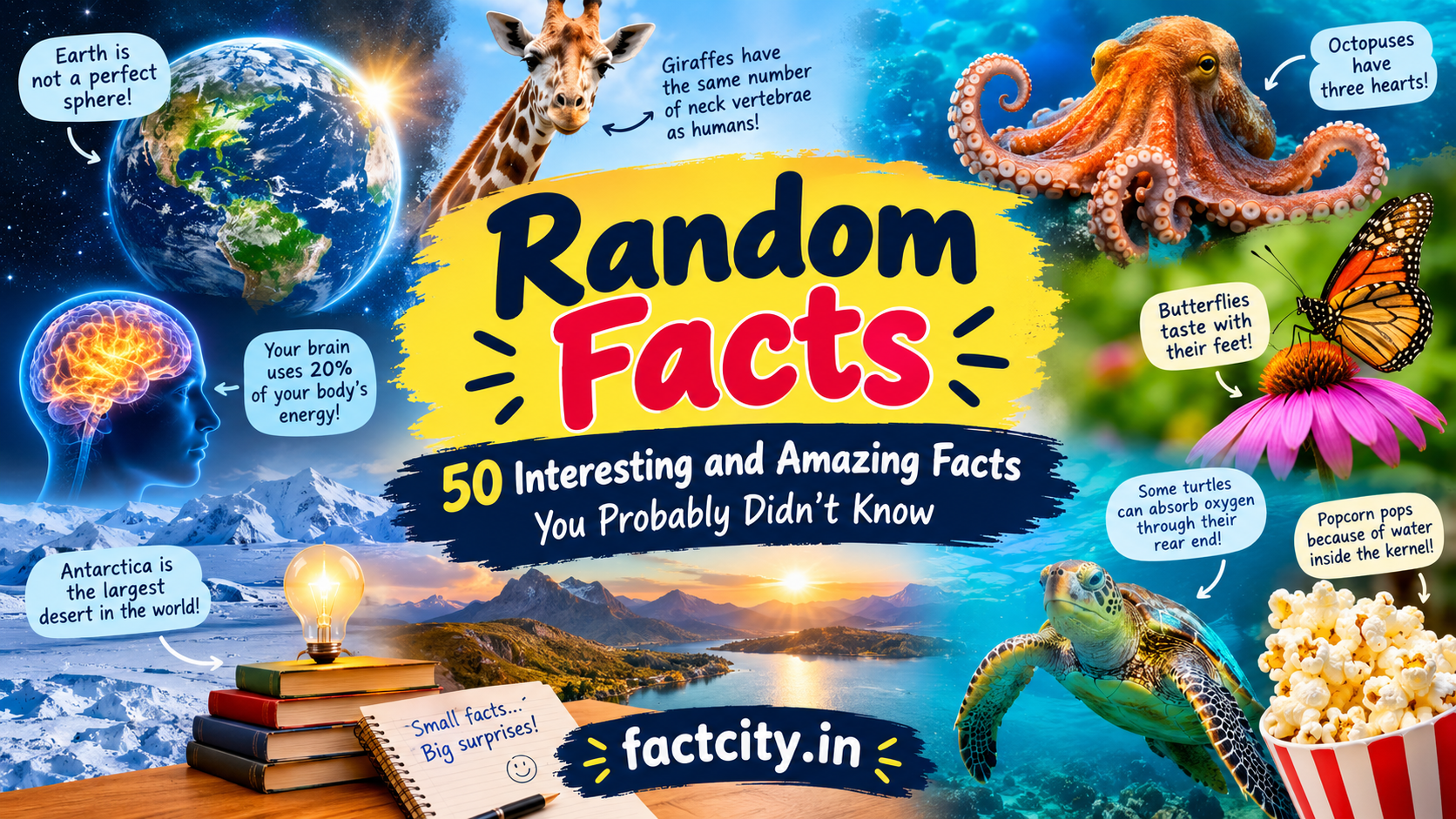
Random Facts: Have you ever wondered why the sky is blue, how animals communicate with each other, or why some things work the way they do? There are many interesting details in the world that most people don’t often see. There is always something new to learn, from surprising facts about nature and the human body to interesting discoveries about space, science, and history.
Random facts are a fun way to learn something unexpected, explore the world, and spice up normal conversations. Some facts will surprise you. Some facts will change the way you view familiar things. In this article, you will find a list of interesting random facts that are easy to understand, fun to read, and share with friends and family.
Incredible facts about the human body
The human body is a great system that performs thousands of activities every day. Many of these processes happen automatically without us even thinking about it. Your brain is always working. When you’re asleep, your brain is still busy doing important stuff, handling information, helping you remember things. Sleep is important for the brain to recover and sort information.
Your skin is the largest organ of the body. The skin protects internal tissues, regulates body temperature, and provides sensations such as touch, pressure, and pain. It is also a protective barrier against many environmental hazards.
Every day your heart beats thousands of times. The heart is a pump that constantly pushes blood around the body, bringing oxygen and nutrients to tissues. Its rate differs according to the level of physical activity, emotions, age, and general health. Your fingerprints are one of a kind. The ridge patterns of human fingertips are unique to each individual. That’s one reason why fingerprints are so often used for identification. These facts show how the human body works all the time to keep us alive and functioning.
Amazing facts about animals randomly
Animals have developed some amazing abilities to help them to survive in many different environments. The animal kingdom has surprises from the deepest ocean to the highest mountain. Octopuses have 3 hearts. Two hearts pump blood to the gills, and the third heart pumps blood to the rest of the body. Their blood contains a copper-based protein called hemocyanin, which helps transport oxygen and makes their blood appear blue.
Butterflies can taste with their feet. Many butterflies can taste using their feet. The receptors help them to find the right plants on which to lay their eggs. Elephants have many ways of talking to each other. Elephants communicate using sounds, body movements, touch, and low-frequency calls. Some of these sounds can travel great distances.
Dolphins have special whistles. Dolphins communicate using a wide range of sounds. Some species develop individual signature whistles that can be used to identify particular animals. A group of flamingos is known as a flamboyance. A flock is a colourful collective noun that is often used to describe a group of flamingos that have gathered together. Animal facts are a reminder that intelligence, communication and survival strategies can take many different forms in nature.
Fun Facts About Space
One of the most interesting topics is space, because it has huge planets, far away stars, and mysteries that scientists are still studying. The Sun is a star. It appears much larger and brighter than other stars because it is fairly close to the Earth. The Sun is the source of light and energy that makes life on our planet possible. Light travels super fast. Light travels at a speed of approximately 300,000 kilometres a second in a vacuum. Even at this incredible speed, light from distant stars may take years or more to reach us.
A day on Venus is longer than its year. Venus has a very slow rotation. One rotation relative to the stars takes approximately 243 days, while one orbit about the Sun takes approximately 225 days. The Moon affects ocean tides. The pull of gravity from the Moon plays a big part in making tides in the oceans on Earth. The Sun also influences the tides by its own gravity. Let’s be clear, space isn’t completely silent everywhere. Sound cannot travel through the vacuum of space in the usual way through air. But scientists can study vibrations and can turn some of the measurements of space into representations of audio.
These facts about space show just how different the universe can be from the world we live in on a day-to-day basis.
Miscellaneous Facts about Nature
Nature is full of strange patterns, mighty forces, and amazing adaptations. Things even as familiar as trees, rain, and oceans have interesting stories behind them. Rain smells a certain way. That smell of the earth after rain is called petrichor. It can be triggered by compounds released from soil and plants and by compounds associated with some soil microorganisms. Bamboo grows very quickly. Bamboo is one of the fastest-growing plants on earth, and some species of bamboo are. Under suitable conditions, some species can grow several tens of centimetres in one day.
Lightning is very hot. The air inside a lightning channel can briefly reach temperatures of around 30,000 degrees Celsius. That is much hotter than the surface of the Sun. Trees “talk” using chemical signals. The trees and other plants can emit airborne chemicals in response to insects or environmental stress. Complex relationships with fungi and their roots also allow plants to exchange resources and signals. The oceans cover most of the Earth’s surface. About 71% of the planet’s surface is covered with water, and most of that water is found in the oceans. Nature has been teaching us that interesting science can be found in even the most mundane of places.
Random Everyday Facts That May Surprise You
Some of the most interesting facts are about things we use or experience every day. An astronomical day is not always exactly 24 hours long. We measure time in 24-hour days for everyday purposes, but the length of a day on Earth varies slightly over time. The length of a solar day is also not constant throughout the year. Bananas are berries, botanically. In botanical terms, bananas are classified as berries, whereas strawberries do not fit the same botanical definition. Everyday names of food do not always match scientific categories. The smell of freshly cut grass is a chemical reaction. When grass is damaged, it releases compounds called green leaf volatiles. These chemicals give the familiar smell and are involved in plant responses to damage.
Microwaves heat foods with electromagnetic waves. Microwave ovens make certain molecules, like water molecules, respond to an alternating electromagnetic field. The transfer of energy makes it easier to heat food. There are many reasons why ice can be slippery. Slipperiness can be caused by pressure, friction, and the nature of the ice surface. The story is more complicated than that simple idea that pressure always melts ice.
These common facts show how science helps to explain familiar experiences.
Fun Facts About History and Inventions
Human history is full of discoveries and inventions that have changed how people live, travel and communicate. The printing press revolutionised communication. The movable-type printing press helped to make books and written knowledge more widely available in Europe in the fifteenth century. Printing technologies had also been developed earlier in East Asia. In 1903, the first successful powered aeroplane flight occurred. At Kitty Hawk, North Carolina, Orville and Wilbur Wright achieved a controlled, sustained flight with a powered aircraft. The Internet and the World Wide Web are not the same thing. The Internet is a global network of interconnected computer systems. The World Wide Web is a service that runs over the Internet and allows people to view linked pages and resources.
Ancient civilisations had advanced engineering skills. The construction of pyramids, aqueducts, and monumental temples serves as a testament to how previous societies utilised maths, organisation, and practical knowledge to solve hard problems. Photography revolutionised the recording of history. Photographs made it possible to keep visual records of people, places, and events, and thus had an impact on journalism, science, art, and individual memory.
Studying inventions teaches us how ideas from the past continue to affect life today.
Why Do Random Facts Interest Us?
Random facts are attention-grabbing because they provide small discoveries without having to study for a long time. One surprising fact can inspire a person to ask questions, explore a subject, or learn more about science and history. Interesting facts to read can also help with general knowledge, curiosity, and conversation skills. Knowing why Venus has an unusually long rotation period or how octopuses circulate blood can make a discussion more engaging.
However, it is important to verify that a fact comes from a reliable source. Some of the more common claims circulating online are overblown, out of date, or lack key context. Scientific facts can also be made more detailed by new discoveries made by researchers. For effective learning, look for credible educational sources, scientific institutions, museums, and well-researched reference materials.facts-about-mercury
Summary
There are so many random facts in the world that just show how crazy everyday life can be. Whatever the subject is, whether it is the complex systems of the human body, the bizarre abilities of animals, the mysteries of space, or the inventions that changed history, there is something interesting to be learned.
These random facts are more than just fun facts. They can spark curiosity, inspire learning, and help us appreciate the world around us. If you like reading about nature, science, technology, or history, then learning a new fact a day is an easy way to increase your knowledge.If you ever find yourself with some surprising information, spend a few minutes investigating. You may find that one small fact leads to an entirely new interest.