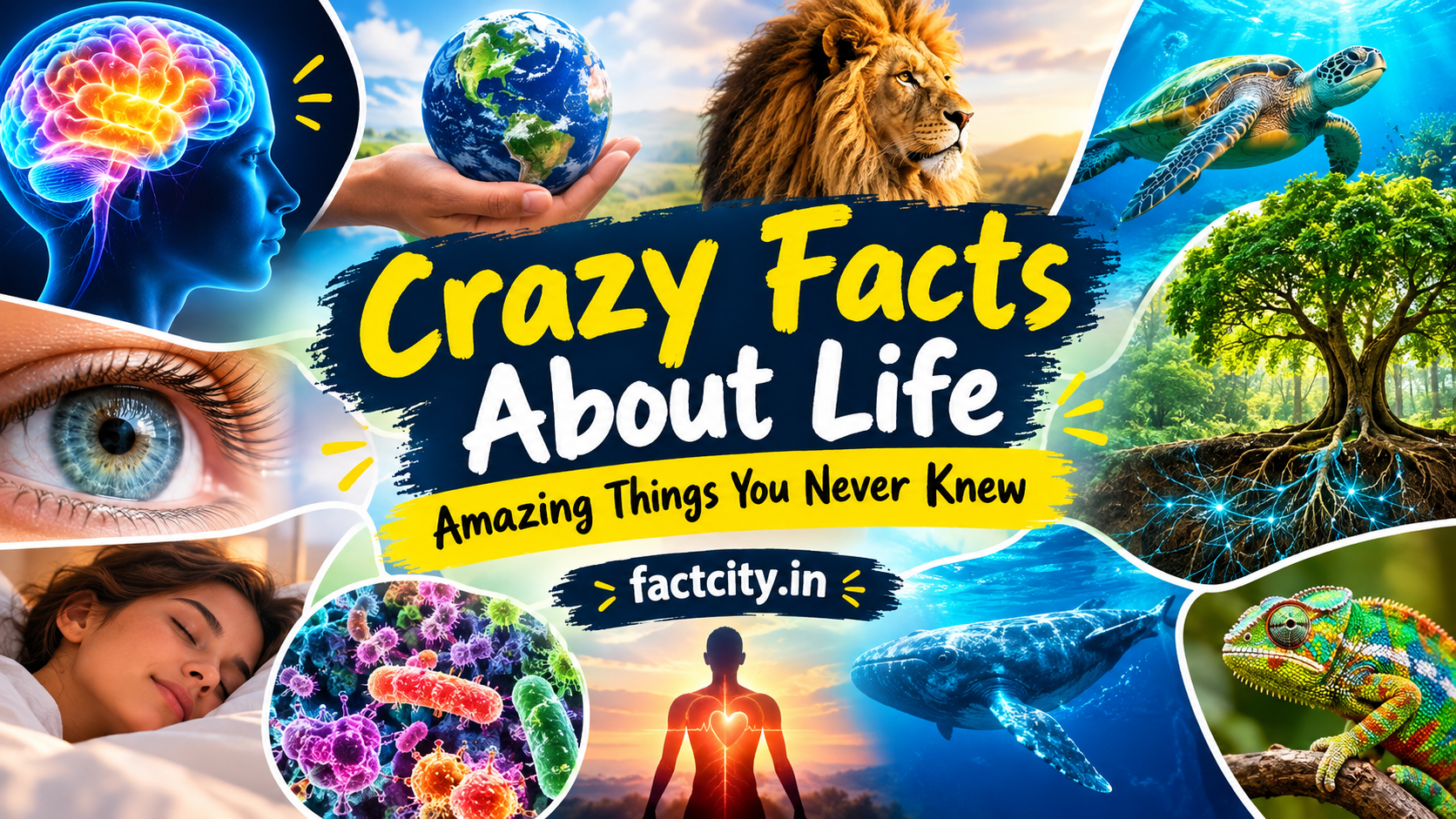
Crazy Facts About Life: Life is made up of ordinary moments, but behind many of those moments are fascinating facts that can completely change the way we see the world. There’s so much going on all around us that most people never notice, from the amazing abilities of the human body to the surprising behaviour of animals to the mysteries of our planet.
These crazy facts about life are a fun way to learn something new, and to find out just how weird, complicated and amazing everyday life can be. Some facts may seem incredible at first; some explain what you experience every day.
Your brain doesn’t ever stop working
The human brain is one of the most complex structures known to science. Your brain is still working, even when you’re asleep. It still controls vital processes, organises information, processes memories and helps regulate many functions throughout the body. Your senses are also constantly sending information to your brain. Your nervous system receives tonnes of information from sight, sound, touch, smell and taste, and much of this information is not perceived by your conscious mind at all. This is one of the reasons why the human brain is often considered to be one of the most interesting aspects of life.
You’re Taller In The Morning
Here’s a surprising fact about the human body: People tend to be slightly taller in the morning than they are later in the day. Because this has something to do with the discs between the bones in your spine. Gravity is pressing on your spine as you stand and move around throughout the day. When you lie down and sleep, that pressure is no longer there, so the spinal discs can expand a little. The difference is typically small, but it shows how the body changes over the course of a normal day.
Your Heart Pounds Millions of Times
Your heart is working 24/7 from the day you are born, for your whole life. It circulates blood through the body, bringing oxygen and nutrients to tissues and removing waste products. The heart can beat billions of times over an average lifetime. The exact number depends on your heart rate and lifespan, but this little organ does an amazing amount of work. You rarely think about your heartbeat, but it is working every second.
Humans share surprisingly large amounts of DNA with other living things
It is difficult to imagine how interconnected life on Earth is. But humans are genetically similar to many other living things. That’s because all living things evolved from ancient common ancestors. This does not mean that humans are only “like” some other species. Instead, it suggests that biological processes use similar molecular instructions. Genetics provides fascinating evidence that life is part of a much larger story of evolution.
Your Skin Is Always Changing
Your skin isn’t a permanent outer shell. It is a living organ that is constantly growing, changing, repairing itself and sloughing off old cells. This is a continuous process, and millions of skin cells are lost naturally. Cells are produced in the deeper layers of the skin and slowly move upwards. This means that the body you see today is always changing at a microscopic level, even if you can’t see the changes.
Some animals can do things humans can’t
The natural world has functions that seem almost impossible. Some animals are sensitive to magnetic fields and use them to navigate large distances. Some birds travel thousands of kilometres. Some creatures in the ocean have evolved more complex ways of communication, while others have the ability to regrow parts of their bodies. These skills remind us that humans are only a small part of the natural world.
Trees Talk To Each Other Through Underground Networks
Forests are far more interconnected than you see when you’re above the ground. Trees and plants have “conversations” with fungi in the soil via mycorrhizal networks. These underground connections can help plants get nutrients and water, and might also help move chemical signals and resources around ecosystems.
Thus, the idea that a forest is simply a collection of individual trees is a simplification. Forest ecosystems are complex networks of connections between plants, fungi, animals, microorganisms, and soil. fun-facts-about-skin-amazing-things-you-may-not-know
Your body is home to trillions of microorganisms
You are not biologically by yourself. The human body is a host to a vast number of microorganisms, including bacteria and other microbes. Many live in places such as the digestive system. They interact with the human body in many ways. The collection of microorganisms that live on the human body is often referred to as the human microbiome. Scientists are still trying to understand these communities because they are linked to digestion, immune function, metabolism, and many other biological processes.
Memories Evolve Over Time
Memory is often imagined to be a perfect recording of things that happened. But human memory is not like a video camera. When you recall an event, your brain reconstructs information. Details may become less accurate or change over time. Later experiences, suggestions, and emotions can all affect the retrieval of a memory. This is one of the most interesting things about life. It means that two people can remember the same event differently.
Your Eyes and Brain Collaborate To Generate What You See
To see is more complicated than simply opening your eyes. Light passes into your eyes, where it is translated into signals that travel through the nervous system to the brain. These signals are interpreted by your brain and form your perception of the world around you. Simply put, your eyes take in the information, but your brain processes it. This is why vision is not a camera-like recording of reality.
Earth Supports an Amazing Diversity of Life
Scientists have identified millions of species, but they believe there are many more species to be found. Life is found in places where it was once thought impossible for organisms to live—deep oceans, frigid areas, deserts, underground habitats, and places of great heat or strange chemical conditions. Life can be very flexible in the case of microorganisms.
Some Animals Can Re-Grow Body Parts
Regeneration is one of nature’s most interesting capabilities. Some animals can regrow damaged or lost parts of the body. For example, some salamander species can regrow limbs and other tissue. Some marine animals are also endowed with remarkable regenerative capabilities. Humans can regenerate to a small extent, but not anywhere near as well as these animals. Scientists study regeneration because it could provide us with important clues about healing and how to repair tissue.
Still, the Ocean Is Full of Mysteries
Earth’s oceans cover most of the planet’s surface, but large parts of the deep ocean are still difficult to explore. The deeper scientists go, the more bizarre creatures and ecosystems they can find. Some organisms have developed specific adaptations for darkness, extreme pressure, and scarce food. The deep sea shows that life can survive under what seem to be incredibly hostile conditions.
Your Body Does Thousands of Things Without You Realising
Think of all the things your body does without you telling it to. You don’t normally have to remind your heart to beat, your lungs to exchange gases, or your digestive system to digest food. Your nervous system and other biological systems constantly coordinate these processes.
Even to keep your body temperature, you need many automatic reactions. While you live your daily life, your human body is basically doing a huge number of biological operations.
Life is always changing
Maybe the biggest fact about life is that nothing is ever exactly the same. Your body changes as you get older. Your thinking is based on experience. Relationships change, environments change, technology changes, entire ecosystems change over time. Even a seemingly normal day can have events that influence your future. If you get this, it can make your day-to-day life a lot more interesting.
Why Are We Interested In Crazy Facts About Life?
Crazy facts about life are not just a source of entertainment. They pique curiosity and allow us to view the world differently. Learning something surprising can cause you to ask better questions. Why do some animals regenerate? How does memory work? How do trees speak underground? Why is there life in extreme environments? Questions like these inspire people to explore biology, psychology, astronomy, environmental science, and more.
Closing Thoughts
There are so many amazing details in life that it’s easy to overlook them. The human body is always doing complex things. Animals are able to do incredible things. Plants interact in surprisingly complex ways. There are environments on our planet that scientists are still trying to understand.
These crazy facts about life show that you don’t always have to travel somewhere out of the ordinary to find something awesome. Sometimes the most exciting discoveries are happening inside your own body, in your backyard, under your feet, or in the world around you.