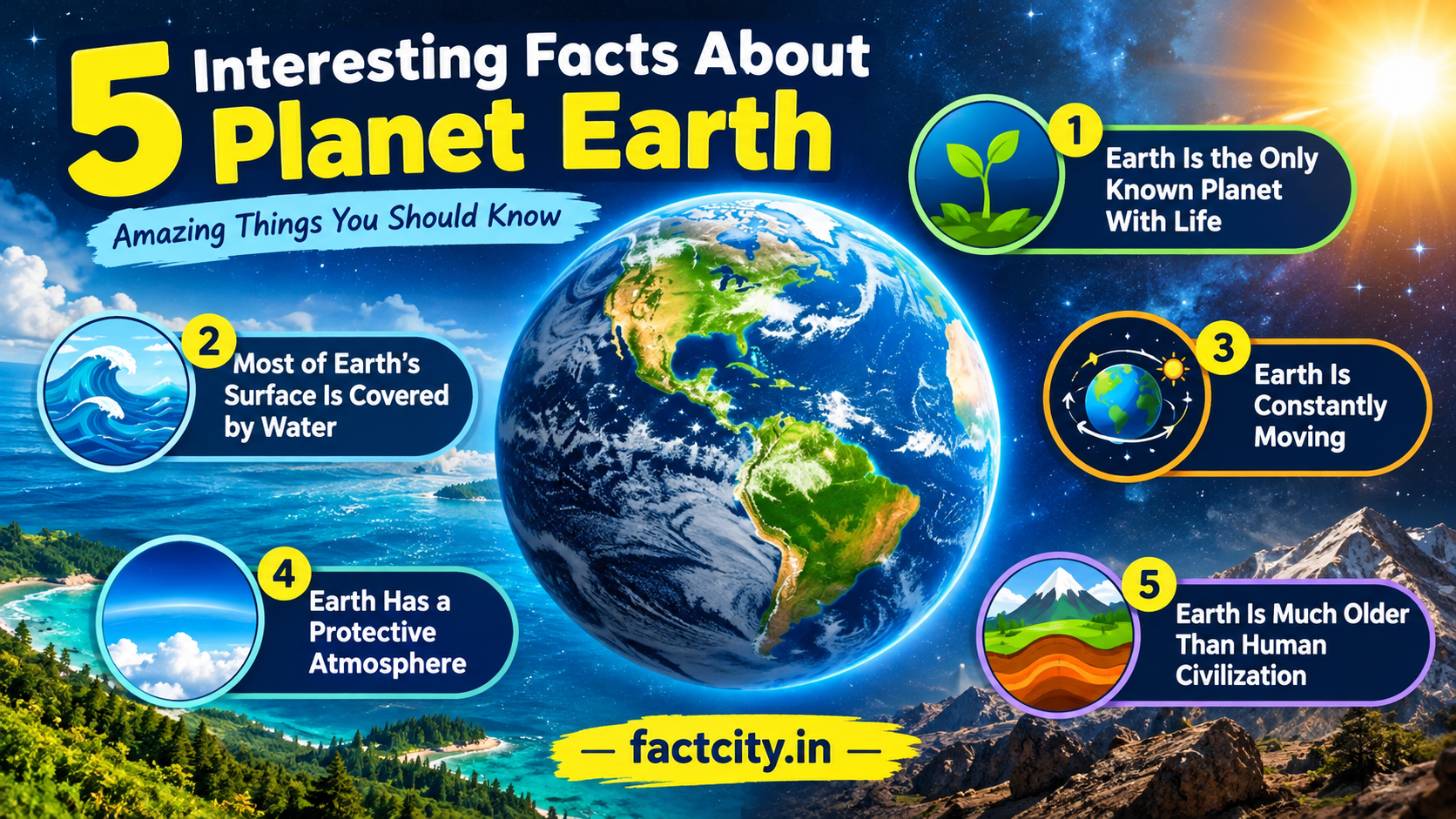
5 Interesting Facts About Planet Earth. Our planet Earth is our home, and yet there is still so much about it that can surprise us! Earth is an interesting planet with many unique features, from its oceans and atmosphere to its constantly moving surface. We live on it every day, but many of its most interesting characteristics are easy to overlook.
If you are looking for 5 interesting facts about planet Earth, then this guide covers some of the most interesting facts about planet Earth in a simple and easy-to-understand way. These facts can help you understand how special our planet really is and why Earth is so important for life.
Earth is the only planet known to support life
One of the most incredible things about planet Earth is that it is the only planet known to support life at this time. While thousands of planets have been discovered outside our solar system, Earth is the only known place where life exists. The planet offers several conditions that make life possible, such as liquid water, a suitable atmosphere, solar energy, and a relatively stable environment.
The Earth is at a perfect distance from the Sun. This region is sometimes called the habitable zone because the temperatures are such that liquid water could exist on the surface, assuming the right atmospheric conditions. Especially Water is important. Humans, animals, plants and micro-organisms all need water in different ways. Earth’s oceans, rivers, lakes, groundwater, glaciers and atmospheric moisture are all part of a huge water cycle that constantly moves water around the planet.
Earth is very different to every other planet we have studied to date, because it has life. Scientists are still searching for life elsewhere, but Earth remains the only confirmed example of a living world.
Most of the Earth’s Surface Is Water
An even more interesting fact is that about 71% of the Earth’s surface is covered with water. The rest is soil. This enormous amount of water is one of the reasons Earth is sometimes referred to as the Blue Planet. Earth’s most prominent feature seen from space is the oceans, which lend Earth its beautiful blue colour.
But most of the water on Earth is not usable by humans for drinking. About 97% of Earth’s water is salty ocean water. Less than 1 percent is freshwater, most of which is trapped in glaciers and ice sheets or stored underground. Earth’s oceans are also very important for climate. They absorb and retain a lot of heat and help distribute energy around the planet. Ocean currents transport warm and cold water from one place to another, affecting weather and climate.
There is an enormous variety of organisms living in the oceans. Marine environments contain a huge variety of life forms, from tiny plankton to huge whales . Although most of the planet is covered with the deep ocean, large swaths of it are difficult to explore. This means there are still underwater environments on Earth that scientists are working to understand better.
The Earth is in perpetual motion
We walk on the surface of the Earth, and it feels like the planet is perfectly stationary. But Earth is always moving. First, the Earth spins on its axis. The Earth takes about 24 hours to make one rotation. This is what causes the regular pattern of day and night. One side is facing the Sun and is in daylight; the other side is in darkness. Earth also goes round the Sun. It takes about 365.25 days to make one trip around the Sun. That extra fraction of a day is also why we have a leap year every four years or so.
But Earth’s movement doesn’t stop there.
The outer solid layer of the planet is divided into large sections known as tectonic plates. These plates move very slowly over geological timescales. They can cause mountains, earthquakes, volcanoes, ocean trenches, and other major geological features. Movement can cause earthquakes . In some places, tectonic plates can pull apart or slip past each other. When tectonic plates crash together, one plate can slide under another . These processes are so slow that we usually cannot see them in our everyday lives. But they have been carving the face of the Earth for millions of years.
The Earth Has a Protective Atmosphere
Earth’s atmosphere is another reason why life can exist on our planet. It is a layer of gases that surrounds the planet and goes far above the surface. The atmosphere is made up mostly of nitrogen and oxygen, with smaller amounts of other gases. These gases are important for maintaining the environment of the Earth. Oxygen is vital for humans and many other organisms. Oxygen is produced by photosynthesis by plants and algae and some microorganisms.
The atmosphere also helps to regulate the Earth’s temperature. The natural greenhouse effect happens when certain gases in the atmosphere trap heat and radiate it back. If this natural process didn’t exist, Earth would be much colder and a lot less habitable for most life forms that exist today. The atmosphere also helps to shield the Earth from some of the Sun’s dangerous radiation. The ozone layer in the stratosphere absorbs a lot of the Sun’s ultraviolet radiation . So the atmosphere of the Earth is far more than just the air we breathe. It is a complex system involving the oceans, land, ice, plants and animals and the Sun.
Earth Is Older Than Human Civilisation
The last fact on our list of 5 interesting facts about planet Earth is its amazing age. Scientists believe Earth formed about 4.54 billion years ago. For a sense of just how much time this is, consider that modern humans have only been around for a small fraction of the Earth’s history. Earth has experienced profound change through its long history. Continents have drifted, oceans have opened and closed, mountain ranges have been uplifted and eroded, climates have changed, and countless species have appeared and disappeared.
The planet has also experienced several major mass extinctions. These events heralded the beginning of a slow recovery of ecosystems and the evolution of new life forms. Take dinosaurs, for example. They walked the Earth for millions of years before dying out about 66 million years ago. Humans evolved in the end, long after they were extinct. The story of Earth is like a giant storybook, and in every layer of rock there are clues to the past. Scientists study rocks, fossils, ice cores, minerals, and other clues to understand how the planet has changed over billions of years. observe-the-relationship-in-the-first-pair-of-words-2
Why These Earth Facts Are Important
Learning interesting facts about Earth is not only enjoyable. It can show us why we must take care of our planet. Human civilisation depends on the water, air, food, soil and natural resources provided by the Earth. Its oceans, forests, rivers, wetlands, mountains and other ecosystems are linked in complex ways.
If people understand these links, they are likely to make more responsible choices. Creating a healthy environment can be achieved by reducing unnecessary waste, saving water, saving wildlife, planting and caring for vegetation, and carefully using natural resources. The more we learn about Earth, the more it’s easy to see how special and precious our home is.
Final Words
These 5 interesting facts about planet Earth show how amazing our world is. Earth is the only planet known to support life, is covered by water most of the time, is in constant motion both in space and in its own interior, has a protective atmosphere, and has existed for about 4.54 billion years. Humans have explored much of the planet, but there are still mysteries on Earth to be studied. From the furthest depths of the oceans to the highest peaks, and from an