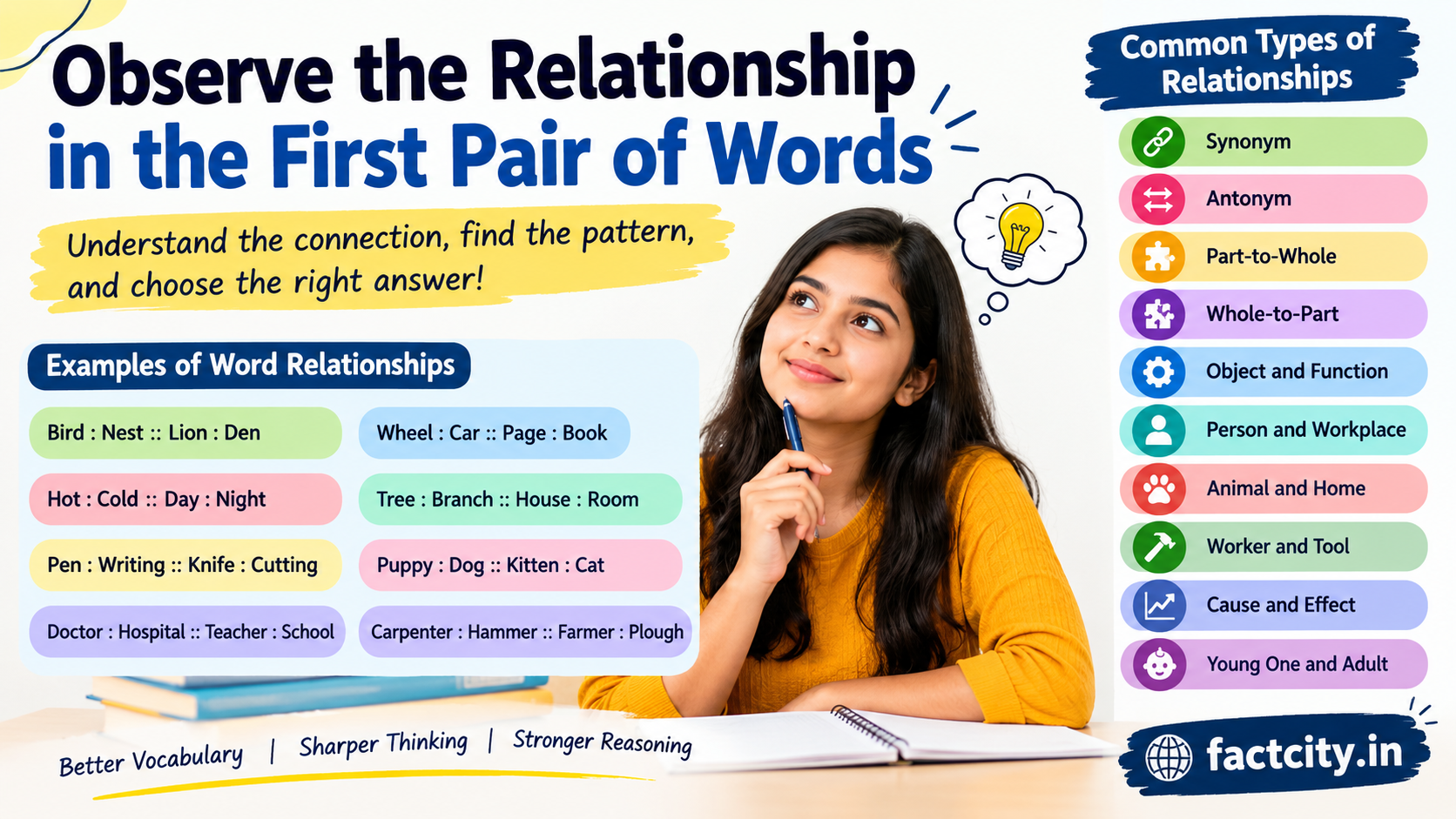
Observe the Relationship in the First Pair of Words. A common phrase used in verbal reasoning, analogy questions, aptitude tests, and vocabulary exercises is “Observe the relationship in the first pair of words”. These questions are designed to test your ability to identify the relationship between two words and then apply that relationship to another pair.
These questions look simple at first glance, but the only way to find the exact relation between the words is through keen observation. The words could be connected by their meanings, functions, opposites, categories, or even the way they are used.
In this guide, we will understand what “observe the relationship in the first pair of words” means, how to solve such questions, and what the common relationships are that you should look for.
What Does “Look at the Relationship of the First Two Words” Mean?
If you are asked to look at the relationship in the first pair of words, you should look at the first two words relationship.
For example
Bird: Nest
Here, a nest is a home for a bird to live in or use. Thus we have the relation:
Animal : Home
Now suppose you are told:
Lion: ????????????
You’d look for something that would represent the same kind of relationship. One possible correct answer is Den because a lion would typically use a den for shelter.
The fundamental concept is:
first word → connection → second word
Then you use the same pattern to answer the next part of the question. “Observe the Relationship in the First Pair of Words“
Why Are Relationship Word Questions Useful?
The word analogy questions are useful because they test many skills at once. They require you to understand vocabulary, see patterns, think logically, and compare concepts.
You will find these questions often in:
- Competition Examination
- School reasoning tests
- English tests of ability
- Vocabulary practice
- IQ and logical reasoning test
- Entrance Exams
- Assessments during interview
So, learning to recognise word relationships can improve your reasoning ability and your English vocabulary.
Common Types of Word Relationships
There are many ways two words can relate to each other. Knowing the most common ones will make the analogy questions a lot easier for you.
synonym relation
Sometimes the two words mean the same thing.
For instance
Happy : Cheerful
Both words convey a similar feeling.
Another example:
Big : Big
Here “big” and “large” are almost interchangeable.
When you answer an analogy question, check to see if the words in the first pair have similar meanings.
Antonym Relation
Words can mean different things.
For instance:
Hot : Cold
Hot and cold are opposite conditions.
Another example:
Defeat: Victory
Victory is to win; defeat is to lose
If the first pair has a reversed relationship, look for another pair with the same pattern.
Relation of Part to the Whole
One word can stand for a part of what the other word stands for.
For example:
Car : Wheel
A wheel is part of a car.
Likewise:
Book : Page
A page is a section of a book.
If you see such a pair, ask yourself, “Is the first thing part of the second thing?”
Whole-Part Relationship
The reverse relationship is also possible.
For instance:
Branch: Tree
A branch is a part of a tree.
Likewise:
House:Room
A room is part of a home.
The important thing is to find out which word stands for the whole and which stands for the part.
Relation of Object and Function
Sometimes a word is the name of a thing, and the second word tells what the thing does.
For instance:
Pen: To write
We write with a pencil.
Another instance:
Knife: Slice
Use a knife to cut things.
When solving these questions, ask yourself:
“What is this thing?”
The relation may be told by the answer.
Relationship between Person and Workplace
A person’s job may be tied to a particular place of employment.
For instance:
Doctor : Clinic
A doctor usually works in a hospital.
Likewise:
Teacher: School
Teachers usually teach in schools.
The relationship may also include a person’s professional role and the location in which that role is performed.
Relationship to Animal and Home
Animals can be connected to their homes or shelters as well.
For example:
Dog: Dog House
A kennel is a dog’s home, or a shelter.
A further example:
Bird: House.
A bird takes refuge in a nest.
These are common relationships in simple reasoning questions.
Relationship between Worker and Tool
A profession may be associated with a tool typically employed by that professional.
For example:
Hammer: Carpenter
A hammer is a common tool for a carpenter.
Another example:
Plough : Farmer
A plough is related to farming.
The key question to pose is:
“What’s the tool this person uses?
Relationship of Cause and Effect
Some word pairs describe an action and the result of that action.
For instance:
Study : Information
Studying can increase your knowledge.
Another case:
Exercise : Fitness
Exercise improves physical fitness on a regular basis.
In this kind of relationship, one word is a cause or activity, and the other is a probable result.
The Young One and the Adult Relationship
Words can also be connected through stages of life.
For instance:
Dog : Puppy
A puppy is a young dog.
Likewise:
Cat : Kitten
A kitten is a baby cat.
This is quite a common type of relationship for vocabulary-based reasoning questions.
How to Tackle “See the Relationship” Questions
The best way to answer these questions is not to guess at once. Don’t. Use a simple process instead.
Step 1: Carefully Read Both Words
First, understand the meaning of both words.
For example,
School : Teacher
You know a teacher is a school worker.
Step 2: Locate the Specific Link
Connected to these is the fact that… See exactly the way they are connected.
Is it:
- Similarity? Difference?
- Function.
- Where at?
- Part and parcel?
- Occupation & place of work?
- Object and user?
- Cause and effect?
The more definite the relation, the easier the question.
Step 3. Build a Simple Sentence
One of the easiest ways to do this is to make a sentence that links the two words.
In favour:
Knife: Cut
You might say:
Knife is used for cutting.
Now use the same sentence pattern with the answer choices.
Step 4: Evaluate the Alternatives
If more than one answer seems possible, compare each with the original relationship.
Don’t select an answer because the words sound related. Select the one that displays the same type and direction of relationship.
Step 5: Check Direction of
It’s a good step.
Think:
Bird : Nest
The relation is:
Bird is in a nest.
If the question has:
Bird : House
the relationship has been inverted.
Therefore, always make sure that the first word links to the second word in the same direction as the original pair.
Word Relationship Questions Examples
Here are some simple examples to grasp the idea.
Example 1
Fish : Water :: Bird : ?
There is a fish in water. A bird dwells in a nest.
Answer: Nesting.
Example 2
Doctor : Hospital :: Professor : School
A doctor is employed at a hospital. A teacher is working in a school.
School
Example 3
Hot:Cold::Day:Night
Hot and cold are antonyms. Day and night are another set of opposites.
Answer: Evening
For example 4
Pen : Writing :: Knife : ? ? ?
Writing is done with a pen. A knife is for cutting.
Answer: Trimming
Example 5.
Dog : Puppy :: Cat : Kitten
A little dog is a puppy. A kitten is a small cat.
Answer: Feline
Common Errors to Avoid
A lot of students make simple mistakes in solving word analogy questions. A common mistake is to look only at the words and whether they are linked. Any two words can have some sort of connection, but the task is to find the specific connection. Another error is to ignore the direction of the relationship. For instance, “doctor : hospital” is not the same as “hospital : doctor.”A third mistake is to select an answer based simply on general knowledge without verifying the precise pattern. To avoid these errors, always describe the first pair in a short sentence, and then use the same sentence structure for the second pair. unknown-facts-fascinating-things
How to Improve Your Analogy Skills
The more you practise these questions, the better you will get. Read different types of English to develop your vocabulary. Find common synonyms and antonyms, understand categories and observe the relationship between objects, jobs, animals and places. You can also practise analogy questions on a regular basis. Start with the easy relationships and then move on to the harder ones.
A helpful trick is to ask yourself these questions:
What is the link?
Can I use it in a sentence?
Is the relation in the same direction?
Does the answer follow the same pattern?
These questions can help you eliminate wrong options fast.
Final Words
The instruction “note the relation in the first pair of words” means only that you must carefully determine the connection between the first two words before picking an answer. The relationship might be synonyms or antonyms. It might be parts and wholes. It might be functions or professions or workplaces or tools. It might be animals and their homes or causes and effects. There are many other logical relationships.
The best thing is to understand the first pair, describe the relationship in a simple sentence, and then choose the option that follows the same pattern. With consistent practice, these questions are much easier and can multiply your vocabulary, logical thinking, and reasoning skills.