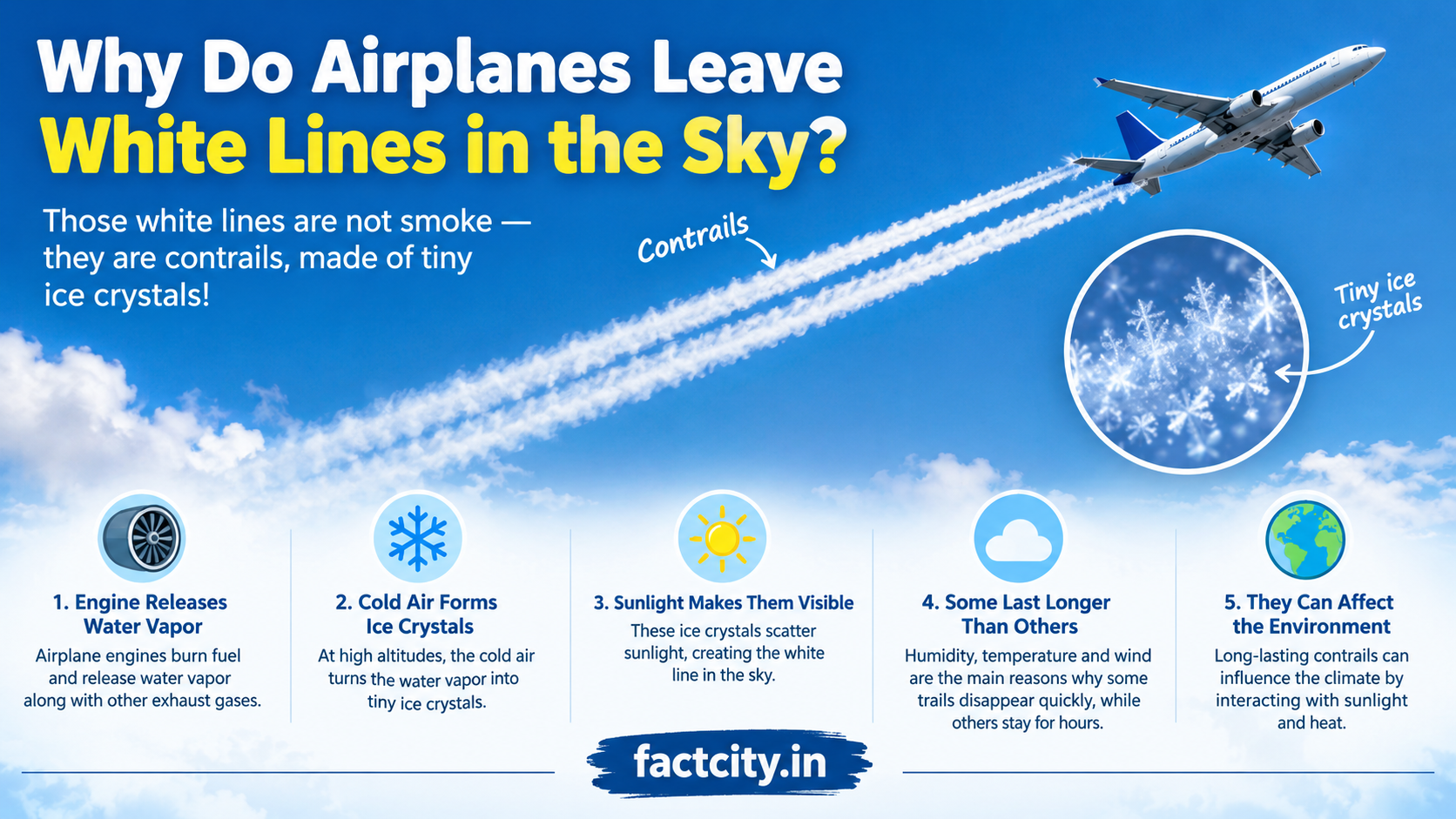
Why Do Airplanes Leave White Lines in the Sky? Have you ever looked up at the sky and noticed a long white line behind an airplane? Sometimes, the line disappears within a few seconds, but other times, it stays in the sky for a long time and slowly spreads out. If you have ever wondered why this happens, you are not alone.
Many people think these white lines are smoke coming from an airplane’s engine. However, the real explanation is much more interesting. These lines are called contrails, which is short for condensation trails. They form because of the way airplane engines work and the extremely cold conditions found high above the Earth. Let’s take a closer look at why airplanes leave white lines in the sky, why some trails last longer than others, and whether they have any effect on the environment.
What Are the White Lines Behind Airplanes?
The white lines you see behind airplanes are usually made of tiny ice crystals. They form when warm, moist exhaust from an airplane engine mixes with the cold air surrounding the aircraft. Why Do Airplanes Leave White Lines in the Sky?
Commercial airplanes often fly at altitudes of around 30,000 to 40,000 feet. At these heights, the temperature can be far below freezing. When the water vapor in the engine exhaust meets this extremely cold air, it can condense and freeze into tiny ice crystals. These crystals scatter sunlight, making the trail visible from the ground. That is why the line looks white against a clear blue sky. Although a contrail may look like smoke, it is mainly made of ice crystals. The process is similar to how clouds form naturally in the atmosphere.
How Do Airplanes Create White Lines?
To understand why contrails form, it helps to know what happens inside an airplane engine.
Airplane Engines Release Water Vapor
Airplane engines burn fuel to produce the energy needed to fly. During this process, water vapor is released along with other exhaust gases. At ground level, this water vapor is usually invisible. But high in the atmosphere, the air is much colder, so the moisture can quickly turn into tiny water droplets and then freeze into ice crystals. This is the first step in creating the familiar white line behind an airplane.
Cold Air Turns Moisture Into Ice Crystals
When the warm exhaust mixes with cold surrounding air, the temperature drops rapidly. Under suitable conditions, the water vapor forms ice crystals. These crystals are extremely small, but together they create a visible white trail. Sunlight reflects and scatters from the crystals, allowing us to see the line from far below. The entire process happens quickly, which is why a white trail can appear almost immediately after an airplane passes.
Why Do Some Airplane Trails Disappear Quickly?
You may have noticed that some airplane trails disappear almost as soon as they appear. Others remain visible for several minutes or even longer. The biggest reason for this difference is the humidity of the air.
When the surrounding air is dry, the ice crystals in a contrail gradually change directly into water vapor. This process is known as sublimation. As the crystals disappear, the white line becomes thinner and eventually vanishes.
That is why an airplane may leave a short trail that disappears quickly on one day but create a much longer-lasting trail on another. It is not necessarily because the airplane is different. The conditions in the atmosphere can change from one location to another, even along the same flight route.
Why Do Some Contrails Stay in the Sky for Hours?
Sometimes, an airplane leaves a white line that remains visible long after the aircraft has disappeared from view. You might even notice the line spreading out and becoming wider over time. This usually happens when the surrounding air contains enough moisture to keep the ice crystals from disappearing. In particularly humid conditions, the crystals can continue to grow by collecting water vapor from the air.
Winds can then push the crystals in different directions, causing the trail to spread across the sky. Over time, a narrow contrail may become a thin, wispy cloud. These formations are often called contrail cirrus because they can look similar to natural high-altitude cirrus clouds. This is why the sky sometimes appears to have several long white lines that gradually blend together.
Why Don’t All Airplanes Leave White Lines?
If you regularly watch airplanes, you may have noticed that not every aircraft leaves a visible trail. Some planes create long white lines, while others seem to leave nothing behind. There is a simple explanation: contrails only form when the atmospheric conditions are suitable.
Temperature is important because the air must be cold enough for ice crystals to form and survive. Humidity also matters because dry air can cause the crystals to disappear quickly. Altitude plays a role, too. Many commercial airplanes fly high enough to encounter the cold conditions needed for contrail formation, but not every part of the atmosphere has the same temperature or moisture level.
As a result, an airplane might leave a visible trail in one part of the sky and then appear to stop producing one as it moves into a different air mass. The airplane can continue flying normally even when its white trail disappears.
Are Airplane White Lines Made of Smoke?
This is a common question, especially when the white lines look thick and bright. In a typical contrail, the visible white material is mainly made up of tiny ice crystals rather than smoke. These crystals scatter sunlight, which gives the trail its white appearance.
However, airplane exhaust contains more than water vapor. Burning aviation fuel also releases carbon dioxide, nitrogen oxides, and small particles. Some of these particles can help ice crystals form. So, although the white line itself is not simply a cloud of smoke, airplane engines do release emissions that can affect the environment. The important point is that a visible contrail is the result of water vapor freezing under the right atmospheric conditions.
Do Airplane Contrails Affect the Environment?
Yes, long-lasting contrails can have an effect on the Earth’s climate. When a contrail spreads into a thin cloud, it can interact with both sunlight coming from the Sun and heat rising from the Earth’s surface. During the day, some clouds reflect sunlight back into space, which can have a cooling effect. At the same time, high-altitude ice clouds can trap some of the heat that would otherwise escape into space, creating a warming effect.
The overall impact depends on several factors, including the time of day, the altitude of the cloud, and the surrounding weather conditions. Persistent contrails are particularly important because they can spread over a large area and remain in the atmosphere for hours. Scientists are studying ways to reduce the climate effects of aviation, including changing flight routes or altitudes when practical. However, these changes must also be considered alongside fuel consumption, flight safety, and other operational requirements.
Are Contrails Dangerous to People?
Seeing white lines behind airplanes is generally not a reason to worry. Contrails are a normal result of aircraft engines operating in cold atmospheric conditions. The visible trails consist mainly of ice crystals, much like those found in high-altitude clouds. Their appearance does not, by itself, indicate that something unusual is happening. However, this does not mean that all aspects of aircraft emissions are harmless. Aviation produces greenhouse gases and other emissions, and persistent contrails can contribute to climate change. It is helpful to distinguish between the ordinary formation of a contrail and the wider environmental effects of flying. 7-amazing-secrets-of-the-world-that-you-cannot-see
Interesting Facts About Airplane Contrails
Here are a few things you might not know about airplane white lines:
- They form very quickly: Under suitable conditions, a visible contrail can appear within seconds of an airplane passing.
- They contain ice crystals: The white appearance comes mainly from sunlight scattering off tiny ice crystals.
- They do not always last long: Dry air can cause contrails to disappear quickly.
- They can turn into clouds: Persistent contrails may spread and become thin, cloud-like formations.
- Wind changes their shape: Winds can stretch, bend, and spread contrails across the sky.
- They can influence the climate: Long-lasting contrail clouds can affect how heat moves through the Earth’s atmosphere.
These small details show how much science is involved in something we often see during an ordinary day.
Conclusion
So, why do airplanes leave white lines in the sky? The answer is that warm, moist exhaust from an airplane engine mixes with extremely cold air, allowing water vapor to freeze into tiny ice crystals. These crystals form the white lines known as contrails. Some trails disappear quickly because the surrounding air is dry, while others remain visible for hours when humidity levels are high. Wind can also spread them out, sometimes turning narrow lines into thin clouds.
The next time you look up and see an airplane leaving a white trail behind it, you will know what is happening. It is a simple but fascinating example of how aircraft engines and the atmosphere work together to create something we can see from the ground.