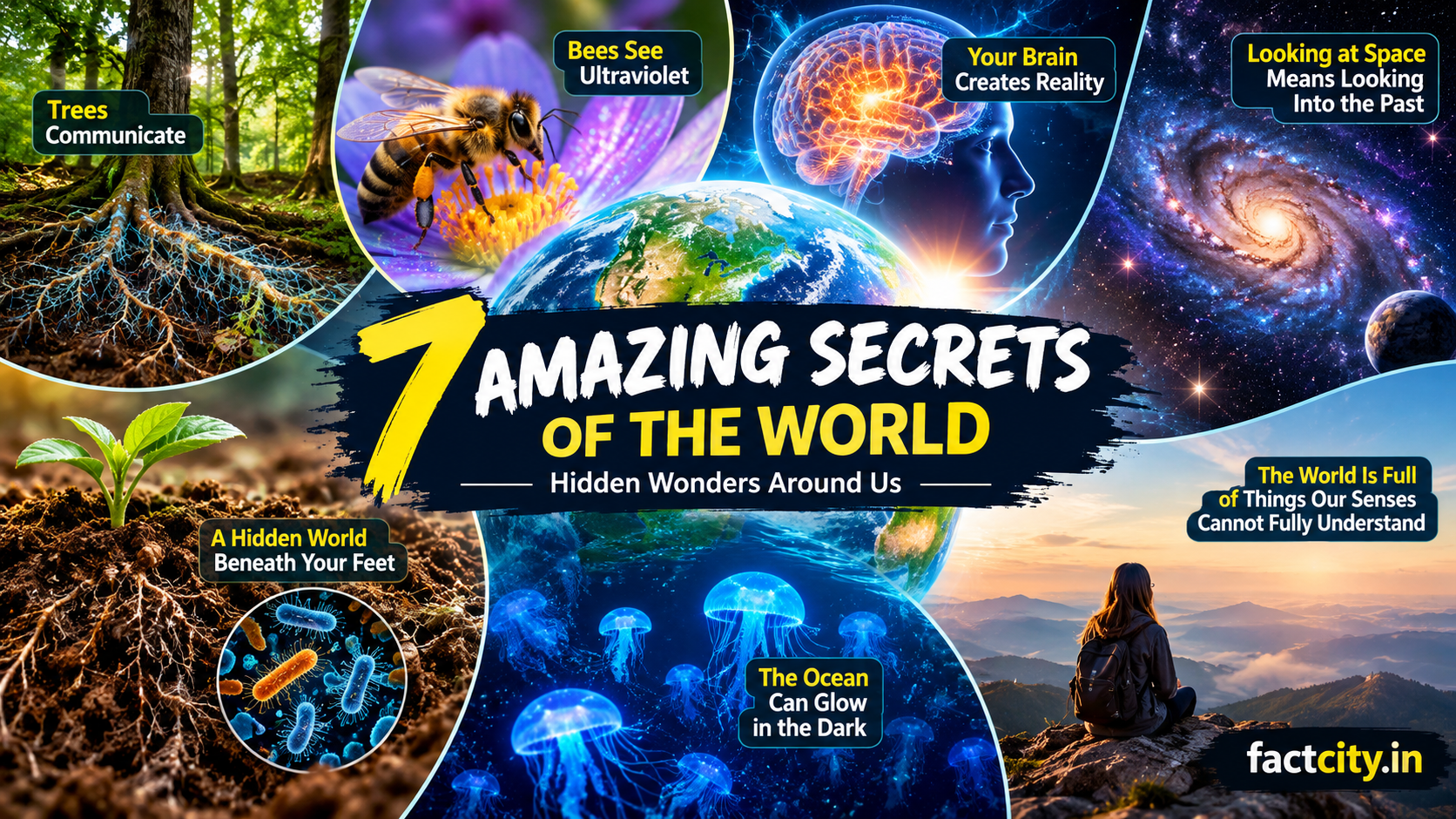
7 Amazing Secrets of the World: What if I told you that countless signals and fascinating processes are happening around you every second, even though you cannot see them with your naked eyes? Trees, animals, and even your own brain hide amazing secrets. Far away in space, countless mysteries are waiting to be discovered. Once we begin to understand these wonders, the world around us starts to look completely different.
So, let’s explore these 7 amazing secrets of the world and discover what makes our planet and the universe so fascinating.
1. Do Trees Communicate With Each Other?
Have you ever wondered whether trees can communicate with one another? Beneath the ground, the roots of trees form part of a vast and fascinating natural world. A network of fungi spreads around many tree roots, creating connections within the soil. These fungal networks help plants exchange nutrients and can play a role in transmitting chemical signals.
Scientists consider these underground connections a complex part of nature. They reveal how plants and other living organisms interact in ways that are not immediately visible to us. This discovery reminds us that nature is more interconnected than it may appear on the surface. 7 Amazing Secrets of the World
2. Honeybees Can See Flowers Differently Than Humans
Have you ever wondered whether every living creature sees the world in the same way? The answer is no. Honeybees see flowers differently from humans because they can detect ultraviolet light, which is invisible to our eyes. Many flowers have special ultraviolet patterns that are difficult for humans to see without special equipment. These patterns can guide bees toward nectar, almost like a runway directing them toward their destination.
With the help of their ultraviolet vision, bees can identify these patterns and find flowers more efficiently. The flowers we see with our eyes may look completely different to bees, revealing another fascinating secret of the natural world.
3. Your Brain Creates Your Experience of Reality
Now, let’s explore one of the most amazing machines in the world: the human brain. Our brain does not record the outside world exactly like a camera. Instead, it processes information received through our senses and combines it with memories and past experiences.
This is one reason why two people can look at the same picture or experience the same situation but understand it differently. Our perception is an active process. The brain continuously interprets sensory information and uses predictions to help us understand what is happening around us. As a result, our experience of reality is shaped not only by what we see but also by how our brain processes and interprets that information.
4. When You Look at Space, You Are Looking Into the Past
Now, look up at the vast and seemingly endless universe. One of the most fascinating secrets of space is that light takes time to travel from one place to another. The light coming from the Sun takes approximately eight minutes to reach Earth. This means that when we observe the Sun, we see it as it was a little more than eight minutes earlier.
The same principle applies to distant stars and galaxies. Their light may travel through space for millions of years before reaching us. When we look at these distant objects, we are seeing light that began its journey long ago. In this way, observing the universe allows us to look into its past. Every shining star and distant galaxy offers us another glimpse into the history of space.
5. There Is a Hidden World Beneath Your Feet
Now, bring your attention back to Earth and look at the soil beneath your feet. A small handful of soil contains a hidden world of microorganisms, including bacteria and other tiny living organisms that cannot be seen with the naked eye. These microscopic organisms play an important role in breaking down organic matter and recycling nutrients in the soil.
The nutrients released through these natural processes help plants and trees grow. Without these essential activities, many of the processes that support life on Earth would be affected. The soil beneath our feet is therefore much more than ordinary dirt. It is a living environment that supports plants and contributes to the continuation of life.
6. The Ocean Can Glow in the Dark
Now, let’s travel into the depths of the vast blue ocean. Have you ever heard that seawater can sometimes glow at night? This fascinating phenomenon is known as bioluminescence. Bioluminescence occurs when certain living organisms produce light through chemical reactions inside their bodies.
Many marine organisms use this ability for different purposes, including protection, communication, or attracting prey. When these organisms produce light in dark ocean waters, they can create a beautiful glowing effect that looks like a natural light show. This remarkable phenomenon shows that even in the darkest parts of the ocean, nature can create extraordinary sights.
7. The World Is Full of Things Our Senses Cannot Fully Understand
The underground connections between trees, the ultraviolet vision of bees, the predictions made by our brains, and the ancient light arriving from distant galaxies all reveal something fascinating about our world. The microscopic life hidden in soil and the glowing organisms found in the ocean provide further examples of natural processes that we cannot always observe directly.
A common idea connects all these wonders: many things exist around us that our ordinary senses cannot fully detect or understand. Science and curiosity help us go beyond our everyday experiences. By observing nature, asking questions, and exploring scientific discoveries, we can gradually understand more about the world around us. 10-mind-blowing-and-fascinating-facts-about-our-world
Conclusion
The next time you look closely at a beautiful flower, gaze at the night sky, or feel the soil beneath your feet, remember that there may be much more happening than you can imagine. Trees interact through complex natural systems, bees see patterns that humans cannot naturally detect, our brains actively interpret the world, and distant galaxies reveal glimpses of the universe’s past.
From the smallest microorganisms to the vastness of space, every discovery reminds us how amazing our world truly is. Perhaps the most wonderful thing is not just that these mysteries exist, but that we have the curiosity to explore them and discover how they work.