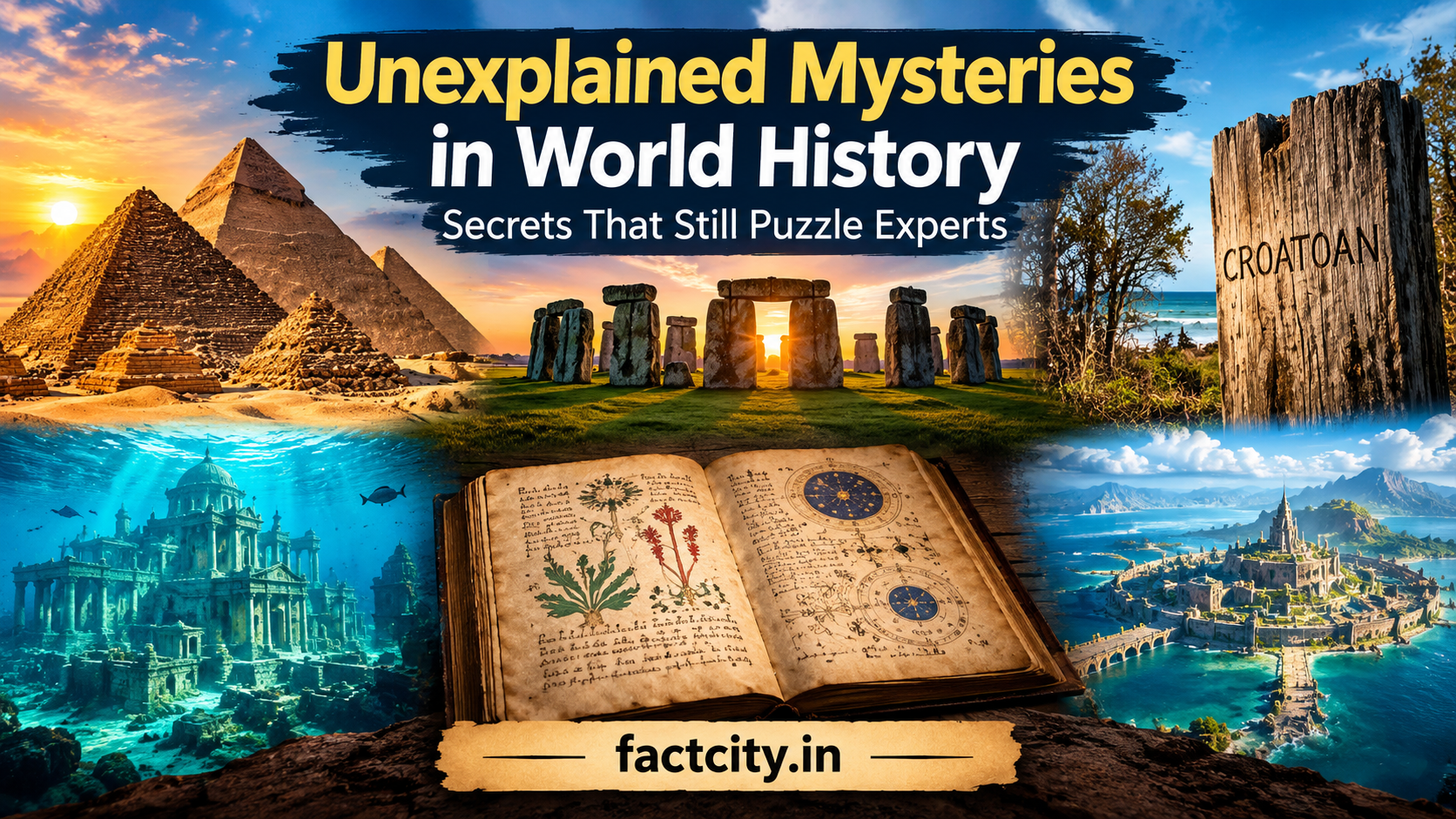
Unexplained Mysteries in World History: History is full of fascinating stories, remarkable discoveries, and events that have changed the world. However, not every historical mystery has a clear answer. Across different countries and civilizations, ancient structures, lost cities, mysterious objects, and unexplained events continue to capture people’s attention. Even after years of research, historians and archaeologists are still searching for answers to some important questions about the past.
The most interesting unexplained mysteries in world history are not always supernatural or impossible to understand. In many cases, they involve missing records, incomplete evidence, or technologies that are difficult to reconstruct today. Some mysteries have several possible explanations, but none has been proven completely. From the construction of ancient monuments to the disappearance of entire settlements, these stories remind us how much there is still to learn about human civilization.
In this article, we will explore some of the world’s most fascinating historical mysteries, the evidence researchers have discovered, and the questions that remain unanswered.
1. The Mystery of the Great Pyramids of Egypt
The Great Pyramid of Giza is one of the most remarkable achievements of the ancient world. Built during the reign of Pharaoh Khufu around the 26th century BCE, it was originally approximately 146.6 meters tall. For thousands of years, it remained the tallest human-made structure in the world. Unexplained Mysteries in World History
What makes this ancient monument so fascinating is the enormous amount of planning, labor, and engineering required to construct it. The pyramid contains millions of stone blocks, some weighing several tons. Ancient Egyptians did not have modern cranes, trucks, or powered construction equipment, yet they managed to create a structure that has survived for more than 4,500 years.
Archaeologists have discovered evidence of workers’ settlements, tools, and transportation methods that help explain how the pyramids were built. Researchers believe that ramps, sledges, organized labor, and careful planning played important roles. However, the exact arrangement of construction ramps and the precise methods used during every stage remain debated. The mystery is not whether humans built the pyramids, but exactly how they organized such an extraordinary engineering project.
2. The Disappearance of the Roanoke Colony
One of the most famous unexplained mysteries in American history is the disappearance of the Roanoke Colony. In 1587, a group of English settlers established a settlement on Roanoke Island, located in present-day North Carolina. The colony’s governor, John White, eventually returned to England to obtain supplies. His return was delayed by circumstances involving England’s conflict with Spain. When he finally arrived back on the island in 1590, he found the settlement abandoned.
The most famous clue was the word “CROATOAN,” carved into a wooden post. Another incomplete carving was also discovered. White had previously agreed with the settlers that they would leave a sign if they relocated.
One possibility is that the colonists moved to live with nearby Indigenous communities, including people associated with Croatoan Island. Other possibilities include disease, food shortages, conflict, or relocation to another settlement. Archaeological investigations have continued to examine the region, but the fate of every missing colonist has never been established conclusively. The mystery remains an important example of how incomplete historical records can leave major questions unanswered.
3. The Unsolved Purpose of Stonehenge
Stonehenge is a prehistoric stone monument in Wiltshire, England, and one of the most recognizable ancient landmarks in the world. Its construction began thousands of years ago, with different stages taking place over a long period.
The monument consists of enormous standing stones arranged in a carefully planned circular formation. Some stones were transported from locations many miles away, making their movement and placement an impressive achievement for prehistoric communities. Researchers have found evidence that Stonehenge was connected to ancient burial practices and ceremonies. Its alignment with the summer solstice sunrise and the winter solstice sunset also suggests that the movement of the Sun was important to its design or use.
However, the complete purpose of Stonehenge remains uncertain. It may have served several functions over different periods, including religious ceremonies, gatherings, and burial-related activities. The exact beliefs and traditions of the people who built it are difficult to reconstruct because they left no written explanation of their intentions.
4. The Voynich Manuscript: A Book Nobody Can Fully Read
The Voynich Manuscript is one of the most mysterious books in the world. Named after Wilfrid Voynich, a bookseller who acquired it in the early twentieth century, the manuscript is generally dated to the early fifteenth century through radiocarbon analysis of its parchment.
Its pages contain an unfamiliar writing system, unusual illustrations of plants, astronomical diagrams, and strange-looking figures. Some illustrations resemble plants that are difficult to identify confidently, while others appear to represent biological or medicinal subjects. Researchers have studied the manuscript using historical analysis, linguistic methods, and computer-based techniques. Despite these efforts, there is no widely accepted decipherment of its text.
Some researchers have suggested that it contains an unknown language or a coded message. Others have considered the possibility that it was created using an artificial writing system or that some of its contents are meaningless. None of these explanations has been conclusively established. Until its writing can be reliably understood, the manuscript will remain one of the most intriguing puzzles in the history of books.
5. The Lost City of Atlantis
The story of Atlantis is among the best-known mysteries in ancient literature. The Greek philosopher Plato described Atlantis in his dialogues Timaeus and Critias, written in the fourth century BCE. According to his account, Atlantis was a powerful island civilization that eventually disappeared beneath the sea.
Plato’s description includes a wealthy society, impressive architecture, and a dramatic destruction. Over the centuries, people have proposed many possible locations for Atlantis, including areas in the Atlantic Ocean and the Mediterranean region.
Some theories connect the story with real natural disasters, such as volcanic eruptions and earthquakes. The eruption of Thera, now known as Santorini, is sometimes discussed because it caused major destruction in the ancient Mediterranean world. However, there is no conclusive evidence that Atlantis existed as the advanced island civilization described by Plato.
Many historians interpret the story as a philosophical tale intended to communicate ideas about power, morality, and the decline of societies. Whether Plato drew inspiration from older traditions or historical events remains uncertain, but Atlantis has continued to inspire exploration, books, and scientific debate.
6. The Mysterious Nazca Lines of Peru
The Nazca Lines are enormous designs created in the desert of southern Peru. They include straight lines, geometric shapes, and figures representing animals such as birds, monkeys, and spiders. Many of these designs are so large that their full shapes are easiest to appreciate from the air or from elevated viewpoints. The geoglyphs were created by removing the dark surface stones to reveal lighter ground beneath them. The dry climate has helped preserve many of the lines for centuries.
Researchers generally associate the Nazca Lines with ancient communities that lived in the region, particularly during the first several centuries CE. Archaeological studies suggest that the designs may have been connected to religious practices, ceremonial activities, and beliefs about water and fertility.
The exact meaning of individual figures and the reasons for creating particular designs remain uncertain. Some popular theories suggest that the lines were made for extraterrestrial visitors, but there is no credible evidence supporting that claim. The real achievement lies in understanding how ancient people planned and created such enormous designs without modern aerial technology.
7. The Mystery of Easter Island’s Moai Statues
Easter Island, also called Rapa Nui, is famous for its massive stone statues known as moai. Located in the southeastern Pacific Ocean, the island is home to hundreds of these figures, many of which were carved from volcanic rock.
The statues were created by the island’s Polynesian inhabitants and are generally understood to have represented important ancestors or respected individuals. Many were positioned on ceremonial platforms called ahu, often facing inland toward communities.
One major question concerns how the islanders transported and raised these heavy statues. Archaeological research, traditional knowledge, and experimental studies suggest that some moai could have been moved upright using ropes and coordinated human effort. Other methods may also have been used.
Although researchers have developed plausible explanations, the precise techniques may have differed between statues and periods. Another subject of debate is how social changes, environmental pressures, and outside contact affected Rapa Nui society. The island’s history is more complex than the popular idea that its civilization simply collapsed because it destroyed its environment.
8. The Bronze Age Collapse
Around the end of the thirteenth and beginning of the twelfth centuries BCE, several major societies in the eastern Mediterranean and nearby regions experienced serious disruption. Powerful kingdoms and trade networks weakened or disappeared, and some major cities were destroyed or abandoned. This period is commonly known as the Bronze Age Collapse. It affected civilizations and trading partners across regions that included the eastern Mediterranean and the Near East.
Historians have proposed several contributing factors, including warfare, drought, food shortages, earthquakes, political instability, and disruptions to international trade. Evidence suggests that different regions experienced different combinations of these problems.
The role of groups often called the Sea Peoples is another subject of debate. Ancient Egyptian inscriptions describe conflicts with these groups, but their identities, origins, and precise involvement in the wider collapse remain uncertain.
Rather than a single mysterious event, the Bronze Age Collapse appears to have been a complicated series of crises. Researchers continue to investigate why interconnected societies struggled during this period and how some communities adapted while others disappeared. why-do-airplanes-leave-white-lines-in-the-sky
9. The Disappearance of the Indus Valley Civilization
The Indus Valley Civilization was one of the great urban civilizations of the ancient world. It flourished in parts of present-day Pakistan and northwestern India, reaching its mature urban phase approximately between 2600 and 1900 BCE.
Cities such as Harappa and Mohenjo-daro featured organized streets, drainage systems, brick buildings, and carefully planned neighborhoods. These features demonstrate impressive knowledge of urban design and public infrastructure.
Over time, many large settlements declined, and populations shifted toward smaller communities and different regions. Researchers have investigated several possible causes, including changing river systems, variations in monsoon rainfall, environmental pressures, and changes in trade.
One major challenge is that the Indus script has not been conclusively deciphered. Without a reliable understanding of the inscriptions, many details about the civilization’s political structure, languages, and beliefs remain uncertain.
The civilization did not simply vanish overnight. Archaeological evidence points to gradual changes and regional differences. Understanding these transformations remains an important challenge in South Asian archaeology.
10. The Antikythera Mechanism
The Antikythera Mechanism is an ancient device recovered from a shipwreck near the Greek island of Antikythera in 1901. Its complexity surprised researchers because it contains a system of interlocking gears that resembles the mechanism of a sophisticated astronomical calculator.
Studies have shown that the device could represent astronomical cycles and help track celestial events. Its gear system demonstrates an extraordinary level of mechanical knowledge in the ancient Greek world.
The mechanism is often described as an early analogue computer, although it was designed for a specific set of calculations rather than general-purpose computing. Researchers have used X-ray imaging and other methods to examine its internal structure and inscriptions.
Many of its functions are now better understood, but the complete design, the full range of its intended uses, and how widely similar devices were produced remain uncertain. The mystery is especially fascinating because few surviving objects provide comparable evidence of ancient mechanical engineering.
Why Do Historical Mysteries Remain Unsolved?
Historical mysteries often survive because the evidence available to researchers is incomplete. Buildings decay, documents are destroyed, languages disappear, and archaeological sites can be damaged by natural processes or human activity. Even when physical evidence survives, it may support several possible interpretations.
Another challenge is that modern people sometimes judge ancient achievements using assumptions about technology and knowledge. Ancient communities had sophisticated practical skills, detailed knowledge of their surroundings, and organizational abilities that should not be underestimated.
New discoveries can also change earlier interpretations. Improved dating methods, satellite imagery, scientific analysis, and archaeological excavations help researchers investigate questions that were once difficult to study. A mystery that seems impossible to solve today may become clearer when new evidence emerges.
It is equally important to distinguish established facts from speculation. A lack of a complete explanation does not automatically mean that an event involved supernatural forces or extraterrestrial visitors. Scientific investigation begins with the evidence and tests explanations against what can be observed.
Conclusion
The unexplained mysteries in world history reveal both the achievements of ancient civilizations and the limits of our current knowledge. From the Great Pyramid of Giza and the Voynich Manuscript to the Nazca Lines and the Antikythera Mechanism, these discoveries continue to raise questions about how people lived, what they believed, and what they understood about the world around them.
Some mysteries may eventually be solved through new archaeological discoveries and scientific research. Others may remain partly uncertain because the evidence needed to reach a definitive answer no longer exists. Either way, these historical puzzles make the past more fascinating and encourage us to keep exploring.