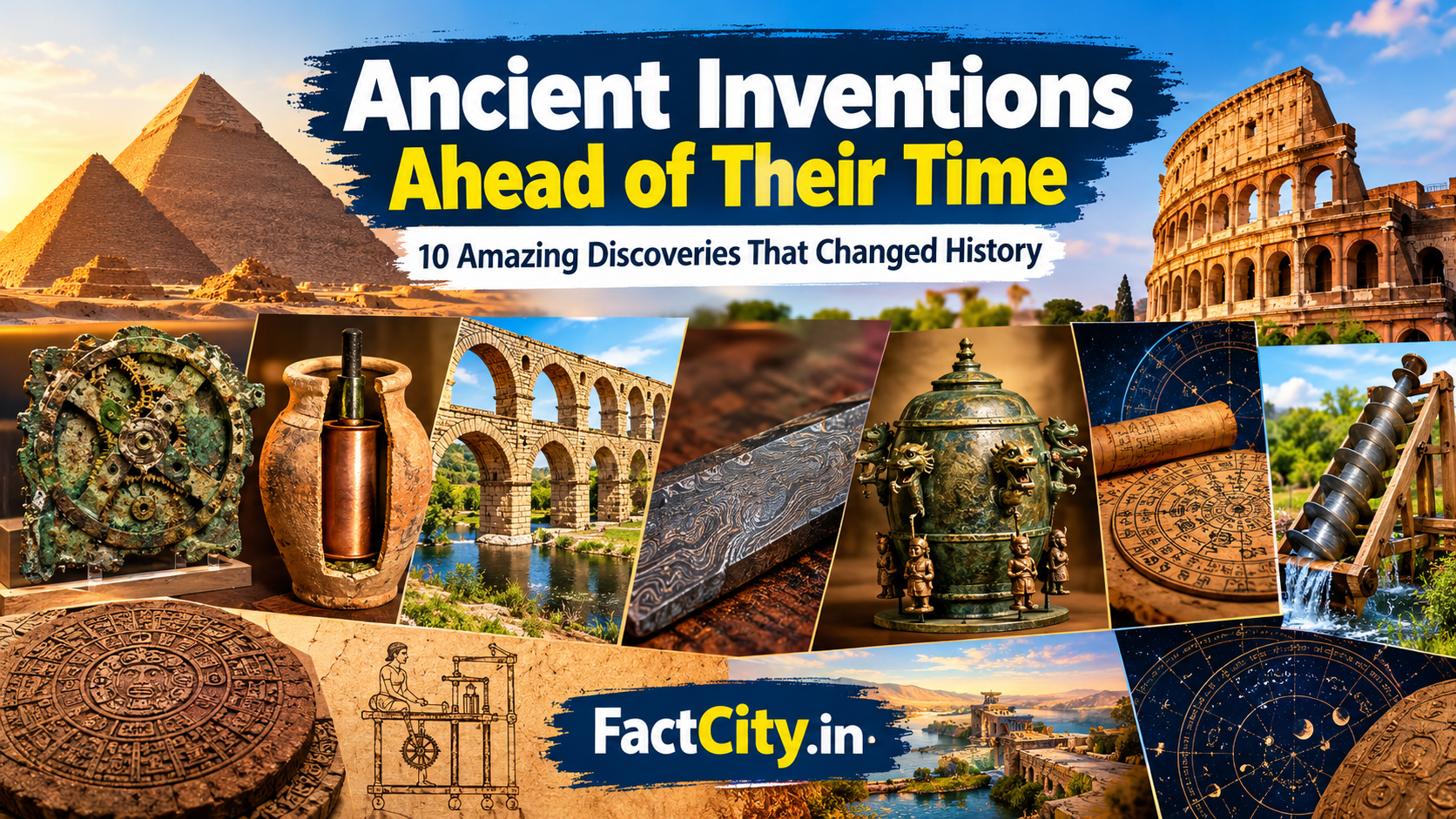
Ancient Inventions Ahead of Their Time: When we think about ancient civilizations, we often imagine people living without modern technology, electricity, computers, or advanced machines. However, history tells a much more interesting story. Thousands of years ago, people created remarkable inventions that helped them build cities, study the stars, transport water, and improve everyday life. Some of these inventions were so impressive that they continue to amaze historians, engineers, and scientists today. From ancient mechanical calculators to long-lasting Roman buildings, these discoveries show how intelligent, creative, and hardworking our ancestors were.
What makes these inventions even more fascinating is that people developed them without modern laboratories, digital tools, or advanced manufacturing equipment. They relied on observation, mathematics, practical experience, and repeated experimentation to solve difficult problems. Some ancient technologies are still used in modified forms today, while others have helped researchers understand how scientific knowledge developed over thousands of years. In this article, we will explore ten ancient inventions ahead of their time, discover how they worked, and learn why they remain important in the modern world.
1. The Antikythera Mechanism: An Ancient Astronomical Computer
One of the most fascinating ancient inventions ever discovered is the Antikythera mechanism, a complicated mechanical device found in a shipwreck near the Greek island of Antikythera in 1901. Researchers believe it was created around the second or first century BCE. The device contained a series of carefully arranged bronze gears that worked together to calculate astronomical information. It could help track the movements of celestial bodies, predict eclipses, and follow important calendar cycles used in ancient Greece. Because it performed mathematical calculations through mechanical movements, researchers often describe it as an ancient astronomical computer. “Ancient Inventions Ahead of Their Time“
The Antikythera mechanism is especially remarkable because its design demonstrates a sophisticated understanding of mathematics, astronomy, and mechanical engineering. Its complexity was not fully appreciated when it was first discovered, and modern imaging techniques have helped researchers examine its internal structure in greater detail. Although it is not a computer in the modern electronic sense, the device shows that ancient engineers could create highly advanced calculating machines more than two thousand years ago. It remains one of the clearest examples of how ancient technology can challenge our assumptions about the capabilities of early civilizations.
2. Roman Concrete: A Building Material That Lasted for Centuries
The ancient Romans were famous for building roads, bridges, temples, aqueducts, and enormous public structures. One of the technologies that helped them achieve these impressive results was concrete. Roman concrete was often made using a mixture of lime, volcanic ash, water, and stone or other aggregates. The exact ingredients and construction methods varied depending on the location and purpose of a building. Some Roman structures have survived for centuries, demonstrating the durability that particular concrete mixtures could achieve under suitable conditions.
Modern scientists have studied Roman concrete to understand why certain ancient structures remain in such good condition. Research suggests that chemical reactions involving lime and volcanic materials contributed to the strength and durability of some mixtures. In particular, certain Roman marine structures developed mineral features that helped them withstand exposure to seawater. The Pantheon in Rome, with its enormous concrete dome, remains an outstanding example of Roman engineering. Although modern concrete has different advantages and applications, studying ancient Roman building materials may help engineers develop more durable construction techniques for the future.
3. The Egyptian Pyramids: Engineering Ahead of Their Time
The Great Pyramid of Giza is one of the most recognizable monuments in the world and an extraordinary example of ancient engineering. It was built during the reign of Pharaoh Khufu around the 26th century BCE and originally stood as a massive structure made from millions of stone blocks. Constructing the pyramid required careful planning, skilled workers, the transportation of heavy materials, and a detailed understanding of measurements and geometry. The ancient Egyptians did not have modern cranes, trucks, or computer-designed construction plans, yet they managed to create a monument that has survived for thousands of years.
Historians and archaeologists continue to study how the Egyptians transported and positioned the enormous stones. Evidence suggests that organized labor, specialized tools, sledges, waterways, and different construction techniques played important roles, although the precise combination of methods used throughout the project remains debated. The pyramid’s impressive alignment and carefully planned structure demonstrate the Egyptians’ advanced knowledge of surveying and architecture. Their achievement reminds us that great engineering depends not only on machinery but also on planning, practical knowledge, teamwork, and the ability to solve difficult problems with the resources available.
4. The Baghdad Battery: A Mysterious Ancient Object
The Baghdad Battery is one of the most debated objects associated with ancient technology. The object consists of a ceramic vessel containing a copper cylinder and an iron rod. Examples were discovered near Baghdad in the 1930s and are commonly associated with the Parthian or early Sasanian period, although its exact age and original purpose remain uncertain. Some researchers have suggested that an object of this design could produce a small electrical voltage if filled with a suitable acidic liquid. Similar arrangements can generate electricity under the right conditions, which has made the discovery particularly interesting to people studying the history of science.
However, there is no conclusive evidence that the original object was actually used as a battery or that ancient people employed it for electrical purposes. Other explanations have also been proposed, and its original function remains a matter of debate. The Baghdad Battery is an excellent example of why historical discoveries should be examined carefully. Just because an object can produce electricity in a modern experiment does not prove that its original creators understood or intended that function. Nevertheless, it remains an intriguing artifact that encourages researchers to investigate the many unanswered questions surrounding ancient craftsmanship and technology.
5. Ancient Greek Automata: Early Experiments With Robotics
Long before modern robots appeared in factories, ancient inventors experimented with machines that could move automatically and perform specific actions. One of the most important figures in this field was Hero of Alexandria, a Greek engineer and mathematician who lived during the first century CE. His writings described mechanical devices powered by water, air pressure, steam, weights, and other physical forces. Some of these inventions were designed to entertain audiences, demonstrate scientific principles, or create impressive effects in temples and theaters. They showed that ancient engineers understood how carefully arranged mechanical components could produce movement without continuous direct control from a person.
One of the most interesting devices associated with Hero was the aeolipile, a steam-powered apparatus that rotated when heated steam escaped through specially positioned openings. Although it was not developed into a practical industrial steam engine, it demonstrated the ability of steam to produce rotational movement. Hero also described automatic doors and mechanical theatrical devices that relied on carefully designed systems. These inventions were different from modern programmable robots, but they represented important early experiments with automation. They reveal that ancient engineers were curious about the same basic question that continues to inspire robotics today: how can a machine be designed to perform a task by itself?
6. Roman Aqueducts: An Advanced Water Supply System
Supplying water to a growing city has always been a major challenge, and the Romans developed an impressive solution through their aqueduct systems. These structures transported water from springs, rivers, and other sources to towns and cities, sometimes across considerable distances. Many aqueducts relied on gravity rather than mechanical pumps, which meant engineers had to plan their routes carefully and maintain a suitable gradient. Water could travel through underground channels, tunnels, bridges, and elevated stone structures before reaching public fountains, bathhouses, and other destinations.
The Pont du Gard in southern France is one of the best-known surviving examples of Roman aqueduct engineering. Its enormous stone arches demonstrate how practical infrastructure could also become a remarkable architectural achievement. Roman aqueducts required advanced surveying, construction skills, and regular maintenance to keep water flowing reliably. Access to water varied between communities and social groups, so not every Roman resident enjoyed the same benefits. Even so, these systems represent a major achievement in civil engineering and show how careful planning could improve public life long before modern water-treatment plants and pumping stations existed.
7. Ancient Indian Wootz Steel: A Remarkable Metallurgical Invention
Ancient India made important contributions to metallurgy, including the production of a high-quality material known as Wootz steel. This type of crucible steel was produced by heating iron with carbon-rich materials under controlled conditions inside a sealed or partially sealed container. The process required practical knowledge of temperature, ingredients, furnace operation, and cooling. Skilled metalworkers learned how to produce steel with distinctive characteristics, and Wootz steel became well known through historical trade networks. Steel associated with this tradition influenced the production of famous patterned blades in other regions, including those connected with the historical Damascus steel tradition.
What makes Wootz steel particularly impressive is that ancient metalworkers developed sophisticated production methods without modern temperature sensors or laboratory equipment. Their knowledge came from craftsmanship, experimentation, and techniques passed from one generation to another. The exact processes varied across places and historical periods, and researchers continue to investigate how particular manufacturing methods created the steel’s distinctive internal structure. This ancient achievement demonstrates that advanced materials science did not begin in modern laboratories. Many important discoveries developed because skilled craftspeople carefully observed how different materials behaved and improved their methods through experience.
8. The Ancient Chinese Seismoscope: An Early Earthquake Detection Device
Around 132 CE, the Chinese scholar and inventor Zhang Heng developed a remarkable instrument intended to indicate the direction of a distant earthquake. The device is commonly known as a seismoscope and is described in historical accounts as a bronze vessel decorated with dragon heads and figures positioned around its exterior. According to traditional descriptions, an internal mechanism responded to ground movement and caused a small ball to fall from one of the dragon mouths into a figure below. The position of the released ball was intended to indicate the direction from which the earthquake had come.
The invention was far different from modern seismometers, which measure ground motion electronically and produce detailed records that scientists can analyze. Zhang Heng’s original device has not survived, so its exact internal design and performance remain uncertain. Nevertheless, the historical account represents an important early attempt to detect earthquakes using a specialized scientific instrument. It shows that ancient scholars were interested in understanding natural disasters and developing practical ways to investigate them. The seismoscope remains a fascinating example of how scientific curiosity led people to develop instruments for studying events that were difficult to observe directly.
9. Ancient Calendars: Measuring Time Through Astronomy
Before the invention of modern clocks, ancient civilizations developed detailed systems for measuring time by observing the Sun, Moon, stars, and changing seasons. These observations helped people organize farming, religious ceremonies, trade, and public activities. The Maya civilization of Mesoamerica developed sophisticated calendar systems that tracked different cycles of days and longer periods. Ancient Egyptians created a civil calendar based on a 365-day year, while Babylonian astronomers carefully recorded celestial events and developed mathematical methods for identifying repeating astronomical patterns.
These calendars were not identical to the modern Gregorian calendar, but they represented impressive achievements in observation and calculation. Ancient astronomers spent generations studying the sky and recording patterns that could be used to organize daily life. Their knowledge helped improve agricultural planning and the timing of important events. Although they lacked modern telescopes and computers, they were able to build useful astronomical systems through careful observation and mathematical reasoning. The development of ancient calendars demonstrates that science often begins with a simple habit: watching the natural world closely, recording what happens, and looking for patterns that can explain or predict future events.
10. The Archimedes Screw: A Simple Invention With Lasting Value
The Archimedes screw is a practical device designed to move water from a lower level to a higher one. It generally consists of a rotating helical surface arranged inside a cylinder or trough. When the screw turns, water moves upward along its length and can be discharged at a higher point. The invention is traditionally associated with the Greek mathematician and engineer Archimedes, who lived during the third century BCE, although the exact history of its earliest development remains uncertain. Its straightforward design made it useful for irrigation, drainage, and other applications where water needed to be lifted efficiently.
One reason this invention remains important is that its basic operating principle is still useful today. Modern Archimedes screws can be used in agricultural water systems, wastewater management, and certain small hydropower installations. In some systems, flowing water rotates the screw and helps generate electricity rather than being lifted upward. Although modern versions may use different materials and engineering improvements, the underlying idea remains closely related to the ancient mechanism. The Archimedes screw demonstrates that a successful invention does not always need to be complicated. Sometimes a simple design can solve a practical problem so effectively that people continue using it for thousands of years. why-is-space-completely-silent
Why Were Ancient Inventions So Advanced?
Ancient inventions were the result of curiosity, necessity, observation, and practical experience. People living thousands of years ago needed reliable ways to grow food, build homes, transport goods, supply water, and understand the natural world. These challenges encouraged them to experiment with available materials and develop better tools. Builders learned how to work with stone and concrete, metalworkers improved their methods through repeated trials, and astronomers recorded the movements of celestial bodies to create useful calendars. Although ancient people did not have the technology available today, they possessed valuable knowledge that developed over many generations.
Trade and cultural exchange also played an important role in the spread of ancient technology. As merchants, travelers, and communities interacted, they exchanged materials, tools, and ideas. Skilled craftspeople passed their knowledge to apprentices, while scholars recorded mathematical and scientific observations for others to study. Many inventions were not the work of a single person but the result of gradual improvements made by different people over long periods. This is one of the most important lessons from ancient history: technological progress usually develops step by step, with each generation learning from earlier discoveries and finding new ways to improve them.
Conclusion
The history of ancient inventions ahead of their time shows that human creativity and scientific curiosity have existed for thousands of years. From the complex gears of the Antikythera mechanism to the impressive aqueducts of Rome, ancient civilizations developed technologies that solved real problems and influenced later generations. Roman concrete helped builders construct durable structures, Indian Wootz steel demonstrated remarkable metallurgical knowledge, and ancient astronomical systems helped people understand the changing patterns of the sky. Even inventions whose original purposes remain uncertain, such as the Baghdad Battery, encourage researchers to investigate the past with curiosity and care.
These discoveries remind us that modern technology did not appear overnight. Many of today’s engineering principles have roots in ideas explored by ancient builders, inventors, and scholars. Their achievements were shaped by the tools and resources available to them, yet their ingenuity allowed them to accomplish extraordinary things. By studying ancient inventions, we gain a better understanding of human history and recognize the importance of experimentation, creativity, and the continuous search for better solutions. The next time you see an impressive building, a water system, or a mechanical device, remember that some of the ideas behind modern technology began thousands of years ago.