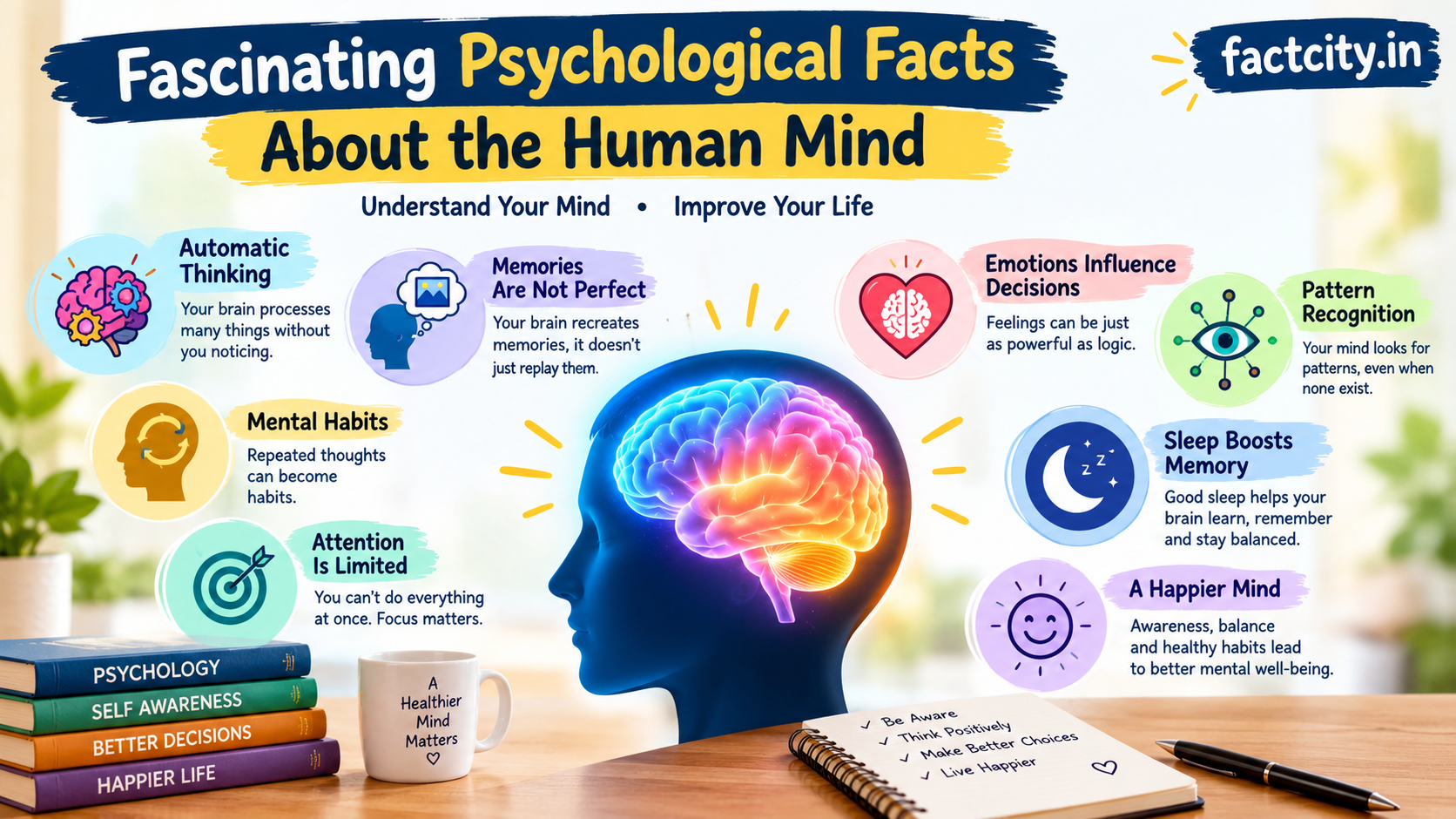
Psychology Facts About the Human Mind: The human mind is one of the most fascinating parts of our existence. It helps us think, learn, remember, make decisions, understand emotions, and build relationships with other people. Yet, many of the mental processes that influence our everyday lives happen without our awareness. From the way we remember childhood experiences to the reasons we sometimes overthink simple situations, psychology helps explain how our minds work.
Learning psychology facts about the human mind can help us understand ourselves better and recognize why people behave differently in similar situations. These insights are useful in everyday life because they can improve communication, emotional awareness, decision-making, and relationships. In this article, we will explore fascinating psychological facts about the human mind in simple English, with practical examples that make these ideas easy to understand.
1. Your Brain Often Processes Information Automatically
One interesting fact about the human mind is that it can process many types of information automatically. You do not have to consciously think about every step when performing a familiar activity, such as walking, brushing your teeth, or recognizing a familiar face. With practice, the brain develops efficient patterns that make these activities feel natural.
Automatic mental processes help us save attention for more demanding tasks. However, they can also influence our judgments without us noticing. For example, you might form an initial impression of someone based on their facial expression, clothing, or tone of voice before learning anything meaningful about their personality. Becoming aware of these automatic reactions can help you make more thoughtful decisions.
2. Your Memories Are Not Perfect Recordings
Many people believe that memories work like videos stored inside the brain, but human memory is more complicated. When you remember an experience, your brain reconstructs aspects of that event rather than simply replaying an exact recording. As a result, details can change over time, and your current knowledge or emotions may influence what you remember.
For example, two friends who attended the same event may remember different details about it. One person might focus on a funny conversation, while the other remembers an uncomfortable moment. Both memories can feel genuine even though their recollections differ. This psychological fact reminds us that confidence in a memory does not always guarantee perfect accuracy.
3. Emotions Can Influence Your Decisions
Although people often believe they make decisions through logic alone, emotions can play an important role in how they evaluate choices. Feelings such as excitement, fear, sadness, and happiness can influence what appears attractive, risky, or important at a particular moment.
For instance, someone who feels anxious may focus more strongly on possible problems when considering a new opportunity. A person who feels excited might pay more attention to the potential benefits. Emotions are not necessarily enemies of good judgment; they can provide useful information about our needs and experiences. The key is to recognize our feelings and consider relevant facts before making important decisions.
4. The Human Mind Naturally Looks for Patterns
The brain is skilled at identifying patterns in sounds, images, experiences, and information. This ability helps us learn languages, recognize familiar objects, predict routines, and understand relationships between events. Without pattern recognition, many everyday tasks would require much more mental effort.
However, the mind sometimes identifies patterns where no meaningful connection exists. For example, a person might believe that wearing a particular shirt brings good luck because they wore it before a successful event. This tendency can lead to mistaken conclusions when unrelated events happen together. Understanding how pattern recognition works can encourage us to question assumptions and look for stronger evidence.
5. Repeated Thoughts Can Become Mental Habits
The thoughts we repeatedly practice can become familiar mental habits. When someone regularly focuses on mistakes, worries, or negative possibilities, their attention may become increasingly drawn toward similar concerns. Likewise, practicing realistic and constructive thinking can make it easier to respond thoughtfully to everyday challenges.
This does not mean that people can control every thought or eliminate difficult emotions through positive thinking. Unwanted thoughts are a normal part of human experience. However, noticing recurring thought patterns can help people decide how to respond to them. Journaling, mindfulness, problem-solving, and talking with someone trustworthy may help create healthier ways of dealing with repetitive worries.
6. Attention Is a Limited Mental Resource
The human mind can process enormous amounts of information, but conscious attention is limited. When several demanding activities compete for attention, performance may suffer. What feels like multitasking is often the rapid switching of attention between tasks rather than performing every task equally well at the same time.
For example, replying to messages while studying may interrupt concentration and make it harder to remember what you have read. Giving one important task your full attention can improve understanding and reduce avoidable mistakes. Short breaks, fewer notifications, and a well-organized workspace can make it easier to concentrate.
7. Sleep Plays an Important Role in Memory
Sleep is essential for more than simply resting the body. Research suggests that sleep supports learning, memory consolidation, attention, and emotional regulation. Information learned during the day can be processed during sleep, helping the brain retain and organize certain memories.
When people regularly get insufficient sleep, they may experience difficulty concentrating, remembering information, or managing their emotions. This is one reason staying awake all night before an examination may not be the best learning strategy. Consistent sleep habits, along with regular study sessions, can support better learning and mental performance.
8. People Often Notice Information That Matches Their Beliefs
A psychological tendency known as confirmation bias can influence how people search for and interpret information. It occurs when someone gives more attention to evidence that supports an existing belief while overlooking or discounting information that challenges it.
Imagine someone who believes that a particular type of person is always unreliable. They may quickly remember examples that support this belief but ignore situations in which people from the same group acted responsibly. Confirmation bias can affect personal relationships, online discussions, and everyday decisions. Looking for alternative explanations and considering evidence from different perspectives can help reduce its influence.
9. Small Habits Can Influence Long-Term Behavior
Human behavior is shaped partly by habits, repeated actions, and the situations in which those actions occur. A behavior that is easy to repeat in a familiar environment can gradually become part of a daily routine. This is why small, consistent changes can sometimes be more practical than attempting a complete lifestyle transformation overnight.
For example, keeping a book beside your bed may encourage regular reading, while placing your phone away from your workspace may reduce distractions. The environment can make certain behaviors easier or harder to perform. Instead of depending entirely on motivation, people can design routines that support the actions they want to practice.
10. Social Connections Can Affect Mental Well-Being
Human beings are social creatures, and relationships can influence emotional well-being, stress, and our sense of belonging. Supportive relationships may help people cope with difficult experiences, celebrate achievements, and feel understood. Even a short conversation with a trusted friend can sometimes make a challenging day feel more manageable.
However, the quality of a relationship matters. Constant conflict, disrespect, or a lack of emotional support can create stress rather than comfort. Healthy connections generally involve mutual respect, communication, trust, and appropriate boundaries. Understanding the psychology of social relationships can help us build stronger connections while recognizing the importance of personal space.
11. The Brain Can Adapt Through Learning
One remarkable property of the brain is neuroplasticity, which refers to its ability to change its connections and functioning in response to learning, experience, and practice. This adaptability helps people develop skills, adjust to new environments, and learn throughout life.
For example, practicing a musical instrument repeatedly can improve the mental and physical coordination required to play it. Learning a new language can strengthen familiarity with new sounds, vocabulary, and grammatical patterns. Progress usually requires time and effort, and improvement varies from person to person. Nevertheless, the brain’s capacity to adapt shows why consistent practice can be valuable at different stages of life.
12. Stress Can Affect Thinking and Concentration
Stress is the body’s response to demands or challenges. In some situations, a moderate level of stress can increase alertness and help a person prepare for an important task. However, intense or prolonged stress can interfere with concentration, working memory, sleep, and decision-making.
For example, a student who feels overwhelmed before an examination may struggle to recall information they previously understood. Taking slow, comfortable breaths, organizing tasks into smaller steps, and preparing in advance may help manage everyday stress. When stress becomes persistent or seriously affects daily life, seeking support from a qualified mental health professional can be helpful.
13. People May Judge Experiences by Their Strongest Moments
The way people evaluate an experience does not always reflect every moment equally. Psychological research has identified patterns in which particularly intense moments and the way an experience ends can influence later evaluations. This idea is often discussed through the peak-end rule.
For instance, someone may remember a holiday mainly because of one extraordinary experience and the final day, rather than calculating how enjoyable every hour was. This is a general tendency, not a rule that applies equally to every person or situation. It helps explain why certain moments can have a disproportionate influence on how we remember an event.
14. Curiosity Helps the Mind Learn
Curiosity encourages people to explore unfamiliar information, ask questions, and discover new ideas. When something captures our interest, we are often more willing to pay attention and spend time understanding it. Curiosity can therefore support learning, creativity, and problem-solving.
For example, a person who wonders how the brain creates dreams may begin reading about sleep, memory, and neuroscience. One question can lead to several new discoveries. Asking questions, exploring different viewpoints, and treating mistakes as opportunities to learn can help keep the mind engaged throughout life.
15. Understanding Yourself Can Improve Your Relationships
Self-awareness means recognizing your emotions, thoughts, habits, strengths, and limitations. It can help you understand why certain situations trigger strong reactions and how your behavior affects other people. Instead of reacting immediately during a disagreement, a self-aware person may pause, identify their feelings, and choose a more constructive response.
For example, if you notice that you become defensive whenever someone offers criticism, you can practice listening before responding. This does not mean accepting every criticism as correct. It means considering the feedback carefully and deciding what, if anything, is useful. Greater self-awareness can support healthier communication, stronger boundaries, and more thoughtful decisions.
How to Use Psychology Facts in Everyday Life
Learning psychology facts about the human mind becomes more useful when you apply them to real situations. Start by observing your own habits without judging yourself too harshly. Notice what affects your concentration, which situations create stress, and how emotions influence your choices. Small observations can help you identify patterns that might otherwise go unnoticed.
You can also practice listening carefully during conversations, checking assumptions before accepting them, and breaking demanding tasks into manageable steps. Maintaining a regular sleep schedule, taking appropriate breaks, and nurturing supportive relationships can contribute to everyday well-being. Remember that psychological findings describe general patterns rather than predicting every individual’s behavior. People differ because of their experiences, personalities, environments, and circumstances.
Conclusion
The human mind is complex, adaptable, and constantly influenced by experiences, emotions, habits, and the surrounding environment. These psychology facts about the human mind reveal why memory can be imperfect, attention can become distracted, emotions can shape decisions, and repeated practice can help us learn new skills.
Understanding these processes does not mean we can control every thought or predict exactly how another person will behave. Instead, psychological knowledge gives us useful tools for becoming more aware of our reactions, questioning assumptions, improving daily habits, and communicating more effectively. By staying curious about how the mind works, we can continue learning about ourselves and develop a deeper understanding of the people around us.
Frequently Asked Questions (FAQs)
1. What are some interesting psychology facts about the human mind?
Interesting psychology facts include the brain’s ability to adapt through learning, the influence of emotions on decisions, the role of sleep in memory, and the tendency to notice information that supports existing beliefs. These concepts help explain many everyday experiences. 10-interesting-facts-about-the-brain
2. Can psychology help us understand human behavior?
Yes. Psychology studies mental processes and behavior, helping researchers understand patterns involving emotions, learning, memory, motivation, and social interactions. However, individual behavior depends on many factors, so psychological concepts cannot explain every action on their own.
3. Does the human brain change as we learn?
Yes. Neuroplasticity allows the brain to change its connections and functioning in response to learning and experience. Practice can help develop skills, although the amount and speed of improvement vary among individuals.
4. Why do people sometimes overthink?
Overthinking can involve repeatedly focusing on worries, uncertainties, or past events without reaching a useful conclusion. Stress, fear of making mistakes, and uncertainty may contribute to this pattern. Breaking problems into smaller steps and focusing on practical actions may help.
5. Why is understanding the human mind important?
Understanding the human mind can improve self-awareness, communication, decision-making, and emotional understanding. It can also help people recognize unhelpful habits and develop more constructive ways to respond to everyday challenges.