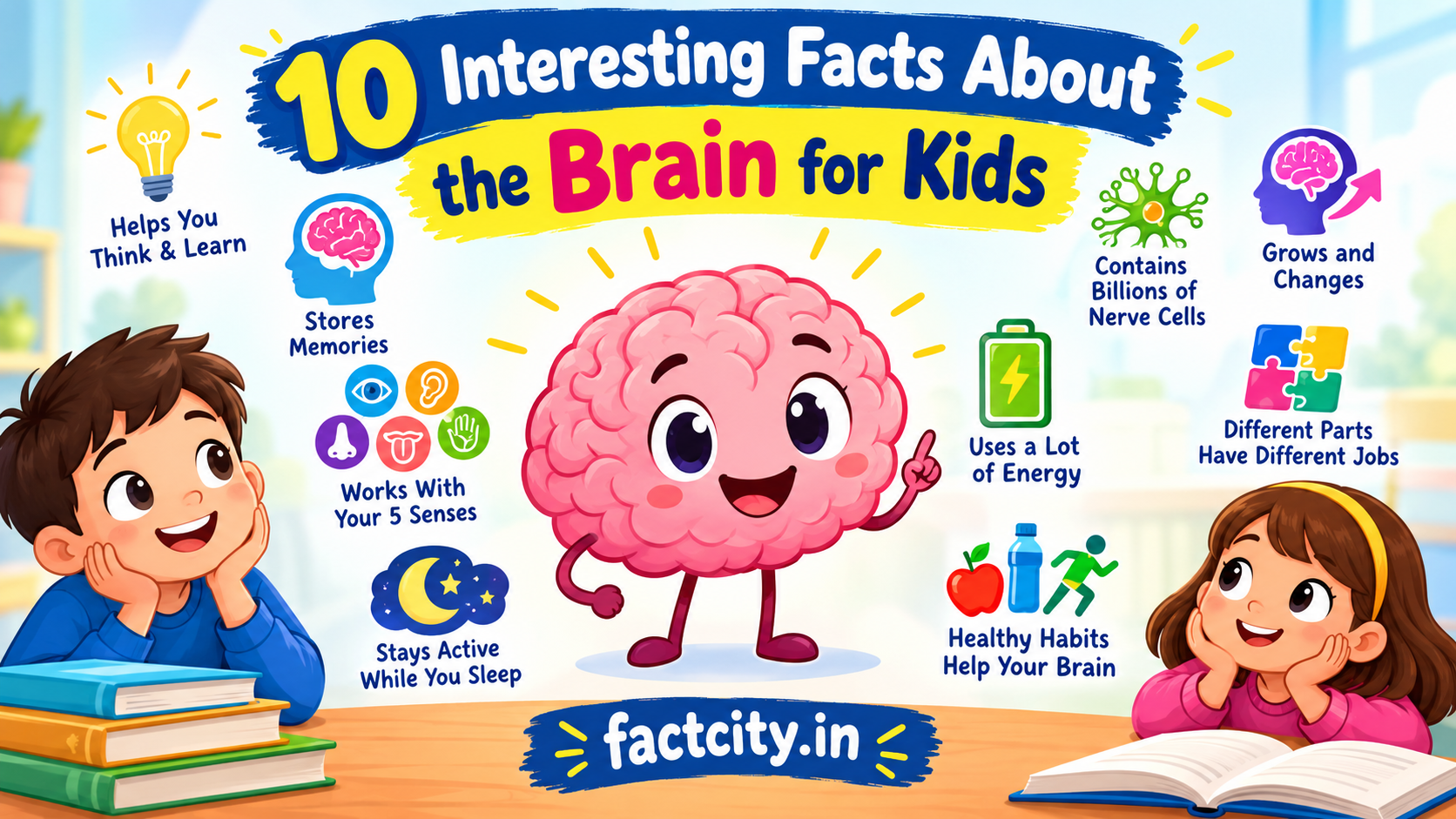
10 Interesting Facts About the Brain. The human brain is one of the most amazing parts of the human body. It helps us think, learn, remember things, solve problems, feel emotions, and understand the world around us. Every time you read a book, play a game, recognize a friend, or learn something new at school, your brain is working hard behind the scenes. Although the brain is protected inside the skull, it performs many important jobs every second of the day. Children can learn a lot about how their brains work through simple facts about memory, dreams, senses, and learning. In this article, we will explore 10 interesting facts about the brain for kids that make science fun, easy to understand, and exciting to discover.
1. The Brain Is the Control Center of Your Body
Your brain works like the control center of your body. It sends and receives messages that help you move, speak, think, and respond to what happens around you. For example, when you see a ball coming toward you, your brain helps you recognize it and move your hands to catch it. It also helps control important automatic activities, such as breathing, heart rate, and body temperature. Different parts of the brain have different responsibilities, but they work together to keep your body functioning. Without your brain, you would not be able to experience the world in the way you do every day. 10 Interesting Facts About the Brain
2. Your Brain Contains Billions of Nerve Cells
One of the most fascinating brain facts for kids is that the brain contains around 86 billion neurons. Neurons are special nerve cells that send information throughout the brain and nervous system. They communicate using electrical signals and chemical messengers, allowing different parts of the body to share information. These signals help you do everything from moving your fingers to remembering your favorite story. Neurons also connect with one another in complex networks that support learning, thinking, and memory. Your brain is constantly using these connections, and many of them become stronger or change as you practice new skills and gain experience.
3. Your Brain Helps You Learn New Things
Every time you learn something new, your brain begins adapting. Whether you are learning multiplication tables, riding a bicycle, drawing a picture, or speaking a new language, your brain creates and strengthens connections between nerve cells. This ability is known as neuroplasticity. It means the brain can change and adapt in response to learning and experience. At first, a new activity might feel difficult, but repeated practice can make it easier. For example, you may struggle to spell a word correctly the first time, but after practicing it several times, you may remember it more easily. This is one reason why curiosity, practice, and patience are important for children’s learning and development.
4. Your Brain Uses a Lot of Energy
Even though the brain makes up only about 2% of an adult’s body weight, it uses roughly 20% of the body’s energy at rest. This energy helps brain cells communicate, process information, and maintain the activities needed for the brain to function properly. Children’s brains also need a steady supply of energy as they grow and develop. Eating balanced meals, drinking enough water, getting sufficient sleep, and staying physically active can help support overall health and learning. Your brain keeps working even when you are sitting quietly, reading a book, or thinking about what to do next. That is why looking after your body is also an important way to look after your brain.
5. Your Brain Helps You Remember Important Things
Have you ever remembered your best friend’s birthday, the name of your favorite cartoon character, or the words of a song you learned at school? Your brain makes these memories possible. Memory involves several brain regions working together to take in information, store it, and bring it back when needed. The hippocampus plays an important role in forming many new memories, while other brain areas help store and retrieve different kinds of information. However, the brain does not remember everything perfectly. You might forget where you left your pencil or what you ate for lunch yesterday, and that is completely normal. Repeating information, paying attention, and connecting new ideas with things you already know can help you remember them more effectively.
6. Your Brain Is Active While You Sleep
Sleep is not a time when your brain simply switches off. In fact, your brain remains active while you sleep, carrying out important processes that support health, learning, and memory. Sleep helps your brain process experiences from the day and strengthen some of the information you have learned. This is one reason why getting enough sleep is important for children who attend school and participate in sports or other activities. When you do not sleep well, it may become harder to concentrate, remember information, and manage your emotions. A regular bedtime and a relaxing nighttime routine can help children get the sleep they need to feel refreshed and ready to learn the next day.
7. Your Brain Helps You Understand Your Five Senses
Your brain helps you make sense of information collected by your eyes, ears, nose, tongue, and skin. These senses allow you to see colors, hear sounds, smell flowers, taste food, and feel whether something is hot, cold, soft, or rough. Your sensory organs collect information and send signals through nerves to the brain, where the information is processed. For example, when you hear a dog barking, your ears detect the sound, and your brain helps you recognize it. Your brain can also combine information from several senses to understand what is happening around you. This teamwork helps you explore your environment, learn new things, and respond to different situations.
8. Your Brain Can Create Amazing Dreams
Dreams are another interesting part of how the brain works. Many people experience dreams during sleep, particularly during a stage called rapid eye movement, or REM, sleep. During this stage, brain activity can be similar to activity during wakefulness, and vivid dreams are common. Dreams may include familiar people, unusual places, funny situations, or events that could never happen in real life. Scientists are still studying exactly why we dream, and there is no single explanation that accounts for every dream. Dreams may be connected with memory, emotions, and the brain’s activity during sleep. So, if you dream about flying over your school or talking to a dinosaur, remember that your sleeping brain can create some surprising experiences.
9. Different Parts of Your Brain Have Different Jobs
Your brain is made up of several connected regions that perform different but related functions. The cerebrum is involved in thinking, language, memory, and voluntary movement. The cerebellum helps coordinate balance and movement, making it easier to walk, run, and ride a bicycle. The brainstem helps control essential functions such as breathing and heart rate. These regions do not work alone; they communicate constantly to help you complete everyday activities. For example, when you kick a football, several brain areas work together to help you see the ball, plan your movement, coordinate your muscles, and maintain your balance. This teamwork makes the brain a remarkable organ.
10. Exercise and Healthy Habits Help Your Brain
Your brain benefits when you take good care of your body. Physical activities such as walking, cycling, dancing, swimming, and playing outdoor games support overall health and can benefit brain function. Eating a balanced diet provides nutrients that the brain needs, while enough sleep supports attention and memory. Activities such as reading, solving puzzles, building with blocks, drawing, and learning musical instruments also give your brain opportunities to develop new skills. Spending time with friends and family can support emotional well-being, too. You do not need to do everything perfectly to care for your brain. Small, healthy habits practiced regularly can make a positive difference as you grow. unbelievable-facts-about-space-that-will-blow
Why Is the Human Brain So Important?
The human brain is important because it allows us to learn, communicate, create, remember, and experience emotions. It helps children develop new abilities, understand their surroundings, and make decisions. From recognizing a parent’s voice to solving a difficult school problem, the brain supports countless everyday experiences. Scientists continue to study the brain to understand how it develops, how memories form, and how people learn new skills. Although there is still much to discover, we already know that the brain changes throughout life and benefits from learning, rest, physical activity, and healthy routines. Understanding how the brain works can encourage children to stay curious and enjoy exploring science.
Conclusion
These 10 interesting facts about the brain for kids show just how remarkable the human brain really is. It controls important body functions, contains billions of nerve cells, helps us remember information, and allows us to learn new skills. It also helps us understand our senses, experience dreams, coordinate movement, and respond to emotions. The best part is that children can support their growing brains through simple habits such as getting enough sleep, eating balanced meals, exercising, reading, and practicing new skills. The next time you solve a puzzle, learn a new word, or remember something important, think about the amazing work your brain is doing. There is always something new and exciting to discover about the human brain!