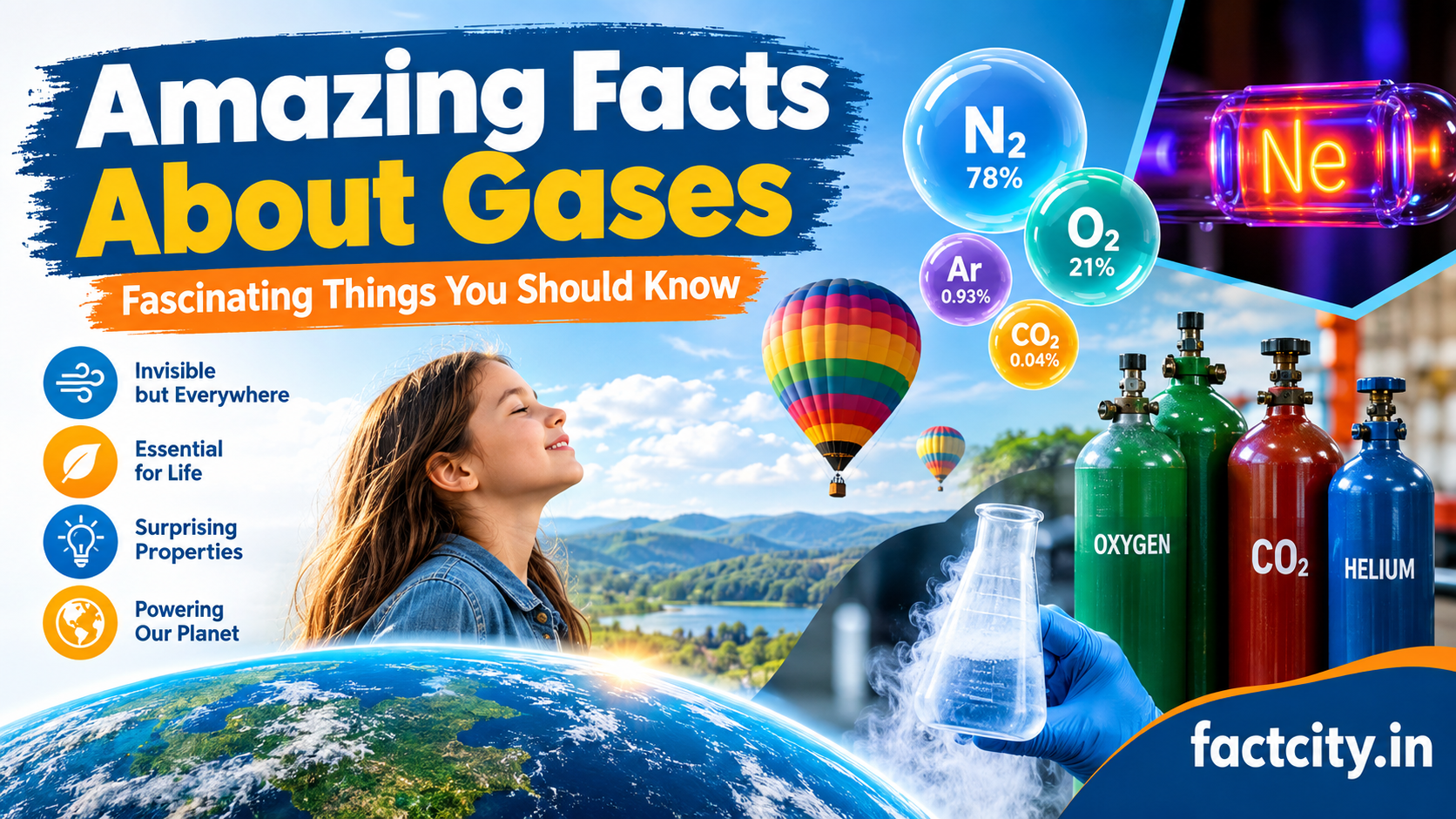
Amazing Facts About Gases, Gasses are all around us but we generally cannot see them. Every second we breathe in gasses, weather patterns depend upon them, plants use them to grow and the atmosphere protects life on Earth. Gasses are a part of everyday life – from the oxygen in the air we breathe to the carbon dioxide we exhale.
But gasses are more interesting than you might think. Some change colors, some glow when electricity is passed through them, some can turn into liquids or solids in the right conditions. Even the air in a normal room is actually a mixture of a number of different gasses.
In this article, we are going to see some amazing facts about gasses in simple and easy way. These facts are helpful to students, science fans and anyone who likes learning surprising things about the world we live in.
What’s a Gas?
Gas is one of the three common states of matter . Solids and liquids . Unlike a solid, a gas has no fixed shape or volume. The particles are quite far apart and they can move freely in different directions. “Amazing Facts About Gases“
Because the particles of gasses are so free to move, gasses can fill the container in which they are put. That’s why a room is full of air even when you can’t see it.
Gasses can be compressed too. Their particles can be forced closer together by the application of pressure. This property is very useful in everyday products such as compressed-air tanks, aerosol cans and gas cylinders.
1.Air is really a mixture of gasses
One of the most basic but interesting facts about gasses is that the air around us is not a single gas .
The primary components of Earth’s atmosphere are:
- Nitrogen.
- OxygenArgon
- CO2
- remains of other gas
Nitrogen is about 78% and oxygen about 21% of dry air. Argon makes up almost 1%, and carbon dioxide exists in a much smaller concentration.
This mixture is vital to life. Humans and many animals need to breathe oxygen . Plants use carbon dioxide as part of photosynthesis .
2.Earth’s Living Things Need Oxygen
Oxygen is one of the most important gasses on our planet. Humans breathe in oxygen and use it in cellular respiration . This helps to release energy from food .
Oddly enough, oxygen itself will not burn. It is not a support for combustion, but an aid to it. Generally materials that will burn will burn much more easily when there is enough oxygen available.
This is why a fire can be made to burn more fiercely if it is fed with extra oxygen.
Oxygen is also used in hospitals, industrial processes, water treatment, welding and many other applications.
3.The Main Part of the Atmosphere Is Nitrogen
You’d think the biggest part of air is oxygen, since we humans need it to survive. In fact, nitrogen is far more prevalent.
The dry atmosphere of the earth is about 78% nitrogen.
Nitrogen is very important to life . Although humans can not normally use atmospheric nitrogen directly for biological purposes . Plants need nitrogen to make proteins and other compounds.
The nitrogen cycle is the cycle of nitrogen moving from the atmosphere to the soil to living organisms and back to the environment.
4.Carbon Dioxide: Not Just a “Bad” Gas
There’s a lot of attention on carbon dioxide because of its association with climate change, but the gas itself is a natural and essential component of Earth’s systems.
Plants take in carbon dioxide during photosynthesis. Plants use sunlight to convert carbon dioxide and water into chemical power and release oxygen.
When animals and humans breathe out they give off carbon dioxide.
And it’s not just carbon dioxide. Modern climate science understands a significant part of the concentration of greenhouse gasses in the atmosphere and of changes caused by human activities.
5.Some gasses have no smell at all
Most of the pure gasses are colorless and odorless.
For example, nitrogen and oxygen are practically without smell under normal conditions. This could mean that some gasses are hard to detect without specialist equipment.
Some gasses used in homes or industry may therefore have added odorants so that leaks can be detected more easily.
This is a good reminder that your senses are not always reliable indicators of a gas.
6.Noble Gasses Can Glow in Pretty Colors
Some gasses will give off spectacular colors when electricity is passed through them.
Excited atoms can emit characteristic colors of light . Noble gasses such as neon , argon , krypton , and xenon have been used in lighting applications .
A well known example is neon lights. When a suitable tube containing neon gas is subjected to an electrical discharge, the gas glows in a characteristic reddish‐orange color.
Different gasses can produce different colors . This can be used for specialized lighting and for scientific applications .
7.Helium Is Lighter Then Air
Helium is one of the lightest elements, and less dense than normal air. That is what makes balloons filled with helium rise.
If a balloon filled with helium is in the presence of a denser air, the buoyant force can push the balloon up.
Helium is also very chemically inert, so it’s useful when a non-reactive gas is needed.
It finds use in scientific research, specialized cooling systems, leak detection and in some industrial processes.
8.Helium Is The Second Lightest Element
Hydrogen is the lightest element, followed by helium.
Hydrogen is even lighter than helium and for that reason can also provide lift in balloons and airships. Hydrogen, however, is very flammable, and helium is not.
Part of the reason for this is that helium has often been the gas of choice for many applications involving human-carrying balloons and airships.
9.Gasses Can Be Made Into Liquids
A gas does not always have to stay a gas.
“There’s a whole bunch of gasses that could be liquified at the right temperature and pressure. This phenomenon is called liquefaction.
Nitrogen and oxygen can be cooled down to extremely low temperatures until they become liquids.
Liquid gasses have extensive application. Liquid nitrogen is used extensively for cooling, scientific research, food processing and laboratory work.
10.Water Vapor Is Gas
Water is usually thought of as a liquid, but water can exist in all three states of matter, the usual states of matter.
Water in its gaseous form is water vapor.
Water vapor itself is generally invisible , unlike visible clouds . Clouds form when warm moist air cools and water condenses into tiny droplets or ice crystals.
This is an important distinction because the white mist seen above a hot shower is not just water vapor, but contains tiny liquid droplets that have condensed.
11.Gasses Expand When Heated
One classic feature of gasses is that they respond very strongly to changes in temperature.
When a gas is heated, the particles in it normally move more quickly. If the pressure is allowed to remain more or less constant , then the gas can expand .
This principle is the reason why hot air balloons can rise. The air inside the balloon is heated and becomes less dense than the surrounding air, which is cooler. An upward buoyant force lifts the balloon.
12.Gasses Are Compressible
Gas particles have a lot of space between them, more than between solid or liquid particles.
This means that gasses can often be compressed quite a lot .
This property is useful in a lot of technologies. Compressed gasses are stored in cylinders and used for medical, industrial, scientific and recreational purposes.
Another common example is air compressors. They squeeze the air down into a smaller volume, so it can be released later to do useful work.
13.Heavier Gasses Exist
Not all gasses are lighter than the air.
Carbon dioxide is heavier than normal air, and under certain conditions will tend to accumulate in low-lying areas. Other gasses may have densities greater or less than air.
The density of gas depends on the molecular mass, temperature and pressure.
Knowledge of the gas density is important in the science and engineering, safety in industry and in atmospheric studies.
14.The air gets thinner the higher you go
The air of the earth’s atmosphere is not of uniform density.
Usually , the higher you go in altitude , the less the pressure of the atmosphere . This is because there is less air above you pushing down .
So at high elevations the air is thinner and has fewer oxygen molecules in a given volume of air.
One reason people have difficulty breathing when they travel quickly to very high altitudes.
15.Greenhouse Gasses Heat the Earth
Greenhouse gasses are gasses in the atmosphere of Earth that absorb and emit infrared radiation.
Greenhouse gasses include water vapor, carbon dioxide, methane and nitrous oxide.
The natural greenhouse effect is crucial for keeping the Earth warm enough to sustain life as we know it. But human activities have increased concentrations of several greenhouse gasses and contributed to modern global warming.
This is why atmospheric gasses are an important subject in climate science.
16.Gas Particles Move Continuously
Even a gas that seems to be completely still has particles that are always in motion.
The particles collide with each other and the walls of their container. These microscopic collisions help create the pressure that gasses exert.
This behavior is explained by the kinetic theory of gasses .
This idea of particles that are invisible but always moving around helps us to understand many things that we see every day . For example, diffusion, pressure, expansion, and changes in temperature .
17.Fumes Move Through The Air
Have you ever smelled food in another room?
This is because molecules diffuse from the source into the air around it. Diffusion is the movement of particles from a region where they are more concentrated to a region where they are less concentrated.
Gas particles can diffuse relatively quickly because they are free to move.
That’s why a smell can eventually permeate a room even if the source remains stationary.
18.Certain Gasses Are Very Reactive
Not all gasses behave the same.
Some gasses are very reactive, while others are very stable. Fluorine is very reactive. Noble gasses such as helium, neon, etc., are usually much less reactive under normal conditions.
The electronic structure of atoms and molecules determines the chemical reactivity.
Gasses are thus especially interesting in chemistry because of this large variety of behavior.
19.The Sun Is Composed Mostly of Hydrogen and Helium in Huge Amounts
The Sun is not a solid sphere of matter. It is made up mostly of extremely hot plasma , with most of its composition being hydrogen and helium .
The Sun achieves nuclear fusion converting hydrogen to helium, releasing enormous quantities of energy.
Eventually, that energy reaches Earth as sunlight, and is essential to Earth’s climate and ecosystems.
20.Gas is in places you wouldn’t believe
“Gases are not confined to the atmosphere.
They are capable of existing within liquids, solids, rocks, living organisms, oceans and even microscopic spaces.
An example would be carbon dioxide dissolved in many drinks, oxygen dissolved in water, or a gas trapped in geological formations.
Scientists study gasses in many diverse environments to understand Earth’s atmosphere, oceans, biology, geology, and climate.
Why Are Gasses Important?
Gasses play a role in countless natural processes and technologies.
They help to support:
- Respiration in humans and animals
- Photosynthesis in plants
- Weather and atmospheric processes
- Manufacturing industry
- Medical treatment
- Refrigeration & cooling
- Preserving food
- Energy generation
- Scientific investigation
- Transportation & Aerospace Technology
Without gasses, life on Earth would be completely different.
Interesting Gas Facts Summary
Here are a few quick amazing facts about gasses to keep in mind:
- Air is a mixture of different gasses.
- Nitrogen is the most abundant gas in the dry atmosphere of Earth.
- Oxygen supports burning. It does not burn itself.
- Helium is less dense than air.
- Hydrogen is less dense than helium.
- Water vapor is water in the form of a gas.
- Gasses are compressible.
- In general, gasses expand when heated.
- Some gasses can glow when they are electrically excited.
- The particles in a gas are always moving.
- Carbon dioxide is a natural component of Earth’s atmosphere.
- Greenhouse gasses affect the temperature of the earth.
- Gasses can be liquefied under proper conditions.
- Air pressure decreases as altitude increases .
- Diffusion causes the gas molecules to spread out in an environment.
- Conclusion
These great facts about gasses show just how important and interesting gasses really are. Many gasses are unseen but they influence nearly everything we do every day.
Gasses are always present in the natural processes that happen around us – the oxygen we breathe, the carbon dioxide that plants use, the helium that fills balloons, and the water vapor that is part of weather.
Learning about gasses helps us to understand chemistry, physics, biology, climate science and even space better. The next time you breathe, see a balloon go up, watch a cloud form or see steam come off a hot drink, remember that you are witnessing the interesting behavior of matter in its gaseous form.