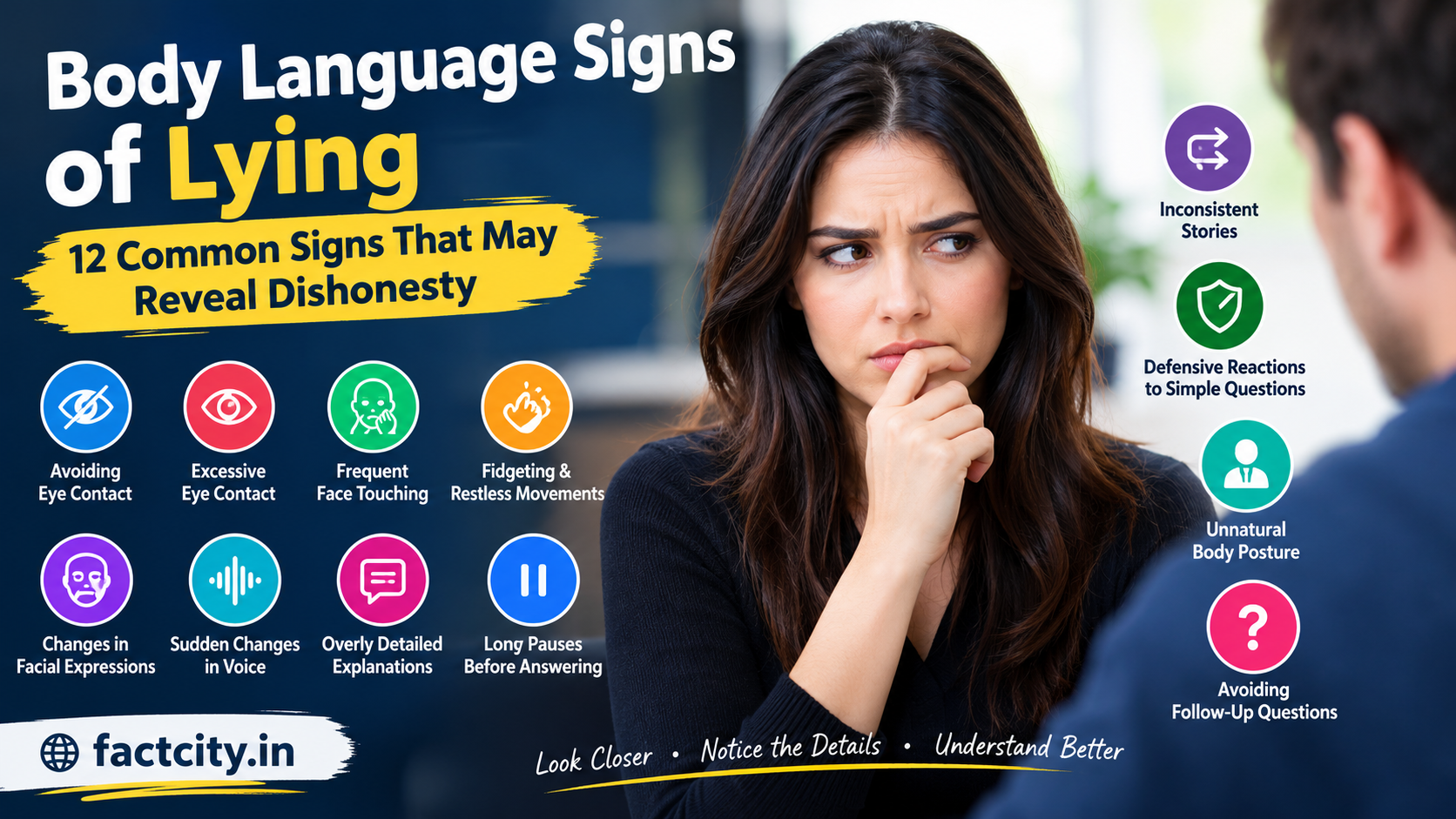
Body Language Signs of Lying: Understanding body language signs of lying can help you become more aware of how people communicate. Sometimes, a person’s facial expressions, eye movements, gestures, or tone of voice may seem inconsistent with their words. These behaviors can make us wonder whether someone is being honest or hiding something.
However, it is important to understand that body language cannot prove that someone is lying. Nervousness, avoiding eye contact, and fidgeting can also occur when a person feels anxious, uncomfortable, embarrassed, or stressed. The best way to understand someone’s behavior is to consider the situation, their usual communication style, and the information they share.
In this article, we will explore 12 common body language signs that may sometimes accompany dishonesty, along with practical tips for interpreting them more accurately.
1. Avoiding Eye Contact
One of the most commonly discussed signs of lying is avoiding eye contact. When someone feels uncomfortable during a conversation, they may look away more frequently than usual. This behavior can make the other person wonder whether they are hiding something.
For example, someone answering a direct question might repeatedly look toward the floor or turn their attention elsewhere. “Body Language Signs of Lying“
However, avoiding eye contact does not automatically mean a person is lying. Many honest people avoid prolonged eye contact because of shyness, cultural differences, social anxiety, or personal habits.
Instead of focusing only on eye contact, pay attention to whether the person’s overall behavior changes during the conversation.
2. Excessive Eye Contact
Interestingly, maintaining too much eye contact can also seem unusual in certain situations. Some people believe that looking directly into another person’s eyes makes them appear more trustworthy.
A person who is trying to create a particular impression may deliberately maintain intense eye contact while answering questions.
For instance, someone might stare continuously at the listener while explaining something that would normally involve more natural eye movements.
Nevertheless, confident people often maintain steady eye contact without any dishonest intentions. Eye contact alone cannot tell you whether someone is telling the truth.
3. Frequent Face Touching
Touching the face is another behavior people sometimes associate with lying. During an uncomfortable conversation, a person might rub their nose, touch their lips, scratch their cheek, or rest their hand against their face.
These movements may happen when someone feels nervous or experiences tension.
For example, a person discussing a sensitive subject might repeatedly touch their face while trying to explain what happened.
However, face touching is a normal human habit. It can also result from itching, tiredness, allergies, or simple distraction. It becomes more useful to observe only when it represents a noticeable change from the person’s usual behavior.
4. Fidgeting and Restless Movements
Fidgeting may include tapping fingers, shaking a leg, moving repeatedly in a chair, or playing with objects nearby.
When people experience stress, their bodies may become more restless. This can happen during difficult conversations, including situations where someone is not being completely honest.
Imagine asking a person about a confusing situation and noticing that they suddenly begin tapping their fingers or moving their feet more than usual.
The change may indicate discomfort, but it does not explain the reason for that discomfort.
They might be worried about being misunderstood, afraid of an argument, or uncomfortable discussing a private matter. Always consider the broader context before drawing conclusions.
5. Changes in Facial Expressions
Facial expressions communicate emotions such as happiness, sadness, anger, surprise, and confusion. Sometimes, a person’s expression may appear inconsistent with the words they are saying.
For example, someone might smile while discussing a serious subject or appear tense while claiming that everything is fine.
Such differences can make a conversation feel unnatural.
However, people express emotions differently. Some individuals smile when nervous, while others struggle to show their feelings clearly. A facial expression that seems unusual does not necessarily indicate dishonesty.
Look for inconsistencies between the person’s words, emotional response, and the circumstances rather than judging a single expression.
6. Sudden Changes in Voice
Although voice is not strictly body language, it is an important part of nonverbal communication. Changes in pitch, volume, speaking speed, or pauses may sometimes occur when someone feels pressure.
A person who becomes uncomfortable might speak faster, lower their voice, or pause repeatedly while answering a question.
For example, someone who normally speaks calmly may suddenly sound tense when discussing a particular event.
These changes can reflect emotional stress, but stress has many possible causes. Public speaking anxiety, embarrassment, fear of conflict, and unexpected questions can all affect the voice.
A sudden vocal change is best treated as a reason to pay attention, not as proof of lying.
7. Giving Unusual or Excessive Explanations
Sometimes, a person may provide far more information than a question requires. Instead of giving a simple answer, they might explain numerous details that were never requested.
For instance, when asked where they were yesterday evening, someone might offer a lengthy explanation about their schedule, transportation, conversations, and unrelated activities.
In some circumstances, excessive explanations may be an attempt to make a story sound convincing. However, people also overexplain when they feel misunderstood or want to avoid confusion.
The important question is whether the explanation is relevant, consistent, and supported by the available information.
Avoid assuming that a detailed answer is dishonest simply because it is long.
8. Long Pauses Before Answering
A noticeable pause before answering can sometimes indicate that a person is carefully considering what to say.
Someone who is uncomfortable with a question may take extra time to respond, particularly when discussing a sensitive subject.
For example, a person might hesitate before explaining an event that involves conflicting information.
However, pauses are common in ordinary conversations. People often stop to remember details, organize their thoughts, or make sure their answer is accurate.
A pause becomes more meaningful when considered alongside other information, such as contradictory statements or details that change repeatedly.
Even then, hesitation alone cannot establish dishonesty.
9. Inconsistent Stories
One potentially useful sign of dishonesty is inconsistency in a person’s account of an event. Unlike eye contact or fidgeting, inconsistencies can sometimes be checked against specific details.
For example, someone might initially say they arrived at a location at 6 p.m. and later claim they arrived at 8 p.m. without explaining the difference.
Small variations in how people remember events are normal, particularly when time has passed. Memory is not a perfect recording of reality.
The important distinction is between minor differences and significant contradictions about important facts.
If something does not match, ask a calm, open-ended question instead of immediately accusing the person of lying.
10. Defensive Reactions to Simple Questions
A person may become unusually defensive when asked about a particular subject. They might change the topic, respond with irritation, or repeatedly insist that they have done nothing wrong.
For example, a straightforward question about a missed appointment might lead to an unexpectedly angry response.
In some situations, defensiveness can occur when someone is trying to avoid accountability. However, honest people may also become defensive when they feel accused, judged, or unfairly treated.
Pay attention to the nature of the question and the relationship between the people involved. A defensive reaction does not automatically reveal whether someone is telling the truth.
11. Unnatural Body Posture
Body posture can influence how comfortable or engaged someone appears during a conversation. A person experiencing stress may hold their body rigidly, cross their arms, turn away, or make fewer natural movements.
Sometimes, these changes happen when a conversation becomes uncomfortable.
For example, someone might appear relaxed while discussing everyday topics but become noticeably stiff when asked about a difficult situation.
Still, posture is influenced by many factors, including temperature, physical discomfort, personality, and personal preferences.
Crossed arms do not necessarily mean someone is hiding information. Similarly, a rigid posture does not prove that a person is being dishonest.
Observe changes in posture alongside the conversation rather than interpreting individual gestures in isolation. 20-interesting-facts-about-human-behavior-and-the-mind
12. Avoiding Follow-Up Questions
Another behavior worth noticing is when someone repeatedly avoids answering reasonable follow-up questions.
They might provide vague responses, redirect the conversation, or answer a different question instead of addressing the original one.
For example, if you ask how an important decision was made, the person may repeatedly discuss unrelated events without explaining the decision itself.
This behavior can sometimes suggest that the person is reluctant to share information. However, reluctance does not always mean lying. They may want privacy, feel uncomfortable, or believe the question is inappropriate.
A respectful follow-up question can help clarify the situation without creating unnecessary conflict.
How to Recognize Possible Dishonesty More Accurately
Understanding body language requires patience and careful observation. Instead of trying to identify a single gesture that supposedly reveals a lie, consider the complete situation.
Here are five practical approaches:
- Know the person’s usual behavior: Notice whether their communication style changes significantly from what is normal for them.
- Look for multiple clues: Do not base your judgment on eye contact, facial expressions, or nervous movements alone.
- Ask open-ended questions: Questions such as “Can you explain what happened next?” may encourage clearer answers.
- Check important facts: When appropriate, compare statements with reliable information rather than relying entirely on impressions.
- Avoid making immediate accusations: Give the person an opportunity to clarify confusing or contradictory details.
Research on deception detection suggests that people are generally not very accurate at identifying lies through nonverbal behavior alone. There is no universally reliable gesture, facial expression, or eye movement that proves dishonesty.
Can You Tell If Someone Is Lying by Their Eyes?
No. Eye movements cannot reliably determine whether someone is telling the truth. The belief that liars always avoid eye contact is a widespread misconception.
Some honest people look away while speaking, while some dishonest people maintain natural eye contact. Eye behavior varies according to personality, culture, attention, and the situation.
Rather than judging someone’s honesty by their eyes, consider the consistency of their statements and any independently verifiable evidence.
Why Do People Show Different Body Language When They Feel Nervous?
Body language can change when people experience emotional pressure. The brain and body respond to stressful situations in different ways, including changes in muscle tension, breathing, attention, and movement.
These reactions are not exclusive to dishonesty.
Someone might appear nervous because they are afraid of disappointing another person, discussing a sensitive memory, or facing an uncomfortable conversation. Another person may remain calm even when discussing something untrue.
This is why understanding the context behind a behavior is more useful than treating nervousness as a sign of guilt.
Final Thoughts
Body language signs of lying can be interesting to observe, but they should never be treated as a guaranteed method for detecting deception. Avoiding eye contact, touching the face, fidgeting, giving lengthy explanations, and changing vocal patterns may indicate discomfort, yet none of these behaviors proves that someone is lying.
The most reliable approach is to consider the full conversation, look for meaningful inconsistencies, ask respectful questions, and check important facts when possible.