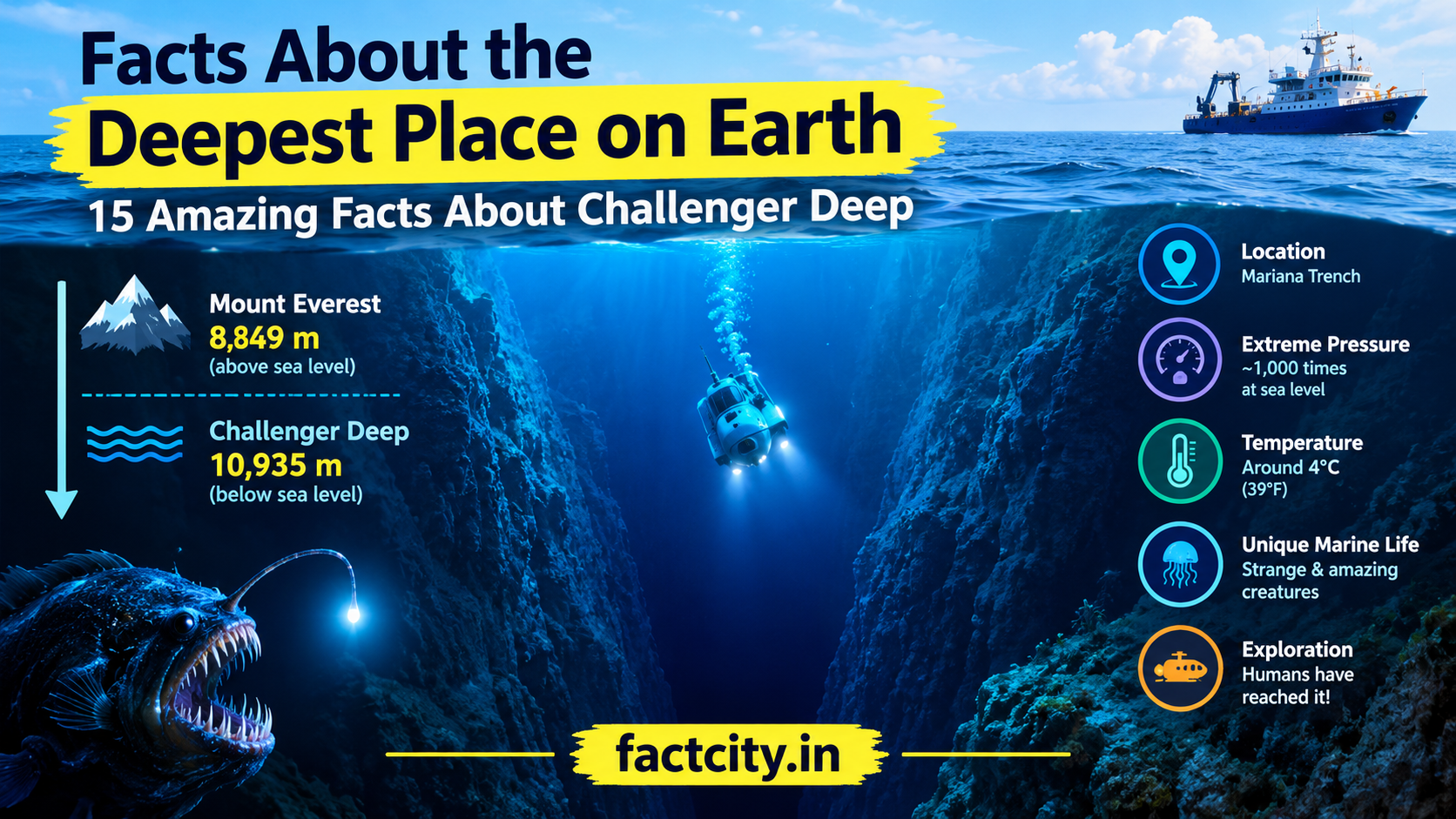
Facts About the Deepest Place on Earth: Have you ever wondered what lies at Earth’s deepest point? Far below the ocean’s surface lies a mysterious world of darkness, freezing water, incredible pressure, and unusual marine life. This hidden place is so deep that even Mount Everest, the tallest mountain in the world, would disappear beneath the water if it were placed there.
The deepest known point on Earth’s seafloor is called Challenger Deep, located in the Mariana Trench in the western Pacific Ocean. It is one of the most extreme environments on our planet and continues to fascinate scientists and ocean explorers. In this article, we will explore 15 amazing facts about the deepest place on Earth, including its depth, location, marine life, extreme pressure, and the challenges scientists face when exploring it.
1. Challenger Deep Is the Deepest Known Place on Earth
Challenger Deep is recognized as the deepest known point on Earth’s ocean floor. Its depth is approximately 10,935 meters (35,876 feet) below sea level, although measurements can vary slightly depending on the equipment and methods used. To understand how deep this is, imagine traveling almost 11 kilometers straight down into the ocean. You would enter an environment completely different from the world we experience on land. Scientists continue to study this extraordinary location to understand more about Earth’s underwater geography.
2. It Is Located in the Mariana Trench
The Mariana Trench lies in the western Pacific Ocean, east of the Philippines and near the Mariana Islands. Challenger Deep is situated at the southern end of this enormous underwater trench. The Mariana Trench is a long, curved depression in the seafloor formed by the movement of Earth’s tectonic plates. It stretches for approximately 2,550 kilometers (1,580 miles). Although the trench is famous for its incredible depth, it is also important for understanding Earth’s geology and the processes that shape the ocean floor.
3. Mount Everest Would Fit Beneath the Ocean
One of the most astonishing facts about the deepest place on Earth involves Mount Everest. Mount Everest rises approximately 8,849 meters (29,032 feet) above sea level. Challenger Deep reaches roughly 10,935 meters below sea level. If Mount Everest were placed at the bottom of Challenger Deep, its summit would still be covered by more than 2,000 meters of seawater. This comparison makes it easier to imagine the enormous depth of the ocean and shows why Challenger Deep is considered one of the planet’s most remarkable natural features.
4. The Water Pressure Is Extremely High
Water pressure increases as depth increases because the weight of the water above becomes greater. At Challenger Deep, the pressure is approximately 1,000 times the atmospheric pressure at sea level. This immense force makes deep-sea exploration extremely difficult. Ordinary diving equipment cannot protect a human being at such depths. Specially engineered submersibles and scientific instruments are needed to withstand the pressure. Even a small weakness in a deep-sea vehicle’s structure could create a serious safety risk. That is why engineers must carefully test equipment before sending it into the deepest parts of the ocean.
5. Sunlight Cannot Reach the Bottom
Sunlight gradually disappears as it travels through seawater. In the deepest parts of the Mariana Trench, sunlight cannot reach the seafloor. This means Challenger Deep remains in permanent natural darkness. Unlike shallow coral reefs, where sunlight supports photosynthesis and colorful ecosystems, the deepest ocean depends on other sources of food. Some deep-sea animals produce their own light through a process called bioluminescence. However, not every deep-sea creature has this ability. The lack of sunlight makes the environment challenging, but it has not prevented life from surviving there.
6. The Temperature Is Close to Freezing
Although the deepest ocean is far below the warm surface waters found in tropical regions, it is generally very cold. Deep-ocean temperatures are often close to 4°C (39°F), although conditions can vary by location and depth. Challenger Deep is no exception to the cold conditions of the deep ocean. Organisms living there must survive low temperatures, darkness, limited food, and extreme pressure. These conditions make the deepest parts of the ocean an important area for studying how living things adapt to extreme environments.
7. Humans Have Reached Challenger Deep
Despite its dangerous conditions, humans have successfully traveled to the deepest known point of the ocean. In January 1960, Swiss oceanographer Jacques Piccard and U.S. Navy Lieutenant Don Walsh descended into Challenger Deep aboard the bathyscaphe Trieste. They became the first people known to reach this extraordinary depth. Their historic dive demonstrated that human exploration was possible even under enormous underwater pressure.
In 2012, filmmaker and explorer James Cameron completed a solo descent to Challenger Deep in a specially designed submersible called Deepsea Challenger. These missions helped scientists improve their understanding of deep-sea exploration and encouraged further research into the ocean’s most inaccessible environments.
8. Strange Creatures Can Survive in the Deep Ocean
You might think that no living creature could survive under such extreme conditions, but the deep ocean supports specially adapted organisms. Scientists have discovered microorganisms, small crustaceans, and other animals in deep-sea environments, including the Mariana Trench.
Some organisms can survive by consuming organic material that sinks from upper ocean layers. This material includes tiny particles, remains of dead organisms, and other food sources. Researchers continue to investigate how these organisms tolerate high pressure and limited food availability. However, not every animal commonly associated with the deep sea lives at the very bottom of Challenger Deep. Different species occupy different depth ranges.
9. The Mariana Trench Was Formed by Moving Tectonic Plates
The Mariana Trench exists because of a geological process called subduction. Earth’s outer layer is divided into large pieces known as tectonic plates. In the Mariana region, one oceanic plate moves beneath another plate and sinks into Earth’s interior. As this process continues, the seafloor bends downward, creating a deep oceanic trench. Subduction also plays a major role in generating earthquakes and volcanic activity. Studying the Mariana Trench therefore helps scientists understand how Earth’s crust moves and changes over time.
10. The Ocean Floor Is Difficult to Map
Even with modern technology, mapping the deepest ocean regions is a major scientific challenge. Scientists use sonar systems to send sound waves toward the seafloor and measure the returning signals. These measurements help researchers estimate underwater depth and create detailed maps.
However, the ocean is enormous, and ships cannot map every part of the seafloor quickly. Deep trenches require careful surveys because accurate measurements depend on equipment, positioning, and local ocean conditions. This is one reason published depth estimates for Challenger Deep may differ slightly.
11. The Deepest Place Has More Than One Measured Depth
You may find different figures for the depth of Challenger Deep when reading about it online. Some sources give measurements around 10,900 meters, while others provide more precise estimates, such as 10,935 meters. These differences do not necessarily mean that one source is incorrect. Scientists use different instruments and measurement methods, and the exact deepest point can be difficult to locate.
Modern research combines sonar measurements, pressure sensors, and other techniques to improve accuracy. For this reason, it is better to describe Challenger Deep as approximately 10.9 kilometers deep rather than assuming that every measurement will produce exactly the same number.
12. The Deep Ocean Is Not Completely Silent
The deepest ocean may be dark and isolated, but it is not necessarily silent. In 2015, researchers deployed a specially designed hydrophone in Challenger Deep to record underwater sounds. The recordings included natural sounds and noise produced by human activities. Sound can travel long distances through water, allowing scientists to investigate the underwater sound environment. Research like this helps experts understand how noise from ships and other human activities may reach deep-sea habitats. It also demonstrates that scientists can learn about remote ocean environments without constantly sending people down to the seafloor.
13. Food Is Limited at Extreme Depths
Plants cannot grow through photosynthesis at Challenger Deep because sunlight does not reach the bottom. Instead, many deep-sea organisms depend on food that comes from other parts of the ocean. Small particles of organic material can sink through the water and provide nutrients for animals living below. Scientists sometimes describe this falling material as marine snow. Because food is limited in deep environments, organisms must survive with fewer resources than many animals living near the surface. Understanding these food sources helps researchers explain how deep-sea ecosystems function.
14. Exploring Challenger Deep Requires Special Technology
Reaching Challenger Deep is not as simple as sending an ordinary submarine underwater. A vehicle must withstand immense pressure, maintain reliable communication, collect useful scientific information, and return safely to the surface. Engineers use specially designed pressure-resistant structures, advanced sensors, navigation systems, and carefully tested equipment. Some missions use crewed submersibles, while others rely on remotely operated vehicles or autonomous underwater instruments. Each approach has advantages and limitations, but all contribute to our understanding of the deepest ocean environments.
15. Much of the Deep Ocean Remains Mysterious
Although scientists have made impressive discoveries, the deep ocean remains one of Earth’s least understood environments. Researchers continue to investigate underwater landscapes, unusual organisms, geological processes, and the effects of human activity. New mapping technology and improved submersibles are making exploration more effective. Every successful expedition can provide valuable information about an environment that is difficult to reach. Challenger Deep reminds us that many extraordinary discoveries may still be waiting beneath the ocean’s surface. facts-about-mercury
Why Is Challenger Deep Important?
Challenger Deep is important because it provides scientists with an opportunity to study extreme pressure, deep-sea ecosystems, tectonic activity, and the limits of life. Research in this region can also improve underwater technology and help scientists understand how environmental changes affect the ocean. The Mariana Trench is more than a record-breaking geographical feature. It is part of a complex marine environment that contributes to our understanding of Earth’s natural systems. Protecting deep-ocean habitats is also important because pollution and human activities can affect marine environments, even in places far below the surface.
Conclusion
The deepest place on Earth is a remarkable reminder of how much there is still to discover about our planet. Challenger Deep, located in the Mariana Trench, reaches approximately 10,935 meters below sea level and contains conditions that would be impossible for humans to survive without specialized equipment. From crushing water pressure and permanent darkness to unusual marine life and groundbreaking underwater exploration, these facts about the deepest place on Earth reveal an extraordinary world hidden beneath the Pacific Ocean.
As technology improves, scientists will continue exploring this mysterious environment and uncovering new information about the ocean floor. Challenger Deep shows that some of Earth’s greatest wonders are not found on mountains or continents but far beneath the surface of the sea.
Frequently Asked Questions
What is the deepest place on Earth?
Challenger Deep, located in the Mariana Trench in the western Pacific Ocean, is the deepest known point of Earth’s seafloor.
How deep is Challenger Deep?
It is approximately 10,935 meters (35,876 feet) below sea level, although scientific measurements may vary slightly.
Can humans visit the deepest point of the ocean?
Yes. A small number of explorers have reached Challenger Deep using specially designed submersibles capable of withstanding extreme underwater pressure.
Can animals live at the bottom of the Mariana Trench?
Yes. Scientists have documented organisms adapted to deep-sea conditions, including microorganisms and small animals. Their adaptations help them survive in darkness, cold water, and extreme pressure.
Why is the Mariana Trench so deep?
It formed through subduction, a geological process in which one tectonic plate moves beneath another, creating a deep depression in the seafloor.
Is Challenger Deep deeper than Mount Everest is tall?
Yes. Challenger Deep is roughly 10,935 meters deep, while Mount Everest is about 8,849 meters tall. The difference is approximately 2,086 meters.